|
시장보고서
상품코드
2045779
클래스 7 트럭 시장 : 시장 기회, 성장요인, 업계 동향 분석 및 예측(2026-2035년)Class 7 Trucks Market Opportunity, Growth Drivers, Industry Trend Analysis, and Forecast 2026 - 2035 |
||||||

세계의 클래스 7 트럭 시장은 2025년에 389억 1,000만 달러로 평가되었고, CAGR 5.6%로 성장할 전망이며, 2035년까지 643억 6,000만 달러에 이를 것으로 추정되고 있습니다.
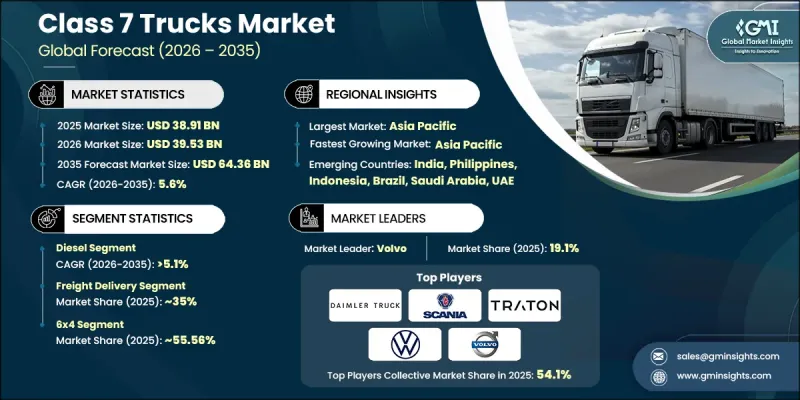
화물 물류, 인프라 개발, 산업 활동이 더욱 최적화되고 기술 기반 차량 생태계로 진화함에 따라 시장은 구조적 변화를 겪고 있습니다. 클래스 7 트럭은 일반적으로 총중량(GVWR)이 26,001-3만 3,000파운드 범위로 정의되며, 물류 활동, 건설 관련 업무, 지자체 기능, 유틸리티 서비스를 지원하는 중형 운송 네트워크에서 필수적인 자산으로 자리매김하고 있습니다. 차량 사업자들은 텔레매틱스 솔루션, 첨단운전자보조시스템(ADAS), 대체 연료 기술을 빠르게 도입하고 있으며, 이를 통해 차량 효율성, 경로 최적화, 라이프사이클 비용 관리 전략을 새롭게 바꾸고 있습니다.
| 시장 범위 | |
|---|---|
| 개시 연도 | 2025년 |
| 예측 기간 | 2026-2035년 |
| 개시 시점 시장 규모 | 389억 1,000만 달러 |
| 예측 시장 규모 | 643억 6,000만 달러 |
| CAGR | 5.6% |
엄격한 배출가스 기준, 무공해 화물 운송 의무화, 지속가능성을 중시하는 운송 정책이 주요 경제권의 구매 행동에 영향을 미치면서 규제 압력이 시장의 방향성을 결정하는 중요한 역할을 하고 있습니다. 북미와 유럽 등의 지역에서는 규제 준수 요건으로 인해 차량 교체 주기가 가속화되고 있으며, 신흥국에서는 배출가스 규제가 단계적으로 강화되어 중형 트럭의 현대화가 촉진되고 있습니다. 이러한 규제 동향은 파워트레인 선정, 인프라 투자, 장기 조달 계획에도 영향을 미치고 있습니다. 동시에 물류 네트워크와 산업 공급망의 확장에 따른 수요 증가로 인해 신뢰성과 적응력이 높은 클래스 7 트럭의 필요성이 더욱 높아져 세계 시장에서 현대 화물 운송 전략의 중심이 되고 있습니다.
디젤 부문은 2025년 77.01%의 점유율을 차지했으며, 2035년까지 연평균 5.1%의 성장률을 보일 것으로 전망됩니다. 디젤 기술은 높은 토크 출력, 연료 효율, 장거리 및 중량물 운송에 대한 높은 적응성으로 인해 클래스 7 트럭 시장에서 계속 선도적인 위치를 차지하고 있습니다. 이 트럭은 물류, 인프라 개발, 지자체 업무, 지역 배송 활동 등 가혹한 조건에서 내구성과 안정적인 성능이 요구되는 분야에서 널리 선호되고 있습니다. 잘 구축된 급유 인프라와 디젤 연료의 광범위한 가용성은 선진국과 개발도상국 모두에서 디젤 차량의 강력한 보급을 더욱 촉진하고 있으며, 디젤 엔진이 장착된 중형 트럭 시장 안정성을 지속적으로 보장하고 있습니다.
유틸리티 서비스 부문은 공공 인프라 유지관리, 폐기물 처리 시스템, 에너지 배전망, 지방 자치 단체 업무에서 클래스 7 트럭의 도입 확대에 힘입어 2035년까지 연평균 복합 성장률(CAGR) 6.4%를 나타낼 것으로 예측됩니다. 정부 및 민간 사업자들은 효율성 향상, 가동 중단 시간 감소, 강화되는 환경 기준 준수를 위해 유틸리티 차량의 현대화를 적극적으로 추진하고 있습니다. 또한, 대체 연료 시스템, 통합 텔레매틱스 플랫폼, 강화된 안전 기술 도입도 차량 업데이트에 힘을 실어주고 있습니다. 이를 통해 운영 성과를 개선하고 유틸리티 기반 운송 서비스의 장기적인 지속가능성 목표를 지원합니다.
중국의 클래스 7 트럭 시장은 2025년 64.2%의 점유율을 차지했으며, 2035년까지 93억 달러 시장 규모를 형성할 것으로 예측됩니다. 이 나라 시장 확대는 대규모 인프라 투자, 도시 화물 운송 시스템의 급속한 성장, 상업용 차량 현대화를 위한 정부의 지속적인 노력에 의해 강력하게 뒷받침되고 있습니다. 산업단지, 스마트시티 프로젝트, 교통 인프라의 지속적인 개발로 건설 지원, 지자체 서비스, 지역 간 화물 운송에 대한 중형 트럭 수요가 크게 증가하고 있습니다. 또한, 디지털 상거래와 정시 배송 서비스의 급속한 확대로 인해 효율적인 미드마일 물류 솔루션에 대한 수요가 증가하고 있으며, 진화하는 중국 운송 생태계에서 클래스 7 트럭의 중요성이 더욱 커지고 있습니다.
자주 묻는 질문
목차
제1장 조사 방법
제2장 주요 요약
제3장 산업 인사이트
제4장 경쟁 구도
제5장 시장 추정 및 예측 : 연료별(2022-2035년)
제6장 시장 추정 및 예측 : 용도별(2022-2035년)
제7장 시장 추정 및 예측 : 차축별(2022-2035년)
제8장 시장 추정 및 예측 : HP별(2022-2035년)
제9장 시장 추정 및 예측 : 소유 형태별(2022-2035년)
제10장 시장 추정 및 예측 : 변속기별(2022-2035년)
제11장 시장 추정 및 예측 : 지역별(2022-2035년)
제12장 기업 개요
AJY 26.06.15The Global Class 7 Trucks Market was valued at USD 38.91 billion in 2025 and is estimated to grow at a CAGR of 5.6% to reach USD 64.36 billion by 2035.
The market is undergoing structural transformation as freight logistics, infrastructure development, and industrial operations evolve toward more optimized and technology-enabled fleet ecosystems. Class 7 trucks, typically defined by a GVWR range of 26,001 to 33,000 lbs, are increasingly positioned as essential assets in medium-duty transportation networks supporting distribution activities, construction-related operations, municipal functions, and utility-based services. Fleet operators are rapidly adopting telematics solutions, advanced driver-assistance systems, and alternative fuel technologies, which are reshaping fleet efficiency, route optimization, and lifecycle cost management strategies.
| Market Scope | |
|---|---|
| Start Year | 2025 |
| Forecast Year | 2026-2035 |
| Start Value | $38.91 Billion |
| Forecast Value | $64.36 Billion |
| CAGR | 5.6% |
Regulatory pressure is playing a defining role in shaping market direction, with stringent emission standards, zero-emission freight mandates, and sustainability-focused transport policies influencing purchasing behavior across major economies. Regions such as North America and Europe are accelerating fleet renewal cycles due to compliance requirements, while emerging economies are progressively tightening emission frameworks, encouraging modernization of medium-duty fleets. These regulatory dynamics are also influencing powertrain selection, infrastructure investments, and long-term procurement planning. In parallel, rising demand from expanding logistics networks and industrial supply chains is reinforcing the need for reliable and adaptable Class 7 trucks, making them central to modern freight mobility strategies across global markets.
The diesel-powered segment held a 77.01% share in 2025 and is projected to grow at a CAGR of 5.1% through 2035. Diesel technology continues to lead the Class 7 trucks space due to its high torque output, fuel efficiency, and strong suitability for long-distance and heavy-load operations. These trucks are widely preferred in sectors requiring durability and consistent performance under demanding conditions, including logistics, infrastructure development, municipal operations, and regional distribution activities. Established fueling infrastructure and widespread diesel availability further reinforce its strong adoption across both developed and developing regions, ensuring continued market stability for diesel-powered medium-duty trucks.
The utility services application segment is expected to grow at a CAGR of 6.4% through 2035, supported by increasing deployment of Class 7 trucks across public infrastructure maintenance, waste handling systems, energy distribution networks, and municipal operations. Governments and private operators are actively modernizing utility fleets to enhance efficiency, reduce operational downtime, and comply with tightening environmental standards. Fleet upgrades are also being driven by the adoption of alternative fuel systems, integrated telematics platforms, and enhanced safety technologies, which are improving operational performance and supporting long-term sustainability goals in utility-based transportation services.
China Class 7 Trucks Market held a 64.2% share in 2025 and generated USD 9.3 billion through 2035. The country's market expansion is strongly supported by large-scale infrastructure investment, rapid growth in urban freight systems, and sustained government initiatives aimed at modernizing commercial vehicle fleets. Ongoing development of industrial zones, smart city projects, and transportation infrastructure is significantly increasing demand for medium-duty trucks across construction support, municipal services, and regional freight movement. Additionally, the rapid expansion of digital commerce and time-sensitive delivery services is strengthening demand for efficient mid-mile logistics solutions, further reinforcing the importance of Class 7 trucks in China's evolving transport ecosystem.
Key players operating in the Global Class 7 Trucks Industry include Volvo, PACCAR, Isuzu Motors, Daimler Trucks, Volkswagen, Traton, Scania, Kenworth, and Peterbilt. Companies in the Class 7 Trucks Market are prioritizing fleet electrification strategies and alternative fuel integration to align with global emission targets and regulatory mandates. They are investing heavily in telematics-based fleet intelligence systems to enhance route optimization, predictive maintenance, and real-time performance tracking. Strategic collaborations with logistics providers and infrastructure developers are strengthening their supply chain presence. Manufacturers are also focusing on modular truck platforms to improve customization flexibility across applications. In addition, continuous R&D investments are being directed toward improving vehicle efficiency, safety systems, and autonomous driving capabilities. Expansion of service networks and lifecycle support programs is further helping companies retain long-term customer relationships and reinforce market competitiveness across diverse regions.
Table of Contents
Chapter 1 Methodology
- 1.1 Research approach
- 1.2 Quality Commitments
- 1.2.1 GMI AI policy & data integrity commitment
- 1.2.1.1 Source consistency protocol
- 1.2.1 GMI AI policy & data integrity commitment
- 1.3 Research Trail & Confidence Scoring
- 1.3.1 Research Trail Components
- 1.3.2 Scoring Components
- 1.4 Data Collection
- 1.4.1 Partial list of primary sources
- 1.5 Data mining sources
- 1.5.1 Paid sources
- 1.5.1.1 Sources, by region
- 1.5.1 Paid sources
- 1.6 Base estimates and calculations
- 1.6.1 Base year calculation
- 1.7 Forecast Model
- 1.7.1 Quantified market impact analysis
- 1.7.1.1 Mathematical impact of growth parameters on forecast
- 1.7.1 Quantified market impact analysis
- 1.8 Research transparency addendum
- 1.8.1 Source attribution framework
- 1.8.2 Quality assurance metrics
- 1.8.3 Our commitment to trust
Chapter 2 Executive Summary
- 2.1 Industry 360° synopsis, 2022 - 2035
- 2.2 Key market trends
- 2.2.1 Regional
- 2.2.2 Fuel
- 2.2.3 Application
- 2.2.4 Axle
- 2.2.5 Horsepower
- 2.2.6 Ownership
- 2.2.7 Transmission
- 2.3 TAM Analysis, 2026-2035
- 2.4 CXO perspectives: Strategic imperatives
Chapter 3 Industry Insights
- 3.1 Industry ecosystem analysis
- 3.1.1 Supplier landscape
- 3.1.2 Profit margin analysis
- 3.1.3 Cost structure
- 3.1.4 Value addition at each stage
- 3.1.5 Factor affecting the value chain
- 3.1.6 Disruptions
- 3.2 Industry impact forces
- 3.2.1 Growth drivers
- 3.2.1.1 Increasing demand for electric & hybrid class 7 trucks across the globe
- 3.2.1.2 Growing freight transportation activities across North America
- 3.2.1.3 Implementation of stringent emission regulations in Europe
- 3.2.1.4 Rising investments in infrastructure development activities in Asia Pacific
- 3.2.1.5 Growing demand for class 7 from mining and oil & gas sector in MEA
- 3.2.2 Industry pitfalls and challenges
- 3.2.2.1 High initial and maintenance costs
- 3.2.2.2 Shortage of truck drivers
- 3.2.3 Market opportunities
- 3.2.3.1 Electrification of municipal and urban logistics fleets
- 3.2.3.2 Expansion of infrastructure and construction activities in emerging economies
- 3.2.3.3 Growth of flexible ownership, leasing, and Truck-as-a-Service (TaaS) models
- 3.2.3.4 Integration of advanced telematics and fleet analytics solutions
- 3.2.1 Growth drivers
- 3.3 Growth potential analysis
- 3.4 Technology and Innovation landscape
- 3.4.1 Current technological trends
- 3.4.2 Emerging technologies
- 3.5 Pricing Analysis (Driven by Primary Research)
- 3.5.1 Historical Price Trend Analysis
- 3.5.2 Pricing Strategy by Player Type (Premium / Value / Cost-plus)
- 3.6 Regulatory landscape
- 3.6.1 North America
- 3.6.1.1 NEVI / IIJA, Advanced Clean Trucks (ACT) Regulation.
- 3.6.2 Europe
- 3.6.2.1 Germany: Electric Mobility Act (EmoG)
- 3.6.2.2 UK: Clean Vehicle Retrofit Accreditation Scheme (CVRAS), Ultra-Low Emission Zone (ULEZ)
- 3.6.2.3 France: Mobility Orientation Law (LOM Act)
- 3.6.2.4 Italy: National Integrated Plan for Energy and Climate (PNIEC)
- 3.6.3 Asia Pacific
- 3.6.3.1 China: New Energy Vehicle (NEV) Mandate
- 3.6.3.2 India: FAME II Scheme
- 3.6.3.3 Japan: Strategic Roadmap for EV/FCV Deployment
- 3.6.3.4 Australia: State-Level Zero-Emission Vehicle Mandates
- 3.6.4 Latin America
- 3.6.4.1 Brazil: National Electric Mobility Policy (PNME)
- 3.6.4.2 Mexico: Urban Zero-Emission Fleet Programs
- 3.6.4.3 Argentina: Provincial EV Incentive Regulations (Buenos Aires)
- 3.6.5 MEA
- 3.6.5.1 UAE: EV Charging Infrastructure Regulation (ADDM/DEWA)
- 3.6.5.2 Saudi Arabia: EV Deployment Regulatory Framework (SASO)
- 3.6.5.3 South Africa: Green Transport Strategy
- 3.6.1 North America
- 3.7 Patent Landscape (Driven by Primary Research)
- 3.8 Trade Data Analysis (Based on Paid Database)
- 3.8.1 Import/Export Volume & Value Trends
- 3.8.2 Key Trade Corridors & Tariff Impact
- 3.9 Impact of AI & Generative AI on the Market (Driven by Primary Research)
- 3.9.1 AI-Driven Disruption of Existing Business Models
- 3.9.2 GenAI Use Cases & Adoption Roadmap by Segment
- 3.9.3 Risks, Limitations & Regulatory Considerations
- 3.10 Capacity & Production Landscape (Driven by Primary Research)
- 3.10.1 Production Capacity by Region & Key Producer
- 3.10.2 Capacity Utilization Rates & Expansion Pipelines
- 3.11 Sustainability and environmental aspects
- 3.11.1 Sustainable practices
- 3.11.2 Waste reduction strategies
- 3.11.3 Energy efficiency in production
- 3.11.4 Eco-friendly initiatives
- 3.11.5 Carbon footprint considerations
- 3.12 Forecast assumptions & scenario analysis (Driven by Primary Research)
- 3.12.1 Base Case - Key Macro & Industry Variables Driving CAGR
- 3.12.2 Optimistic Scenarios - Favourable macro and industry tailwinds
- 3.12.3 Pessimistic Scenario - Macroeconomic slowdown or industry headwinds
Chapter 4 Competitive Landscape, 2025
- 4.1 Company market share analysis
- 4.1.1 North America
- 4.1.2 Europe
- 4.1.3 Asia Pacific
- 4.1.4 Latin America
- 4.1.5 MEA
- 4.2 Competitive analysis of major market players
- 4.3 Competitive positioning matrix
- 4.4 Key developments
- 4.4.1 Mergers & acquisitions
- 4.4.2 Partnerships & collaborations
- 4.4.3 New Product Launches
- 4.4.4 Expansion Plans and funding
- 4.5 Company Tier Benchmarking
- 4.5.1 Tier Classification Criteria & Qualifying Thresholds
- 4.5.2 Tier Positioning Matrix by Revenue, Geography & Innovation
Chapter 5 Market Estimates & Forecast, By Fuel, 2022 - 2035 ($Bn, Units)
- 5.1 Key trends
- 5.2 Diesel
- 5.3 Natural gas
- 5.4 Hybrid electric
- 5.5 Others
Chapter 6 Market Estimates & Forecast, By Application, 2022 - 2035 ($Bn, Units)
- 6.1 Key trends
- 6.2 Freight delivery
- 6.3 Utility services
- 6.4 Construction & mining
- 6.5 Others
Chapter 7 Market Estimates & Forecast, By Axle, 2022 - 2035 ($Bn, Units)
- 7.1 Key trends
- 7.2 4x2
- 7.3 6x4
- 7.4 6x2
Chapter 8 Market Estimates & Forecast, By Horsepower, 2022 - 2035 ($Bn, Units)
- 8.1 Key trends
- 8.2 Below 300HP
- 8.3 300HP - 400HP
- 8.4 400HP - 500HP
- 8.5 500HP & Above
Chapter 9 Market Estimates & Forecast, By Ownership, 2022 - 2035 ($Bn, Units)
- 9.1 Key trends
- 9.2 Fleet operator
- 9.3 Independent operator
Chapter 10 Market Estimates & Forecast, By Transmission, 2022 - 2035 ($Bn, Units)
- 10.1 Key trends
- 10.2 Manual transmission
- 10.3 Automatic transmission
Chapter 11 Market Estimates & Forecast, By Region, 2022 - 2035 ($Bn, Units)
- 11.1 Key trends
- 11.2 North America
- 11.2.1 US
- 11.2.2 Canada
- 11.3 Europe
- 11.3.1 Germany
- 11.3.2 UK
- 11.3.3 France
- 11.3.4 Italy
- 11.3.5 Spain
- 11.3.6 Russia
- 11.3.7 Nordics
- 11.4 Asia Pacific
- 11.4.1 China
- 11.4.2 India
- 11.4.3 Japan
- 11.4.4 Australia
- 11.4.5 South Korea
- 11.4.6 Philippines
- 11.4.7 Indonesia
- 11.5 Latin America
- 11.5.1 Brazil
- 11.5.2 Mexico
- 11.5.3 Argentina
- 11.6 MEA
- 11.6.1 South Africa
- 11.6.2 Saudi Arabia
- 11.6.3 UAE
Chapter 12 Company Profiles
- 12.1 Global Players
- 12.1.1 Daimler Truck
- 12.1.2 Ford Motor Company
- 12.1.3 Hino Motors
- 12.1.4 Isuzu Motors
- 12.1.5 Navistar
- 12.1.6 Scania
- 12.1.7 TRATON
- 12.1.8 Volvo Trucks
- 12.2 Regional Players
- 12.2.1 Ashok Leyland
- 12.2.2 BYD
- 12.2.3 Eicher Motor
- 12.2.4 GMC
- 12.2.5 Hyundai
- 12.2.6 JAC Motors
- 12.2.7 Kenworth
- 12.2.8 Kia
- 12.2.9 Mack Trucks
- 12.2.10 Mahindra & Mahindra
- 12.2.11 Mitsubishi Fuso Truck and Bus Corporation
- 12.2.12 Peterbilt
- 12.2.13 SML Isuzu
- 12.2.14 Tata Motors
- 12.3 Emerging Players
- 12.3.1 Dongfeng Motor
- 12.3.2 Rivian Automotive
- 12.3.3 SAIC Maxus