

|
시장보고서
상품코드
2045788
지베렐린 시장 : 기회, 성장 촉진요인, 업계 동향 분석 및 예측(2026-2035년)Gibberellins Market Opportunity, Growth Drivers, Industry Trend Analysis, and Forecast 2026 - 2035 |
||||||

세계의 지베렐린 시장은 2025년에 8억 7,220만 달러로 평가되었고 CAGR 10%를 나타내 2035년까지 20억 달러에 이를 것으로 예측됩니다.
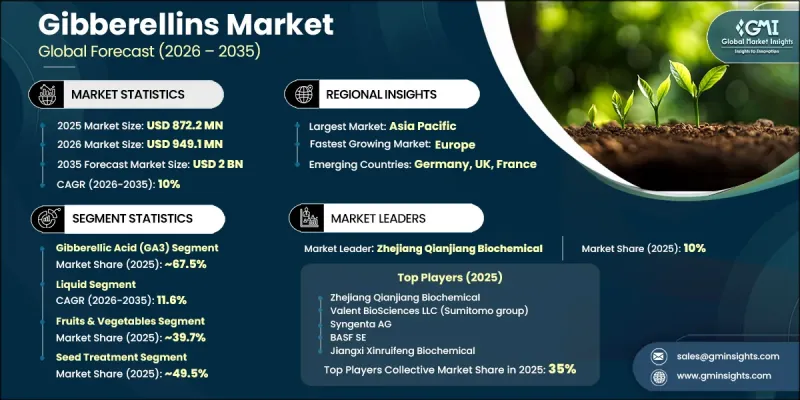
지베렐린은 식물 성장 호르몬의 일종으로 줄기 신장, 종자 발아, 개화 과정 등 식물 발육의 여러 단계를 조절하는 데 중요한 역할을 합니다. 이러한 호르몬은 식물에서 자연적으로 생성되기도 하지만, 농업용으로 상업적으로 생산되기도 합니다. 농업 산업에서 지베렐린은 작물 생산성 향상, 과일 품질 향상, 식물 성장 촉진 및 효과적인 종자 발아를 돕기 위해 널리 사용되고 있습니다. 일반적인 적용 방법으로는 종자 처리와 엽면 살포가 있으며, 이는 성장 단계별로 식물의 발육을 최적화하기 위해 사용됩니다. 지베렐린 시장에서 활동하는 기업들은 전 세계 농업 시스템에서 농업의 효율성과 작물 품질 향상에 중요한 역할을 하고 있습니다. 인구 증가에 따른 세계 식량 수요 증가는 농업 생산성에 대한 압력을 가중시키고 있으며, 농부들은 작물 생산성을 향상시키기 위해 지베렐린과 같은 식물 성장 조절제를 채택하도록 촉구하고 있습니다. 또한, 지속 가능한 농법의 인기가 높아지는 것도 시장 성장을 가속하고 있습니다. 식물 성장 조절제는 농업 생산량을 향상시킬 수 있는 친환경적인 솔루션을 제공하기 때문입니다.
| 시장 범위 | |
|---|---|
| 시작 연도 | 2025년 |
| 예측 기간 | 2026-2035년 |
| 시작 연도 시장 규모 | 8억 7,220만 달러 |
| 예측 금액 | 20억 달러 |
| CAGR | 10% |
지베렐린산(GA3) 부문은 2025년 67.5%의 점유율을 차지했으며, 2035년까지 연평균 복합 성장률(CAGR) 10.1%를 나타낼 것으로 예측됩니다. GA3는 다양한 원예작물 및 농작물에서 그 효과가 입증되어 시장 내에서 확고한 입지를 유지하고 있습니다. 이 화합물은 세포의 증식을 촉진하고, 식물의 균일한 발육을 지원하며, 작물의 수확량과 품질을 전반적으로 향상시키는 능력으로 널리 알려져 있습니다. 안정적인 성능 특성과 다양한 적용 기술과의 적합성이 농업 분야 전반에 걸쳐 폭넓게 채택되는 데 크게 기여하고 있습니다. 작물의 효율성을 극대화하고 생산의 일관성을 향상시키는 데 주력하면서 GA3를 기반으로 한 제형에 대한 수요가 더욱 증가하고 있습니다.
과일 및 채소 부문은 2025년 39.7%의 점유율을 차지했으며, 2035년까지 연평균 10.7%의 성장률을 나타낼 것으로 전망됩니다. 이 부문의 강력한 수요는 주로 고부가가치 원예 생산 전반에 걸쳐 작물의 품질 향상, 크기 일관성 향상, 효과적인 생육 관리에 대한 요구에 의해 주도되고 있습니다. 지베렐린은 개화를 촉진하고, 착과를 개선하며, 다양한 재배 주기를 통해 안정적인 농업 생산량을 유지하기 위해 널리 사용되고 있습니다. 고품질 농산물과 농업 생산성 향상에 대한 관심이 높아지면서 과일 및 채소 재배에 식물 성장 조절제 사용이 더욱 가속화되고 있습니다.
북미의 지베렐린 시장은 2025년 32.5%의 점유율을 차지했습니다. 이 지역 전체 시장 확대는 첨단 농업 기술, 통제된 작물 관리 기술의 도입 확대, 고품질 농산물에 대한 수요 증가에 의해 뒷받침되고 있습니다. 이 지역의 정밀 농업 기술과 지속 가능한 농업 생산성에 대한 강한 관심은 첨단 지베렐린 제제의 급속한 보급을 촉진하고 있습니다. 또한, 현대 농업 기술 및 개선된 작물 관리 시스템에 대한 지속적인 투자는 북미 전역의 지베렐린 산업 확장에 유리한 환경을 계속 조성하고 있습니다.
자주 묻는 질문
목차
제1장 조사 방법과 범위
제2장 주요 요약
제3장 업계 인사이트
제4장 경쟁 구도
제5장 시장 추산 및 예측 : 유형별(2022-2035년)
제6장 시장 추산 및 예측 : 형태별(2022-2035년)
제7장 시장 추산 및 예측 : 작물 유형별(2022-2035년)
제8장 시장 추산 및 예측 : 용도별(2022-2035년)
제9장 시장 추산 및 예측 : 지역별(2022-2035년)
제10장 기업 개요
KTH 26.06.10The Global Gibberellins Market was valued at USD 872.2 million in 2025 and is estimated to grow at a CAGR of 10% to reach USD 2 billion by 2035.
Gibberellins are a category of plant growth hormones that play a critical role in regulating various stages of plant development, including stem growth, seed germination, and flowering processes. These hormones are naturally produced by plants and can also be commercially manufactured for agricultural applications. The agricultural industry widely utilizes gibberellins to improve crop productivity, enhance fruit quality, stimulate plant growth, and support more effective seed germination. Application methods commonly include seed treatment and foliar spraying to optimize plant development during different growth stages. Companies operating in the gibberellins market continue to play an essential role in improving agricultural efficiency and crop quality across global farming systems. Rising global food demand driven by population growth is creating increasing pressure on agricultural productivity, encouraging farmers to adopt plant growth regulators such as gibberellins to improve crop performance. In addition, the growing popularity of sustainable farming practices is further supporting market growth as plant growth regulators offer environmentally responsible solutions for enhancing agricultural output.
| Market Scope | |
|---|---|
| Start Year | 2025 |
| Forecast Year | 2026-2035 |
| Start Value | $872.2 Million |
| Forecast Value | $2 Billion |
| CAGR | 10% |
The gibberellic acid (GA3) segment held a 67.5% share in 2025 and is expected to register a CAGR of 10.1% through 2035. GA3 continues to maintain a strong position within the market due to its proven effectiveness across a broad range of horticultural and agricultural crops. The compound is widely recognized for its ability to stimulate cell expansion, support uniform plant development, and improve overall crop yield and quality. Its stable performance characteristics and compatibility with multiple application techniques have contributed significantly to its widespread adoption throughout the agricultural sector. The focus on maximizing crop efficiency and improving production consistency continues to strengthen demand for GA3-based formulations.
The fruits and vegetables segment accounted for 39.7% share in 2025 and is anticipated to grow at a CAGR of 10.7% by 2035. Strong demand within this segment is primarily driven by the need for improved crop quality, enhanced size consistency, and effective growth management across high-value horticultural production. Gibberellins are extensively utilized to support flowering, improve fruit setting, and maintain consistent agricultural output throughout varying cultivation cycles. Increasing emphasis on premium-quality produce and higher agricultural productivity is further accelerating the use of plant growth regulators in the cultivation of fruits and vegetables.
North America Gibberellins Market held a 32.5% share in 2025. Market expansion throughout the region is being supported by advanced agricultural practices, increasing adoption of controlled crop management technologies, and rising demand for high-quality agricultural produce. The region's strong focus on precision farming techniques and sustainable agricultural productivity is encouraging rapid adoption of advanced gibberellin formulations. In addition, ongoing investments in modern farming technologies and improved crop management systems continue to create favorable conditions for the expansion of the gibberellins industry across North America.
Key companies operating in the Global Gibberellins Market include Syngenta AG, BASF SE, Valent BioSciences LLC, Nufarm Limited, Sumitomo Chemical Co., Ltd., Zhejiang Qianjiang Biochemical, Jiangxi Xinruifeng Biochemical, Sichuan Lomon Bio Technology, Jiangsu Fengyuan Bioengineering, Awiner Biotech Co., Ltd., Hefei TNJ Chemical Industry, Hangzhou Tianlong Biotechnology, Zhejiang Rayfull Chemicals, and Hi Field AG. Chem India. Companies operating in the gibberellins market are implementing multiple strategic initiatives to strengthen their market position and expand their global reach. Manufacturers are increasing investments in research and development to create advanced plant growth regulator formulations with higher efficiency and improved crop compatibility. Many companies are focusing on expanding production capabilities and strengthening distribution networks to meet rising global agricultural demand. Strategic partnerships with agricultural cooperatives, distributors, and farming organizations are helping businesses improve product accessibility and customer engagement. In addition, market participants are emphasizing sustainable and environmentally responsible product development to align with growing demand for eco-friendly farming solutions.
Table of Contents
Chapter 1 Methodology & Scope
- 1.1 Market scope and definition
- 1.2 Research design
- 1.2.1 Research approach
- 1.2.2 Data collection methods
- 1.3 Data mining sources
- 1.3.1 Global
- 1.3.2 Regional/Country
- 1.4 Base estimates and calculations
- 1.4.1 Base year calculation
- 1.4.2 Key trends for market estimation
- 1.5 Primary research and validation
- 1.5.1 Primary sources
- 1.6 Forecast model
- 1.7 Research assumptions and limitations
Chapter 2 Executive Summary
- 2.1 Industry 360° synopsis
- 2.2 Key market trends
- 2.2.1 Regional
- 2.2.2 Type
- 2.2.3 Form
- 2.2.4 Crop type
- 2.2.5 Application
- 2.3 TAM Analysis, 2026-2035
- 2.4 CXO perspectives: Strategic imperatives
- 2.4.1 Executive decision points
- 2.4.2 Critical success factors
- 2.5 Future Outlook and Strategic Recommendations
Chapter 3 Industry Insights
- 3.1 Industry ecosystem analysis
- 3.1.1 Supplier landscape
- 3.1.2 Profit margin
- 3.1.3 Value addition at each stage
- 3.1.4 Factor affecting the value chain
- 3.1.5 Disruptions
- 3.2 Industry impact forces
- 3.2.1 Growth drivers
- 3.2.1.1 Increasing global food demand propels the need for higher agricultural productivity
- 3.2.1.2 Growing adoption of sustainable farming practices favors gibberellins usage
- 3.2.1.3 Advances in biotechnology drive the development of new gibberellin formulations
- 3.2.2 Industry pitfalls and challenges
- 3.2.2.1 Regulatory restrictions pose challenges for gibberellins use in agriculture
- 3.2.2.2 Environmental concerns arise from potential overuse of gibberellins
- 3.2.3 Market opportunities
- 3.2.3.1 Development of bio-based & eco-friendly gibberellin formulations
- 3.2.3.2 Expansion into emerging markets with growing agricultural sectors
- 3.2.1 Growth drivers
- 3.3 Growth potential analysis
- 3.4 Regulatory landscape
- 3.4.1 North America
- 3.4.2 Europe
- 3.4.3 Asia Pacific
- 3.4.4 Latin America
- 3.4.5 Middle East & Africa
- 3.5 Porter's analysis
- 3.6 PESTEL analysis
- 3.7 Price trends
- 3.7.1 By region
- 3.7.2 By type
- 3.8 Future market trends
- 3.9 Technology and Innovation landscape
- 3.9.1 Current technological trends
- 3.9.2 Emerging technologies
- 3.10 Patent Landscape
- 3.11 Trade statistics (HS code)
- 3.11.1 Major importing countries
- 3.11.2 Major exporting countries
- 3.12 Sustainability and environmental aspects
- 3.12.1 Sustainable practices
- 3.12.2 Waste reduction strategies
- 3.12.3 Energy efficiency in production
- 3.12.4 Eco-friendly initiatives
- 3.13 Carbon footprint consideration
Chapter 4 Competitive Landscape, 2025
- 4.1 Introduction
- 4.2 Company market share analysis
- 4.2.1 By region
- 4.2.1.1 North America
- 4.2.1.2 Europe
- 4.2.1.3 Asia Pacific
- 4.2.1.4 LATAM
- 4.2.1.5 MEA
- 4.2.1 By region
- 4.3 Company matrix analysis
- 4.4 Competitive analysis of major market players
- 4.5 Competitive positioning matrix
- 4.6 Key developments
- 4.6.1 Mergers & acquisitions
- 4.6.2 Partnerships & collaborations
- 4.6.3 New Product Launches
- 4.6.4 Expansion Plans
Chapter 5 Market Estimates and Forecast, By Type, 2022-2035 (USD Million) (Kilo Tons)
- 5.1 Key trends
- 5.2 Gibberellic Acid (GA3)
- 5.3 Gibberellins A4/A7
Chapter 6 Market Estimates and Forecast, By Form, 2022-2035 (USD Million) (Kilo Tons)
- 6.1 Key trends
- 6.2 Liquid
- 6.3 Powder
- 6.4 Granules
Chapter 7 Market Estimates and Forecast, By Crop type, 2022-2035 (USD Million) (Kilo Tons)
- 7.1 Key trends
- 7.2 Fruits & Vegetables
- 7.3 Cereals & Grains
- 7.4 Sugarcane
- 7.5 Ornamental Plants & Floriculture
- 7.6 Other Crops
Chapter 8 Market Estimates and Forecast, By Application, 2022-2035 (USD Million) (Kilo Tons)
- 8.1 Key trends
- 8.2 Seed Treatment
- 8.3 Foliar Spray
Chapter 9 Market Estimates and Forecast, By Region, 2022-2035 (USD Million) (Kilo Tons)
- 9.1 Key trends
- 9.2 North America
- 9.2.1 U.S.
- 9.2.2 Canada
- 9.3 Europe
- 9.3.1 Germany
- 9.3.2 UK
- 9.3.3 France
- 9.3.4 Spain
- 9.3.5 Italy
- 9.3.6 Rest of Europe
- 9.4 Asia Pacific
- 9.4.1 China
- 9.4.2 India
- 9.4.3 Japan
- 9.4.4 Australia
- 9.4.5 South Korea
- 9.4.6 Rest of Asia Pacific
- 9.5 Latin America
- 9.5.1 Brazil
- 9.5.2 Mexico
- 9.5.3 Argentina
- 9.5.4 Rest of Latin America
- 9.6 Middle East and Africa
- 9.6.1 Saudi Arabia
- 9.6.2 South Africa
- 9.6.3 UAE
- 9.6.4 Rest of Middle East and Africa
Chapter 10 Company Profiles
- 10.1 Valent BioSciences LLC
- 10.2 Nufarm Limited
- 10.3 Syngenta AG
- 10.4 BASF SE
- 10.5 Sumitomo Chemical Co., Ltd.
- 10.6 Zhejiang Qianjiang Biochemical
- 10.7 Jiangxi Xinruifeng Biochemical
- 10.8 Sichuan Lomon Bio Technology
- 10.9 Jiangsu Fengyuan Bioengineering
- 10.10 Awiner Biotech Co., Ltd.
- 10.11 Hefei TNJ Chemical Industry
- 10.12 Hangzhou Tianlong Biotechnology
- 10.13 Zhejiang Rayfull Chemicals
- 10.14 Hi Field AG. Chem India


