|
시장보고서
상품코드
2045791
식품 보관 용기 시장 : 기회, 성장 촉진요인, 업계 동향 분석 및 예측(2026-2035년)Food Storage Container Market Opportunity, Growth Drivers, Industry Trend Analysis, and Forecast 2026 - 2035 |
||||||

세계의 식품 보관 용기 시장은 2025년에 1,701억 달러로 평가되었고 CAGR 4.6%를 나타내 2035년까지 2,666억 달러에 이를 것으로 예측됩니다.
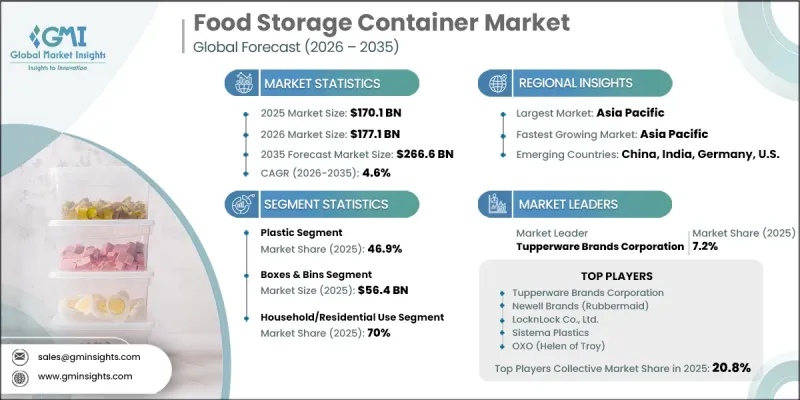
포장된 식사, 간편식, 즉석식품의 소비 증가는 세계 시장 확대에 크게 기여하고 있습니다. 주거 및 상업 부문에서 효율적인 식품 저장 솔루션에 대한 의존도가 높아짐에 따라 내구성이 뛰어나고 성능이 우수한 보관 용기에 대한 수요가 증가하고 있습니다. 또한 식품 안전, 위생 및 폐기물 감소에 대한 인식이 높아지면서 시장 성장에 힘을 실어주고 있습니다. 소비자들은 유통기한을 연장하고 신선도를 유지하는 데 도움이 되는 고품질 용기를 점점 더 선호하고 있습니다. 또한, 지속가능성에 대한 노력과 순환 경제 정책으로 인해 제조업체들은 재사용 및 재활용이 가능하고 환경 친화적인 보존 솔루션의 개발을 촉진하고 있습니다. 보존, 재가열, 제공 등 다양한 용도에 대응하는 다기능 식품 용기의 보급이 확산되고 있는 점도 산업 성장에 힘을 보태고 있습니다. 제품 디자인, 누수 방지 기술, 쌓을 수 있는 형태, 전자 레인지 사용 가능 소재의 발전은 소비자의 편의성을 향상시켜 전 세계 가정, 레스토랑, 외식 산업에서 제품 수요를 주도하고 있습니다.
| 시장 범위 | |
|---|---|
| 시작 연도 | 2025년 |
| 예측 기간 | 2026-2035년 |
| 시작 연도 시장 규모 | 1,701억 달러 |
| 예측 금액 | 2,666억 달러 |
| CAGR | 4.6% |
유리 제품 부문은 지속 가능하고 무독성이며 냄새가 나지 않는 식품 보존 솔루션에 대한 소비자의 선호도가 높아짐에 따라 2035년까지 연평균 5.9%의 성장률을 나타낼 것으로 예측됩니다. 유리 용기는 내구성이 뛰어나고 위생적이며 전자 레인지와 오븐에 사용할 수 있어 오래 사용할 수 있는 주방 용품을 찾는 소비자들에게 매우 매력적입니다. 친환경적이고 고품질의 보관 용기에 대한 수요가 증가함에 따라 주거용 및 상업용 주방에 대한 도입이 계속 가속화되고 있습니다.
항아리 및 캐니스터 부문은 2026년부터 2035년까지 연평균 복합 성장률(CAGR) 5.8%를 나타낼 것으로 예측됩니다. 소비자들이 깔끔한 주방 공간과 편리한 식료품 저장실 수납 솔루션에 대한 관심이 높아짐에 따라 이러한 제품에 대한 수요가 증가하고 있습니다. 항아리와 캐니스터는 건조물의 가시성, 인출 용이성, 보관 효율을 향상시키는 동시에 현대식 주방의 미관을 향상시켜줍니다. 가정 내 정리정돈과 고급 주방 액세서리에 대한 관심이 높아지면서 이 부문의 성장에 더욱 기여하고 있습니다.
북미의 식품 보관 용기 시장은 2025년 27.8%의 점유율을 차지했습니다. 이 지역 전체에서 포장식품, 냉동식품, 벌크식품에 대한 강력한 수요가 시장 확대를 뒷받침하고 있습니다. 기존 소매 네트워크의 존재, 식습관의 변화, 내구성 및 대용량 저장 솔루션에 대한 선호도가 높아지면서 제품 보급에 긍정적인 영향을 미치고 있습니다. 가처분 소득 증가와 가정 정리 및 주방 업그레이드를 위한 소비자 지출 증가는 고급 식품 보관 용기에 대한 지역적 수요를 더욱 견인하고 있습니다.
자주 묻는 질문
목차
제1장 조사 방법과 범위
제2장 주요 요약
제3장 업계 인사이트
제4장 경쟁 구도
제5장 시장 추산 및 예측 : 소재별(2022-2035년)
제6장 시장 추산 및 예측 : 제품 유형별(2022-2035년)
제7장 시장 추산 및 예측 : 용도별(2022-2035년)
제8장 시장 추산 및 예측 : 최종 사용자별(2022-2035년)
제9장 시장 추산 및 예측 : 지역별(2022-2035년)
제10장 기업 개요
KTH 26.06.10The Global Food Storage Container Market was valued at USD 170.1 billion in 2025 and is estimated to grow at a CAGR of 4.6% to reach USD 266.6 billion by 2035.
Rising consumption of packaged meals, convenience foods, and ready-to-eat products is significantly contributing to market expansion worldwide. Increasing reliance on efficient food preservation solutions across residential and commercial sectors is creating strong demand for durable and high-performance storage containers. The market is also benefiting from growing awareness regarding food safety, hygiene, and waste reduction. Consumers are increasingly favoring premium-quality containers that help extend shelf life and maintain freshness. In addition, sustainability initiatives and circular economy policies are encouraging manufacturers to develop reusable, recyclable, and eco-conscious storage solutions. Growing adoption of multifunctional food containers that support storage, reheating, and serving applications is further strengthening industry growth. Advancements in product design, leak-proof technology, stackable formats, and microwave-safe materials are also improving consumer convenience and driving product demand across households, restaurants, and foodservice establishments globally.
| Market Scope | |
|---|---|
| Start Year | 2025 |
| Forecast Year | 2026-2035 |
| Start Value | $170.1 Billion |
| Forecast Value | $266.6 Billion |
| CAGR | 4.6% |
The glass segment is anticipated to record a CAGR of 5.9% through 2035, supported by increasing consumer preference for sustainable, non-toxic, and odor-resistant food storage solutions. Glass-based containers provide enhanced durability, superior hygiene, and compatibility with microwave and oven applications, making them highly attractive among consumers seeking long-lasting kitchen products. Rising demand for environmentally friendly and premium storage materials continues to accelerate adoption across residential and commercial kitchens.
The jars and canisters segment is forecast to grow at a CAGR of 5.8% during 2026-2035. Demand for these products is increasing as consumers prioritize organized kitchen spaces and convenient pantry storage solutions. Jars and canisters improve visibility, accessibility, and storage efficiency for dry food items while complementing modern kitchen aesthetics. Growing interest in home organization and premium kitchen accessories is further contributing to segment growth.
North America Food Storage Container Market accounted for 27.8% share in 2025. Strong demand for packaged, frozen, and bulk food products across the region continues to support market expansion. The presence of established retail networks, changing eating habits, and increasing preference for durable and large-capacity storage solutions are positively influencing product adoption. Rising disposable income and growing consumer spending on home organization and kitchen upgrades are further driving regional demand for advanced food storage containers.
Key companies operating in the Global Food Storage Container Market include Amcor plc, Brabantia Branding B.V., Sistema Plastics, Sonoco Products Company, Novolex, LocknLock Co., Berry Global Inc., Sabert Corporation, OXO, EMSA GmbH, Zojirushi, Decor Corporation Pty. Ltd., Mepal, Tupperware, Borosil Limited, Anchor Hocking, Glasslock USA, Inc., Hamilton Housewares Pvt. Ltd., Corelle Brands, Rubbermaid Commercial Products, Cambro, and Zishta. Companies operating in the food storage container market are focusing on product innovation, sustainability initiatives, and expansion of premium product portfolios to strengthen their market position. Manufacturers are increasingly introducing reusable, BPA-free, recyclable, and microwave-safe containers to align with changing consumer preferences and environmental regulations. Many companies are investing in advanced material technologies to improve durability, leak resistance, and multifunctionality. Strategic collaborations with retail chains and e-commerce platforms are helping brands expand product accessibility and strengthen customer reach globally. Businesses are also emphasizing smart packaging designs, stackable storage formats, and aesthetically appealing products to improve customer engagement.
Table of Contents
Chapter 1 Methodology and Scope
- 1.1 Market scope and definition
- 1.2 Research design
- 1.2.1 Research approach
- 1.2.2 Data collection methods
- 1.3 Data mining sources
- 1.3.1 Global
- 1.3.2 Regional/Country
- 1.4 Base estimates and calculations
- 1.4.1 Base year calculation
- 1.4.2 Key trends for market estimation
- 1.5 Primary research and validation
- 1.5.1 Primary sources
- 1.6 Forecast model
- 1.7 Research assumptions and limitations
Chapter 2 Executive Summary
- 2.1 Industry 360° synopsis, 2022 - 2035
- 2.2 Key market trends
- 2.2.1 Material trends
- 2.2.2 Product type trends
- 2.2.3 Application trends
- 2.2.4 End-User trends
- 2.2.5 Regional trends
- 2.3 TAM Analysis, 2026-2035
- 2.4 CXO perspectives: Strategic imperatives
Chapter 3 Industry Insights
- 3.1 Industry ecosystem analysis
- 3.1.1 Supplier Landscape
- 3.1.2 Profit Margin
- 3.1.3 Cost structure
- 3.1.4 Value addition at each stage
- 3.1.5 Factor affecting the value chain
- 3.1.6 Disruptions
- 3.2 Industry impact forces
- 3.2.1 Growth drivers
- 3.2.1.1 Increasing consumption of packaged and ready-to-eat food products
- 3.2.1.2 Growing demand from foodservice and commercial kitchen operations
- 3.2.1.3 Rising consumer shift toward sustainable and reusable storage solutions
- 3.2.1.4 Strong demand for advanced sealing and freshness-preserving features
- 3.2.1.5 Premiumization driven by demand for durable and high-quality materials
- 3.2.2 Industry pitfalls and challenges
- 3.2.2.1 High competition from low-cost and unorganized manufacturers
- 3.2.2.2 Concerns related to plastic safety and regulatory compliance
- 3.2.3 Market opportunities
- 3.2.3.1 Adoption of smart and digitally enabled food storage ecosystems
- 3.2.3.2 Market expansion driven by urbanization and evolving kitchen infrastructure in emerging economies
- 3.2.1 Growth drivers
- 3.3 Growth potential analysis
- 3.4 Regulatory landscape
- 3.4.1 North America
- 3.4.2 Europe
- 3.4.3 Asia Pacific
- 3.4.4 Latin America
- 3.4.5 Middle East & Africa
- 3.5 Porter's analysis
- 3.6 PESTEL analysis
- 3.7 Technology and Innovation landscape
- 3.7.1 Current technological trends
- 3.7.2 Emerging technologies
- 3.8 Price trends
- 3.8.1 By region
- 3.8.2 By product
- 3.9 Pricing Strategies
- 3.10 Emerging Business Models
- 3.11 Compliance Requirements
- 3.12 Patent and IP analysis
Chapter 4 Competitive Landscape, 2025
- 4.1 Introduction
- 4.2 Company market share analysis
- 4.2.1 By region
- 4.2.1.1 North America
- 4.2.1.2 Europe
- 4.2.1.3 Asia Pacific
- 4.2.1.4 Latin America
- 4.2.1.5 Middle East & Africa
- 4.2.2 Market concentration analysis
- 4.2.1 By region
- 4.3 Competitive benchmarking of key players
- 4.3.1 Financial performance comparison
- 4.3.1.1 Revenue
- 4.3.1.2 Profit margin
- 4.3.1.3 R&D
- 4.3.2 Product portfolio comparison
- 4.3.2.1 Product range breadth
- 4.3.2.2 Technology
- 4.3.2.3 Innovation
- 4.3.3 Geographic presence comparison
- 4.3.3.1 Global footprint analysis
- 4.3.3.2 Service network coverage
- 4.3.3.3 Market penetration by region
- 4.3.4 Competitive positioning matrix
- 4.3.4.1 Leaders
- 4.3.4.2 Challengers
- 4.3.4.3 Followers
- 4.3.4.4 Niche players
- 4.3.5 Strategic outlook matrix
- 4.3.1 Financial performance comparison
- 4.4 Key developments
- 4.4.1 Mergers and acquisitions
- 4.4.2 Partnerships and collaborations
- 4.4.3 Technological advancements
- 4.4.4 Expansion and investment strategies
- 4.4.5 Digital transformation initiatives
- 4.5 Emerging/ startup competitors landscape
Chapter 5 Market Estimates and Forecast, By Material, 2022 - 2035 (USD Billion)
- 5.1 Key trends
- 5.2 Plastic
- 5.2.1 Polypropylene (PP)
- 5.2.2 High-density polyethylene (HDPE)
- 5.2.3 Polyethylene terephthalate (PET)
- 5.2.4 Others
- 5.3 Glass
- 5.4 Metal
- 5.5 Others
- 5.5.1 Silicone
- 5.5.2 Bamboo fiber
- 5.5.3 Wheat straw composites
Chapter 6 Market Estimates and Forecast, By Product Type, 2022 - 2035 (USD Billion)
- 6.1 Key trends
- 6.2 Boxes & bins
- 6.3 Jars & canisters
- 6.4 Bottles & cans
- 6.5 Bags & pouches
- 6.6 Others
- 6.6.1 Meal prep
- 6.6.2 Lunch boxes
- 6.6.3 Bento boxes
Chapter 7 Market Estimates and Forecast, By Application, 2022 - 2035 (USD Billion)
- 7.1 Key trends
- 7.2 Refrigerator storage
- 7.3 On-the-go & lunch containers
- 7.4 Freezer storage
- 7.5 Pantry storage
- 7.6 Others
Chapter 8 Market Estimates and Forecast, By End-User, 2022 - 2035 (USD Billion)
- 8.1 Key trends
- 8.2 Household/residential use
- 8.3 Commercial use
- 8.3.1 Quick-service restaurants (QSR)
- 8.3.2 Hotels & lodging
- 8.3.3 Cloud kitchens
- 8.3.4 Cafes & coffee shops
- 8.3.5 Others
- 8.4 Institutional use
Chapter 9 Market Estimates and Forecast, By Region, 2022 - 2035 (USD Billion)
- 9.1 Key trends
- 9.2 North America
- 9.2.1 U.S.
- 9.2.2 Canada
- 9.3 Europe
- 9.3.1 Germany
- 9.3.2 UK
- 9.3.3 France
- 9.3.4 Spain
- 9.3.5 Italy
- 9.3.6 Russia
- 9.4 Asia Pacific
- 9.4.1 China
- 9.4.2 India
- 9.4.3 Japan
- 9.4.4 Australia
- 9.4.5 South Korea
- 9.5 Latin America
- 9.5.1 Brazil
- 9.5.2 Mexico
- 9.5.3 Argentina
- 9.6 Middle East and Africa
- 9.6.1 South Africa
- 9.6.2 Saudi Arabia
- 9.6.3 UAE
Chapter 10 Company Profiles
- 10.1 Global Key Players
- 10.1.1 Tupperware Brands Corporation
- 10.1.2 Newell Brands (Rubbermaid)
- 10.1.3 LocknLock Co., Ltd.
- 10.1.4 Sistema Plastics
- 10.1.5 OXO (Helen of Troy)
- 10.2 Regional key players
- 10.2.1 North America
- 10.2.1.1 Amcor plc
- 10.2.1.2 Anchor Hocking
- 10.2.1.3 Berry Global Inc.
- 10.2.1.4 Cambro
- 10.2.1.5 Corelle Brands
- 10.2.1.6 Novolex
- 10.2.1.7 Sabert Corporation
- 10.2.1.8 Sonoco Products Company
- 10.2.2 Asia Pacific
- 10.2.2.1 Borosil Limited
- 10.2.2.2 Decor Corporation Pty. Ltd.
- 10.2.2.3 Glasslock USA, Inc.
- 10.2.2.4 Hamilton Housewares Pvt. Ltd.
- 10.2.2.5 Zojirushi
- 10.2.2.6 Zishta
- 10.2.3 Europe
- 10.2.3.1 EMSA GmbH
- 10.2.3.2 Mepal
- 10.2.3.3 Brabantia Branding B.V.
- 10.2.1 North America