

|
시장보고서
상품코드
2045812
자동차용 세라믹 시장 : 시장 기회, 성장요인, 업계 동향 분석 및 예측(2026-2035년)Automotive Ceramics Market Opportunity, Growth Drivers, Industry Trend Analysis, and Forecast 2026 - 2035 |
||||||

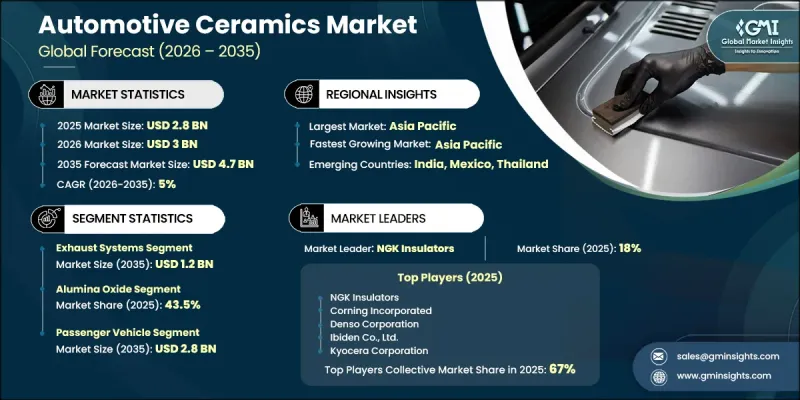
세계의 자동차용 세라믹 시장은 2025년에 28억 달러로 평가되었고, CAGR 5%로 성장할 전망이며, 2035년까지 47억 달러에 이를 것으로 예측됩니다.

시장 성장은 2022-2025년 사이에 도입된 자동차 배기가스 규제 강화로 인해 세라믹 기반 배기가스 제어 부품의 채택이 가속화되고 있습니다. 자동차 제조업체들은 차량의 효율성을 유지하면서 진화하는 환경 규제 기준을 충족하기 위해 코디라이트와 실리콘 카바이드로 제조된 내구성 높은 세라믹 기판에 대한 의존도를 높이고 있습니다. 자동차 파워트레인 기술의 지속적인 변화에도 불구하고, 애프터마켓 및 OEM 용도 분야에서 첨단 세라믹 여과 기술에 대한 수요는 꾸준히 증가하고 있습니다. 또한, 세라믹 소재가 파워 일렉트로닉스, 배터리 절연, 인버터 부품을 포함한 전기자동차 및 하이브리드 자동차 시스템에서 필수 불가결한 요소로 자리 잡으면서 자동차 세라믹 산업은 전동화 추세의 수혜를 받고 있습니다. 알루미나, 질화알루미늄 등의 재료는 고전압 환경에서의 우수한 열전도율과 전기절연 성능으로 인해 그 활용이 확대되고 있습니다. 또한, 자동차 제조업체들은 연비 향상, 차량 설계의 소형화, 변동하는 작동 온도에서 성능 안정성을 보장하기 위해 내열 충격성이 우수한 경량 소재를 점점 더 많이 요구하고 있습니다.
| 시장 범위 | |
|---|---|
| 개시 연도 | 2025년 |
| 예측 기간 | 2026-2035년 |
| 개시 연도 시장 규모 | 28억 달러 |
| 예측 시장 규모 | 47억 달러 |
| CAGR | 5% |
배기 시스템 부문은 2025년 7억 2,340만 달러 시장 규모를 기록했으며, 배출가스 제어 기술의 지속적인 발전과 촉매 컨버터 및 미립자 물질 필터 시스템에 대한 수요 증가에 힘입어 2035년까지 12억 달러에 이를 것으로 전망됩니다. 전 세계적으로 자동차 배기가스 저감에 대한 관심이 높아지면서 배기가스 처리 용도에 사용되는 세라믹 기판에 대한 수요가 꾸준히 증가하고 있습니다. 자동차 제조업체들은 내구성을 높이고 여과 효율을 향상시키며 전 세계 자동차 시장에서 강화되는 환경 기준을 충족시키기 위해 배기 시스템에 첨단 세라믹 소재를 지속적으로 채택하고 있습니다.
알루미나 산화물 부문은 2025년 43.5%의 점유율을 차지했으며, 2035년까지 강력한 성장이 예상됩니다. 이 부문 시장 확대는 이 소재의 비용 효율성, 우수한 전기 절연 성능, 자동차 전자 시스템 및 센서 기술과의 폭넓은 호환성으로 인해 주도되고 있습니다. 알루미나 산화물 세라믹은 고온에 견딜 수 있고 전기적으로 열악한 환경에서도 안정적인 작동 성능을 발휘할 수 있기 때문에 현대 자동차 용도에 점점 더 많이 사용되고 있습니다. 자동차 기술이 고도화되고 전자화가 진행됨에 따라 자동차용 일렉트로닉스에 광범위하게 사용되면서 이 부문의 성장을 지속적으로 뒷받침하고 있습니다.
북미의 자동차용 세라믹 시장은 2025년 6억 3,310만 달러에 달했으며, 자동차 배기가스 제어 시스템의 업그레이드 증가와 전동화 기술의 급속한 통합에 힘입어 2035년까지 11억 달러에 달할 것으로 전망됩니다. 전기차 및 하이브리드 자동차 제조에 대한 투자 확대와 더불어 환경 규제 강화로 인해 자동차 용도 전반에 걸쳐 첨단 세라믹 소재에 대한 수요가 가속화되고 있습니다. 또한, 차세대 차량에서 고성능 열 관리 및 전기 절연 솔루션에 대한 관심이 높아지면서 북미 전역 시장 확대에 더욱 기여하고 있습니다.
자주 묻는 질문
목차
제1장 조사 방법 및 범위
제2장 주요 요약
제3장 산업 인사이트
제4장 경쟁 구도
제5장 시장 추정 및 예측 : 용도별(2022-2035년)
제6장 시장 추정 및 예측 : 재료별(2022-2035년)
제7장 시장 추정 및 예측 : 차종별(2022-2035년)
제8장 시장 추정 및 예측 : 지역별(2022-2035년)
제9장 기업 개요
AJY 26.06.15The Global Automotive Ceramics Market was valued at USD 2.8 billion in 2025 and is estimated to grow at a CAGR of 5% to reach USD 4.7 billion by 2035.
Market growth is driven by increasingly stringent vehicle emission regulations introduced between 2022 and 2025, which have accelerated the adoption of ceramic-based emission control components. Automakers are increasingly relying on durable ceramic substrates manufactured from cordierite and silicon carbide to meet evolving environmental compliance standards while maintaining vehicle efficiency. Demand for advanced ceramic filtration technologies is stable across replacement and original equipment applications despite ongoing shifts in vehicle powertrain technologies. The automotive ceramics industry is also benefiting from rising electrification trends, as ceramic materials are becoming essential in electric and hybrid vehicle systems, including power electronics, battery insulation, and inverter components. Materials such as alumina and aluminum nitride are witnessing growing utilization due to their superior thermal conductivity and electrical insulation capabilities in high-voltage environments. Additionally, automotive manufacturers are increasingly seeking lightweight materials with high thermal shock resistance to improve fuel efficiency, enhance compact vehicle designs, and support performance stability under fluctuating operating temperatures.
| Market Scope | |
|---|---|
| Start Year | 2025 |
| Forecast Year | 2026-2035 |
| Start Value | $2.8 Billion |
| Forecast Value | $4.7 Billion |
| CAGR | 5% |
The exhaust systems segment generated USD 723.4 million in 2025 and is anticipated to reach USD 1.2 billion by 2035, supported by continued advancements in emission control technologies and increasing demand for catalytic converters and particulate filtration systems. The growing focus on reducing vehicle emissions globally is sustaining strong demand for ceramic substrates used in exhaust treatment applications. Automotive manufacturers continue to integrate advanced ceramic materials into exhaust systems to enhance durability, improve filtration efficiency, and comply with tightening environmental standards across global automotive markets.
The alumina oxide segment accounted for 43.5% share in 2025 and is expected to witness strong growth through 2035. Market expansion for this segment is being driven by the material's cost-effectiveness, excellent electrical insulation performance, and broad compatibility with automotive electronic systems and sensor technologies. Alumina oxide ceramics are increasingly utilized across modern vehicle applications due to their ability to withstand high temperatures and provide reliable operational performance in electrically demanding environments. Their widespread use in automotive electronics continues to support segment growth as vehicle technologies become more advanced and electronically integrated.
North America Automotive Ceramics Market reached USD 633.1 million in 2025 and is projected to reach to USD 1.1 billion by 2035, supported by increasing upgrades in vehicle emission control systems and the rapid integration of electrified vehicle technologies. Rising investments in electric and hybrid vehicle manufacturing, along with stricter environmental regulations, are accelerating the demand for advanced ceramic materials across automotive applications. In addition, the growing focus on high-performance thermal management and electrical insulation solutions within next-generation vehicles is further contributing to market expansion across North America.
Leading companies operating in the Global Automotive Ceramics Market include Corning Incorporated, Kyocera Corporation, NGK Insulators, Denso Corporation, Ceramtec GmbH, Coorstek Inc., 3M, Almatis GmbH, Elan Technologies, Ferrotec Corporation, Hoganas AB, and Ibiden Co., Ltd. Companies operating in the automotive ceramics market are focusing on several strategic initiatives to strengthen their market presence and enhance long-term competitiveness. Manufacturers are investing heavily in research and development activities to create advanced ceramic materials with improved thermal resistance, lightweight properties, and higher electrical insulation performance. Many industry participants are also expanding production capabilities to meet increasing demand from electric and hybrid vehicle manufacturers. Strategic collaborations with automotive OEMs and technology providers are helping companies accelerate product innovation and improve integration across next-generation vehicle platforms. In addition, businesses are prioritizing the development of high-efficiency emission control ceramics to comply with tightening global environmental regulations.
Table of Contents
Chapter 1 Methodology & Scope
- 1.1 Market scope and definition
- 1.2 Research design
- 1.2.1 Research approach
- 1.2.2 Data collection methods
- 1.3 Data mining sources
- 1.3.1 Global
- 1.3.2 Regional/Country
- 1.4 Base estimates and calculations
- 1.4.1 Base year calculation
- 1.4.2 Key trends for market estimation
- 1.5 Primary research and validation
- 1.5.1 Primary sources
- 1.6 Forecast model
- 1.7 Research assumptions and limitations
Chapter 2 Executive Summary
- 2.1 Industry 360° synopsis
- 2.2 Key market trends
- 2.2.1 Regional
- 2.2.2 Application
- 2.2.3 Material
- 2.2.4 Vehicle Type
- 2.3 TAM Analysis, 2026-2035
- 2.4 CXO perspectives: Strategic imperatives
- 2.4.1 Executive decision points
- 2.4.2 Critical success factors
- 2.5 Future Outlook and Strategic Recommendations
Chapter 3 Industry Insights
- 3.1 Industry ecosystem analysis
- 3.1.1 Supplier landscape
- 3.1.2 Profit margin
- 3.1.3 Value addition at each stage
- 3.1.4 Factor affecting the value chain
- 3.1.5 Disruptions
- 3.2 Industry impact forces
- 3.2.1 Growth drivers
- 3.2.2 Industry pitfalls and challenges
- 3.2.3 Market opportunities
- 3.3 Growth potential analysis
- 3.4 Regulatory landscape
- 3.4.1 North America
- 3.4.2 Europe
- 3.4.3 Asia Pacific
- 3.4.4 Latin America
- 3.4.5 Middle East & Africa
- 3.5 Porter's analysis
- 3.6 PESTEL analysis
- 3.7 Price trends
- 3.7.1 By region
- 3.7.2 By Application
- 3.8 Production Capacity, 2025
- 3.9 Future market trends
- 3.10 Technology and Innovation landscape
- 3.10.1 Current technological trends
- 3.10.2 Emerging technologies
- 3.11 Patent Landscape
- 3.12 Trade statistics (HS code)
- 3.12.1 Major importing countries
- 3.12.2 Major exporting countries
- 3.13 Sustainability and environmental aspects
- 3.13.1 Sustainable practices
- 3.13.2 Waste reduction strategies
- 3.13.3 Energy efficiency in production
- 3.13.4 Eco-friendly initiatives
- 3.14 Carbon footprint consideration
Chapter 4 Competitive Landscape, 2025
- 4.1 Introduction
- 4.2 Company market share analysis
- 4.2.1 By region
- 4.2.1.1 North America
- 4.2.1.2 Europe
- 4.2.1.3 Asia Pacific
- 4.2.1.4 LATAM
- 4.2.1.5 MEA
- 4.2.1 By region
- 4.3 Company matrix analysis
- 4.4 Competitive analysis of major market players
- 4.5 Competitive positioning matrix
- 4.6 Key developments
- 4.6.1 Mergers & acquisitions
- 4.6.2 Partnerships & collaborations
- 4.6.3 New Product Launches
- 4.6.4 Expansion Plans
Chapter 5 Market Estimates and Forecast, By Application, 2022-2035 (USD Billion) (Kilo Tons)
- 5.1 Key trends
- 5.2 Engine Parts
- 5.3 Exhaust Systems
- 5.4 Automotive Electronics
- 5.5 Braking Systems
- 5.6 Others (friction components, heat shields)
Chapter 6 Market Estimates and Forecast, By Material, 2022-2035 (USD Billion) (Kilo Tons)
- 6.1 Key trends
- 6.2 Titanate Oxide
- 6.3 Zirconia Oxide
- 6.4 Alumina Oxide
- 6.5 Others (silicon nitride (Si3N4), silicon carbide (SiC))
Chapter 7 Market Estimates and Forecast, By Vehicle Type, 2022-2035 (USD Billion) (Kilo Tons)
- 7.1 Key trends
- 7.2 Passenger Vehicle
- 7.3 Commercial Vehicle
Chapter 8 Market Estimates and Forecast, By Region, 2022-2035 (USD Billion) (Kilo Tons)
- 8.1 Key trends
- 8.2 North America
- 8.2.1 U.S.
- 8.2.2 Canada
- 8.3 Europe
- 8.3.1 Germany
- 8.3.2 UK
- 8.3.3 France
- 8.3.4 Spain
- 8.3.5 Italy
- 8.3.6 Rest of Europe
- 8.4 Asia Pacific
- 8.4.1 China
- 8.4.2 India
- 8.4.3 Japan
- 8.4.4 Australia
- 8.4.5 South Korea
- 8.4.6 Rest of Asia Pacific
- 8.5 Latin America
- 8.5.1 Brazil
- 8.5.2 Mexico
- 8.5.3 Argentina
- 8.5.4 Rest of Latin America
- 8.6 Middle East and Africa
- 8.6.1 Saudi Arabia
- 8.6.2 South Africa
- 8.6.3 UAE
- 8.6.4 Rest of Middle East and Africa
Chapter 9 Company Profiles
- 9.1 3M
- 9.2 Almatis GmbH
- 9.3 Ceramtec GmbH
- 9.4 Coorstek Inc.
- 9.5 Corning Incorporated
- 9.6 Denso Corporation
- 9.7 Elan Technologies
- 9.8 Ferrotec Corporation
- 9.9 Hoganas AB
- 9.10 Ibiden Co., Ltd.
- 9.11 Kyocera Corporation
- 9.12 NGK Insulators


