

|
시장보고서
상품코드
2045820
입상 바이오차 시장 : 기회, 성장 촉진요인, 업계 동향 분석 및 예측(2026-2035년)Granular Biochar Market Opportunity, Growth Drivers, Industry Trend Analysis, and Forecast 2026 - 2035 |
||||||

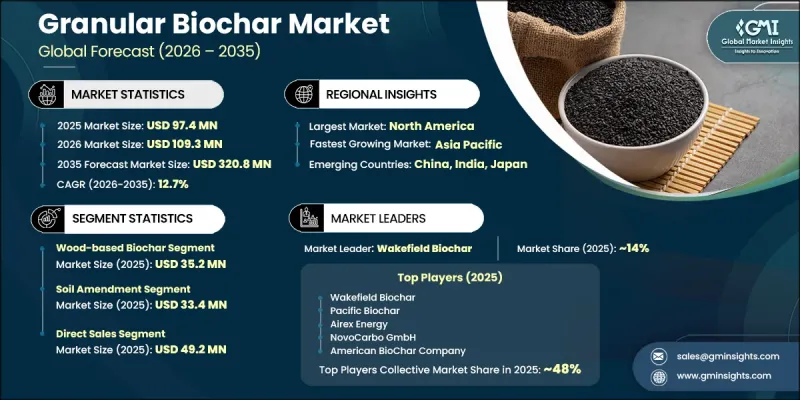
세계의 입상 바이오차 시장은 2025년에 9,740만 달러로 평가되었고, 2035년까지 연평균 복합 성장률(CAGR) 12.7%를 나타내 3억 2,080만 달러에 이를 것으로 추정되고 있습니다.
지속 가능한 농법 채택 확대는 입상 바이오차 산업의 성장을 가속화하는 데 큰 역할을 하고 있습니다. 농부들은 토양의 질 저하, 화학비료에 대한 과도한 의존, 농업 생산성 저하 등의 문제를 해결하기 위해 장기적인 토양 관리 전략에 바이오차르를 도입하는 사례가 늘고 있습니다. 이 소재는 영양분 보유력 향상, 수분 관리 지원, 건강한 미생물 활동을 촉진하는 토양 환경 개선에 도움이 되기 때문에 높은 수요를 보이고 있습니다. 재생형 농법과 친환경 재배기술에 대한 관심이 높아진 것도 시장 확대에 더욱 기여하고 있습니다. 또한, 자발적 탄소 시장의 발전은 입상 바이오차 제조업체에게 새로운 성장 기회를 창출하고 있습니다. 바이오char는 효과적인 탄소 고정 재료로 점점 더 많이 인식되고 있으며, 조직이 탄소 제거 이니셔티브에 이를 통합하여 인증된 탄소 배출권을 생성하도록 장려하고 있습니다. 제품 상용화와 탄소배출권 창출을 결합한 이 이중 수익 모델은 더 많은 투자를 유치하고 세계의 입상 바이오차 시장 전체에서 생산 능력 확장을 지원하고 있습니다.
| 시장 범위 | |
|---|---|
| 시작 연도 | 2025년 |
| 예측 기간 | 2026-2035년 |
| 시작 연도 시장 규모 | 9,740만 달러 |
| 예측 금액 | 3억 2,080만 달러 |
| CAGR | 12.7% |
2025년 목재 유래 바이오차 부문 시장 규모는 3,520만 달러에 달했습니다. 업계 내 제품 수요는 원자재 가용성, 제조 효율성, 최종 용도의 성능 요건 등의 요인에 의해 영향을 받습니다. 목재 유래 바이오차콜은 안정적인 탄소 조성, 고다공성 구조, 일관된 대규모 생산 지원 능력으로 인해 지속적으로 강력한 시장 지위를 유지하고 있습니다. 이러한 특성으로 인해 장기적인 토양 개량과 효율적인 탄소 저장 성능이 요구되는 농업 및 환경 분야에 매우 적합합니다.
2025년 직접 판매 부문 시장 규모는 4,920만 달러였습니다. 입상 바이오차 시장의 유통 채널 동향은 맞춤형 제품 솔루션에 대한 니즈, 대량 처리 능력, 공급업체와 최종 사용자 간의 긴밀한 협력에 따라 크게 좌우됩니다. 기술 지원, 사양 맞춤화, 용도에 따른 지도가 필요한 산업 시설, 농업 사업자 및 탄소 관리 프로젝트에는 직접 판매 채널이 여전히 필수적입니다. 이러한 판매 방식을 통해 제조업체는 가격의 일관성을 유지하고 제품 품질 기준을 보장하는 동시에 맞춤형 서비스 제공 및 전문 솔루션을 통해 장기적인 비즈니스 관계를 구축할 수 있습니다.
2025년 북미의 입상 바이오차 시장은 3,510만 달러 규모에 달했습니다. 토양 건강 개선 및 탄소 고정 관행에 대한 인식이 높아짐에 따라 미국이 지역 시장에서 가장 큰 점유율을 차지했습니다. 시장의 성장은 기후 친화적인 농업 개발과 지속 가능한 토지 관리 이니셔티브에 초점을 맞춘 우호적인 정책 프레임워크에 의해 뒷받침되고 있습니다. 재생 가능한 농업 시스템과 탄소배출권 프로그램에 바이오차르가 도입되고 있는 것도 지역 전체에서 제품 수요를 더욱 촉진하고 있습니다. 또한, 열분해 기술의 지속적인 발전과 잘 구축된 R&D 생태계의 존재는 북미 입상 바이오차 산업에서 신생 제조업체와 대규모 제조업체 모두 상용화 노력을 가속화하고 생산 능력을 확대할 수 있도록 지원하고 있습니다.
자주 묻는 질문
목차
제1장 조사 방법과 범위
제2장 주요 요약
제3장 업계 인사이트
제4장 경쟁 구도
제5장 시장 추산 및 예측 : 유형별(2022-2035년)
제6장 시장 추산 및 예측 : 유통 채널별(2022-2035년)
제7장 시장 추산 및 예측 : 지역별(2022-2035년)
제8장 기업 개요
KTH 26.06.10The Global Granular Biochar Market was valued at USD 97.4 million in 2025 and is estimated to grow at a CAGR of 12.7% to reach USD 320.8 million by 2035.
Rising adoption of sustainable agricultural practices is playing a major role in accelerating the growth of the granular biochar industry. Farmers are increasingly incorporating biochar into long-term soil management strategies to address declining soil quality, excessive chemical dependency, and reduced agricultural productivity. The material is gaining strong demand due to its ability to improve nutrient retention, support moisture management, and enhance soil conditions that promote healthier microbial activity. Growing interest in regenerative farming methods and environmentally responsible cultivation techniques is further contributing to market expansion. In addition, the development of voluntary carbon markets is creating new growth opportunities for granular biochar manufacturers. Biochar is increasingly recognized as an effective carbon sequestration material, encouraging organizations to integrate it into carbon dioxide removal initiatives to generate certified carbon credits. This dual-revenue model, combining product commercialization with carbon credit generation, is attracting higher investments and supporting production capacity expansion across the global granular biochar market.
| Market Scope | |
|---|---|
| Start Year | 2025 |
| Forecast Year | 2026-2035 |
| Start Value | $97.4 Million |
| Forecast Value | $320.8 Million |
| CAGR | 12.7% |
The wood-based biochar segment accounted for USD 35.2 million in 2025. Product demand within the industry is influenced by factors such as raw material availability, manufacturing efficiency, and performance requirements across end-use applications. Wood-derived biochar continues to maintain a strong market position due to its stable carbon composition, highly porous structure, and ability to support consistent large-scale production. These characteristics make it highly suitable for agricultural and environmental applications that require long-lasting soil enhancement and efficient carbon storage performance.
The direct sales segment was valued at USD 49.2 million in 2025. Distribution channel dynamics in the granular biochar market are largely influenced by the need for customized product solutions, large-volume handling capabilities, and strong engagement between suppliers and end users. Direct sales channels remain essential for industrial facilities, agricultural operators, and carbon management projects that require technical support, tailored specifications, and application-based guidance. This sales approach allows manufacturers to maintain pricing consistency, ensure product quality standards, and establish long-term business relationships through customized service offerings and specialized solutions.
North America Granular Biochar Market generated USD 35.1 million in 2025. The United States accounted for the largest share within the regional market due to growing awareness surrounding soil health improvement and carbon sequestration practices. Market growth is being supported by favorable policy frameworks focused on climate-conscious agricultural development and sustainable land management initiatives. Increasing integration of biochar into regenerative agriculture systems and carbon credit programs is further driving product demand across the region. In addition, ongoing advancements in pyrolysis technologies and the presence of a well-established research and development ecosystem are enabling both emerging and large-scale manufacturers to accelerate commercialization efforts and expand production capabilities within the North American granular biochar industry.
Key participants operating in the Global Granular Biochar Market include Airex Energy, American BioChar Company, ArSta Eco Pvt Ltd., Carbo Culture, Carbon Gold Ltd., Carbofex Ltd., CharGrow USA, NextChar, NovoCarbo GmbH, Oregon Biochar Solutions, Pacific Biochar Benefit Corporation, PYREG GmbH, Sonnenerde GmbH, Vedic Orgo LLP, and Wakefield Biochar. Companies operating in the granular biochar market are adopting several strategic initiatives to strengthen their market presence and improve long-term competitiveness. Manufacturers are focusing on expanding production capacity and investing in advanced pyrolysis technologies to enhance product quality and operational efficiency. Strategic collaborations with agricultural organizations, carbon credit platforms, and research institutions are helping companies broaden their customer base and improve product adoption. Many market participants are also prioritizing sustainability-focused branding to align with rising environmental awareness among consumers and businesses. In addition, companies are increasing investments in research and development activities to create application-specific biochar products with improved soil enhancement and carbon sequestration performance.
Table of Contents
Chapter 1 Methodology & Scope
- 1.1 Market scope and definition
- 1.2 Research design
- 1.2.1 Research approach
- 1.2.2 Data collection methods
- 1.3 Data mining sources
- 1.3.1 Global
- 1.3.2 Regional/Country
- 1.4 Base estimates and calculations
- 1.4.1 Base year calculation
- 1.4.2 Key trends for market estimation
- 1.5 Primary research and validation
- 1.5.1 Primary sources
- 1.6 Forecast model
- 1.7 Research assumptions and limitations
Chapter 2 Executive Summary
- 2.1 Industry 360° synopsis
- 2.2 Key market trends
- 2.2.1 Regional
- 2.2.2 Product Type
- 2.2.3 Application
- 2.2.4 Distribution Channel
- 2.3 TAM Analysis, 2026-2035
- 2.4 CXO perspectives: Strategic imperatives
- 2.4.1 Executive decision points
- 2.4.2 Critical success factors
- 2.5 Future Outlook and strategic recommendations
Chapter 3 Industry Insights
- 3.1 Industry ecosystem analysis
- 3.1.1 Supplier Landscape
- 3.1.2 Profit Margin
- 3.1.3 Value addition at each stage
- 3.1.4 Factor affecting the value chain
- 3.1.5 Disruptions
- 3.2 Industry impact forces
- 3.2.1 Growth drivers
- 3.2.1.1 Growing demand for sustainable agriculture & soil health solutions
- 3.2.1.2 Expansion of voluntary carbon markets & CDR credit demand
- 3.2.1.3 Increasing focus on circular economy & waste valorization
- 3.2.2 Industry pitfalls and challenges
- 3.2.2.1 High initial capital investment for production facilities
- 3.2.2.2 Limited awareness among end-users in emerging markets
- 3.2.3 Market opportunities
- 3.2.3.1 Integration with renewable energy & biofuel production
- 3.2.3.2 Development of high-value niche applications
- 3.2.1 Growth drivers
- 3.3 Growth potential analysis
- 3.4 Regulatory landscape
- 3.4.1 North America
- 3.4.2 Europe
- 3.4.3 Asia Pacific
- 3.4.4 Latin America
- 3.4.5 Middle East & Africa
- 3.5 Porter's analysis
- 3.6 PESTEL analysis
- 3.6.1 Technology and innovation landscape
- 3.6.2 Current technological trends
- 3.6.3 Emerging technologies
- 3.7 Price trends
- 3.7.1 By region
- 3.7.2 By product type
- 3.8 Future market trends
- 3.9 Technology and Innovation Landscape
- 3.9.1 Current technological trends
- 3.9.2 Emerging technologies
- 3.10 Patent Landscape
- 3.11 Trade statistics (HS code) (Note: the trade statistics will be provided for key countries only)
- 3.11.1 Major importing countries
- 3.11.2 Major exporting countries
- 3.12 Sustainability and environmental aspects
- 3.12.1 Sustainable practices
- 3.12.2 Waste reduction strategies
- 3.12.3 Energy efficiency in production
- 3.12.4 Eco-friendly initiatives
- 3.13 Carbon Footprint Considerations
Chapter 4 Competitive Landscape, 2025
- 4.1 Introduction
- 4.2 Company market share analysis
- 4.2.1 By region
- 4.2.1.1 North America
- 4.2.1.2 Europe
- 4.2.1.3 Asia Pacific
- 4.2.1.4 LATAM
- 4.2.1.5 MEA
- 4.2.1 By region
- 4.3 Company matrix analysis
- 4.4 Competitive analysis of major market players
- 4.5 Competitive positioning matrix
- 4.6 Key developments
- 4.6.1 Mergers & acquisitions
- 4.6.2 Partnerships & collaborations
- 4.6.3 New product launches
- 4.6.4 Expansion plans
Chapter 5 Market Estimates and Forecast, By Type, 2022 - 2035 (USD Million) (Kilo Tons)
- 5.1 Key trends
- 5.2 Wood-based biochar
- 5.2.1 Sawdust & wood chips
- 5.2.2 Forest thinnings & logging residues
- 5.2.3 Wood manufacturing waste
- 5.3 Agricultural waste-based biochar
- 5.3.1 Crop residues (corn stover, wheat straw)
- 5.3.2 Rice husks & paddy waste
- 5.3.3 Nut shells & fruit pits
- 5.4 Animal manure-based biochar
- 5.4.1 Poultry litter
- 5.4.2 Cattle & dairy manure
- 5.4.3 Swine waste
- 5.5 Others
- 5.5.1 Biosolids & sewage sludge
- 5.5.2 Purpose-grown energy crops
- 5.5.3 Urban organic waste
Chapter 6 Market Estimates and Forecast, By Distribution Channel, 2022 - 2035 (USD Million) (Kilo Tons)
- 6.1 Key trends
- 6.2 Direct Sales
- 6.3 Distributors and Wholesalers
- 6.4 Online Retailers
Chapter 7 Market Estimates and Forecast, By Region, 2022 - 2035 (USD Million) (Kilo Tons)
- 7.1 Key trends
- 7.2 North America
- 7.2.1 U.S.
- 7.2.2 Canada
- 7.3 Europe
- 7.3.1 Germany
- 7.3.2 UK
- 7.3.3 France
- 7.3.4 Spain
- 7.3.5 Italy
- 7.3.6 Rest of Europe
- 7.4 Asia Pacific
- 7.4.1 China
- 7.4.2 India
- 7.4.3 Japan
- 7.4.4 Australia
- 7.4.5 South Korea
- 7.4.6 Rest of Asia Pacific
- 7.5 Latin America
- 7.5.1 Brazil
- 7.5.2 Mexico
- 7.5.3 Argentina
- 7.5.4 Rest of Latin America
- 7.6 Middle East and Africa
- 7.6.1 Saudi Arabia
- 7.6.2 South Africa
- 7.6.3 UAE
- 7.6.4 Rest of Middle East and Africa
Chapter 8 Company Profiles
- 8.1 Airex Energy
- 8.2 American BioChar Company
- 8.3 ArSta Eco Pvt Ltd.
- 8.4 Carbo Culture
- 8.5 Carbon Gold Ltd.
- 8.6 Carbofex Ltd.
- 8.7 CharGrow USA
- 8.8 NextChar
- 8.9 NovoCarbo GmbH
- 8.10 Oregon Biochar Solutions
- 8.11 Pacific Biochar Benefit Corporation
- 8.12 PYREG GmbH
- 8.13 Sonnenerde GmbH
- 8.14 Vedic Orgo LLP
- 8.15 Wakefield Biochar

(주말 및 공휴일 제외)


