

|
시장보고서
상품코드
2045826
산업용 수소에너지 저장 시장 : 시장 기회, 성장요인, 업계 동향 분석 및 예측(2026-2035년)Industrial Hydrogen Energy Storage Market Opportunity, Growth Drivers, Industry Trend Analysis, and Forecast 2026 - 2035 |
||||||

세계의 산업용 수소에너지 저장 시장은 2025년에 128억 달러로 평가되었고, CAGR 8.5%로 성장할 전망이며, 2035년까지 288억 달러에 이를 것으로 추정되고 있습니다.
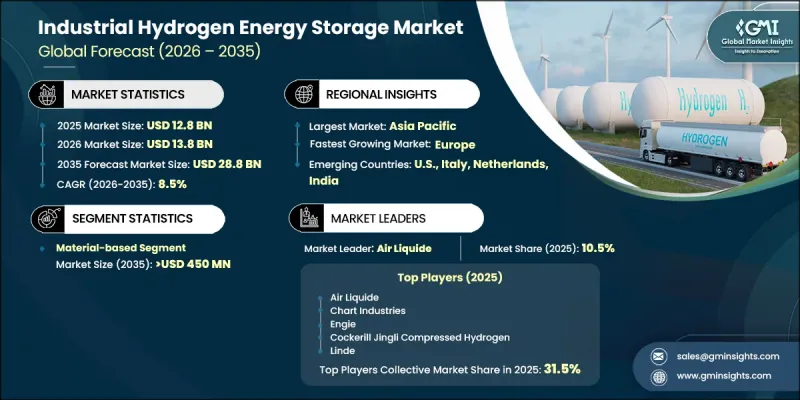
산업용 수소에너지 저장 산업의 성장은 전 세계적으로 탈탄소화로의 전환이 가속화되고 효율적인 재생에너지 통합 솔루션에 대한 수요가 증가함에 따라 성장하고 있습니다. 수소는 발전, 제조, 운송, 중공업 등의 분야에서 배출량 감축을 지원하는 깨끗하고 유연한 에너지 운반체로서 점점 더 인정받고 있습니다. 또한, 재생에너지의 보급 확대에 따라 간헐적인 전력 공급을 조정할 수 있는 장기 저장 시스템에 대한 수요도 증가하고 있습니다. 고압 저장 시스템, 극저온 기술, 고체 수소 저장 기술 등 수소 저장 기술의 발전으로 효율성, 안전성, 확장성이 향상되고 있습니다. 수소 생산 시설, 저장 인프라, 유통망에 대한 투자 증가는 시장의 발전을 더욱 촉진하고 있습니다. 정부와 이해관계자들은 자금 지원, 정책적 인센티브, 대규모 인프라 프로젝트 등을 통해 수소경제의 틀을 적극적으로 지원하고 있습니다. 또한, 수소 저장과 태양광 및 풍력 발전 시스템의 통합은 전력망의 안정성과 에너지의 신뢰성을 향상시켜 수소를 세계 산업 분야에서 미래 청정 에너지 시스템의 중요한 원동력으로 자리매김하고 있습니다.
| 시장 범위 | |
|---|---|
| 개시 연도 | 2025년 |
| 예측 기간 | 2026-2035년 |
| 개시 연도 시장 규모 | 128억 달러 |
| 예측 시장 규모 | 288억 달러 |
| CAGR | 8.5% |
소재 기반 부문은 2035년까지 4억 5,000만 달러에 달할 것으로 예측됩니다. 수소 저장 재료의 지속적인 혁신이 이 부문의 확대에 크게 기여하고 있으며, 금속수소화물, 화학수소화물, 복합수소화물 시스템과 같은 첨단 화합물의 개발이 진행되고 있습니다. 이러한 재료는 높은 저장 밀도, 안정성, 전체 시스템 효율을 향상시키는 능력으로 인해 주목을 받고 있습니다. 재료 과학의 발전으로 수소의 흡착 및 방출 성능이 향상되어 저장 시스템의 신뢰성이 향상되어 대규모 산업 응용 분야에서 상업적으로 실현 가능한 저장 시스템이 되었습니다. 현재 진행 중인 연구개발을 통해 수소 저장 기술의 비용 효율성과 운영 안전성이 더욱 향상되고 있습니다.
미국의 산업용 수소 에너지 저장 시장은 2035년까지 42억 달러에 달할 것으로 예측됩니다. 미국 시장 확대는 강력한 연방정부의 정책적 지원, 청정 에너지에 대한 투자 증가, 지속 가능한 산업 에너지 솔루션에 대한 수요 증가로 뒷받침되고 있습니다. 국가 청정에너지법에 따른 인센티브 프로그램은 수소 생산 및 저장 인프라 개발을 가속화하고 있습니다. 정유, 화학, 야금 등 대규모 산업 부문의 존재는 효율적인 수소에너지 저장 시스템에 대한 수요를 더욱 견인하고 있습니다. 또한, 재생에너지 용량의 급속한 확대에 따라 전력 계통의 안정성을 확보하기 위한 장시간 저장 기술에 대한 요구가 증가하고 있습니다. 민관 협력과 대규모 수소 허브 구상을 통해 미국 전역의 도입이 더욱 강화되고 있으며, 미국은 주요 성장 시장으로 자리매김하고 있습니다.
자주 묻는 질문
목차
제1장 조사 방법 및 범위
제2장 주요 요약
제3장 산업 인사이트
제4장 경쟁 구도
제5장 시장 규모 및 예측 : 방법별(2022-2035년)
제6장 시장 규모 및 예측 : 지역별(2022-2035년)
제7장 기업 개요
AJY 26.06.15The Global Industrial Hydrogen Energy Storage Market was valued at USD 12.8 billion in 2025 and is estimated to grow at a CAGR of 8.5% to reach USD 28.8 billion by 2035.
Growth in the industrial hydrogen energy storage industry is driven by the accelerating global shift toward decarbonization and the rising need for efficient renewable energy integration solutions. Hydrogen is increasingly being recognized as a clean and flexible energy carrier that supports emissions reduction across power generation, manufacturing, transportation, and heavy industry applications. Expanding renewable energy penetration is also increasing demand for long-duration storage systems capable of balancing intermittent power supply. Technological advancements in hydrogen storage, including high-pressure containment systems, cryogenic technologies, and solid-state storage innovations, are improving efficiency, safety, and scalability. Rising investments in hydrogen production facilities, storage infrastructure, and distribution networks are further strengthening market development. Governments and private stakeholders are actively supporting hydrogen economy frameworks through funding initiatives, policy incentives, and large-scale infrastructure projects. Integration of hydrogen storage with solar and wind energy systems is also enhancing grid stability and energy reliability, positioning hydrogen as a key enabler of future clean energy systems across global industrial sectors.
| Market Scope | |
|---|---|
| Start Year | 2025 |
| Forecast Year | 2026-2035 |
| Start Value | $12.8 Billion |
| Forecast Value | $28.8 Billion |
| CAGR | 8.5% |
The material-based segment is expected to reach USD 450 million by 2035. Continuous innovation in hydrogen storage materials is significantly contributing to this segment's expansion, with growing development of advanced compounds such as metal hydrides, chemical hydrides, and complex hydride systems. These materials are gaining attention due to their high storage density, stability, and ability to improve overall system efficiency. Advancements in material science are enhancing hydrogen absorption and release performance, making storage systems more reliable and commercially viable for large-scale industrial applications. Ongoing research and development efforts are further improving cost efficiency and operational safety in hydrogen storage technologies.
U.S. Industrial Hydrogen Energy Storage Market is projected to reach USD 4.2 billion by 2035. Market expansion in the United States is supported by strong federal policy frameworks, rising clean energy investments, and growing demand for sustainable industrial energy solutions. Incentive programs under national clean energy legislation are accelerating the development of hydrogen production and storage infrastructure. The presence of large-scale industrial sectors such as refining, chemicals, and metallurgy is further driving demand for efficient hydrogen storage systems. In addition, the rapid expansion of renewable energy capacity is increasing the need for long-duration storage technologies to ensure grid stability. Public-private collaborations and large-scale hydrogen hub initiatives are further strengthening deployment across the country, positioning the U.S. as a leading growth market.
Key companies operating in the Global Industrial Hydrogen Energy Storage Market include Air Liquide, Linde plc, Air Products and Chemicals, Inc., ENGIE, Plug Power Inc., Nel ASA, ITM Power PLC, McPhy Energy S.A., Chart Industries, Worthington Industries, Hexagon Purus ASA, FuelCell Energy, Inc., Everfuel A/S, NPROXX B.V., Cockerill Jingli Compressed Hydrogen, GKN Compressed Hydrogen, SSE, and Gravitricity Ltd. Companies operating in the industrial hydrogen energy storage market are adopting multiple strategies to strengthen their competitive position and expand global reach. Leading players are heavily investing in research and development to improve hydrogen storage efficiency, safety, and scalability across industrial applications. Strategic partnerships with energy utilities, industrial manufacturers, and renewable energy developers are enabling companies to accelerate project deployment and expand infrastructure networks. Firms are also focusing on large-scale hydrogen hub developments and integrated storage solutions linked with wind and solar energy systems. Expansion of manufacturing capacity and localization of supply chains are helping reduce production costs and improve accessibility. In addition, companies are actively engaging in government-backed clean energy programs and policy-driven initiatives to secure long-term contracts.
Table of Contents
Chapter 1 Methodology & Scope
- 1.1 Research approach
- 1.2 Quality commitments
- 1.2.1 GMI AI policy & data integrity commitment
- 1.2.1.1 Source consistency protocol
- 1.2.1 GMI AI policy & data integrity commitment
- 1.3 Research trail & confidence scoring
- 1.3.1 Research trail components
- 1.3.2 Scoring components
- 1.4 Data collection
- 1.4.1 Partial list of primary sources
- 1.5 Data mining sources
- 1.5.1 Paid sources
- 1.5.1.1 Sources, by region
- 1.5.1 Paid sources
- 1.6 Base estimates and calculations
- 1.6.1 Base year calculation for any one approach
- 1.7 Market estimates & forecasts parameters
- 1.8 Forecast model
- 1.8.1 Quantified market impact analysis
- 1.8.1.1 Mathematical impact of growth parameters on forecast
- 1.8.1 Quantified market impact analysis
- 1.9 Research transparency addendum
- 1.9.1 Source attribution framework
- 1.9.2 Quality assurance metrics
- 1.9.3 Our commitment to trust
- 1.10 Market definitions
Chapter 2 Executive Summary
- 2.1 Industry synopsis, 2022 - 2035
- 2.1.1 Business trends
- 2.1.2 Method trends
- 2.1.3 Regional trends
Chapter 3 Industry Insights
- 3.1 Industry ecosystem analysis
- 3.1.1 Raw material availability & sourcing analysis
- 3.1.2 Manufacturing capacity assessment
- 3.1.3 Supply chain resilience & risk factors
- 3.1.4 Distribution network analysis
- 3.2 Regulatory landscape
- 3.3 Industry impact forces
- 3.3.1 Growth drivers
- 3.3.2 Industry pitfalls & challenges
- 3.4 Growth potential analysis
- 3.5 Porter's analysis
- 3.5.1 Bargaining power of suppliers
- 3.5.2 Bargaining power of buyers
- 3.5.3 Threat of new entrants
- 3.5.4 Threat of substitutes
- 3.6 PESTEL analysis
- 3.6.1 Political factors
- 3.6.2 Economic factors
- 3.6.3 Social factors
- 3.6.4 Technological factors
- 3.6.5 Legal factors
- 3.6.6 Environmental factors
- 3.7 Capacity & production landscape (Driven by Primary Research)
- 3.7.1 Capacity by key producer (Driven by Primary Research)
- 3.7.2 Capacity utilization rates & expansion pipelines (Driven by Primary Research)
- 3.8 Impact of AI & Generative AI on the market (Core Solution)
- 3.8.1 AI-Driven production optimization (Core Solution)
- 3.8.2 Predictive maintenance & fault detection (Core Solution)
- 3.9 Emerging opportunities & trends
- 3.10 Investment analysis & future prospects
- 3.11 Sustainability initiatives & industry 4.0 integration
Chapter 4 Competitive Landscape, 2026
- 4.1 Introduction
- 4.2 Company market share analysis, by region, 2025
- 4.2.1 North America
- 4.2.2 Europe
- 4.2.3 Asia Pacific
- 4.3 Key developments
- 4.3.1 Key partnerships & collaborations
- 4.3.2 Major M&A activities
- 4.3.3 Product innovations & launches
- 4.3.4 Market expansion strategies
- 4.4 Competitive positioning matrix
Chapter 5 Market Size and Forecast, By Method, 2022 - 2035 (USD Million)
- 5.1 Key trends
- 5.2 Compression
- 5.3 Liquefaction
- 5.4 Material based
Chapter 6 Market Size and Forecast, By Region, 2022 - 2035 (USD Million)
- 6.1 Key trends
- 6.2 North America
- 6.2.1 U.S.
- 6.2.2 Canada
- 6.2.3 Mexico
- 6.3 Europe
- 6.3.1 Germany
- 6.3.2 UK
- 6.3.3 France
- 6.3.4 Italy
- 6.3.5 Netherlands
- 6.3.6 Russia
- 6.4 Asia Pacific
- 6.4.1 China
- 6.4.2 India
- 6.4.3 Japan
- 6.5 Rest of World
Chapter 7 Company Profiles
- 7.1 Air Liquide
- 7.2 Air Products and Chemicals, Inc.
- 7.3 Chart Industries
- 7.4 Cockerill Jingli Compressed hydrogen
- 7.5 ENGIE
- 7.6 Everfuel A/S
- 7.7 FuelCell Energy, Inc.
- 7.8 GKN Compressed Hydrogen
- 7.9 Gravitricity Ltd
- 7.10 Hexagon Purus ASA
- 7.11 ITM Power PLC
- 7.12 Linde plc
- 7.13 McPhy Energy S.A.
- 7.14 Nel ASA
- 7.15 NPROXX B.V.
- 7.16 Plug Power Inc.
- 7.17 SSE
- 7.18 Worthington Industries


