|
시장보고서
상품코드
2045838
옥틸 알코올 시장 : 기회, 성장 촉진요인, 업계 동향 분석 및 예측(2026-2035년)Octyl Alcohol Market Opportunity, Growth Drivers, Industry Trend Analysis, and Forecast 2026 - 2035 |
||||||

세계의 옥틸 알코올 시장은 2025년에 72억 달러로 평가되었고, 2035년까지 연평균 복합 성장률(CAGR) 2.8%를 나타내 92억 달러에 이를 것으로 추정되고 있습니다.
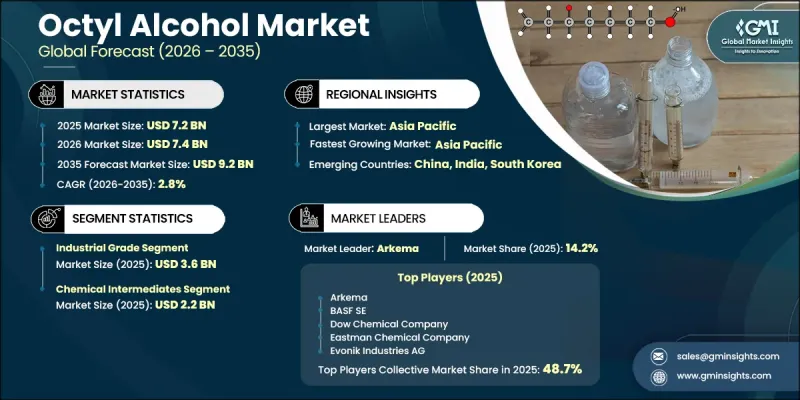
산업 제조 및 특수 제제 공정에서 광범위하게 사용되는 다용도 화학 중간체에 대한 수요가 증가함에 따라 시장이 점차 확대되고 있습니다. 옥틸 알코올은 옥소 합성에 의해 제조되며, 이 과정에서 프로파일렌은 하이드로 포르밀화 조건에서 합성 가스와 반응하여 여러 이성질체 구조를 형성합니다. 직쇄 및 분지형 분자 구조는 우수한 용매 성능과 높은 화학 반응성을 제공하기 때문에 신뢰할 수 있는 중간 화합물을 필요로 하는 산업에 필수적인 원료가 되고 있습니다. 옥틸알콜은 제제의 안정성과 화학합성의 효율성에 기여하는 역할을 하기 때문에 화학처리, 의약품, 퍼스널케어 등 다양한 분야에서 널리 사용되고 있습니다. 이 화합물은 산화에 대한 내성이 있고 유기 물질과의 상용성이 높아 산업 규모의 운영과 소비자 제제 모두에 적합합니다. 저독성 및 지속 가능한 화학적 대체품에 대한 수요 증가도 채택을 촉진하고 있으며, 촉매 시스템 및 제조 방법의 지속적인 발전으로 수율 효율과 이성질체 제어가 향상되고 있습니다. 제조업체들은 점점 더 개선된 옥소 합성 경로와 바이오 생산 공정을 채택하고 있으며, 이를 통해 순도를 높이고 최종 용도 요건에 맞게 제품 특성을 보다 정밀하게 제어할 수 있게 되었습니다.
| 시장 범위 | |
|---|---|
| 시작 연도 | 2025년 |
| 예측 기간 | 2026-2035년 |
| 시작 연도 시장 규모 | 72억 달러 |
| 예측 시장 규모 | 92억 달러 |
| CAGR | 2.8% |
산업용 등급 부문은 비용 효율성과 대규모 화학 합성 및 가소제 제조에 대한 높은 적용 가능성으로 인해 2025년 36억 달러에 달했으며 계속 확대되고 있습니다. 높은 반응성과 성능으로 인해 특히 프탈레이트계 이외의 가소제 대체품에 대한 수요가 증가함에 따라 에스테르 생산에서 선호되는 원료로 각광받고 있습니다. 제조 공정의 지속적인 개선으로 순도 수준이 더욱 향상되어 산업계에서의 채택이 확대되고 있습니다.
화학 중간체 부문은 2025년 22억 달러를 차지했습니다. 옥틸 알코올은 환경 성능이 향상된 에스테르, 계면활성제, 가소제 제조에 널리 사용되어 수요가 증가하고 있습니다. 또한, 효율적이고 안정적인 화학 처리 솔루션에 대한 산업계의 요구에 힘입어 페인트 및 세정제 배합의 용매로 사용이 계속 확대되고 있습니다.
북미의 옥틸 알코올 시장은 2025년 17억 달러에서 2035년 21억 달러로 성장할 것으로 예측됩니다. 이 지역의 성장은 고순도 중간체에 대한 의존도가 높은 화학 제조 및 퍼스널케어 산업의 강력한 수요와 지속 가능한 화학 제조 방법의 채택 확대에 힘입어 성장세를 보이고 있습니다. 시장 확대는 공급 효율과 환경 성능을 향상시키는 첨단 생산 기술에 대한 투자와 바이오 원료 인프라 개발에 힘입어 더욱 탄력을 받고 있습니다.
자주 묻는 질문
목차
제1장 조사 방법과 범위
제2장 주요 요약
제3장 업계 인사이트
제4장 경쟁 구도
제5장 시장 추산 및 예측 : 유형별(2022-2035년)
제6장 시장 추산 및 예측 : 용도별(2022-2035년)
제7장 시장 추산 및 예측 : 지역별(2022-2035년)
제8장 기업 개요
KTH 26.06.10The Global Octyl Alcohol Market was valued at USD 7.2 billion in 2025 and is estimated to grow at a CAGR of 2.8% to reach USD 9.2 billion by 2035.
The market is gradually advancing as demand rises for versatile chemical intermediates used across industrial manufacturing and specialty formulation processes. Octyl alcohol is produced through oxo synthesis, where propylene reacts with synthesis gas under hydroformylation conditions to form multiple isomeric structures. Its linear and branched molecular configurations provide strong solvent performance and high chemical reactivity, making it a critical input for industries requiring reliable intermediate compounds. It is widely utilized across chemical processing, pharmaceuticals, and personal care applications due to its role in enabling formulation stability and chemical synthesis efficiency. The compound's resistance to oxidation and strong compatibility with organic substances enhances its suitability for both industrial-scale operations and consumer-oriented formulations. Growing preference for low-toxicity and more sustainable chemical alternatives is also supporting adoption, while ongoing advancements in catalytic systems and production methods are improving yield efficiency and isomer control. Manufacturers are increasingly adopting modified oxo synthesis routes and bio-based production pathways, enabling improved purity levels and more controlled product characteristics tailored to end-use requirements.
| Market Scope | |
|---|---|
| Start Year | 2025 |
| Forecast Year | 2026-2035 |
| Start Value | $7.2 Billion |
| Forecast Value | $9.2 Billion |
| CAGR | 2.8% |
The industrial grade segment reached USD 3.6 billion in 2025 and continues to expand due to its cost efficiency and strong applicability in large-scale chemical synthesis and plasticizer manufacturing. Its high reactivity and performance make it a preferred input in ester production, particularly as demand rises for non-phthalate plasticizer alternatives. Continuous improvements in production processes are further enhancing purity levels and expanding industrial adoption.
The chemical intermediates segment accounted for USD 2.2 billion in 2025. Demand is increasing as octyl alcohol is widely used in the production of esters, surfactants, and plasticizers with improved environmental profiles. Its use as a solvent in coatings and cleaning formulations also continues to grow, supported by industrial requirements for efficient and stable chemical processing solutions.
North America Octyl Alcohol Market is projected to grow from USD 1.7 billion in 2025 to USD 2.1 billion in 2035. Growth in the region is driven by strong demand from chemical manufacturing and personal care industries that rely on high-purity intermediates, alongside increasing adoption of sustainable chemical production practices. Market expansion is further supported by investments in advanced production technologies and the development of bio-based feedstock infrastructure, which are improving supply efficiency and environmental performance.
Major players operating in the Global Octyl Alcohol Industry include ExxonMobil Chemical, INEOS Group Holdings, Dow Chemical Company, BASF SE, Arkema, Eastman Chemical Company, Evonik Industries AG, Shell Chemicals, Sasol Limited, Formosa Plastics Corporation, LG Chem, and Huntsman Corporation. Companies in the octyl alcohol market are focusing on upgrading catalytic process technologies to improve production efficiency and enhance isomer selectivity. Strategic investments in bio-based feedstock integration are being prioritized to align with sustainability goals and reduce environmental impact. Manufacturers are strengthening R&D capabilities to develop high-purity and application-specific grades suitable for diverse industrial uses. Expansion of production capacity and modernization of manufacturing facilities are helping meet rising global demand. Partnerships with downstream industries are supporting better value chain integration, while digital process monitoring systems are being adopted to optimize operational efficiency.
Table of Contents
Chapter 1 Methodology & Scope
- 1.1 Market scope and definition
- 1.2 Research design
- 1.2.1 Research approach
- 1.2.2 Data collection methods
- 1.3 Data mining sources
- 1.3.1 Global
- 1.3.2 Regional/Country
- 1.4 Base estimates and calculations
- 1.4.1 Base year calculation
- 1.4.2 Key trends for market estimation
- 1.5 Primary research and validation
- 1.5.1 Primary sources
- 1.6 Forecast model
- 1.7 Research assumptions and limitations
Chapter 2 Executive Summary
- 2.1 Industry 360° synopsis
- 2.2 Key market trends
- 2.2.1 Type
- 2.2.2 Application
- 2.2.3 Regional
- 2.3 TAM Analysis, 2026-2035
- 2.4 CXO perspectives: Strategic imperatives
Chapter 3 Industry Insights
- 3.1 Industry ecosystem analysis
- 3.1.1 Supplier landscape
- 3.1.2 Profit margin
- 3.1.3 Value addition at each stage
- 3.1.4 Factor affecting the value chain
- 3.1.5 Disruptions
- 3.2 Industry impact forces
- 3.2.1 Growth drivers
- 3.2.2 Industry pitfalls and challenges
- 3.2.3 Market opportunities
- 3.3 Growth potential analysis
- 3.4 Regulatory landscape
- 3.4.1 North America
- 3.4.2 Europe
- 3.4.3 Asia Pacific
- 3.4.4 Latin America
- 3.4.5 Middle East & Africa
- 3.5 Porter's analysis
- 3.6 PESTEL analysis
- 3.7 Price trends
- 3.7.1 By region
- 3.7.2 By type
- 3.8 Future market trends
- 3.9 Technology and Innovation landscape
- 3.9.1 Current technological trends
- 3.9.2 Emerging technologies
- 3.10 Patent Landscape
- 3.11 Trade statistics
- 3.11.1 Major importing countries
- 3.11.2 Major exporting countries
- 3.12 Sustainability and environmental aspects
- 3.12.1 Sustainable practices
- 3.12.2 Waste reduction strategies
- 3.12.3 Energy efficiency in production
- 3.12.4 Eco-friendly initiatives
- 3.13 Carbon footprint consideration
Chapter 4 Competitive Landscape, 2025
- 4.1 Introduction
- 4.2 Company market share analysis
- 4.2.1 By region
- 4.2.1.1 North America
- 4.2.1.2 Europe
- 4.2.1.3 Asia Pacific
- 4.2.1.4 LATAM
- 4.2.1.5 MEA
- 4.2.1 By region
- 4.3 Competitive analysis of major market players
- 4.4 Competitive positioning matrix
- 4.5 Key developments
- 4.5.1 Mergers & acquisitions
- 4.5.2 Partnerships & collaborations
- 4.5.3 New Product Launches
- 4.5.4 Expansion Plans
Chapter 5 Market Estimates and Forecast, By Type, 2022-2035 (USD Billion) (Million Litters)
- 5.1 Key trends
- 5.2 Industrial Grade
- 5.3 Food Grade
- 5.4 Pharmaceutical Grade
- 5.5 Cosmetic Grade
- 5.6 Others
Chapter 6 Market Estimates and Forecast, By Application, 2022-2035 (USD Billion) (Million Litters)
- 6.1 Key trends
- 6.2 Chemical Intermediates
- 6.2.1 Plasticizers Production
- 6.2.2 Surfactants & Emulsifiers
- 6.2.3 Esters Production (Octyl Acetate)
- 6.2.4 Others
- 6.3 Solvent
- 6.3.1 Paints & Coatings Solvent
- 6.3.2 Inks Solvent
- 6.3.3 Others
- 6.4 Plastics and Polymers
- 6.4.1 PVC Plasticization
- 6.4.2 Other Polymer Applications
- 6.5 Flavors and Fragrances
- 6.6 Personal Care Products
- 6.7 Pharmaceuticals
- 6.8 Others
Chapter 7 Market Estimates and Forecast, By Region, 2022-2035 (USD Billion) (Kilo Tons)
- 7.1 Key trends
- 7.2 North America
- 7.2.1 U.S.
- 7.2.2 Canada
- 7.3 Europe
- 7.3.1 Germany
- 7.3.2 UK
- 7.3.3 France
- 7.3.4 Spain
- 7.3.5 Italy
- 7.3.6 Rest of Europe
- 7.4 Asia Pacific
- 7.4.1 China
- 7.4.2 India
- 7.4.3 Japan
- 7.4.4 Australia
- 7.4.5 South Korea
- 7.4.6 Rest of Asia Pacific
- 7.5 Latin America
- 7.5.1 Brazil
- 7.5.2 Mexico
- 7.5.3 Argentina
- 7.5.4 Rest of Latin America
- 7.6 Middle East and Africa
- 7.6.1 Saudi Arabia
- 7.6.2 South Africa
- 7.6.3 UAE
- 7.6.4 Rest of Middle East and Africa
Chapter 8 Company Profiles
- 8.1 Arkema
- 8.2 BASF SE
- 8.3 Dow Chemical Company
- 8.4 Eastman Chemical Company
- 8.5 Evonik Industries AG
- 8.6 ExxonMobil Chemical
- 8.7 INEOS Group Holdings
- 8.8 LG Chem
- 8.9 Sasol Limited
- 8.10 Formosa Plastics Corporation
- 8.11 Huntsman Corporation
- 8.12 Shell Chemicals