|
시장보고서
상품코드
2045846
식물 육종 시장 : 시장 기회, 성장요인, 업계 동향 분석 및 예측(2026-2035년)Plant Breeding Market Opportunity, Growth Drivers, Industry Trend Analysis, and Forecast 2026 - 2035 |
||||||

세계의 식물 육종 시장은 2025년에 188억 달러로 평가되었고, CAGR 12.8%로 성장할 전망이며, 2035년까지 628억 달러에 이를 것으로 추정되고 있습니다.
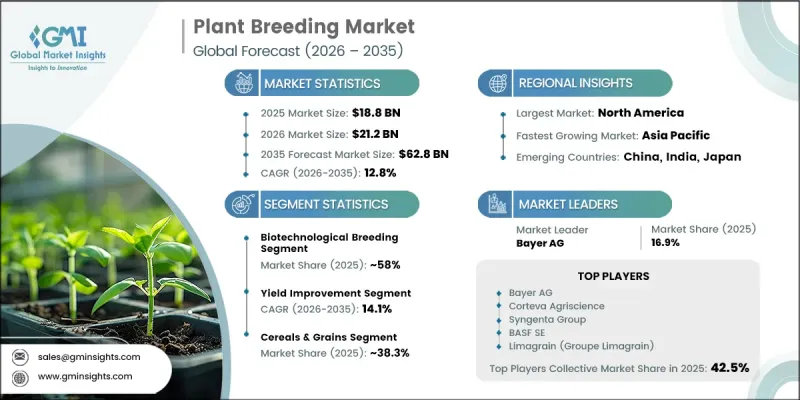
높은 수확량, 기후 변화에 강하고 영양가가 높은 작물 품종에 대한 세계 수요 증가로 인해 이 산업은 강력한 성장세를 보이고 있습니다. 인구 증가, 기후 변화, 경작지 부족으로 인한 농업 시스템에 대한 압력이 증가함에 따라 첨단 작물 개량 솔루션의 필요성이 증가하고 있습니다. 전통적인 육종 기술은 그 신뢰성과 비용적 우위로 인해 여전히 중요한 역할을 하고 있지만, 현대의 생명공학을 통한 방법은 높은 정확도와 개발 주기의 단축으로 인해 큰 추진력을 얻고 있습니다. 유기농, 기능성 식품, 고품질 식품에 대한 소비자 선호도가 높아지면서 농업 부문 전반의 육종 우선순위에 영향을 미치고 있습니다. 전 세계 정부 및 농업 관련 기관들은 작물 유전학 분야의 혁신과 생산성 향상을 촉진하는 연구 이니셔티브와 자금 지원 프로그램을 지원하고 있습니다. 또한, 데이터 기반 분석, 원격 감지 기술, 고급 표현형 분석 시스템 등의 디지털 농업 도구는 정확성, 효율성, 확장성을 향상시킴으로써 육종 프로세스를 혁신하고 있습니다. 이러한 기술적 진보를 통해 육종가들은 해충 저항성, 생산성 향상, 환경 스트레스에 대한 내성을 강화한 작물 품종을 개발할 수 있게 되었으며, 궁극적으로 진화하는 식량 안보의 요구에 맞추어 전 세계 식물 육종 상황을 재편할 수 있게 되었습니다.
| 시장 범위 | |
|---|---|
| 개시 연도 | 2025년 |
| 예측 기간 | 2026-2035년 |
| 개시 연도 시장 규모 | 188억 달러 |
| 예측 시장 규모 | 628억 달러 |
| CAGR | 12.8% |
농업 이해관계자들이 작물 생산성 향상과 장기적인 식량 안보 확보에 점점 더 집중하면서 식물 육종 산업은 빠르게 발전하고 있습니다. 유전학 연구와 분자생물학의 발전으로 보다 정밀한 육종 성과가 가능해져 개량 품종 개발이 가속화되고 있습니다. 농업 연구에 디지털 기술을 통합하여 의사결정 능력을 더욱 향상시키고, 보다 정밀한 형질 선별을 가능하게 하고 있습니다. 또한, 연구기관, 농업기업, 기술 제공업체 간의 협력 강화도 이 산업에 긍정적인 영향을 미치고 있습니다. 지속 가능한 농업 관행과 기후 변화에 강한 농업에 대한 투자 확대는 작물 개량 전략의 혁신을 더욱 촉진하고 있습니다. 그 결과, 전 세계 농업 시장에서 식물 육종은 데이터 기반, 기술 활용, 효율성 중심으로 변화하고 있습니다.
생명공학 육종 부문은 2025년 58%의 점유율을 차지했으며, 2035년까지 연평균 14.6%의 성장률을 보일 것으로 전망됩니다. 이 부문은 첨단 유전공학 기술과 분자 선발 툴을 통해 정확하고 효율적인 형질 개발을 실현할 수 있어 지속적으로 선도적인 위치를 유지하고 있습니다. 생명공학을 통한 접근으로 해충 저항성 강화, 수확량 향상, 환경 스트레스에 대한 적응력을 높인 작물 개발이 가속화되고 있습니다. 유전체 기반 기술과 분자 육종 도구의 채택 확대는 이 부문의 우위를 더욱 강화시키고 있습니다. 특정 기후 및 토양 조건에 맞는 고성능 작물 품종에 대한 수요 증가도 이 고급 육종 카테고리의 지속적인 확장을 뒷받침하고 있습니다.
직접 판매 채널은 2025년 40%의 점유율을 차지했으며, 2035년까지 연평균 복합 성장률(CAGR) 11.6%를 나타낼 것으로 예측됩니다. 이러한 유통 방식은 개량된 종자 품종과 육종 솔루션을 대규모 농업 생산자 및 상업적 농업 사업자에게 직접 제공하는 데 중요한 역할을 하고 있습니다. 직접 참여함으로써 기업은 특정 작물의 요구 사항에 따라 개별적인 농업 지원, 기술 자문 서비스, 맞춤형 제품 솔루션을 제공할 수 있습니다. 효율적인 공급망 관리에 대한 수요 증가와 농업 종사자와 제조업체와의 관계 강화는 이 유통 모델을 더욱 강화시키고 있습니다. 또한, 이 채널은 피드백의 통합을 촉진하고, 기업이 실제 농업 환경을 기반으로 육종 프로그램을 개선하고 제품 성능을 향상시킬 수 있도록 합니다.
북미의 식물 육종 시장은 2025년 64억 달러 규모에 달했습니다. 이 지역의 선도적 지위는 유전자 편집 기술, 분자 육종 시스템, 정밀 농업 도구와 같은 첨단 농업 기술이 광범위하게 채택되고 있기 때문입니다. 탄탄한 연구 인프라, 농업 혁신에 대한 막대한 투자, 주요 종자 기업의 존재는 시장 확대를 더욱 촉진하고 있습니다. 지속 가능한 농업 관행과 기후 변화에 강한 작물 개발에 대한 관심이 높아진 것도 지역 성장에 기여하고 있습니다. 또한, 공공 연구 기관과 민간 농업 기업 간의 협력으로 작물 개량에 대한 혁신이 가속화되고 있으며, 세계 식물 육종 부문에서 북미의 입지가 강화되고 있습니다.
자주 묻는 질문
목차
제1장 조사 방법 및 범위
제2장 주요 요약
제3장 산업 인사이트
제4장 경쟁 구도
제5장 시장 추정 및 예측 : 유형별(2022-2035년)
제6장 시장 추정 및 예측 : 특성별(2022-2035년)
제7장 시장 추정 및 예측 : 용도별(2022-2035년)
제8장 시장 추정 및 예측 : 유통 채널별(2022-2035년)
제9장 시장 추정 및 예측 : 지역별(2022-2035년)
제10장 기업 개요
AJY 26.06.15The Global Plant Breeding Market was valued at USD 18.8 billion in 2025 and is estimated to grow at a CAGR of 12.8% to reach USD 62.8 billion by 2035.
The industry is experiencing robust growth due to increasing global demand for high-yielding, climate-resilient, and nutritionally enhanced crop varieties. Growing pressure on agricultural systems from population expansion, climate variability, and limited arable land is pushing the need for advanced crop improvement solutions. Traditional breeding techniques continue to play a key role due to their reliability and cost advantages, while modern biotechnology-based methods are gaining strong momentum for their precision and faster development cycles. Increasing consumer preference for organic, functional, and high-quality food products is further influencing breeding priorities across the agricultural sector. Governments and agricultural organizations worldwide are supporting research initiatives and funding programs that encourage innovation in crop genetics and productivity enhancement. In addition, digital agriculture tools such as data-driven analytics, remote sensing technologies, and advanced phenotyping systems are transforming breeding processes by improving accuracy, efficiency, and scalability. These technological advancements are enabling breeders to develop crop varieties with improved pest resistance, higher productivity, and enhanced tolerance to environmental stress, ultimately reshaping the global plant breeding landscape in line with evolving food security needs.
| Market Scope | |
|---|---|
| Start Year | 2025 |
| Forecast Year | 2026-2035 |
| Start Value | $18.8 Billion |
| Forecast Value | $62.8 Billion |
| CAGR | 12.8% |
The plant breeding industry is evolving rapidly as agricultural stakeholders increasingly focus on improving crop performance and ensuring long-term food security. Advancements in genetic research and molecular biology are enabling more targeted breeding outcomes and accelerating the development of improved plant varieties. Integration of digital technologies into agricultural research is further enhancing decision-making capabilities and enabling more precise trait selection. The industry is also benefiting from rising collaboration between research institutions, agricultural companies, and technology providers. Increasing investment in sustainable farming practices and climate-resilient agriculture is further driving innovation in crop improvement strategies. As a result, plant breeding is becoming more data-driven, technology-enabled, and efficiency-focused across global agricultural markets.
The biotechnological breeding segment accounted for 58% share in 2025 and is projected to grow at a CAGR of 14.6% through 2035. This segment continues to lead due to its ability to deliver precise and efficient trait development using advanced genetic engineering techniques and molecular selection tools. Biotechnological approaches enable faster development of crops with enhanced resistance to pests, improved yield performance, and better adaptation to environmental stresses. Increasing adoption of genome-based technologies and molecular breeding tools is further strengthening the dominance of this segment. Growing demand for high-performance crop varieties tailored to specific climatic and soil conditions is also supporting continued expansion within this advanced breeding category.
The direct sales channel held 40% share in 2025 and is expected to grow at a CAGR of 11.6% through 2035. This distribution approach plays a key role in delivering improved seed varieties and breeding solutions directly to large-scale agricultural producers and commercial farming operations. Direct engagement allows companies to provide tailored agronomic support, technical advisory services, and customized product solutions based on specific crop requirements. Increasing demand for efficient supply chain management and stronger farmer-manufacturer relationships is further strengthening this distribution model. The channel also supports better feedback integration, enabling companies to refine breeding programs and improve product performance based on real-world agricultural conditions.
North America Plant Breeding Market captured USD 6.4 billion in 2025. The region's leadership is supported by widespread adoption of advanced agricultural technologies, including gene editing techniques, molecular breeding systems, and precision agriculture tools. Strong research infrastructure, high investment in agricultural innovation, and the presence of leading seed companies are further driving market expansion. Increasing focus on sustainable farming practices and climate-resilient crop development is also contributing to regional growth. Additionally, collaboration between public research institutions and private agricultural firms is accelerating innovation in crop improvement and strengthening North America's position in the global plant breeding landscape.
Key companies operating in the Global Plant Breeding Market include BASF SE, Bayer AG, Corteva Agriscience, Syngenta Group, Limagrain, KWS SAAT SE & Co. KGaA, Bejo Zaden B.V., Rijk Zwaan, Enza Zaden, Sakata Seed Corporation, Takii & Co., Ltd., DLF Seeds A/S, Advanta Seeds, Nuseed, and Pairwise Plants. Companies operating in the plant breeding market are adopting multiple strategic initiatives to strengthen their market position and expand global reach. Leading players are heavily investing in advanced biotechnology research, genome editing platforms, and molecular breeding technologies to accelerate trait development and improve crop performance. Strategic collaborations with agricultural research institutions, universities, and agri-tech firms are helping companies enhance innovation capabilities and speed up product commercialization. Many organizations are also expanding their breeding programs to develop climate-resilient, high-yield, and nutrient-enriched crop varieties tailored to regional agricultural needs. In addition, companies are integrating digital agriculture tools such as data analytics and precision phenotyping to improve breeding accuracy and efficiency.
Table of Contents
Chapter 1 Methodology & Scope
- 1.1 Market scope and definition
- 1.2 Research design
- 1.2.1 Research approach
- 1.2.2 Data collection methods
- 1.3 Data mining sources
- 1.3.1 Global
- 1.3.2 Regional/Country
- 1.4 Base estimates and calculations
- 1.4.1 Base year calculation
- 1.4.2 Key trends for market estimation
- 1.5 Primary research and validation
- 1.5.1 Primary sources
- 1.6 Forecast model
- 1.7 Research assumptions and limitations
Chapter 2 Executive Summary
- 2.1 Industry 360° synopsis
- 2.2 Key market trends
- 2.2.1 Regional
- 2.2.2 Type
- 2.2.3 Trait
- 2.2.4 Application
- 2.2.5 Distribution channel
- 2.3 TAM Analysis, 2026-2035
- 2.4 CXO perspectives: Strategic imperatives
- 2.4.1 Executive decision points
Chapter 3 Industry Insights
- 3.1 Industry ecosystem analysis
- 3.1.1 Supplier landscape
- 3.1.2 Profit margin
- 3.1.3 Value addition at each stage
- 3.1.4 Factor affecting the value chain
- 3.1.5 Disruptions
- 3.2 Industry impact forces
- 3.2.1 Growth drivers
- 3.2.2 Industry pitfalls and challenges
- 3.2.3 Market opportunities
- 3.3 Growth potential analysis
- 3.4 Regulatory landscape
- 3.4.1 North America
- 3.4.2 Europe
- 3.4.3 Asia Pacific
- 3.4.4 Latin America
- 3.4.5 Middle East & Africa
- 3.5 Porter's analysis
- 3.6 PESTEL analysis
- 3.7 Price trends
- 3.7.1 By region
- 3.7.2 By type
- 3.8 Future market trends
- 3.9 Technology and Innovation landscape
- 3.9.1 Current technological trends
- 3.9.2 Emerging technologies
- 3.10 Patent Landscape
- 3.11 Trade statistics (HS code)
- 3.11.1 Major importing countries
- 3.11.2 Major exporting countries
- 3.12 Sustainability and environmental aspects
- 3.12.1 Sustainable practices
- 3.12.2 Waste reduction strategies
- 3.12.3 Energy efficiency in production
- 3.12.4 Eco-friendly initiatives
- 3.13 Carbon footprint consideration
Chapter 4 Competitive Landscape, 2025
- 4.1 Introduction
- 4.2 Company market share analysis
- 4.2.1 By region
- 4.2.1.1 North America
- 4.2.1.2 Europe
- 4.2.1.3 Asia Pacific
- 4.2.1.4 LATAM
- 4.2.1.5 MEA
- 4.2.1 By region
- 4.3 Company matrix analysis
- 4.4 Competitive analysis of major market players
- 4.5 Competitive positioning matrix
- 4.6 Key developments
- 4.6.1 Mergers & acquisitions
- 4.6.2 Partnerships & collaborations
- 4.6.3 New Product Launches
- 4.6.4 Expansion Plans
Chapter 5 Market Estimates and Forecast, By Type, 2022-2035 (USD Billion) (Kilo Tons)
- 5.1 Key trends
- 5.2 Traditional breeding
- 5.2.1 Mass selection
- 5.2.2 Pure line selection
- 5.2.3 Pedigree breeding
- 5.2.4 Backcross breeding
- 5.3 Biotechnological breeding
- 5.3.1 Genetic engineering
- 5.3.2 Genome editing
- 5.3.3 Hybrid breeding (biotech-assisted)
Chapter 6 Market Estimates and Forecast, By Trait, 2022-2035 (USD Billion) (Kilo Tons)
- 6.1 Key trends
- 6.2 Yield improvement
- 6.3 Herbicide tolerance
- 6.4 Disease resistance
- 6.5 Insect resistance
- 6.6 Abiotic stress
- 6.7 Nutritional enhancement
- 6.8 Others
Chapter 7 Market Estimates and Forecast, By Application, 2022-2035 (USD Billion) (Kilo Tons)
- 7.1 Key trends
- 7.2 Cereals & grains
- 7.2.1 Maize (corn)
- 7.2.2 Wheat
- 7.2.3 Rice
- 7.2.4 Barley
- 7.2.5 Sorghum
- 7.2.6 Millet
- 7.2.7 Oats
- 7.2.8 Rye
- 7.2.9 Others
- 7.3 Oilseeds & pulses
- 7.3.1 Soybean
- 7.3.2 Canola (rapeseed)
- 7.3.3 Sunflower
- 7.3.4 Peas
- 7.3.5 Lentils
- 7.3.6 Chickpeas
- 7.3.7 Cotton
- 7.3.8 Peanuts (groundnuts)
- 7.3.9 Others
- 7.4 Fruits & vegetables
- 7.4.1 Tomato
- 7.4.2 Potato
- 7.4.3 Lettuce
- 7.4.4 Cabbage
- 7.4.5 Strawberry
- 7.4.6 Cucumber
- 7.4.7 Pepper (bell & hot)
- 7.4.8 Onion
- 7.4.9 Carrot
- 7.4.10 Melon & watermelon
- 7.4.11 Others
- 7.5 Others
Chapter 8 Market Estimates and Forecast, By Distribution Channel, 2022-2035 (USD Billion) (Kilo Tons)
- 8.1 Key trends
- 8.2 Direct sales
- 8.3 Indirect sales
- 8.4 Licensing & tech transfer
- 8.5 E-commerce & digital
Chapter 9 Market Estimates and Forecast, By Region, 2022-2035 (USD Billion) (Kilo Tons)
- 9.1 Key trends
- 9.2 North America
- 9.2.1 U.S.
- 9.2.2 Canada
- 9.3 Europe
- 9.3.1 Germany
- 9.3.2 UK
- 9.3.3 France
- 9.3.4 Spain
- 9.3.5 Italy
- 9.3.6 Rest of Europe
- 9.4 Asia Pacific
- 9.4.1 China
- 9.4.2 India
- 9.4.3 Japan
- 9.4.4 Australia
- 9.4.5 South Korea
- 9.4.6 Rest of Asia Pacific
- 9.5 Latin America
- 9.5.1 Brazil
- 9.5.2 Mexico
- 9.5.3 Argentina
- 9.5.4 Rest of Latin America
- 9.6 Middle East and Africa
- 9.6.1 Saudi Arabia
- 9.6.2 South Africa
- 9.6.3 UAE
- 9.6.4 Rest of Middle East and Africa
Chapter 10 Company Profiles
- 10.1 Bayer AG
- 10.2 Corteva Agriscience
- 10.3 Syngenta Group
- 10.4 BASF SE
- 10.5 Limagrain (Groupe Limagrain)
- 10.6 KWS SAAT SE & Co. KGaA
- 10.7 Bejo Zaden B.V.
- 10.8 Rijk Zwaan Zaadteelt en Zaadhandel B.V.
- 10.9 Enza Zaden
- 10.10 Sakata Seed Corporation
- 10.11 Takii & Co., Ltd.
- 10.12 DLF Seeds A/S
- 10.13 Advanta Seeds (UPL Limited)
- 10.14 Nuseed (Nufarm)
- 10.15 Pairwise Plants