
|
시장보고서
상품코드
2045853
화학적 공기 분리 유닛 시장 : 시장 기회, 성장요인, 업계 동향 분석 및 예측(2026-2035년)Chemical Air Separation Unit Market Opportunity, Growth Drivers, Industry Trend Analysis, and Forecast 2026 - 2035 |
||||||

세계의 화학적 공기 분리 유닛 시장은 2025년에 57억 달러로 평가되었고, CAGR 4.1%로 성장할 전망이며, 2035년까지 85억 달러에 이를 것으로 추정되고 있습니다.
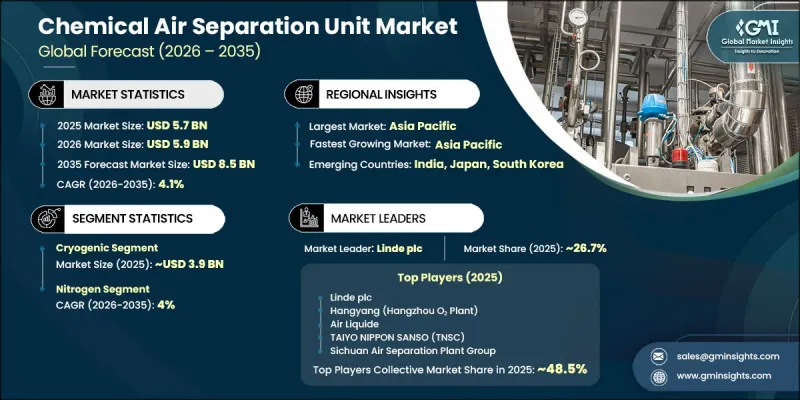
화학적 공기 분리 유닛 산업의 성장은 운영 효율성 향상, 에너지 소비 감소, 생산량 증가를 위해 산소가 풍부한 산업 공정의 채택이 확대됨에 따라 주도되고 있습니다. 화학 제조, 철강 가공, 폐수 처리와 관련된 산업은 성능을 최적화하고 총 운영 비용을 절감하기 위해 산소 기반 기술을 점점 더 많이 도입하고 있습니다. 공기 분리 유닛은 산소, 질소, 아르곤 등 이러한 용도에 필요한 고순도 산업용 가스를 공급하는 데 중요한 역할을 하고 있습니다. 공정 최적화 및 비용 효율적인 가스 생산 기술에 대한 업계의 관심이 높아지면서 시장 수요가 더욱 증가하고 있습니다. 또한, 제조, 정제 및 가공 산업 전반에 걸쳐 신뢰할 수 있는 산업용 가스 공급에 대한 수요가 증가함에 따라 고급 공기 분리 시스템에 대한 투자가 증가하고 있습니다. 에너지 효율, 확장성, 연속 가스 생산 능력에 초점을 맞춘 기술 발전도 시장 확대를 뒷받침하고 있습니다. 산업 인프라의 현대화와 자동화 제조 공정의 도입이 증가함에 따라 예측 기간 동안 세계 화학적 공기 분리 유닛 시장은 유리한 성장 기회를 창출할 것으로 예측됩니다.
| 시장 범위 | |
|---|---|
| 개시 연도 | 2025년 |
| 예측 기간 | 2026-2035년 |
| 개시 연도 시장 규모 | 57억 달러 |
| 예측 시장 규모 | 85억 달러 |
| CAGR | 4.1% |
극저온 분리 부문은 고순도 산업용 가스를 대량으로 생산할 수 있는 능력으로 인해 화학적 공기 분리 유닛 시장에서 선두를 지키고 있습니다. 이 기술은 대기를 극저온으로 냉각시켜 분리하고, 각 가스의 끓는점에 따라 액화 및 분리를 가능하게 합니다. 극저온 공기 분리 시스템은 화학, 에너지, 정유, 제조 등 산업에서 산업용 가스의 지속적이고 안정적인 공급이 필요한 분야에 널리 사용되고 있습니다. 이러한 시스템은 운영 효율성, 확장성, 연속 생산 환경에서의 신뢰성 때문에 대규모 산업 환경에서 특히 선호되고 있습니다. 대용량 가스 발생 시스템에 대한 산업 수요 증가는 극저온 공기 분리 장치 부문의 추가 확장을 촉진할 것으로 예측됩니다.
2025년 극저온 부문 시장 규모는 39억 달러에 달했으며, 2026-2035년 연평균 복합 성장률(CAGR) 3.4%로 성장할 것으로 전망됩니다. 극저온 기술의 채택이 확대되고 있는 주요 원인은 고순도의 산소, 질소, 아르곤을 대량으로 생산할 수 있는 능력에 있습니다. 대량 생산 환경에서 운영되는 산업에서는 중요한 업무에 안정적이고 효율적인 가스 공급을 보장하기 위해 극저온 공기분리장치에 대한 의존도가 높아지고 있습니다. 산업 현대화 및 공정 효율성 향상을 위한 투자 증가는 전 세계적으로 극저온 공기분리 시스템에 대한 수요를 지속적으로 견인할 것으로 예측됩니다.
질소 부문은 2025년 37.6%의 점유율을 차지했으며, 2026-2035년 연평균 4%의 성장률을 보일 것으로 전망됩니다. 불활성화, 퍼지, 냉각, 블랭킷 처리 등 다양한 산업 용도 분야에서 질소 수요가 지속적으로 증가하고 있습니다. 비반응성이라는 특성으로 인해 질소는 제조 및 가공 활동에서 운영의 안전성을 유지하고 오염을 방지하는 데 필수적인 요소로 작용하고 있습니다. 화학, 제약, 식품 가공, 전자제품 등의 산업은 질소 기반 산업용 가스 솔루션에 대한 견고한 수요를 지속적으로 견인하고 있습니다. 산업 생산의 확대와 안전하고 통제된 제조 환경에 대한 의존도가 높아짐에 따라 향후 몇 년 동안 질소 부문의 성장이 더욱 가속화될 것으로 예측됩니다.
중국의 화학적 공기 분리 유닛 시장은 2025년에 13억 달러 규모에 달했으며, 2026-2035년 동안 연평균 4.5%의 성장률을 보일 것으로 예측됩니다. 이 나라의 강력한 시장 성장은 광범위한 산업 생산 기반과 다양한 분야에서 산업용 가스에 대한 수요 증가로 뒷받침되고 있습니다. 화학 처리, 전자제품 제조, 대규모 산업 생산, 에너지 관련 사업은 이 지역 전체에서 첨단 공기 분리 기술 도입을 계속 주도하고 있습니다. 산업 현대화, 에너지 효율성, 환경 지속가능성에 초점을 맞춘 정부의 이니셔티브도 고성능 공기분리 시스템 도입 확대에 힘을 실어주고 있습니다. 국내 제조업체들은 대규모 산업용으로 설계된 비용 효율적인 대용량 솔루션을 제공함으로써 시장에서 확고한 입지를 유지하고 있습니다.
자주 묻는 질문
목차
제1장 조사 방법과 범위
제2장 주요 요약
제3장 산업 인사이트
제4장 경쟁 구도
제5장 시장 추정 및 예측 : 기술별(2022-2035년)
제6장 시장 추정 및 예측 : 가스 유형별(2022-2035년)
제7장 시장 추정 및 예측 : 공급 형태별(2022-2035년)
제8장 시장 추정 및 예측 : 최종 이용 산업별(2022-2035년)
제9장 시장 추정 및 예측 : 지역별(2022-2035년)
제10장 기업 개요
AJY 26.06.15The Global Chemical Air Separation Unit Market was valued at USD 5.7 billion in 2025 and is estimated to grow at a CAGR of 4.1% to reach USD 8.5 billion by 2035.
Growth across the chemical air separation unit industry is driven by increasing adoption of oxygen-enriched industrial processes aimed at improving operational efficiency, reducing energy consumption, and increasing production output. Industries involved in chemical manufacturing, steel processing, and wastewater treatment are increasingly integrating oxygen-based technologies to optimize performance and lower overall operating expenses. Air separation units play a critical role in supplying high-purity industrial gases required for these applications, including oxygen, nitrogen, and argon. Rising industrial focus on process optimization and cost-effective gas production technologies is further strengthening market demand. In addition, the growing requirement for reliable industrial gas supply across manufacturing, refining, and processing industries is encouraging investments in advanced air separation systems. Technological advancements focused on energy efficiency, scalability, and continuous gas production capabilities are also supporting market expansion. The increasing modernization of industrial infrastructure and rising adoption of automated manufacturing processes are expected to create favorable growth opportunities for the global chemical air separation unit market throughout the forecast period.
| Market Scope | |
|---|---|
| Start Year | 2025 |
| Forecast Year | 2026-2035 |
| Start Value | $5.7 Billion |
| Forecast Value | $8.5 Billion |
| CAGR | 4.1% |
The cryogenic segment continues to dominate the chemical air separation unit market due to its ability to generate high-purity industrial gases at large production volumes. This technology separates atmospheric air by cooling it to extremely low temperatures, allowing different gases to be liquefied and separated according to their boiling points. Cryogenic air separation systems are widely used across industries that require a continuous and dependable supply of industrial gases, including chemicals, energy, refining, and manufacturing operations. These systems are highly preferred for large-scale industrial environments because of their operational efficiency, scalability, and reliability in continuous production settings. Growing industrial demand for high-capacity gas generation systems is expected to further support the expansion of the cryogenic air separation unit segment.
In 2025, the cryogenic segment generated USD 3.9 billion and is projected to grow at a CAGR of 3.4% from 2026 to 2035. Strong adoption of cryogenic technology is primarily attributed to its capability to produce oxygen, nitrogen, and argon in large quantities with high purity levels. Industries operating in high-volume production environments increasingly rely on cryogenic air separation units to ensure stable and efficient gas supply for critical operations. Rising investments in industrial modernization and process efficiency improvements are expected to continue driving demand for cryogenic air separation systems globally.
The nitrogen segment accounted for 37.6% share in 2025 and is anticipated to grow at a CAGR of 4% during 2026-2035. Demand for nitrogen continues to increase because of its extensive use in industrial applications involving inerting, purging, cooling, and blanketing processes. Its non-reactive properties make nitrogen essential for maintaining operational safety and preventing contamination during manufacturing and processing activities. Industries including chemicals, pharmaceuticals, food processing, and electronics continue to drive strong demand for nitrogen-based industrial gas solutions. Expanding industrial production and increasing reliance on safe and controlled manufacturing environments are expected to support further growth of the nitrogen segment over the coming years.
China Chemical Air Separation Unit Market generated USD 1.3 billion in 2025 and is expected to grow at a CAGR of 4.5% from 2026 to 2035. Strong market growth in the country is supported by its extensive industrial manufacturing base and rising demand for industrial gases across multiple sectors. Chemical processing, electronics manufacturing, large-scale industrial production, and energy-related operations continue to drive adoption of advanced air separation technologies throughout the region. Government initiatives focused on industrial modernization, energy efficiency, and environmental sustainability are also encouraging increased deployment of high-performance air separation systems. Domestic manufacturers maintain a strong market presence by offering cost-efficient and high-capacity solutions designed for large industrial applications.
Major companies operating in the Global Chemical Air Separation Unit Market include Air Liquide, Linde plc, Air Products and Chemicals, Inc., Messer Group, TAIYO NIPPON SANSO CORPORATION, AIR WATER INC, and Hangzhou Oxygen Plant Group Co., Ltd. Additional regional players active in the industry include Yingde Gases, Sichuan Air Separation Plant Group, KaiFeng Air Separation Group Co., LTD., INOX Air Products, SIAD Macchine Impianti, Air Water Plant & Engineering Inc., and Cryogenmash. Emerging and specialized participants operating in the market include Nikkiso Clean Energy & Industrial Gases Group, AMCS Corporation, Universal Industrial Gases, Inc., Technex Limited, Ranch Cryogenics, Inc., Atlas Copco Gas and Process, and Sumitomo Seika Chemicals Co., Ltd. Companies operating in the Chemical Air Separation Unit Industry are implementing several strategic initiatives to strengthen their market position and expand global presence. Leading manufacturers are investing heavily in research and development activities to improve energy efficiency, operational reliability, and gas production capacity of air separation systems. Many companies are also focusing on technological advancements in cryogenic and non-cryogenic separation processes to enhance system performance and reduce operating costs. Strategic partnerships, acquisitions, and regional expansion projects are helping businesses strengthen distribution networks and improve access to emerging industrial markets. In addition, manufacturers are increasingly offering customized air separation solutions tailored to specific industrial requirements.
Table of Contents
Chapter 1 Methodology & Scope
- 1.1 Market scope and definition
- 1.2 Research design
- 1.2.1 Research approach
- 1.2.2 Data collection methods
- 1.3 Data mining sources
- 1.3.1 Global
- 1.3.2 Regional/Country
- 1.4 Base estimates and calculations
- 1.4.1 Base year calculation
- 1.4.2 Key trends for market estimation
- 1.5 Primary research and validation
- 1.5.1 Primary sources
- 1.6 Forecast model
- 1.7 Research assumptions and limitations
Chapter 2 Executive Summary
- 2.1 Industry 360° synopsis
- 2.2 Key market trends
- 2.2.1 Regional
- 2.2.2 Technology
- 2.2.3 Gas Type
- 2.2.4 Supply Mode
- 2.2.5 End-Use Industry
Chapter 3 Industry Insights
- 3.1 Industry ecosystem analysis
- 3.1.1 Supplier landscape
- 3.1.2 Profit margin
- 3.1.3 Value addition at each stage
- 3.1.4 Factor affecting the value chain
- 3.2 Industry impact forces
- 3.2.1 Growth drivers
- 3.2.1.1 Rising demand for industrial gases such as oxygen, nitrogen, and argon in chemical processes
- 3.2.1.2 Increasing adoption of oxygen-enriched processes for efficiency improvement
- 3.2.1.3 Expansion of healthcare and pharmaceutical sectors requiring medical-grade gases
- 3.2.2 Pitfalls & Challenges
- 3.2.2.1 High capital investment and installation costs
- 3.2.2.2 High energy consumption during air separation processes
- 3.2.3 Opportunities
- 3.2.3.1 Growing demand for green hydrogen and clean energy production
- 3.2.3.2 Rising industrial gas outsourcing and on-site gas generation trends
- 3.2.1 Growth drivers
- 3.3 Growth potential analysis
- 3.4 Future market trends
- 3.5 Technology and innovation landscape
- 3.5.1 Current technological trends
- 3.5.2 Emerging technologies
- 3.6 Regulatory landscape
- 3.6.1 Standards and compliance requirements
- 3.6.2 Regional regulatory frameworks
- 3.6.3 Certification standards
- 3.7 Porter's analysis
- 3.8 PESTEL analysis
- 3.9 Pricing analysis (driven by primary research)
- 3.9.1 Historical price trend analysis (driven by primary research)
- 3.9.2 Pricing strategy by player type (tier 1 OEMs vs regional manufacturers) (driven by primary research)
- 3.9.3 Regional price variations and influencing factors
- 3.9.4 Total cost of ownership (TCO) benchmarking
- 3.10 Trade data analysis (driven by paid database)
- 3.10.1 Import/export volume and value trends by key markets (driven by paid database)
- 3.10.2 Key trade corridors and tariff impact (driven by paid database)
- 3.10.3 Trade flow analysis (cryogenic vs non-cryogenic equipment)
- 3.10.4 Intra-regional vs inter-regional trade patterns
- 3.11 Impact of AI and generative AI on the market
- 3.11.1 AI-driven disruption of ASU operations and maintenance
- 3.11.2 GenAI use cases and adoption roadmap (predictive maintenance, process optimization)
- 3.11.3 AI-enabled energy management systems
- 3.11.4 Risks, limitations and data security considerations
- 3.12 Capacity and production landscape (driven by primary research)
- 3.12.1 Installed ASU capacity by region and key producer (driven by primary research)
- 3.12.2 Capacity utilization rates and expansion pipelines (driven by primary research)
- 3.12.3 Greenfield vs brownfield project activity
- 3.12.4 Capacity concentration analysis (top 10 producers)
Chapter 4 Competitive Landscape, 2025
- 4.1 Introduction
- 4.2 Company market share analysis
- 4.2.1 By Region
- 4.2.1.1 North America
- 4.2.1.2 Europe
- 4.2.1.3 Asia Pacific
- 4.2.1.4 Latin America
- 4.2.1.5 Middle East & Africa
- 4.2.1 By Region
- 4.3 Company matrix analysis
- 4.4 Competitive analysis of major market players
- 4.5 Competitive positioning matrix
- 4.6 Key developments
- 4.6.1 Mergers & acquisitions
- 4.6.2 Partnerships & collaborations
- 4.6.3 New product launches
- 4.6.4 Expansion plans
Chapter 5 Market Estimates & Forecast, By Technology, 2022 - 2035, (USD Billion) (Thousand Units)
- 5.1 Key trends
- 5.2 Cryogenic
- 5.3 Non-Cryogenic
Chapter 6 Market Estimates & Forecast, By Gas Type, 2022 - 2035, (USD Billion) (Thousand Units)
- 6.1 Key trends
- 6.2 Oxygen
- 6.3 Nitrogen
- 6.4 Argon
- 6.5 Others
Chapter 7 Market Estimates & Forecast, By Supply Mode, 2022 - 2035, (USD Billion) (Thousand Units)
- 7.1 Key trends
- 7.2 On-Site
- 7.3 Merchant
- 7.4 Pipeline
- 7.5 Cylinder
Chapter 8 Market Estimates & Forecast, By End-Use Industry, 2022 - 2035, (USD Billion) (Thousand Units)
- 8.1 Key trends
- 8.2 Iron & Steel
- 8.3 Chemical & Petrochem
- 8.4 Oil & Gas
- 8.5 Healthcare
- 8.6 Electronics/Semi
- 8.7 Food & Beverage
- 8.8 Glass & Metal Fab
- 8.9 Others
Chapter 9 Market Estimates & Forecast, By Region, 2022 - 2035, (USD Billion) (Thousand Units)
- 9.1 Key trends
- 9.2 North America
- 9.2.1 U.S.
- 9.2.2 Canada
- 9.3 Europe
- 9.3.1 Germany
- 9.3.2 UK
- 9.3.3 France
- 9.3.4 Italy
- 9.3.5 Spain
- 9.4 Asia Pacific
- 9.4.1 China
- 9.4.2 India
- 9.4.3 Japan
- 9.4.4 South Korea
- 9.4.5 Australia
- 9.5 Latin America
- 9.5.1 Brazil
- 9.5.2 Mexico
- 9.5.3 Argentina
- 9.6 MEA
- 9.6.1 Saudi Arabia
- 9.6.2 UAE
- 9.6.3 South Africa
Chapter 10 Company Profiles
- 10.1 Top Global Players
- 10.1.1 Air Liquide
- 10.1.2 Linde plc
- 10.1.3 Air Products and Chemicals, Inc.
- 10.1.4 Messer Group
- 10.1.5 TAIYO NIPPON SANSO CORPORATION
- 10.1.6 AIR WATER INC
- 10.1.7 Hangzhou Oxygen Plant Group Co., Ltd.
- 10.2 Regional Champions
- 10.2.1 Yingde Gases
- 10.2.2 Sichuan Air Separation Plant Group
- 10.2.3 KaiFeng Air Separation Group Co., LTD.
- 10.2.4 INOX Air Products
- 10.2.5 SIAD Macchine Impianti
- 10.2.6 Air Water Plant & Engineering Inc.
- 10.2.7 Cryogenmash
- 10.3 Emerging & Specialized Players
- 10.3.1 Nikkiso Clean Energy & Industrial Gases Group
- 10.3.2 AMCS Corporation
- 10.3.3 Universal Industrial Gases, Inc.
- 10.3.4 Technex Limited
- 10.3.5 Ranch Cryogenics, Inc.
- 10.3.6 Atlas Copco Gas and Process
- 10.3.7 Sumitomo Seika Chemicals Co., Ltd.

(주말 및 공휴일 제외)


