

|
시장보고서
상품코드
2061292
대드론 스웜 시스템 시장 기회, 성장요인, 업계 동향 분석 및 예측(2026-2035년)Counter-Drone Swarm Systems Market Opportunity, Growth Drivers, Industry Trend Analysis, and Forecast 2026 - 2035 |
||||||

세계의 대드론 스웜 시스템 시장은 2025년에 7억 8,500만 달러로 평가되며, 2035년까지 CAGR 11.5%로 성장하며, 23억 달러에 달할 것으로 추정되고 있습니다.
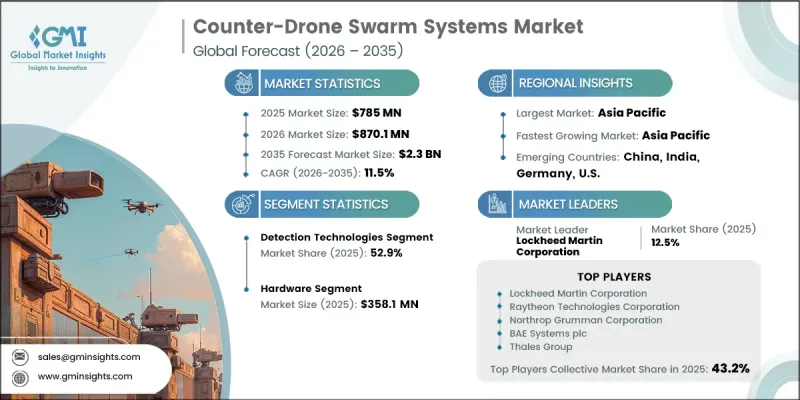
전 세계 드론 스웜 대응 시스템 산업의 성장은 고도화된 다중 드론에 의한 위협 환경의 증가, 비대칭 전쟁 시나리오에서 저비용 무인 항공 플랫폼의 도입 확대, 그리고 전략적 인프라 및 고가치 자산 보호에 대한 수요 증가에 힘입어 견인되고 있습니다. 정부 주도의 국방 현대화 구상 확대와 공역 보안 기술에 대한 투자 증가 역시 시장 발전을 가속화하고 있습니다. 또한 인공지능, 전자전 시스템, 센서 융합 기술, 자율적인 위협 탐지 능력의 지속적인 발전으로 인해 드론 대응 솔루션의 운영 효율이 크게 향상되고 있습니다. 방위 기관 및 치안 기관이 여러 공중 위협을 동시에 식별, 추적, 무력화할 수 있는 확장 가능한 시스템을 점점 더 우선시함에 따라 시장은 성장세를 보이고 있습니다. 기술의 발전으로 인해 응답 시간 단축, 상황 인식 능력 향상, 운용 신뢰성 제고가 가능해지면서, 군사, 국토 안보, 중요 인프라 보호 등 각 분야에서 광범위한 도입이 촉진되고 있습니다. 이처럼 진화하는 보안 요건으로 인해 드론 스웜 대응 시스템은 전 세계의 현대적인 방위 및 감시 체계에서 필수적인 요소로 자리매김하고 있습니다.
| 시장 범위 | |
|---|---|
| 시작연도 | 2025년 |
| 예측 기간 | 2026-2035년 |
| 개시 금액 | 7억 8,500만 달러 |
| 예측액 | 23억 달러 |
| CAGR | 11.5% |
전 세계 드론 스웜 대응 시스템 시장은 기존 방공 시스템에 대항하도록 설계된 협업형 무인 항공기를 활용한 위협이 증가함에 따라 강력한 성장세를 보이고 있습니다. 차세대 방위 프로그램에 대한 투자 증가와 진화하는 항공 위협 환경에 대응하기 위한 정부 자금 확대가 시장 성장을 더욱 지원하고 있습니다. 규제 체계의 강화와 조달 활동의 가속화로 인해 국방 및 보안 작전 전반에 걸쳐 첨단 대드론 기술의 도입이 가속화되고 있습니다. 동시에, 인공지능, 통합 센싱 시스템, 전자전 능력의 급속한 발전으로 인해 드론 대응 솔루션의 정확성, 확장성, 대응성이 향상되고 있습니다. 이러한 진전에 힘입어, 드론 스웜 대응 기술은 현대 보안 인프라 및 장기적인 국방 전략에서 중요한 요소로서의 위상을 확립해 가고 있습니다.
'위협 완화 기술' 부문은 2035년까지 연평균 성장률(CAGR) 13.1%를 기록할 것으로 예상됩니다. 점점 더 고도화되고 자율화되는 드론 스웜의 위협에 대응할 수 있는 능동적인 드론 무력화 시스템에 대한 수요가 증가함에 따라 이 부문의 성장이 주도되고 있습니다. 방해, 요격 및 공중 위협 제압에 중점을 둔 기술은 군사 및 보안 분야에서 빠르게 통합되고 있습니다. 중요 인프라 및 전략적 시설의 방어 능력 강화에 대한 관심이 높아짐에 따라 이 부문에서의 도입이 더욱 가속화되고 있습니다.
하드웨어 부문은 2025년에 3억 5,810만 달러를 차지했습니다. 시장에서의 주도적 지위는 주로 드론 떼의 위협을 식별하고 무력화하기 위해 설계된 첨단 탐지, 감시 및 요격 장비의 대규모 조달에 기인합니다. 방위 기관과 국토안보 기관은 즉각적인 작전 대응 및 위협 완화 능력을 제공하는 물리적 방위 자산을 계속해서 우선시하고 있습니다. 시스템 도입 및 인프라 통합과 관련된 막대한 투자 덕분에, 하드웨어는 업계 내에서 매출을 창출하는 주요 부문으로서의 위상을 유지하고 있습니다.
2025년, 북미의 드론 대응 시스템 시장은 31.4%의 점유율을 차지했습니다. 지역 시장의 확대는 국토 안보에 대한 우려가 커지고, 군사 시설 및 국가 영공 보호에 대한 관심이 높아지며, 무허가 드론 활동에 대한 인식이 개선됨에 따라 주도되고 있습니다. 또한 새로운 공중 위협으로부터 중요 인프라와 전략적으로 중요한 시설을 보호해야 할 필요성으로 인해 첨단 드론 대응 시스템에 대한 수요도 증가하고 있습니다. 첨단 감시 및 방어 기술에 대한 지속적인 투자가 해당 지역 전체에 걸쳐 드론 떼에 대응하는 솔루션의 꾸준한 도입을 지원하고 있습니다.
자주 묻는 질문
목차
제1장 조사 방법과 범위
제2장 개요
제3장 업계 인사이트
제4장 경쟁 구도
제5장 시장 추산·예측 : 기술 유형별, 2022-2035년
제6장 시장 추산·예측 : 컴포넌트/제품별, 2022-2035년
제7장 시장 추산·예측 : 도입 플랫폼별, 2022-2035년
제8장 시장 추산·예측 : 최종사용자별, 2022-2035년
제9장 시장 추산·예측 : 지역별, 2022-2035년
제10장 기업 개요
KSA 26.06.25The Global Counter-Drone Swarm Systems Market was valued at USD 785 million in 2025 and is estimated to grow at a CAGR of 11.5% to reach USD 2.3 billion by 2035.
Growth across the global counter-drone swarm systems industry is fueled by the increasing occurrence of sophisticated multi-drone threat environments, rising deployment of low-cost unmanned aerial platforms in asymmetric warfare scenarios, and the growing need to secure strategic infrastructure and high-value assets. Expanding government-backed defense modernization initiatives and rising investments in airspace security technologies are also accelerating market development. In addition, continuous progress in artificial intelligence, electronic warfare systems, sensor fusion technologies, and autonomous threat detection capabilities is significantly improving the operational effectiveness of counter-drone solutions. The market is gaining momentum as defense organizations and security agencies increasingly prioritize scalable systems capable of identifying, tracking, and neutralizing multiple airborne threats simultaneously. Technological advancements are enabling faster response times, enhanced situational awareness, and improved operational reliability, supporting broader deployment across military, homeland security, and critical infrastructure protection applications. These evolving security requirements are transforming counter-drone swarm systems into an essential component of modern defense and surveillance frameworks worldwide.
| Market Scope | |
|---|---|
| Start Year | 2025 |
| Forecast Year | 2026-2035 |
| Start Value | $785 Million |
| Forecast Value | $2.3 Billion |
| CAGR | 11.5% |
The global counter drone swarm systems market is witnessing strong growth due to the increasing use of coordinated unmanned aerial threats designed to challenge conventional air defense systems. Rising investments in next-generation defense programs and increasing government funding aimed at addressing evolving aerial threat environments are further supporting market expansion. Strengthening regulatory frameworks and accelerated procurement activities are contributing to faster deployment of advanced counter-drone technologies across defense and security operations. At the same time, rapid advancements in artificial intelligence, integrated sensing systems, and electronic warfare capabilities are improving the accuracy, scalability, and responsiveness of counter-drone solutions. These developments are positioning counter-drone swarm technologies as a critical element within modern security infrastructure and long-term defense strategies.
The mitigation technologies segment is expected to register a CAGR of 13.1% throughout 2035. Rising demand for active drone neutralization systems capable of addressing increasingly sophisticated and autonomous swarm threats is driving segment growth. Technologies focused on disruption, interception, and airborne threat suppression are witnessing rapid integration across military and security applications. Growing emphasis on strengthening protective capabilities for sensitive infrastructure and strategic facilities is further accelerating adoption within this segment.
The hardware segment accounted for USD 358.1 million in 2025. Market dominance is primarily attributed to large-scale procurement of advanced detection, monitoring, and interception equipment designed to identify and neutralize drone swarm threats. Defense agencies and homeland security organizations continue to prioritize physical defense assets that provide immediate operational response and threat mitigation capabilities. Significant investments associated with system deployment and infrastructure integration are maintaining hardware as the leading revenue-generating segment within the industry.
North America Counter-Drone Swarm Systems Market held a 31.4% share in 2025. Regional market expansion is being driven by rising homeland security concerns, increased focus on safeguarding military facilities and national airspace, and growing awareness regarding unauthorized drone activities. Demand for advanced counter-drone systems is also increasing due to the need to protect critical infrastructure and strategically important facilities from emerging aerial threats. Continuous investments in advanced surveillance and defense technologies are supporting steady deployment of counter-drone swarm solutions across the region.
Major companies operating in the Global Counter-Drone Swarm Systems Market include Lockheed Martin Corporation, Raytheon Technologies Corporation, Northrop Grumman Corporation, BAE Systems plc, Thales Group, Leonardo S.p.A., Israel Aerospace Industries (IAI), Elbit Systems Ltd., Saab AB, Rheinmetall AG, L3Harris Technologies, Inc., Anduril Industries, Inc., Dedrone Holdings, Inc., DroneShield Ltd., and Hensoldt AG. Companies active in the counter-drone swarm systems industry are focusing on technological innovation, strategic defense collaborations, and advanced product development to strengthen their market position. Industry participants are investing heavily in artificial intelligence-enabled threat detection, sensor fusion platforms, autonomous interception systems, and next-generation electronic warfare capabilities to improve operational performance and response accuracy. Many organizations are also expanding partnerships with defense agencies, security contractors, and government institutions to accelerate system deployment and broaden their market reach. Continuous investments in research and development are enabling companies to enhance scalability, real-time threat analysis, and integrated airspace security solutions.
Table of Contents
Chapter 1 Methodology and Scope
- 1.1 Market scope and definition
- 1.2 Research design
- 1.2.1 Research approach
- 1.2.2 Data collection methods
- 1.3 Data mining sources
- 1.3.1 Global
- 1.3.2 Regional/Country
- 1.4 Base estimates and calculations
- 1.4.1 Base year calculation
- 1.4.2 Key trends for market estimation
- 1.5 Primary research and validation
- 1.5.1 Primary sources
- 1.6 Forecast model
- 1.7 Research assumptions and limitations
Chapter 2 Executive Summary
- 2.1 Industry 360° synopsis, 2022 - 2035
- 2.2 Key market trends
- 2.2.1 Technology type trends
- 2.2.2 Component / offering trends
- 2.2.3 Deployment platform trends
- 2.2.4 End-user trends
- 2.2.5 Regional trends
- 2.3 TAM Analysis, 2026-2035
- 2.4 CXO perspectives: Strategic imperatives
Chapter 3 Industry Insights
- 3.1 Industry ecosystem analysis
- 3.1.1 Supplier Landscape
- 3.1.2 Profit Margin
- 3.1.3 Cost structure
- 3.1.4 Value addition at each stage
- 3.1.5 Factor affecting the value chain
- 3.1.6 Disruptions
- 3.2 Industry impact forces
- 3.2.1 Growth drivers
- 3.2.1.1 Rising threat of coordinated drone swarm attacks
- 3.2.1.2 Escalation of asymmetric and urban warfare
- 3.2.1.3 Protection of critical infrastructure and high-value assets
- 3.2.1.4 Government regulations and defense modernization programs
- 3.2.1.5 Rapid advancements in AI, sensors, and electronic warfare
- 3.2.2 Industry pitfalls and challenges
- 3.2.2.1 Regulatory constraints and operational authorization limitations
- 3.2.2.2 High system complexity and integration challenges
- 3.2.3 Market opportunities
- 3.2.3.1 Expansion into civilian and commercial security applications
- 3.2.3.2 Integration of counter-drone capabilities into broader airspace security platforms
- 3.2.1 Growth drivers
- 3.3 Growth potential analysis
- 3.4 Regulatory landscape
- 3.4.1 North America
- 3.4.2 Europe
- 3.4.3 Asia Pacific
- 3.4.4 Latin America
- 3.4.5 Middle East & Africa
- 3.5 Porter’s analysis
- 3.6 PESTEL analysis
- 3.7 Technology and Innovation landscape
- 3.7.1 Current technological trends
- 3.7.2 Emerging technologies
- 3.8 Price trends
- 3.8.1 By region
- 3.8.2 By product
- 3.9 Pricing Strategies
- 3.10 Emerging Business Models
- 3.11 Compliance Requirements
- 3.12 Patent and IP analysis
Chapter 4 Competitive Landscape, 2025
- 4.1 Introduction
- 4.2 Company market share analysis
- 4.2.1 By region
- 4.2.1.1 North America
- 4.2.1.2 Europe
- 4.2.1.3 Asia Pacific
- 4.2.1.4 Latin America
- 4.2.1.5 Middle East & Africa
- 4.2.2 Market concentration analysis
- 4.2.1 By region
- 4.3 Competitive benchmarking of key players
- 4.3.1 Financial performance comparison
- 4.3.1.1 Revenue
- 4.3.1.2 Profit margin
- 4.3.1.3 R&D
- 4.3.2 Product portfolio comparison
- 4.3.2.1 Product range breadth
- 4.3.2.2 Technology
- 4.3.2.3 Innovation
- 4.3.3 Geographic presence comparison
- 4.3.3.1 Global footprint analysis
- 4.3.3.2 Service network coverage
- 4.3.3.3 Market penetration by region
- 4.3.4 Competitive positioning matrix
- 4.3.4.1 Leaders
- 4.3.4.2 Challengers
- 4.3.4.3 Followers
- 4.3.4.4 Niche players
- 4.3.5 Strategic outlook matrix
- 4.3.1 Financial performance comparison
- 4.4 Key developments
- 4.4.1 Mergers and acquisitions
- 4.4.2 Partnerships and collaborations
- 4.4.3 Technological advancements
- 4.4.4 Expansion and investment strategies
- 4.4.5 Digital transformation initiatives
- 4.5 Emerging/ startup competitors landscape
Chapter 5 Market Estimates and Forecast, By Technology Type, 2022 - 2035 (USD Million)
- 5.1 Key trends
- 5.2 Detection technologies
- 5.3 Mitigation technologies
Chapter 6 Market Estimates and Forecast, By Component / Offering, 2022 - 2035 (USD Million)
- 6.1 Key trends
- 6.2 Hardware
- 6.2.1 Sensors
- 6.2.2 Effectors - non-kinetic
- 6.2.3 Effectors - kinetic
- 6.2.4 Command & control hardware units
- 6.3 Software
- 6.4 Services
Chapter 7 Market Estimates and Forecast, By Deployment Platform, 2022 - 2035 (USD Million)
- 7.1 Key trends
- 7.2 Ground-based
- 7.2.1 Fixed mount
- 7.2.2 Vehicle mount
- 7.2.3 Portable/handheld
- 7.3 Airborne
- 7.3.1 Manned aircraft
- 7.3.2 UAV-based
- 7.4 Naval
- 7.4.1 Ship-mounted
- 7.4.2 Submarine
Chapter 8 Market Estimates and Forecast, By End-User, 2022 - 2035 (USD Million)
- 8.1 Key trends
- 8.2 Military & defense
- 8.3 Homeland security & law enforcement
- 8.4 Critical infrastructure operators
- 8.5 Energy & utilities
- 8.6 Oil & gas
- 8.7 Transportation hubs
- 8.8 Airports
- 8.9 Ports
- 8.10 Dams
- 8.11 Others
Chapter 9 Market Estimates and Forecast, By Region, 2022 - 2035 (USD Million)
- 9.1 Key trends
- 9.2 North America
- 9.2.1 U.S.
- 9.2.2 Canada
- 9.3 Europe
- 9.3.1 Germany
- 9.3.2 UK
- 9.3.3 France
- 9.3.4 Spain
- 9.3.5 Italy
- 9.3.6 Russia
- 9.4 Asia Pacific
- 9.4.1 China
- 9.4.2 India
- 9.4.3 Japan
- 9.4.4 Australia
- 9.4.5 South Korea
- 9.5 Latin America
- 9.5.1 Brazil
- 9.5.2 Mexico
- 9.5.3 Argentina
- 9.6 Middle East and Africa
- 9.6.1 South Africa
- 9.6.2 Saudi Arabia
- 9.6.3 UAE
Chapter 10 Company Profiles
- 10.1 Global Key Players
- 10.1.1 Lockheed Martin Corporation
- 10.1.2 Raytheon Technologies Corporation
- 10.1.3 Northrop Grumman Corporation
- 10.1.4 BAE Systems plc
- 10.1.5 Thales Group
- 10.2 Regional key players
- 10.2.1 North America
- 10.2.1.1 L3Harris Technologies, Inc.
- 10.2.1.2 Anduril Industries, Inc.
- 10.2.1.3 Dedrone Holdings, Inc.
- 10.2.2 Asia Pacific
- 10.2.2.1 DroneShield Ltd.
- 10.2.3 Europe
- 10.2.3.1 Leonardo S.p.A.
- 10.2.3.2 Saab AB
- 10.2.3.3 Rheinmetall AG
- 10.2.3.4 Hensoldt AG
- 10.2.4 Middle East & Africa
- 10.2.4.1 Israel Aerospace Industries (IAI)
- 10.2.4.2 Elbit Systems Ltd.
- 10.2.1 North America


