|
시장보고서
상품코드
2061349
수유 패드 시장 기회, 성장요인, 업계 동향 분석 및 예측(2026-2035년)Breast Pads Market Opportunity, Growth Drivers, Industry Trend Analysis, and Forecast 2026 - 2035 |
||||||

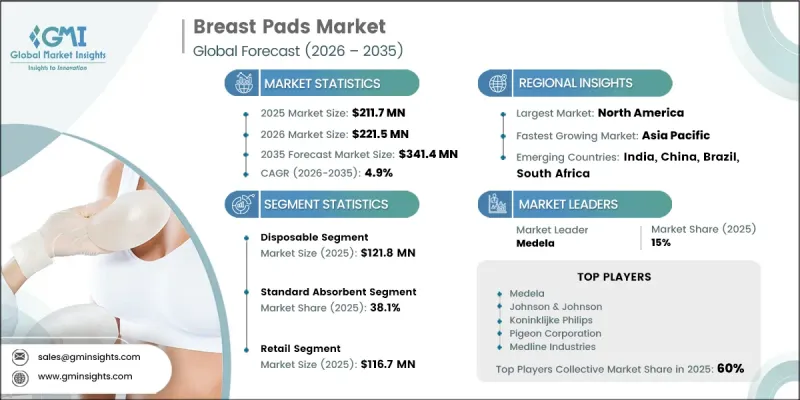
세계의 수유 패드 시장은 2025년에 2억 1,170만 달러로 평가되며, 2035년까지 CAGR 4.9%로 성장하며, 3억 4,140만 달러에 달할 것으로 추정되고 있습니다.
이 시장의 성장은 모유 수유의 이점에 대한 의식의 향상, 전 세계 여성의 노동 시장 참여 증가, 임산부의 건강 의식 향상을 목표로 한 정부의 지원 정책, 그리고 자연스러운 수유 방식에 대한 선호도 증가에 힘입어 이루어지고 있습니다. 또한 라이프스타일의 변화와 산후 관리에 대한 관심 증가도 전 세계에서 해당 제품이 꾸준히 보급되는 데 기여하고 있습니다. 수유 패드는 모유 누출을 흡수하고 수유 기간 중의 편안함을 보장하기 위해 고안된 필수 산후 위생용품으로 널리 알려져 있습니다. 이러한 제품은 일반적으로 수유 브라 안에 착용하며, 수유 중간이나 유즙 분비 반사가 일어날 때 나오는 모유의 흐름을 조절하는 데 사용됩니다. 부드럽고 흡수성이 뛰어나며 통기성이 우수한 소재로 제작되어 피부를 건조한 상태로 유지하고, 피부 자극을 줄이며, 옷이 더러워지는 것을 방지하는 데 도움이 됩니다. 수유 중의 편안함, 위생, 자신감을 높여주는 역할을 통해 산후 관리의 중요한 요소로 자리 잡고 있습니다. 수유 기간 중 편의성과 위생을 중시하는 어머니들이 늘어남에 따라 눈에 띄지 않고 편안하며 흡수력이 뛰어난 제품에 대한 수요가 지속적으로 증가하고 있으며, 이것이 시장 확대를 지원하고 있습니다.
| 시장 범위 | |
|---|---|
| 시작연도 | 2025년 |
| 예측 기간 | 2026-2035년 |
| 개시 금액 | 2억 1,170만 달러 |
| 예측액 | 3억 4,140만 달러 |
| CAGR | 4.9% |
일회용 부문은 2025년에 1억 2,180만 달러의 시장 규모를 기록했습니다. 일회용 수유 패드는 1회 사용을 목적으로 설계되었으며, 그 편리성과 위생상의 장점, 그리고 처분이 용이하다는 점 때문에 널리 선호되고 있습니다. 이 제품들은 오염 위험을 줄이면서도 안정적인 성능을 보장하므로, 일상적인 산후 관리에 사용하기에 매우 적합합니다. 수유 중인 엄마들 사이에서 인기가 높아지고 있는 배경에는 세탁이나 재사용이 필요 없고 번거로움이 없는 위생적인 수유 솔루션에 대한 수요가 증가하고 있기 때문입니다.
2025년, 표준 흡수성 부문은 38.1%의 시장 점유율을 차지했습니다. 이 제품들은 뛰어난 액체 흡수 능력 덕분에 수유 중 청결함과 편안함을 유지하는 데 도움이 되므로 널리 사용되고 있습니다. 표준 흡수재는 기본적인 수유 패드 디자인에 일반적으로 사용되며, 습기를 효율적으로 관리하는 동시에 피부를 보호하는 능력이 높이 평가받고 있습니다. 합리적인 가격과 구하기 쉬운 점은, 신뢰할 수 있는 일상적인 수유 지원을 원하는 가격에 민감한 소비자들을 중심으로 그 보급을 더욱 촉진하고 있습니다.
2025년, 북미 수유 패드 시장은 33.9%의 점유율을 차지했습니다. 이 지역의 경쟁력은 슈퍼마켓, 임산부 전문점, 편의점, 온라인 소매 플랫폼 등을 포함한 강력하고 잘 구축된 소매 유통 네트워크에 의해 지원되고 있습니다. 이러한 광범위한 유통망을 통해 소비자는 제품을 쉽게 구할 수 있습니다. 또한 지역 전체의 가처분 소득 수준이 높아 프리미엄급이며 쾌적하고 고품질의 수유 용품 채택을 촉진하고 있으며, 시장의 지속적인 성장을 더욱 지원하고 있습니다.
자주 묻는 질문
목차
제1장 조사 방법
제2장 개요
제3장 업계 인사이트
제4장 경쟁 구도
제5장 시장 추산·예측 : 제품 유형별, 2022-2035년
제6장 시장 추산·예측 : 소재별, 2022-2035년
제7장 시장 추산·예측 : 용도별, 2022-2035년
제8장 시장 추산·예측 : 유통 채널별, 2022-2035년
제9장 시장 추산·예측 : 지역별, 2022-2035년
제10장 기업 개요
KSA 26.06.23The Global Breast Pads Market was valued at USD 211.7 million in 2025 and is estimated to grow at a CAGR of 4.9% to reach USD 341.4 million by 2035.
The market growth is driven by increasing awareness of breastfeeding benefits, rising participation of women in the global workforce, supportive government initiatives aimed at improving maternal health awareness, and the growing preference for natural infant feeding practices. In addition, evolving lifestyle patterns and higher emphasis on postpartum care are contributing to steady product adoption worldwide. Breast pads are widely recognized as essential maternal hygiene products designed to absorb breast milk leakage and ensure comfort during lactation. These products are typically worn inside nursing bras to manage milk flow between feeding sessions and during let-down reflexes. Manufactured using soft, highly absorbent, and breathable materials, they help maintain skin dryness, reduce irritation, and prevent clothing stains. Their role in enhancing comfort, hygiene, and confidence during breastfeeding makes them an important component of postpartum care. Increasing demand for discreet, comfortable, and highly absorbent solutions continues to support market expansion as more mothers prioritize convenience and hygiene during the breastfeeding period.
| Market Scope | |
|---|---|
| Start Year | 2025 |
| Forecast Year | 2026-2035 |
| Start Value | $211.7 Million |
| Forecast Value | $341.4 Million |
| CAGR | 4.9% |
The disposable segment held generated USD 121.8 million in 2025. Disposable breast pads are designed for single-use applications and are widely preferred due to their convenience, hygiene benefits, and ease of disposal. They help reduce contamination risks while ensuring consistent performance, making them highly suitable for everyday maternal care usage. Their growing preference among nursing mothers is supported by rising demand for hassle-free and hygienic breastfeeding solutions that eliminate the need for washing or reuse.
The standard absorbent segment held a 38.1% share in 2025. These products are widely used due to their effective fluid absorption capabilities, helping maintain cleanliness and comfort during breastfeeding. Standard absorbent materials are commonly incorporated into basic breast pad designs and are valued for their ability to manage moisture efficiently while supporting skin protection. Their affordability and easy availability further enhance their adoption, particularly among cost-conscious consumers seeking reliable everyday breastfeeding support.
North America Breast Pads Market accounted for a share of 33.9% in 2025. The region's dominance is supported by a strong and well-developed retail distribution network that includes supermarkets, maternity specialty outlets, convenience stores, and online retail platforms. This extensive availability ensures easy product access for consumers. In addition, higher disposable income levels across the region encourage the adoption of premium, comfortable, and high-quality breastfeeding products, further supporting sustained market growth.
Key companies operating in the Global Breast Pads Market include Koninklijke Philips, Johnson & Johnson, Medela, Cardinal Health, Pigeon Corporation, Medline Industries, Ameda, Newell Brands (NUK USA), Cache Coeur, Kindred Bravely, MOOGCO, Yoboo, LatchPad (daLAIT), and Lily Padz. Companies operating in the breast pads market are actively focusing on expanding their product portfolios by introducing advanced, skin-friendly, and highly absorbent materials that improve comfort and leakage protection. A major strategy involves increasing investment in product innovation, including breathable fabrics, eco-friendly materials, and ergonomically designed shapes that enhance user convenience. Market players are also strengthening their presence through strategic partnerships with maternity clinics, hospitals, and retail distributors to improve product accessibility. In addition, expanding e-commerce distribution channels has become a key focus area, enabling brands to reach a wider consumer base. Companies are also emphasizing brand positioning through awareness campaigns that highlight breastfeeding benefits and maternal care importance. Furthermore, competitive pricing strategies combined with premium product segmentation are being used to target diverse consumer groups and strengthen long-term market penetration.
Table of Contents
Chapter 1 Research Methodology
- 1.1 Research approach
- 1.2 Quality commitments
- 1.2.1 GMI AI policy & data integrity commitment
- 1.2.1.1 Source consistency protocol
- 1.2.1 GMI AI policy & data integrity commitment
- 1.3 Research trail & confidence scoring
- 1.3.1 Research trail components
- 1.3.2 Scoring components
- 1.4 Data collection
- 1.4.1 Partial list of primary sources
- 1.5 Data mining sources
- 1.5.1 Paid sources
- 1.5.1.1 Sources, by region
- 1.5.1 Paid sources
- 1.6 Base estimates and calculations
- 1.6.1 Base year calculation for any one approach
- 1.7 Forecast model
- 1.7.1 Quantified market impact analysis
- 1.7.1.1 Mathematical impact of growth parameters on forecast
- 1.7.1 Quantified market impact analysis
- 1.8 Research transparency addendum
- 1.8.1 Source attribution framework
- 1.8.2 Quality assurance metrics
- 1.8.3 Our commitment to trust
Chapter 2 Executive Summary
- 2.1 Industry 360° synopsis
- 2.1.1 Key market trends
- 2.1.2 Product type trends
- 2.1.3 Material trends
- 2.1.4 Application trends
- 2.1.5 Distribution channel trends
- 2.2 CXO perspectives: Strategic imperatives
Chapter 3 Industry Insights
- 3.1 Industry ecosystem analysis
- 3.2 Industry impact forces
- 3.2.1 Growth drivers
- 3.2.1.1 Increasing awareness and demand for breastfeeding among new mothers
- 3.2.1.2 Increasing global women employment rates
- 3.2.1.3 Presence of government initiatives aimed at improving consumer awareness levels
- 3.2.1.4 Growing popularity of natural feeding
- 3.2.2 Industry pitfalls and challenges
- 3.2.2.1 Lack of awareness about various breastfeeding hygiene products
- 3.2.2.2 Sustainability and environmental concerns
- 3.2.3 Market opportunity
- 3.2.3.1 Expansion through e-commerce and direct-to-consumer channels
- 3.2.1 Growth drivers
- 3.3 Growth potential analysis
- 3.4 Regulatory landscape (Driven by Primary Research)
- 3.4.1 North America
- 3.4.2 Europe
- 3.4.3 Asia Pacific
- 3.5 Technological landscape (Driven by Primary Research)
- 3.5.1 Current technologies
- 3.5.1.1 High-absorbency multi-layer core technology
- 3.5.1.2 Contoured and ultra-thin design technology
- 3.5.2 Emerging technologies
- 3.5.2.1 Antimicrobial and pH-regulating fabric technology
- 3.5.2.2 Eco-friendly and biodegradable material innovation
- 3.5.1 Current technologies
- 3.6 Future market trends (Driven by Primary Research)
- 3.7 Pricing trend analysis (Driven by Primary Research)
- 3.8 Impact of AI and Generative AI on the market (Driven by Primary Research)
- 3.9 Porter’s analysis
- 3.10 PESTEL analysis
- 3.11 Gap analysis
Chapter 4 Competitive Landscape, 2025
- 4.1 Introduction
- 4.2 Company market share analysis
- 4.2.1 North America
- 4.2.2 Europe
- 4.2.3 Asia Pacific
- 4.3 Company matrix analysis
- 4.4 Competitive analysis of major market players
- 4.5 Competitive positioning matrix
- 4.6 Key developments
- 4.6.1 Merger and acquisition
- 4.6.2 Partnership and collaboration
- 4.6.3 New product launches
- 4.6.4 Expansion plans
Chapter 5 Market Estimates and Forecast, By Product Type, 2022 - 2035 ($ Mn)
- 5.1 Key trends
- 5.2 Disposable
- 5.3 Reusable
Chapter 6 Market Estimates and Forecast, By Material, 2022 - 2035 ($ Mn)
- 6.1 Key trends
- 6.2 Standard absorbent
- 6.3 Hydrogel
- 6.4 Fabric-based
- 6.5 Silicone
Chapter 7 Market Estimates and Forecast, By Application, 2022 - 2035 ($ Mn)
- 7.1 Key trends
- 7.2 Personal use
- 7.3 Hospitals and maternity clinics
Chapter 8 Market Estimates and Forecast, By Distribution Channel, 2022 - 2035 ($ Mn)
- 8.1 Key trends
- 8.2 Retail
- 8.3 Wholesale
- 8.4 E-commerce
Chapter 9 Market Estimates and Forecast, By Region, 2022 - 2035 ($ Mn)
- 9.1 Key trends
- 9.2 North America
- 9.2.1 U.S.
- 9.2.2 Canada
- 9.3 Europe
- 9.3.1 Germany
- 9.3.2 UK
- 9.3.3 France
- 9.3.4 Spain
- 9.3.5 Italy
- 9.3.6 Netherlands
- 9.4 Asia Pacific
- 9.4.1 China
- 9.4.2 Japan
- 9.4.3 India
- 9.4.4 Australia
- 9.4.5 South Korea
- 9.5 Latin America
- 9.5.1 Brazil
- 9.5.2 Mexico
- 9.5.3 Argentina
- 9.6 Middle East and Africa
- 9.6.1 South Africa
- 9.6.2 Saudi Arabia
- 9.6.3 UAE
Chapter 10 Company Profiles
- 10.1 Ameda
- 10.2 Cache Coeur
- 10.3 Cardinal Health
- 10.4 Johnson & Johnson
- 10.5 Kindred Bravely
- 10.6 Koninklijke Philips
- 10.7 LatchPad (daLAIT)
- 10.8 LilyPadz
- 10.9 MAM Baby
- 10.10 Medela
- 10.11 Medline Industries
- 10.12 MOOGCO
- 10.13 Newell Brands (NUK USA)
- 10.14 Pigeon Corporation
- 10.15 Yoboo