

|
시장보고서
상품코드
2061355
배란 검사 키트 시장 기회, 성장요인, 업계 동향 분석 및 예측(2026-2035년)Ovulation Testing Kits Market Opportunity, Growth Drivers, Industry Trend Analysis, and Forecast 2026 - 2035 |
||||||

세계의 배란 검사 키트 시장은 2025년에 4억 9,620만 달러로 평가되고 CAGR 7.2%로 성장하며, 2035년까지 10억 달러에 달할 것으로 예측됩니다.
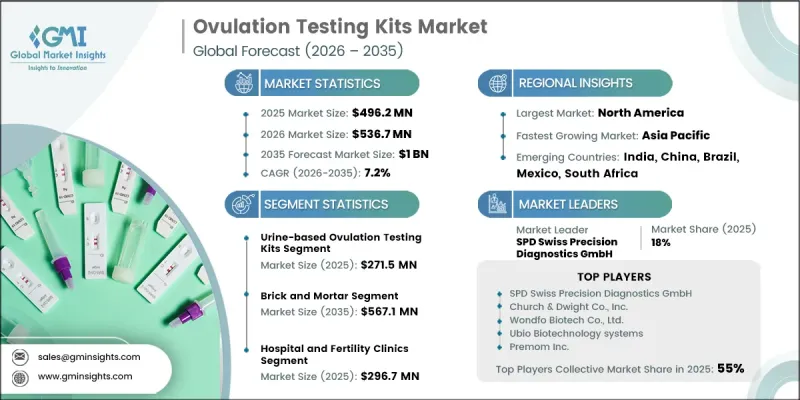
다낭성난소증후군(PCOS) 및 호르몬 불균형 발생률의 증가, 그리고 체외수정(IVF) 등 보조생식기술에 대한 인식이 높아짐에 따라 시장은 꾸준한 성장을 달성하고 있습니다. 불임에 대한 인식이 높아지고, 적극적인 생식 헬스케어에 대한 관심이 증가함에 따라 전 세계적인 보급이 더욱 가속화되고 있습니다. 진단 기술의 지속적인 발전으로 인해 배란 검사 솔루션의 정확성, 사용 편의성 및 접근성이 향상되면서 소비자들의 수용도가 더욱 확대되고 있습니다. 이러한 키트를 사용하면 호르몬 변화, 특히 황체형성호르몬의 급격한 증가를 감지함으로써 개인이 임신 가능 기간을 파악할 수 있게 되어, 보다 적절한 가족 계획 결정을 내리는 데 도움을 줍니다. 월경과 관련된 건강 상태에 대한 인식이 높아지고, 자가 관리형 헬스케어 솔루션이 보급되는 추세 역시 시장 확대에 기여하고 있습니다. 또한 유통망 개선, 의료 인식 제고 캠페인의 활성화, 오프라인 매장 및 온라인 채널을 통한 접근성 향상도 제품의 시장 침투를 지원하고 있습니다. 여성 노동력의 증가와 일부 지역에서 나타나는 출산 연기 추세는 편의성이 높은 재택형 임신 기간 추적 솔루션에 대한 수요를 더욱 부추겨, 세계 시장의 장기적인 성장 전망을 더욱 공고히 하고 있습니다.
| 시장 범위 | |
|---|---|
| 시작연도 | 2025년 |
| 예측 기간 | 2026-2035년 |
| 개시 금액 | 4억 9,620만 달러 |
| 예측 시장 규모 | 10억 달러 |
| CAGR | 7.2% |
소변을 이용한 배란 검사 키트 시장은 2025년에 2억 7,150만 달러의 시장 규모를 기록했습니다. 이 시장에서 차지하는 우위는 합리적인 가격, 높은 신뢰성, 그리고 소비자가 쉽게 구할 수 있다는 점에 기인합니다. 이러한 키트는 스트립, 카세트, 미드스트림형 등 다양한 형태로 널리 구할 수 있으며, 일상적인 사용에 편리합니다. 황체형성호르몬의 급격한 증가를 정확하게 감지할 수 있는 기능 덕분에, 신뢰할 수 있는 배란 추적 솔루션을 찾는 사용자들 사이에서 선호되는 선택지가 되고 있습니다.
오프라인 판매 채널은 예측 기간 중 강력한 성장세를 보일 것으로 예상되며, 2035년까지 5억 6,710만 달러에 달할 것으로 전망됩니다. 소비자들이 즉시 구매 가능성과 직접 구매 경험을 선호하므로 오프라인 매장은 여전히 주요 판매 채널로 자리 잡고 있습니다. 약국, 슈퍼마켓, 전문 건강식품점은 의료 전문가들의 전문적인 조언을 바탕으로 제품 유통에서 계속해서 중요한 역할을 수행하고 있습니다. 또한 이 채널은 특히 디지털화가 비교적 제한적으로 확산된 지역에서 제품에 대한 직접적인 평가나 브랜드 비교를 통해 소비자의 신뢰를 높이고 있습니다.
미국의 배란 검사 키트 시장은 2025년에 1억 7,920만 달러로 평가되며, 2026-2035년 연평균 성장률(CAGR) 7%로 성장할 것으로 예상됩니다. 해당 국가의 시장 성장은 주로 정상적인 배란 주기를 방해하는 다낭성난소증후군(PCOS) 및 호르몬 장애의 유병률 증가에 힘입어 이루어지고 있습니다. 첨단 의료 인프라에 힘입어 인식이 높아지고 진단률이 향상됨에 따라 점점 더 많은 여성들이 불임 치료 추적 솔루션을 도입하고 있습니다. 생식 헬스케어 및 호르몬 불균형의 조기 발견에 대한 관심이 높아지면서, 해당 지역 전체의 시장 확대를 더욱 지원하고 있습니다.
자주 묻는 질문
목차
제1장 조사 방법
제2장 개요
제3장 업계 인사이트
제4장 경쟁 구도
제5장 시장 추산·예측 : 제품별, 2022-2035년
제6장 시장 추산·예측 : 판매 채널별, 2022-2035년
제7장 시장 추산·예측 : 최종 사용별, 2022-2035년
제8장 시장 추산·예측 : 지역별, 2022-2035년
제9장 기업 개요
KSA 26.06.23The Global Ovulation Testing Kits Market was valued at USD 496.2 million in 2025 and is estimated to grow at a CAGR of 7.2% to reach USD 1 billion by 2035.
The market is witnessing steady growth due to rising incidences of polycystic ovary syndrome (PCOS), hormonal irregularities, and increasing awareness surrounding assisted reproductive techniques such as IVF. Growing emphasis on fertility awareness and proactive reproductive health management is further accelerating adoption across global populations. Continuous advancements in diagnostic technologies are improving the accuracy, ease of use, and accessibility of ovulation testing solutions, encouraging wider consumer acceptance. These kits enable individuals to identify fertile windows by detecting hormonal changes, particularly luteinizing hormone surges, thereby supporting better family planning decisions. Increasing awareness of menstrual health conditions and the rising trend of self-monitoring health solutions are also contributing to market expansion. In addition, improved distribution networks, rising healthcare awareness campaigns, and growing availability through both physical and online channels are supporting product penetration. Expanding female workforce participation and delayed pregnancy trends in several regions are further boosting demand for convenient at-home fertility tracking solutions, strengthening the long-term growth outlook of the market globally.
| Market Scope | |
|---|---|
| Start Year | 2025 |
| Forecast Year | 2026-2035 |
| Start Value | $496.2 Million |
| Forecast Value | $1 Billion |
| CAGR | 7.2% |
The urine-based ovulation testing kits segment generated USD 271.5 million in 2025. This dominance is attributed to its affordability, high reliability, and ease of accessibility for consumers. These kits are widely available in various formats such as strips, cassettes, and midstream devices, making them convenient for regular use. Their ability to accurately detect luteinizing hormone surges has made them a preferred choice among users seeking dependable fertility tracking solutions.
The brick-and-mortar distribution channel is projected to reach USD 567.1 million by 2035, reflecting strong growth over the forecast period. Physical retail outlets remain a key sales channel due to consumer preference for immediate availability and a direct purchase experience. Pharmacies, supermarkets, and specialty health stores continue to play an important role in product distribution, often supported by professional guidance from healthcare staff. This channel also strengthens consumer confidence through direct product evaluation and brand comparison, particularly in regions where digital adoption is relatively limited.
United States Ovulation Testing Kits Market was valued at USD 179.2 million in 2025, and is expected to grow at a CAGR of 7% from 2026 to 2035. Market growth in the country is primarily driven by the increasing prevalence of PCOS and hormonal disorders that disrupt normal ovulation cycles. Rising awareness and improved diagnosis rates, supported by advanced healthcare infrastructure, are encouraging more women to adopt fertility tracking solutions. Growing focus on reproductive health management and early detection of hormonal imbalances is further supporting market expansion across the region.
Major players operating in the Global Ovulation Testing Kits Industry include Church & Dwight Co., Inc., QuidelOrtho Corporation, SPD Swiss Precision Diagnostics GmbH, Geratherm Medical AG, Fairhaven Health, LLC, Clinical Guard LLC, Premom Inc., Ubio Biotechnology Systems, Hangzhou AllTest Biotech Co., Ltd., Mankind Pharma Ltd., and Nantong Diagnos Biotechnology Co., Ltd. Companies in the ovulation testing kits market are focusing on strengthening their market presence through continuous product innovation, particularly by improving test accuracy, digital integration, and user-friendly formats. They are expanding distribution networks across both online and offline channels to improve product accessibility. Strategic investments in digital fertility tracking platforms and mobile applications are enhancing consumer engagement and retention. Manufacturers are also emphasizing affordability while maintaining diagnostic reliability to reach wider consumer bases. Partnerships with healthcare providers and pharmacies are helping improve trust and product visibility. In addition, companies are increasing awareness campaigns focused on reproductive health and fertility education. Expansion into emerging markets with growing healthcare awareness is further supporting long-term growth and competitive positioning in the global market.
Table of Contents
Chapter 1 Research Methodology
- 1.1 Research approach
- 1.2 Quality commitments
- 1.2.1 GMI AI policy & data integrity commitment
- 1.2.1.1 Source consistency protocol
- 1.2.1 GMI AI policy & data integrity commitment
- 1.3 Research trail & confidence scoring
- 1.3.1 Research trail components
- 1.3.2 Scoring components
- 1.4 Data collection
- 1.4.1 Partial list of primary sources
- 1.5 Data mining sources
- 1.5.1 Paid sources
- 1.5.1.1 Sources, by region
- 1.5.1 Paid sources
- 1.6 Base estimates and calculations
- 1.6.1 Base year calculation for any one approach
- 1.7 Forecast model
- 1.7.1 Quantified market impact analysis
- 1.7.1.1 Mathematical impact of growth parameters on forecast
- 1.7.1 Quantified market impact analysis
- 1.8 Research transparency addendum
- 1.8.1 Source attribution framework
- 1.8.2 Quality assurance metrics
- 1.8.3 Our commitment to trust
Chapter 2 Executive Summary
- 2.1 Industry 3600 synopsis
- 2.2 Key market trends
- 2.2.1 Product trends
- 2.2.2 Sales Channel trends
- 2.2.3 End use trends
- 2.2.4 Regional trends
- 2.3 CXO perspectives: Strategic imperatives
Chapter 3 Industry Insights
- 3.1 Industry ecosystem analysis
- 3.2 Industry impact forces
- 3.2.1 Growth drivers
- 3.2.1.1 Increasing prevalence of polycystic ovary syndrome (PCOS) and other hormonal disorders
- 3.2.1.2 Rising awareness regarding IVF procedures
- 3.2.1.3 Growing technological advancements in ovulation testing kits
- 3.2.1.4 Rising number of fertility issues among women
- 3.2.2 Industry pitfalls and challenges
- 3.2.2.1 Errors associated with ovulation test kits
- 3.2.2.2 Stringent regulatory scenario
- 3.2.3 Market opportunities
- 3.2.3.1 Integration with fertility tracking apps & telemedicine platforms
- 3.2.1 Growth drivers
- 3.3 Growth potential analysis
- 3.4 Regulatory landscape (Driven by primary research)
- 3.4.1 North America
- 3.4.2 Europe
- 3.4.3 Asia Pacific
- 3.4.4 Latin America
- 3.4.5 Middle East and Africa
- 3.5 Technology landscape (Driven by primary research)
- 3.5.1 Current technological trends
- 3.5.1.1 Multi-hormone detection systems
- 3.5.1.2 High-sensitivity rapid test strips
- 3.5.2 Emerging technologies
- 3.5.2.1 Connected smart fertility ecosystems
- 3.5.2.2 Non-invasive saliva-based and wearable solutions
- 3.5.1 Current technological trends
- 3.6 Future market trends (Driven by primary research)
- 3.7 Impact of AI and Generative AI on the market (Driven by primary research)
- 3.8 Pricing trend analysis (Driven by primary research)
- 3.9 Porter’s analysis
- 3.10 PESTEL analysis
Chapter 4 Competitive Landscape, 2025
- 4.1 Introduction
- 4.2 Company market share analysis
- 4.2.1 Global
- 4.2.2 North America
- 4.2.3 Europe
- 4.2.4 Asia Pacific
- 4.3 Company matrix analysis
- 4.4 Competitive analysis of major market players
- 4.5 Competitive positioning matrix
- 4.6 Key developments
- 4.6.1 Mergers and acquisitions
- 4.6.2 Partnerships and collaborations
- 4.6.3 New product launches
- 4.6.4 Expansion plans
Chapter 5 Market Estimates and Forecast, By Product, 2022 - 2035 ($ Mn)
- 5.1 Key trends
- 5.2 Urine-based ovulation testing kits
- 5.2.1 Test strip type
- 5.2.2 Cassette type
- 5.2.3 Midstream type
- 5.3 Saliva-based ovulation testing kits
- 5.4 Digital ovulation testing kits
Chapter 6 Market Estimates and Forecast, By Sales Channel, 2022 - 2035 ($ Mn)
- 6.1 Key trends
- 6.2 Brick and mortar
- 6.3 E-commerce
Chapter 7 Market Estimates and Forecast, By End Use, 2022 - 2035 ($ Mn)
- 7.1 Key trends
- 7.2 Hospitals and fertility clinics
- 7.3 Home care
- 7.4 Other end users
Chapter 8 Market Estimates and Forecast, By Region, 2022 - 2035 ($ Mn)
- 8.1 Key trends
- 8.2 North America
- 8.2.1 U.S.
- 8.2.2 Canada
- 8.3 Europe
- 8.3.1 Germany
- 8.3.2 UK
- 8.3.3 France
- 8.3.4 Spain
- 8.3.5 Italy
- 8.3.6 Netherlands
- 8.4 Asia Pacific
- 8.4.1 China
- 8.4.2 Japan
- 8.4.3 India
- 8.4.4 Australia
- 8.4.5 South Korea
- 8.5 Latin America
- 8.5.1 Brazil
- 8.5.2 Mexico
- 8.5.3 Argentina
- 8.6 Middle East and Africa
- 8.6.1 South Africa
- 8.6.2 Saudi Arabia
- 8.6.3 UAE
Chapter 9 Company Profiles
- 9.1 Church & Dwight Co., Inc.
- 9.2 Clinical Guard LLC
- 9.3 Cyclotest LH Test Strips
- 9.4 Fairhaven Health, LLC
- 9.5 Geratherm Medical AG
- 9.6 Ubio Biotechnology systems
- 9.7 Hangzhou AllTest Biotech Co., Ltd.
- 9.8 Mankind Pharma Ltd.
- 9.9 Nantong Diagnos Biotechnology Co., Ltd.
- 9.10 Premom Inc.
- 9.11 PRIMA Lab SA
- 9.12 QuidelOrtho Corporation
- 9.13 SPD Swiss Precision Diagnostics GmbH


