

|
시장보고서
상품코드
2061367
콜드체인 장비 시장 기회, 성장요인, 업계 동향 분석 및 예측(2026-2035년)Cold Chain Equipment Market Opportunity, Growth Drivers, Industry Trend Analysis, and Forecast 2026 - 2035 |
||||||

세계의 콜드체인 장비 시장은 2025년에 395억 달러로 평가되고 CAGR 7.6%로 성장하며, 2035년까지 812억 달러에 달할 것으로 예측됩니다.
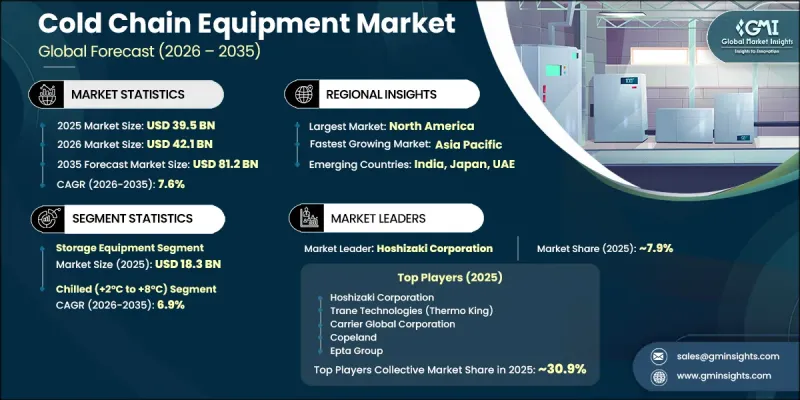
의약품, 생명공학, 헬스케어, 식품 및 음료 업계 전반에서 온도 조절이 가능한 보관 및 운송에 대한 수요가 증가함에 따라 해당 시장은 강력한 성장세를 보이고 있습니다. 바이오의약품, 백신, 냉동식품 및 온도에 민감한 의약품의 전 세계 소비량 증가는 첨단 냉장 시스템과 체계적인 물류 인프라에 대한 수요를 크게 높이고 있습니다. 콜드체인 장비는 엔드투엔드 공급망 전반에 걸쳐 정확한 온도 조건을 유지함으로써 제품의 안전성을 확보하고, 이를 통해 부패를 최소화하며, 규정 준수를 보장하는 데 있으며, 매우 중요한 역할을 하고 있습니다. 체계화된 소매 네트워크, 의약품 유통 시스템, 그리고 E-Commerce 식품 플랫폼의 급속한 확장이 시장 성장을 더욱 촉진하고 있습니다. 동시에, 업계에서는 가시성과 운영 관리를 향상시키는 IoT 기반 모니터링 시스템, 스마트 센서, 실시간 추적 솔루션의 통합을 통해 큰 기술적 변화가 진행되고 있습니다. 자동화 도입도 늘어나고 있으며, 기업은 효율성을 높이고 제품 손실 위험을 줄일 수 있게 되었습니다. 식품 안전 기준 및 의약품 취급 요건에 대한 규제 압력이 높아짐에 따라 첨단 콜드체인 인프라에 대한 투자가 지속적으로 촉진되고 있습니다. 또한 바이오의약품 생산 확대와 전 세계적인 백신 공급 프로그램의 전개에 따라 선진국 및 신흥 국가 경제권 전반에서 신뢰성이 높고 확장성이 뛰어난 콜드체인 시스템에 대한 수요가 더욱 가속화되고 있습니다.
| 시장 범위 | |
|---|---|
| 시작연도 | 2025년 |
| 예측 기간 | 2026-2035년 |
| 개시 금액 | 395억 달러 |
| 예측액 | 812억 달러 |
| CAGR | 7.6% |
2025년 기준으로 보관 설비 부문은 183억 달러를 차지하고 있으며, 2026-2035년 연평균 성장률(CAGR) 5.4%로 성장할 것으로 예상됩니다. 이 부문은 냉장 창고, 콜드룸, 산업용 냉각 시스템 및 의약품 등급 보관 시설에 대한 투자 증가에 힘입어 시장을 주도하고 있습니다. 이러한 솔루션은 식품 가공, 백신 보관, 생물제제 보존, 의약품 재고 관리 등의 분야에서 장기간에 걸쳐 온도 안정성을 유지하는 데 필수적입니다. 체계적으로 구축된 냉장 창고 네트워크의 지속적인 확대와 전 세계 냉동식품 공급망의 성장이 이 부문의 실적을 더욱 강화하고 있습니다.
저온 온도대 부문(2°C-8°C)은 2025년에 37.9%의 시장 점유율을 차지하며, 2035년까지 연평균 성장률(CAGR) 6.9%로 성장할 것으로 전망됩니다. 이 부문은 유제품, 백신, 신선식품, 바이오의약품 및 온도에 민감한 의약품 분야에서 널리 활용되고 있으므로 여전히 매우 중요한 위치를 차지하고 있습니다. 냉장 시스템은 보관 및 운송 중 품질 저하의 위험을 줄이면서 제품의 품질을 유지하는 데 도움이 됩니다. 안정적인 냉장 환경이 필요한 바이오의약품 및 가공식품의 유통 확대에 따라 냉장 콜드체인 솔루션에 대한 수요는 계속해서 견고한 추세를 보이고 있습니다.
미국의 콜드체인 장비 시장은 2025년에 109억 달러에 달하며, 2035년까지 연평균 성장률(CAGR) 6.8%로 성장할 것으로 전망됩니다. 이 국가의 성장은 강력한 의약품 생산 능력, 첨단인 의료 물류 시스템, 그리고 고도로 발달한 냉장 식품 유통 네트워크에 의해 지원되고 있습니다. 백신, 바이오의약품, 냉동식품 및 온도에 민감한 의약품에 대한 수요가 증가함에 따라 냉장 창고 인프라 및 운송용 냉장 기술에 대한 투자 확대가 촉진되고 있습니다. 또한 이 시장은 운용 성과와 규제 준수를 강화하는 에너지 효율이 높은 냉각 시스템, 자동화 창고, 그리고 IoT 기반 모니터링 플랫폼의 도입 확대로부터도 혜택을 보고 있습니다.
자주 묻는 질문
목차
제1장 조사 방법과 범위
제2장 개요
제3장 업계 인사이트
제4장 경쟁 구도
제5장 시장 추산·예측 : 장비 유형별, 2022-2035년
제6장 시장 추산·예측 : 온도 범위별, 2022-2035년
제7장 시장 추산·예측 : 용도별, 2022-2035년
제8장 시장 추산·예측 : 운영 모드별, 2022-2035년
제9장 시장 추산·예측 : 유통 채널별, 2022-2035년
제10장 시장 추산·예측 : 지역별, 2022-2035년
제11장 기업 개요
KSA 26.06.25The Global Cold Chain Equipment Market was valued at USD 39.5 billion in 2025 and is estimated to grow at a CAGR of 7.6% to reach USD 81.2 billion by 2035.
The market is witnessing strong expansion owing to rising demand for temperature-controlled storage and transportation across pharmaceuticals, biotechnology, healthcare, and food and beverage industries. The increasing global consumption of biologics, vaccines, frozen foods, and temperature-sensitive pharmaceutical products is significantly strengthening the need for advanced refrigeration systems and controlled logistics infrastructure. Cold chain equipment plays a crucial role in ensuring product safety by maintaining precise temperature conditions across end-to-end supply chains, thereby minimizing spoilage and ensuring regulatory compliance. The rapid expansion of organized retail networks, pharmaceutical distribution systems, and e-commerce grocery platforms is further reinforcing market growth. At the same time, the industry is undergoing a major technological shift with the integration of IoT-enabled monitoring systems, smart sensors, and real-time tracking solutions that improve visibility and operational control. Automation adoption is also rising, allowing companies to enhance efficiency and reduce product loss risks. Increasing regulatory pressure regarding food safety standards and pharmaceutical handling requirements continues to encourage investments in advanced cold chain infrastructure. Additionally, the expansion of biologics manufacturing and global vaccine distribution programs is further accelerating demand for reliable and scalable cold chain systems across developed and emerging economies.
| Market Scope | |
|---|---|
| Start Year | 2025 |
| Forecast Year | 2026-2035 |
| Start Value | $39.5 Billion |
| Forecast Value | $81.2 Billion |
| CAGR | 7.6% |
The storage equipment segment accounted for USD 18.3 billion in 2025 and is expected to grow at a CAGR of 5.4% from 2026 to 2035. This segment leads the market due to rising investments in refrigerated warehouses, cold rooms, industrial cooling systems, and pharmaceutical-grade storage facilities. These solutions are essential for preserving temperature stability over long durations across applications such as food processing, vaccine storage, biologics preservation, and pharmaceutical inventory management. Continued expansion of organized cold storage networks and the growing global frozen food supply chain are further strengthening segment performance.
The chilled temperature range segment (2°C to 8°C) held 37.9% share in 2025 and is projected to grow at a CAGR of 6.9% through 2035. This segment remains highly important due to its extensive use in dairy products, vaccines, fresh produce, biologics, and temperature-sensitive medicines. Chilled systems help maintain product integrity while reducing deterioration risks during storage and transportation. Rising distribution of biologics and processed food products requiring stable refrigerated environments continues to drive consistent demand for chilled cold chain solutions.
United States Cold Chain Equipment Market reached USD 10.9 billion in 2025 and is forecast to grow at a CAGR of 6.8% through 2035. Growth in the country is supported by strong pharmaceutical production capabilities, advanced healthcare logistics systems, and highly developed refrigerated food distribution networks. Increasing demand for vaccines, biologics, frozen foods, and temperature-sensitive medicines is encouraging greater investment in cold storage infrastructure and transport refrigeration technologies. The market is also benefiting from the growing adoption of energy-efficient cooling systems, automated warehouses, and IoT-based monitoring platforms that enhance operational performance and regulatory adherence.
Major players operating in the Global Cold Chain Equipment Industry Include Carrier Global Corporation, Trane Technologies, Daikin Industries Ltd., Johnson Controls International PLC, Copeland, Danfoss A/S, Dover Corporation (Hillphoenix), Liebherr Group, Blue Star Limited, Voltas Limited, CIMC (China International Marine Containers), Arneg Group, Hoshizaki Corporation, Epta Group, ThermoSafe, Peli BioThermal, Cold Chain Technologies, va-Q-tec AG, Panasonic Corporation, Haier Biomedical, and Frigoglass S.A. Companies in the cold chain equipment market are focusing on strengthening their position through digital transformation, especially by integrating IoT-based tracking systems, smart temperature sensors, and cloud-enabled monitoring platforms. They are investing heavily in energy-efficient refrigeration technologies to reduce operational costs while meeting sustainability goals. Strategic partnerships with logistics providers and pharmaceutical firms are expanding their service networks and improving distribution efficiency. Many players are also prioritizing automation in warehousing and transportation to enhance accuracy and reduce human error. Product innovation, particularly in modular and scalable cold storage systems, is helping companies address diverse end-user requirements.
Table of Contents
Chapter 1 Methodology & Scope
- 1.1 Market scope and definition
- 1.2 Research design
- 1.2.1 Research approach
- 1.2.2 Data collection methods
- 1.3 Data mining sources
- 1.3.1 Global
- 1.3.2 Regional/Country
- 1.4 Base estimates and calculations
- 1.4.1 Base year calculation
- 1.4.2 Key trends for market estimation
- 1.5 Primary research and validation
- 1.5.1 Primary sources
- 1.6 Forecast model
- 1.7 Research assumptions and limitations
Chapter 2 Executive Summary
- 2.1 Industry 360° synopsis
- 2.2 Key market trends
- 2.2.1 Regional
- 2.2.2 Equipment type
- 2.2.3 Temperature range
- 2.2.4 Application
- 2.2.5 Mode of operation
- 2.2.6 Distribution channel
Chapter 3 Industry Insights
- 3.1 Industry ecosystem analysis
- 3.1.1 Supplier landscape
- 3.1.2 Profit margin
- 3.1.3 Value addition at each stage
- 3.1.4 Factor affecting the value chain
- 3.2 Industry impact forces
- 3.2.1 Growth drivers
- 3.2.1.1 Rising demand for temperature-sensitive transportation and storage solutions
- 3.2.1.2 Expansion of biologics, vaccines, and temperature-sensitive pharmaceutical products
- 3.2.1.3 Growing investment in organized cold storage infrastructure and food logistics
- 3.2.2 Pitfalls & Challenges
- 3.2.2.1 High installation and operational costs associated with advanced refrigeration systems
- 3.2.2.2 Energy consumption and maintenance complexity of cold chain infrastructure
- 3.2.3 Opportunities
- 3.2.3.1 Increasing adoption of IoT-enabled monitoring and automation technologies
- 3.2.3.2 Expansion of pharmaceutical cold chain infrastructure across emerging economies
- 3.2.1 Growth drivers
- 3.3 Growth potential analysis
- 3.4 Future market trends
- 3.5 Technology and innovation landscape
- 3.5.1 Current technological trends
- 3.5.2 Emerging technologies
- 3.6 Regulatory landscape
- 3.6.1 Standards and compliance requirements
- 3.6.2 Regional regulatory frameworks
- 3.6.3 Certification standards
- 3.7 Porter’s analysis
- 3.8 PESTEL analysis
- 3.9 Pricing analysis (driven by primary research)
- 3.9.1 Historical price trend analysis (driven by primary research)
- 3.9.2 Pricing strategy by player type (premium / value / cost-plus) (driven by primary research)
- 3.10 Trade data analysis (HS Code 8418 for active refrigerating/freezing machinery and HS Code 9406 for insulated cold room structures) (driven by paid database)
- 3.10.1 Import/export volume and value trends (driven by paid database)
- 3.10.2 Key trade corridors and tariff impact (driven by paid database)
- 3.11 Impact of AI and generative AI on the market
- 3.11.1 AI-driven disruption of existing business models
- 3.11.2 GenAI use cases and adoption roadmap by segment
- 3.11.3 Risks, limitations and regulatory considerations
- 3.12 Capacity and production landscape (driven by primary research)
- 3.12.1 Installed capacity by region and key producer (driven by primary research)
- 3.12.2 Capacity utilization rates and expansion pipelines (driven by primary research)
Chapter 4 Competitive Landscape, 2025
- 4.1 Introduction
- 4.2 Company market share analysis
- 4.2.1 By Region
- 4.2.1.1 North America
- 4.2.1.2 Europe
- 4.2.1.3 Asia Pacific
- 4.2.1.4 Latin America
- 4.2.1.5 Middle East & Africa
- 4.2.1 By Region
- 4.3 Company matrix analysis
- 4.4 Competitive analysis of major market players
- 4.5 Competitive positioning matrix
- 4.6 Key developments
- 4.6.1 Mergers & acquisitions
- 4.6.2 Partnerships & collaborations
- 4.6.3 New product launches
- 4.6.4 Expansion plans
Chapter 5 Market Estimates & Forecast, By Equipment Type, 2022 - 2035, (USD Billion) (Thousand Units)
- 5.1 Key trends
- 5.2 Storage Equipment
- 5.3 Transportation Equipment
- 5.4 Monitoring & Control Systems
- 5.5 Temperature-Controlled Packaging
Chapter 6 Market Estimates & Forecast, By Temperature Range, 2022 - 2035, (USD Billion) (Thousand Units)
- 6.1 Key trends
- 6.2 Controlled Ambient (+15°C to +25°C)
- 6.3 Chilled (+2°C to +8°C)
- 6.4 Frozen (-18°C to -25°C)
- 6.5 Cryogenic (Below -80°C)
Chapter 7 Market Estimates & Forecast, By Application, 2022 - 2035, (USD Billion) (Thousand Units)
- 7.1 Key trends
- 7.2 Food & Beverages
- 7.2.1 Fruits & Vegetables
- 7.2.2 Dairy Products
- 7.2.3 Meat, Fish & Seafood
- 7.2.4 Processed Food & Ready-to-Eat Meals
- 7.2.5 Bakery & Confectioneries
- 7.2.6 Others
- 7.3 Pharmaceuticals
- 7.3.1 Vaccines
- 7.3.2 Biologics & Biosimilars
- 7.3.3 Temperature-Sensitive APIs
- 7.3.4 Clinical Trial Materials
- 7.4 Healthcare
- 7.4.1 Blood Products & Plasma
- 7.4.2 Organs & Tissue for Transplantation
- 7.4.3 Medical Supplies & Reagents
- 7.5 Chemicals
- 7.5.1 Specialty Chemicals
- 7.5.2 Volatile Compounds
- 7.6 Biotechnology
- 7.6.1 Cell & Gene Therapies
- 7.6.2 Research Samples & Biobanking
- 7.7 Others
Chapter 8 Market Estimates & Forecast, By Mode of Operation, 2022 - 2035, (USD Billion) (Thousand Units)
- 8.1 Key trends
- 8.2 Active Systems
- 8.3 Passive Systems
Chapter 9 Market Estimates & Forecast, By Distribution Channel, 2022 - 2035, (USD Billion) (Thousand Units)
- 9.1 Key trends
- 9.2 Direct Sales
- 9.3 Indirect Sales
Chapter 10 Market Estimates & Forecast, By Region, 2022 - 2035, (USD Billion) (Thousand Units)
- 10.1 Key trends
- 10.2 North America
- 10.2.1 U.S.
- 10.2.2 Canada
- 10.3 Europe
- 10.3.1 Germany
- 10.3.2 UK
- 10.3.3 France
- 10.3.4 Italy
- 10.3.5 Spain
- 10.4 Asia Pacific
- 10.4.1 China
- 10.4.2 India
- 10.4.3 Japan
- 10.4.4 South Korea
- 10.4.5 Australia
- 10.5 Latin America
- 10.5.1 Brazil
- 10.5.2 Mexico
- 10.5.3 Argentina
- 10.6 MEA
- 10.6.1 Saudi Arabia
- 10.6.2 UAE
- 10.6.3 South Africa
Chapter 11 Company Profiles
- 11.1 Top Global Players
- 11.1.1 Carrier Global Corporation
- 11.1.2 Daikin Industries Ltd.
- 11.1.3 Trane Technologies
- 11.1.4 Copeland
- 11.1.5 Johnson Controls International PLC
- 11.1.6 Danfoss A/S
- 11.1.7 Dover Corporation (Hillphoenix)
- 11.2 Regional Champions
- 11.2.1 Blue Star Limited
- 11.2.2 Voltas Limited
- 11.2.3 CIMC (China International Marine Containers)
- 11.2.4 Liebherr Group
- 11.2.5 Hoshizaki Corporation
- 11.2.6 Arneg Group
- 11.2.7 Epta Group
- 11.3 Emerging & Specialized Players
- 11.3.1 ThermoSafe
- 11.3.2 Peli BioThermal
- 11.3.3 Cold Chain Technologies
- 11.3.4 va-Q-tec AG
- 11.3.5 Panasonic Corporation
- 11.3.6 Haier Biomedical
- 11.3.7 Frigoglass S.A.


