|
시장보고서
상품코드
2061379
유리섬유 도어 시장 기회, 성장요인, 업계 동향 분석 및 예측(2026-2035년)Fiberglass Doors Market Opportunity, Growth Drivers, Industry Trend Analysis, and Forecast 2026 - 2035 |
||||||

세계의 유리섬유 도어 시장은 2025년에 237억 달러로 추계되고 있으며, CAGR 6.4%로 성장하며, 2035년까지 445억 달러에 달할 것으로 예측됩니다.
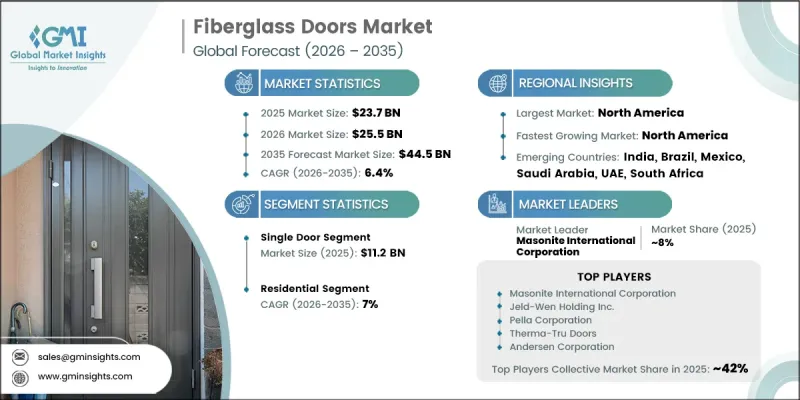
에너지 절약형 건축자재와 내구성이 뛰어난 도어 시스템에 대한 수요가 증가함에 따라 유리섬유 도어 산업의 확장에 크게 기여하고 있습니다. 이러한 문은 뛰어난 단열 성능과 내후성, 그리고 주택 및 상업용 건물의 전반적인 에너지 손실을 줄여주는 능력 덕분에 점점 더 선호되고 있습니다. 지속가능한 건축 기법과 비용 대비 효과가 높은 건물 개보수가 중요시되는 경향이 강해지고 있는 점도 시장 수요를 더욱 부추기고 있습니다. 주택 건설 프로젝트의 급속한 확대와 더불어 상업용 인프라 개발이 증가함에 따라 전 세계 시장에서 첨단 유리섬유 도어 솔루션의 도입이 가속화되고 있습니다. 또한 개보수 및 리모델링 활동이 증가함에 따라 부동산 소유주들은 미적 매력과 에너지 효율을 모두 향상시키는 고품질 도어 시스템에 대한 투자를 적극적으로 추진하고 있습니다. 유리섬유 문은 내구성이 뛰어나고 유지보수가 간편하며 디자인의 유연성이 뛰어나, 기존 소재를 대체할 만한 바람직한 선택지로 자리 잡고 있습니다. 다양한 문 구성과 건축 양식을 선택할 수 있다는 점도 현대 건축 분야에서 이 제품이 폭넓게 채택되는 데 기여하고 있습니다.
| 시장 범위 | |
|---|---|
| 시작연도 | 2025년 |
| 예측 기간 | 2026-2035년 |
| 개시 금액 | 237억 달러 |
| 예측액 | 445억 달러 |
| CAGR | 6.4% |
유리섬유 도어 시스템은 장기적인 내구성과 에너지 절약을 추구하는 주택 및 상업 시설 소유주에게 합리적인 가격에 신뢰할 수 있는 건축 개보수 솔루션을 제공합니다. 이 시장은 싱글 도어 시스템, 양쪽 여닫이문, 미닫이문 및 특수 상업용 제품 등 다양한 제품 옵션을 이용할 수 있다는 점에서 계속해서 혜택을 보고 있습니다. 기존 대체재보다 더 첨단인 건축자재에 대한 선호도가 높아지고 있는 것은 에너지 성능, 유지보수 부담 경감, 건물의 내구성 향상에 중점을 두는 소비자들의 우선순위 변화를 반영하고 있습니다. 또한 에너지 효율이 높은 건축 기준에 대한 규제가 점점 더 중요시되고 있는 점도 전 세계 유리섬유 도어 제품 수요 증가에 기여하고 있습니다.
2025년에는 싱글 도어 부문이 시장 점유율의 47%를 차지하며 112억 달러의 매출을 올렸습니다. 단일 유리섬유 문은 주거용 및 상업용 분야에서 폭넓은 호환성을 바탕으로 계속해서 시장을 주도하고 있습니다. 이러한 표준화된 치수는 교체 공사 및 신축 개발 모두에서 설치를 간소화합니다. 건설업체와 주택 소유주들은 작동 효율과 단열 성능이 향상되고, 고급 목재와 같은 외관을 재현하면서도 장기적인 유지보수 비용을 절감할 수 있다는 점에서 단일 유리섬유 문을 점점 더 선호하고 있습니다. 또한 풍부한 디자인과 가공제 선택지를 통해 다양한 건축적 취향과 건축 양식에 맞춘 맞춤 제작도 가능합니다.
주택 부문은 2025년에 76.2%의 점유율을 차지하며, 2035년까지 연평균 성장률(CAGR) 7%로 성장할 것으로 전망됩니다. 활발한 주택 건설 활동, 확대되는 주택 리모델링 프로젝트, 그리고 유지보수 부담이 적은 건축자재에 대한 소비자의 선호도 증가가 이 부문의 시장 성장을 지속적으로 지원하고 있습니다. 주거용으로는 현관 시스템, 파티오로 통하는 출입문, 뒷문, 그리고 다양한 주거 유형에 걸친 실내 출입구가 포함됩니다. 주택 소유자들은 기존 문 자재에 일반적으로 수반되는 유지보수 문제를 최소화하면서도 단열 효율 향상, 장기적인 내구성, 매력적인 표면 마감을 제공하는 유리섬유 도어 시스템을 점점 더 많이 선택하고 있습니다.
미국의 유리섬유 도어 시장은 2025년에 79억 달러 규모에 달하며, 2026-2035년 연평균 성장률(CAGR) 5.8%를 기록하며 북미 전체에서 지배적인 위치를 유지할 것으로 전망됩니다. 해당 국가의 시장 성장은 대규모 주택 건설 프로젝트, 활발한 리모델링 활동, 그리고 에너지 절약형 건축자재의 채택 확대에 힘입어 이루어지고 있습니다. 단독주택, 아파트 단지 개발 및 상업용 빌딩 분야에서 고급 유리섬유 도어 시스템에 대한 수요는 여전히 높은 수준을 유지하고 있습니다. 건설 회사와 부동산 개발업체들은 뛰어난 단열 성능, 내충격 설계, 그리고 최신 스마트 보안 시스템과의 호환성을 갖춘 유리섬유 도어 기술에 대한 투자를 점점 더 늘리고 있습니다. 또한 에너지 효율 및 내후성 기준에 관한 건축 규제가 강화됨에 따라 미국 시장 전반에서 고성능 유리섬유 도어 제품의 사용이 더욱 촉진되고 있습니다.
자주 묻는 질문
목차
제1장 조사 방법과 범위
제2장 개요
제3장 업계 인사이트
제4장 경쟁 구도
제5장 시장 추산·예측 : 제품 유형별, 2022-2035년
제6장 시장 추산·예측 : 디자인별, 2022-2035년
제7장 시장 추산·예측 : 설치 형태별, 2022-2035년
제8장 시장 추산·예측 : 가격별, 2022-2035년
제9장 시장 추산·예측 : 용도별, 2022-2035년
제10장 시장 추산·예측 : 최종 용도별, 2022-2035년
제11장 시장 추산·예측 : 유통 채널별, 2022-2035년
제12장 시장 추산·예측 : 지역별, 2022-2035년
제13장 기업 개요
KSA 26.06.24The Global Fiberglass Doors Market was estimated at USD 23.7 billion in 2025 and is estimated to grow at a CAGR of 6.4% to reach USD 44.5 billion by 2035.
Rising demand for energy-efficient construction materials and long-lasting door systems is significantly contributing to the expansion of the fiberglass doors industry. These doors are increasingly preferred for their superior thermal insulation performance, weather resistance, and ability to reduce overall energy loss in residential and commercial buildings. The growing emphasis on sustainable construction practices and cost-effective building upgrades is further strengthening market demand. Rapid expansion of residential housing projects, along with increasing commercial infrastructure development, is accelerating the adoption of advanced fiberglass door solutions across global markets. In addition, rising renovation and remodeling activities are encouraging property owners to invest in premium door systems that improve both aesthetic appeal and energy efficiency. Fiberglass doors are becoming a preferred alternative to conventional materials due to their durability, low maintenance requirements, and design flexibility. The availability of multiple door configurations and architectural styles is also supporting widespread product adoption across modern construction applications.
| Market Scope | |
|---|---|
| Start Year | 2025 |
| Forecast Year | 2026-2035 |
| Start Value | $23.7 Billion |
| Forecast Value | $44.5 Billion |
| CAGR | 6.4% |
Fiberglass door systems provide an affordable and reliable building enhancement solution for residential and commercial property owners seeking long-term durability and energy savings. The market continues to benefit from the availability of diverse product options, including single-door systems, double-entry designs, sliding doors, and specialized commercial applications. Growing preference for advanced construction materials over traditional alternatives reflects changing consumer priorities focused on energy performance, reduced maintenance, and enhanced building durability. Increasing regulatory emphasis on energy-efficient construction standards is also contributing to higher demand for fiberglass-based door products worldwide.
The single-door segment accounted for 47% share in 2025 and generated USD 11.2 billion. Single fiberglass doors continue to dominate the market due to their broad compatibility across residential and commercial applications. Their standardized dimensions simplify installation for both replacement projects and new construction developments. Builders and homeowners increasingly prefer single fiberglass doors because of their operational efficiency, enhanced insulation performance, and ability to replicate premium wood-like aesthetics while offering lower long-term maintenance costs. The wide range of available designs and finishes also supports customization across multiple architectural preferences and building styles.
The residential segment held 76.2% share in 2025 and is forecast to grow at a CAGR of 7% through 2035. Strong residential construction activity, expanding home renovation projects, and rising consumer preference for low-maintenance building materials continue to support market growth within this segment. Residential applications include front entrance systems, patio access doors, rear entry doors, and interior access points across various housing categories. Homeowners are increasingly choosing fiberglass door systems because they offer improved insulation efficiency, long-term durability, and attractive surface finishes while minimizing the maintenance challenges commonly associated with conventional door materials.
U.S. Fiberglass Doors Market was valued at USD 7.9 billion in 2025 and is expected to grow at a CAGR of 5.8% from 2026 to 2035, maintaining its dominant position across North America. Market growth in the country is being driven by large-scale residential construction projects, strong remodeling activity, and increasing adoption of energy-efficient building products. Demand for premium fiberglass door systems remains high across single-family homes, multi-family residential developments, and commercial buildings. Construction companies and property developers are increasingly investing in fiberglass door technologies featuring advanced insulation capabilities, impact-resistant designs, and compatibility with modern smart security systems. In addition, stricter building regulations related to energy efficiency and weather protection standards are further encouraging the use of high-performance fiberglass door products throughout the U.S. market.
Major companies operating in the Global Fiberglass Doors Industry include Andersen Corporation, ASSA ABLOY, Bayer Built Woodworks, ETO Doors, Everlast Group, Feather River Doors, Fibertec Windows and Doors, Glasscraft Door, Jeld-Wen Holding Inc., Kohltech Windows and Entrance Systems, Masonite International Corporation, Pella Corporation, Plastpro, Taylor Entrance Systems, and Therma-Tru Doors. Companies participating in the fiberglass doors market are adopting multiple strategic initiatives to strengthen their competitive position and expand market reach. Leading manufacturers are focusing heavily on product innovation, energy-efficient door technologies, and advanced material engineering to improve product durability and performance. Businesses are also increasing investments in customized door designs, smart security integration, and premium aesthetic finishes to attract a broader consumer base. Strategic partnerships with construction companies, distributors, and renovation contractors are helping manufacturers improve market penetration and expand distribution capabilities. In addition, companies are strengthening production capacities and investing in sustainable manufacturing practices to align with evolving environmental standards and consumer preferences.
Table of Contents
Chapter 1 Methodology and Scope
- 1.1 Market scope and definition
- 1.2 Research design
- 1.2.1 Research approach
- 1.2.2 Data collection methods
- 1.3 Data mining sources
- 1.3.1 Global
- 1.3.2 Regional/Country
- 1.4 Base estimates and calculations
- 1.4.1 Base year calculation
- 1.4.2 Key trends for market estimation
- 1.5 Primary research and validation
- 1.5.1 Primary sources
- 1.6 Forecast model
- 1.7 Research assumptions and limitations
Chapter 2 Executive Summary
- 2.1 Industry 360° synopsis
- 2.2 Key market trends
- 2.2.1 Regional
- 2.2.2 Product type
- 2.2.3 Design
- 2.2.4 Installation
- 2.2.5 Price range
- 2.2.6 Application
- 2.2.7 End use
- 2.2.8 Distribution channel
Chapter 3 Industry Insights
- 3.1 Industry ecosystem analysis
- 3.1.1 Supplier landscape
- 3.1.2 Profit margin
- 3.1.3 Value addition at each stage
- 3.1.4 Factor affecting the value chain
- 3.2 Industry impact forces
- 3.2.1 Growth drivers
- 3.2.2 Industry pitfalls & challenges
- 3.2.3 Opportunities
- 3.3 Growth potential analysis
- 3.3.1 Price volatility and market unpredictability
- 3.3.2 Quality assurance and equipment reliability concerns
- 3.4 Future market trends
- 3.5 Regulatory landscape
- 3.5.1 Standards and compliance requirements
- 3.5.2 Regional regulatory frameworks
- 3.5.3 Certification standards
- 3.6 Porter's analysis
- 3.7 PESTEL analysis
- 3.8 Trade Data Analysis (Driven by Primary Research)
- 3.8.1 Import/Export Volume & Value Trends (Driven by Primary Research)
- 3.8.2 Key Trade Corridors & Tariff Impact (Driven by Primary Research)
- 3.8.3 HS Code Classification & Trade Flow Analysis
- 3.9 Technology/innovation landscape
- 3.9.1 Smart door integration
- 3.9.2 IoT-enabled access control systems
- 3.10 Pricing trend analysis (driven by primary research)
- 3.10.1 Historical price trend analysis
- 3.10.2 Pricing strategy by player type (premium / value / cost-plus)
- 3.11 Consumer behavior analysis
- 3.12 Impact of AI & Generative AI on the Market
- 3.12.1 AI-Driven Disruption of Existing Business Models
- 3.12.2 GenAI Use Cases & Adoption Roadmap by Segment
- 3.12.3 Risks, Limitations & Regulatory Considerations
- 3.13 Capacity & Production Landscape (Driven by Primary Research)
- 3.13.1 Installed Manufacturing Capacity by Region & Key Producer (Driven by Primary Research)
- 3.13.2 Capacity Utilization Rates & Expansion Pipelines (Driven by Primary Research)
Chapter 4 Competitive Landscape, 2025
- 4.1 Introduction
- 4.2 Company market share analysis
- 4.2.1 By region
- 4.2.1.1 North America
- 4.2.1.2 Europe
- 4.2.1.3 Asia Pacific
- 4.2.1.4 Latin America
- 4.2.1.5 Middle East and Africa
- 4.2.1 By region
- 4.3 Company matrix analysis
- 4.4 Competitive analysis of major market players
- 4.5 Competitive positioning matrix
- 4.6 Key developments
- 4.6.1 Mergers & acquisitions
- 4.6.2 Partnerships & collaborations
- 4.6.3 New product launches
- 4.6.4 Expansion plans
Chapter 5 Market Estimates & Forecast, By Product Type, 2022-2035 (USD Billion) (Million Units)
- 5.1 Key trends
- 5.2 Single door
- 5.3 Double door
- 5.4 Sliding door
- 5.5 Others
Chapter 6 Market Estimates & Forecast, By Design, 2022-2035 (USD Billion) (Million Units)
- 6.1 Key trends
- 6.2 Interior
- 6.3 Exterior
Chapter 7 Market Estimates & Forecast, By Installation, 2022-2035 (USD Billion) (Million Units)
- 7.1 Key trends
- 7.2 Mobile
- 7.3 Manufactured
Chapter 8 Market Estimates & Forecast, By Price Range 2022-2035 (USD Billion) (Million Units)
- 8.1 Key trends
- 8.2 Low
- 8.3 Medium
- 8.4 High
Chapter 9 Market Estimates & Forecast, By Application 2022-2035 (USD Billion) (Million Units)
- 9.1 Key trends
- 9.2 Residential
- 9.3 Commercial
- 9.4 Industrial
Chapter 10 Market Estimates & Forecast, By End Use 2022-2035 (USD Billion) (Million Units)
- 10.1 Key trends
- 10.2 New construction
- 10.3 Replacement/renovation
Chapter 11 Market Estimates & Forecast, By Distribution Channel, 2022-2035 (USD Billion) (Million Units)
- 11.1 Key trends
- 11.2 Direct
- 11.3 Indirect
Chapter 12 Market Estimates and Forecast, By Region, 2022 - 2035 (USD Billion) (Million Units)
- 12.1 Key trends
- 12.2 North America
- 12.2.1 U.S.
- 12.2.2 Canada
- 12.3 Europe
- 12.3.1 Germany
- 12.3.2 UK
- 12.3.3 France
- 12.3.4 Italy
- 12.3.5 Spain
- 12.4 Asia Pacific
- 12.4.1 China
- 12.4.2 Japan
- 12.4.3 India
- 12.4.4 Australia
- 12.4.5 South Korea
- 12.5 Latin America
- 12.5.1 Brazil
- 12.5.2 Mexico
- 12.5.3 Argentina
- 12.6 Middle East and Africa
- 12.6.1 South Africa
- 12.6.2 Saudi Arabia
- 12.6.3 UAE
Chapter 13 Company Profiles
- 13.1 Top Global Player
- 13.1.1 Andersen Corporation
- 13.1.2 Masonite International Corporation
- 13.1.3 Pella Corporation
- 13.1.4 Therma-Tru Doors
- 13.1.5 Jeld-Wen Holding Inc.,
- 13.2 Regional Player
- 13.2.1 ASSA ABLOY
- 13.2.2 Bayer Built Woodworks
- 13.2.3 ETO Doors
- 13.2.4 Everlast Group
- 13.2.5 Feather River Doors
- 13.3 Emerging Players
- 13.3.1 Plastpro
- 13.3.2 Taylor Entrance Systems
- 13.3.3 Kohltech Windows and Entrance Systems
- 13.3.4 Fibertec Windows and Doors
- 13.3.5 Glasscraft Door