|
시장보고서
상품코드
2061414
태양전지 봉지 시장 기회, 성장 촉진요인, 업계 동향 분석 및 예측(2026-2035년)Solar Encapsulation Market Opportunity, Growth Drivers, Industry Trend Analysis, and Forecast 2026 - 2035 |
||||||

세계의 태양전지 봉지 시장은 2025년에 362억 달러로 평가되고 CAGR 6.2%로 성장하며, 2035년까지 647억 달러에 달할 것으로 추정되고 있습니다.
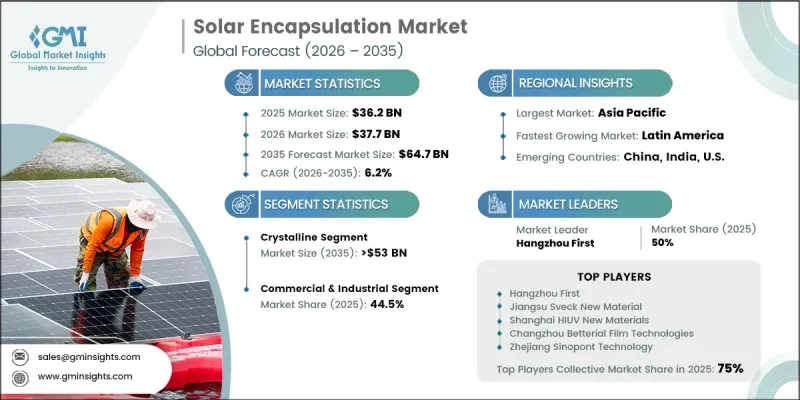
태양전지 봉지 업계 전반의 성장은 태양광 제조의 현지화 전환이 가속화되고 있으며, 국내 태양광발전 생산 능력을 강화하기 위한 투자가 증가하고 있는 데 힘입고 있습니다. 선진국 및 개발도상국 정부는 태양광 모듈 제조 분야의 자급자족을 적극적으로 추진하고 있으며, 이로 인해 지역 전체의 공급망에서 고성능 밀봉재에 대한 막대한 수요가 발생하고 있습니다. 전 세계에서 태양광 모듈의 생산 능력이 지속적으로 확대됨에 따라 밀봉재의 소비량은 꾸준히 증가할 것으로 예상됩니다. 수입 태양광 부품에 대한 의존도를 낮추려는 노력에 따라 현지 제조 생태계에 대한 투자가 촉진되고 있으며, 이로 인해 주요 태양광발전 소재의 수요가 증가하고 있습니다. 또한 수직 통합형 태양광 제조업체의 부상은 밀봉재 제품의 대규모 조달로 이어지고 있으며, 이는 시장 성장을 더욱 촉진하고 있습니다. 또한 태양광발전 프로젝트에 대한 투자 확대는 모듈의 내구성과 운영 효율을 향상시키는 고품질 밀봉재 시장에 새로운 기회를 창출하고 있습니다. 장기적인 태양광발전 도입 전략과 태양광발전 밸류체인 전반에 걸친 비용 최적화에 대한 관심이 높아지면서 수요가 더욱 증가하고 있습니다. 또한 태양광발전 기술의 발전과 모듈 설계의 진화에 따라 뛰어난 성능, 신뢰성 및 장기적인 보호 기능을 제공할 수 있는 특수 밀봉 솔루션에 대한 수요가 증가하고 있으며, 이는 전 세계 태양전지 밀봉 시장에 대한 긍정적인 전망을 더욱 공고히 하고 있습니다.
| 시장 범위 | |
|---|---|
| 시작연도 | 2025년 |
| 예측 기간 | 2026-2035년 |
| 시작 금액 | 362억 달러 |
| 예측 금액 | 647억 달러 |
| CAGR | 6.2% |
고효율 태양전지 모듈의 채택 확대는 태양전지 봉지재 시장의 혁신을 더욱 촉진하고 있습니다. 업계에서는 진화하는 태양전지 셀 구조에 대응하면서도 광학적 성능, 기계적 강도, 전기 절연 특성의 향상을 실현할 수 있는 첨단 봉지재에 대한 수요가 높아지고 있습니다. 태양전지 제조사들이 에너지 출력과 모듈 수명의 극대화에 지속적으로 주력함에 따라 기술적으로 정교한 밀봉 솔루션의 필요성은 점점 더 중요해지고 있습니다. 지속적인 소재 혁신은 차세대 태양광발전 시스템을 지원하고, 장기적인 시장 확대를 유지하는 데 중요한 역할을 할 것으로 예상됩니다.
결정질 부문은 비용 효율이 높은 태양전지 모듈 생산에 광범위하게 활용되는 데 힘입어, 2035년까지 530억 달러에 달할 것으로 전망됩니다. 이 부문에서 사용되는 밀봉재는 합리적인 가격을 유지하면서도 신뢰할 수 있는 열 안정성, 자외선 차단 기능 및 모듈의 장기적인 내구성을 제공할 수 있다는 점에서 높은 평가를 받고 있습니다. 결정계 기술에 수반되는 비교적 단순한 구조적 요건은 확립된 밀봉 솔루션의 사용을 지속적으로 촉진하고 있으며, 이는 해당 부문 전체의 지속적인 성장을 지원하고 있습니다. 전 세계 결정질 태양광 모듈의 보급은 봉지재 수요 증가에 기여하는 중요한 요인으로 계속해서 작용하고 있습니다.
주거용 애플리케이션 부문은 2035년까지 178억 달러에 달할 것으로 예상됩니다. 시장 성장은 신뢰성이 높고 수명이 긴 재생에너지 솔루션을 원하는 주택 소유주들이 옥상 태양광발전 시스템 설치를 늘리고 있는 데 힘입어 이루어지고 있습니다. 주택용 태양광 모듈에는 장기간 가동하는 동안 광학적 투명성, 내후성 및 구조적 무결성을 유지할 수 있는 밀봉재가 필요합니다. 미관이 뛰어난 태양광발전 설비에 대한 소비자의 관심이 높아지고, 주택 구조에 태양광 기술이 지속적으로 통합됨에 따라 이 부문에서 고품질 밀봉재에 대한 수요가 더욱 증가하고 있습니다.
미국의 태양전지 봉지 시장은 2025년에 98억 달러로 평가되었습니다. 해당 지역의 시장 확대는 국내 태양광발전 생산 능력 강화와 공급망의 회복탄력성 향상을 목표로 한 투자 증가에 힘입어 이루어지고 있습니다. 태양광발전 소재의 지역내 생산을 강화하고 외부 공급에 대한 의존도를 낮추려는 노력이, 밀봉재 제조업체들에게 유리한 환경을 조성하고 있습니다. 지속적인 정책 지원과 태양광발전 도입 활동의 확대로 인해, 예측 기간 중 북미 전역에서 시장 성장이 더욱 가속화될 것으로 전망됩니다.
자주 묻는 질문
목차
제1장 조사 방법과 범위
제2장 개요
제3장 업계 인사이트
제4장 경쟁 구도
제5장 시장 규모·예측 : 패널 유형별, 2022-2035년
제6장 시장 규모·예측 : 재료 유형별, 2022-2035년
제7장 시장 규모·예측 : 용도별, 2022-2035년
제8장 시장 규모·예측 : 최종 용도별, 2022-2035년
제9장 시장 규모·예측 : 지역별, 2022-2035년
제10장 기업 개요
KSA 26.06.24The Global Solar Encapsulation Market was valued at USD 36.2 billion in 2025 and is estimated to grow at a CAGR of 6.2% to reach USD 64.7 billion by 2035.
Growth across the solar encapsulation industry is supported by the accelerating transition toward localized solar manufacturing and increasing investments aimed at strengthening domestic photovoltaic production capabilities. Governments across both developed and developing economies are actively promoting self-sufficiency in solar module manufacturing, creating substantial demand for high-performance encapsulation materials throughout regional supply chains. As solar module production capacity continues to expand globally, consumption of encapsulation materials is expected to rise steadily. Efforts to reduce reliance on imported solar components are encouraging greater investment in local manufacturing ecosystems, which is increasing demand for critical photovoltaic materials. The emergence of vertically integrated solar manufacturers is also contributing to large-scale procurement of encapsulation products, further supporting market growth. In addition, growing investments in solar power generation projects are creating favorable opportunities for premium encapsulation materials that enhance module durability and operational efficiency. Long-term solar deployment strategies and increasing focus on cost optimization throughout the solar value chain continue to strengthen demand. Furthermore, advancements in photovoltaic technologies and evolving module designs are increasing the need for specialized encapsulation solutions capable of delivering superior performance, reliability, and long-term protection, reinforcing the positive outlook for the global solar encapsulation market.
| Market Scope | |
|---|---|
| Start Year | 2025 |
| Forecast Year | 2026-2035 |
| Start Value | $36.2 Billion |
| Forecast Value | $64.7 Billion |
| CAGR | 6.2% |
Increasing adoption of high-efficiency solar modules is further driving innovation within the solar encapsulation market. The industry is witnessing rising demand for advanced encapsulation materials that can support evolving photovoltaic cell architectures while delivering improved optical performance, mechanical strength, and electrical insulation characteristics. As solar manufacturers continue to focus on maximizing energy output and module lifespan, the need for technologically advanced encapsulation solutions is becoming increasingly important. Continuous material innovation is expected to play a critical role in supporting the next generation of solar energy systems and sustaining long-term market expansion.
The crystalline segment is projected to reach USD 53 billion by 2035, supported by its widespread utilization in cost-effective solar module production. Encapsulation materials used within this segment are valued for their ability to provide dependable thermal stability, ultraviolet protection, and long-term module durability while maintaining affordability. The relatively straightforward structural requirements associated with crystalline technologies continue to encourage the use of established encapsulation solutions, supporting ongoing growth across the segment. Strong adoption of crystalline solar modules worldwide remains a key factor contributing to increasing demand for encapsulation materials.
The residential application segment is expected to reach USD 17.8 billion by 2035. Market growth is being driven by the increasing installation of rooftop solar systems among homeowners seeking reliable and long-lasting renewable energy solutions. Residential solar modules require encapsulation materials capable of maintaining optical transparency, weather resistance, and structural integrity over extended operating periods. Growing consumer interest in aesthetically appealing solar installations and the continued integration of solar technologies into residential structures are further contributing to rising demand for premium encapsulation products within this segment.
U.S. Solar Encapsulation Market was valued at USD 9.8 billion in 2025.Market expansion across the region is being supported by increasing investments aimed at strengthening domestic solar manufacturing capabilities and improving supply chain resilience. Efforts to enhance regional production of photovoltaic materials and reduce external supply dependencies are creating favorable conditions for encapsulation material manufacturers. Continued policy support and growing solar deployment activities are expected to further stimulate market growth throughout North America over the forecast period.
Major companies operating in the Global Solar Encapsulation Industry include 3M, Alishan Green Energy, Al Technology, Changzhou Betterial Film Technologies, Crown Advanced Materials, Cybrid Technologies, Dow Corning, DuPont, Eastman, Endurans Solar, Enrich Encap Pvt Ltd., First Solar, Hangzhou First PV Material, Jiangsu Sveck New Material, Jolywood (Suzhou) Sunwatt, Momentive, Mitsubishi Chemicals, RenewSys India, SATINAL SpA, Shanghai HIUV New Materials, Sunlink Photovoltaic, and Zhejiang Sinopont Technology. Companies participating in the solar encapsulation market are implementing a range of strategic initiatives to strengthen their market position and expand their competitive advantage. Significant investments in research and development are focused on enhancing material durability, optical performance, weather resistance, and compatibility with advanced photovoltaic technologies. Manufacturers are also expanding production capacities to meet growing global demand and improve supply chain reliability. Strategic partnerships with solar module producers and long-term supply agreements are helping companies secure stable revenue streams and strengthen customer relationships. Many industry participants are pursuing geographic expansion strategies to increase their presence in high-growth solar markets.
Table of Contents
Chapter 1 Methodology & Scope
- 1.1 Research design
- 1.2 Quality commitment
- 1.2.1 GMI AI policy & data integrity commitment
- 1.2.1.1 Source consistency protocol
- 1.2.1 GMI AI policy & data integrity commitment
- 1.3 Research Trail & Confidence Scoring
- 1.3.1 Research Trail Components
- 1.3.2 Scoring Components
- 1.4 Data collection
- 1.4.1 Partial list of primary sources
- 1.5 Data mining sources
- 1.5.1 Paid sources
- 1.5.1.1 Sources, by region
- 1.5.1 Paid sources
- 1.6 Base estimates and calculations
- 1.6.1 Base year calculation for any one approach
- 1.7 Forecast model
- 1.8 Research transparency addendum
- 1.8.1 Source attribution framework
- 1.8.2 Quality assurance metrics
- 1.8.3 Our commitment to trust
- 1.9 Market definitions
Chapter 2 Executive Summary
- 2.1 Industry synopsis, 2022 - 2035
- 2.2 Business trends
- 2.3 Panel type trends
- 2.4 Material type trends
- 2.5 Application trends
- 2.6 End use trends
- 2.7 Regional trends
Chapter 3 Industry Insights
- 3.1 Industry ecosystem
- 3.1.1 Raw Material Suppliers
- 3.1.2 Encapsulant Film Manufacturers
- 3.1.3 Solar Module OEMs & Lamination Equipment Providers
- 3.1.4 EPC Contractors & Downstream Installers
- 3.1.5 End-Use Buyers & Independent Power Producers (IPPs)
- 3.2 Regulatory landscape
- 3.2.1 IEC Standards for PV Encapsulants
- 3.2.2 EU REACH & RoHS Compliance Impact on Encapsulant Chemistry
- 3.2.3 Anti-Dumping Measures & Trade Policies
- 3.2.4 National Renewable Energy Mandates & Their Encapsulant Demand Implications
- 3.2.5 Environmental & Recycling Regulations
- 3.3 Industry impact forces
- 3.3.1 Growth drivers
- 3.3.2 Industry pitfalls & challenges
- 3.4 Growth potential analysis
- 3.5 Porter's analysis
- 3.5.1 Bargaining power of suppliers
- 3.5.2 Bargaining power of buyers
- 3.5.3 Threat of new entrants
- 3.5.4 Threat of substitutes
- 3.6 PESTEL analysis
- 3.6.1 Political factors
- 3.6.2 Economic factors
- 3.6.3 Social factors
- 3.6.4 Technological factors
- 3.6.5 Legal factors
- 3.6.6 Environmental factors
- 3.7 Technology & innovation landscape
- 3.7.1 EVA Technology Evolution & Limitations
- 3.7.2 POE & Non-EVA Encapsulant Advancements
- 3.7.3 Next-Generation Encapsulant Technologies
- 3.7.4 Encapsulant Requirements for Perovskite & Tandem Modules
- 3.7.5 Smart Encapsulants & Functional Integration
- 3.8 Pricing Analysis (Driven by Primary Research)
- 3.8.1 Historical Price Trend Analysis by Material Type
- 3.8.2 Pricing Strategy by Player Type
- 3.8.3 Impact of Raw Material Costs on Encapsulant Pricing
- 3.9 Trade Data Analysis (Driven by Primary Research)
- 3.9.1 Import/Export Volume & Value Trends by Encapsulant Type
- 3.9.2 Key Trade Corridors & Tariff Impact
- 3.10 Impact of AI & Generative AI (Solution Core)
- 3.10.1 AI-Driven Disruption of Encapsulant Design & Formulation Processes
- 3.10.2 GenAI Use Cases & Adoption Roadmap by Segment
- 3.10.3 Risks, Limitations & Regulatory Considerations for AI in PV Manufacturing
- 3.11 Capacity & Production Landscape (Driven by Primary Research)
- 3.11.1 Installed Production Capacity by Region & Key Producer
- 3.11.2 Capacity Utilization Rates & Expansion Pipeline
Chapter 4 Competitive landscape, 2026
- 4.1 Introduction
- 4.2 Company market share analysis, by region, 2025
- 4.2.1 North America
- 4.2.2 Europe
- 4.2.3 Asia Pacific
- 4.2.4 Middle East & Africa
- 4.2.5 Latin America
- 4.3 Competitive analysis of major market players
- 4.4 Competitive positioning matrix
- 4.5 Key developments
- 4.5.1 Mergers & acquisitions
- 4.5.2 Partnerships & collaborations
- 4.5.3 New product launches
- 4.5.4 Expansion plans & funding
- 4.6 Company tier benchmarking
- 4.6.1 Tier classification criteria & qualifying thresholds
- 4.6.2 Tier positioning matrix by revenue, geography & innovation
Chapter 5 Market Size and Forecast, By Panel Type, 2022 - 2035 (USD Billion)
- 5.1 Key trends
- 5.2 Crystalline
- 5.3 Thin Film
- 5.4 Others
Chapter 6 Market Size and Forecast, By Material Type, 2022 - 2035 (USD Billion)
- 6.1 Key trends
- 6.2 EVA
- 6.2.1 Transparent
- 6.2.2 White
- 6.3 POE
- 6.4 EPE
Chapter 7 Market Size and Forecast, By Application, 2022 - 2035 (USD Billion)
- 7.1 Key trends
- 7.2 Residential
- 7.3 Commercial & industrial
- 7.4 Utility
Chapter 8 Market Size and Forecast, By End Use, 2022 - 2035 (USD Billion)
- 8.1 Key trends
- 8.2 Construction
- 8.3 Electronics
- 8.4 Others
Chapter 9 Market Size and Forecast, By Region, 2022 - 2035 (USD Billion)
- 9.1 Key trends
- 9.2 North America
- 9.2.1 U.S.
- 9.2.2 Canada
- 9.2.3 Mexico
- 9.3 Europe
- 9.3.1 Austria
- 9.3.2 Denmark
- 9.3.3 Finland
- 9.3.4 France
- 9.3.5 Germany
- 9.3.6 Italy
- 9.4 Asia Pacific
- 9.4.1 China
- 9.4.2 Australia
- 9.4.3 India
- 9.4.4 Japan
- 9.4.5 South Korea
- 9.4.6 Singapore
- 9.5 Middle East and Africa
- 9.5.1 Israel
- 9.5.2 Saudi Arabia
- 9.5.3 UAE
- 9.5.4 Jordan
- 9.5.5 Oman
- 9.6 Latin America
- 9.6.1 Brazil
- 9.6.2 Chile
- 9.6.3 Argentina
- 9.6.4 Peru
Chapter 10 Company Profiles
- 10.1 3M
- 10.2 Alishan Green Energy
- 10.3 Al Technology
- 10.4 Changzhou Betterial Film Technologies
- 10.5 Crown Advanced Materials
- 10.6 Cybrid Technologies
- 10.7 Dow Corning
- 10.8 DuPont
- 10.9 Eastman
- 10.10 Endurans Solar
- 10.11 Enrich Encap Pvt Ltd.
- 10.12 First Solar
- 10.13 Hangzhou First PV Material
- 10.14 Jiangsu Sveck New Material
- 10.15 Jolywood (Suzhou) Sunwatt
- 10.16 Momentive
- 10.17 Mitsubishi Chemicals
- 10.18 RenewSys India
- 10.19 SATINAL SpA
- 10.20 Shanghai HIUV New Materials
- 10.21 Sunlink Photovoltaic
- 10.22 Zhejiang Sinopont Technology