

|
시장보고서
상품코드
2061418
파브리병 치료 시장 기회, 성장요인, 업계 동향 분석 및 예측(2026-2035년)Fabry Disease Treatment Market Opportunity, Growth Drivers, Industry Trend Analysis, and Forecast 2026 - 2035 |
||||||

세계의 파브리병 치료제 시장은 2025년에 25억 달러로 평가되고 CAGR 8.5%로 성장하며, 2035년까지 56억 달러에 달할 것으로 추정되고 있습니다.
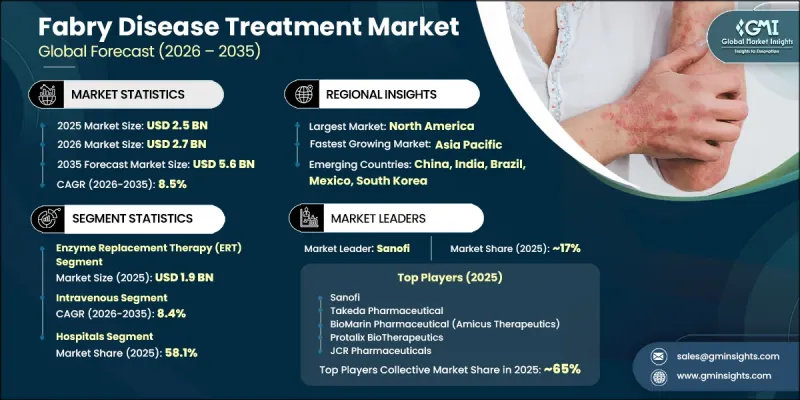
파브리병에 대한 첨단이고 표적화된 치료 솔루션에 대한 수요가 증가함에 따라 향후 수년간 시장 확대가 크게 촉진될 것으로 예상됩니다. 희귀 유전성 질환에 대한 인식이 높아지는 데 더해, 질환 진단 및 치료에 대한 접근성이 개선되면서 전 세계 업계의 성장이 더욱 가속화되고 있습니다. 각 제약사는 임상 결과 개선으로 이어지는 혁신적인 치료법의 도입에 초점을 맞춘 연구개발 활동에 대한 투자를 확대하고 있습니다. 의료 인프라 확충, 희귀질환 치료에 대한 규제 측면의 지원, 그리고 정밀 의료 솔루션의 활용 확대 역시 시장 발전에 기여하고 있습니다. 파브리병과 관련된 합병증의 부담이 커짐에 따라 의료 서비스 제공자들은 환자의 장기적인 관리와 삶의 질을 향상시키는 첨단 치료 방식의 도입을 촉진하고 있습니다. 또한 생명공학 및 희귀질환 치료제 개발 분야의 지속적인 발전으로 인해 새로운 치료법의 상용화가 가속화되고 있으며, 이는 환자들의 치료 접근성 확대를 지원할 뿐만 아니라 예측 기간 중 파브리병 치료 산업 전반의 성장 전망을 강화하고 있습니다.
| 시장 범위 | |
|---|---|
| 시작연도 | 2025년 |
| 예측 기간 | 2026-2035년 |
| 개시 금액 | 25억 달러 |
| 예측액 | 56억 달러 |
| CAGR | 8.5% |
파브리병은 신장, 심혈관계, 신경계, 피부, 눈 등 체내의 여러 장기에 영향을 미치는 희귀 유전성 질환입니다. 이 질환은 α-갈락토시다제 A 효소의 결핍으로 인해 발병하며, 이로 인해 신체 조직 내에 글로봇리아오실세라마이드가 축적됩니다. 파브리병 환자는 만성 신경통, 피부 이상, 발한 감소, 시력과 관련된 합병증 등을 겪는 경우가 많습니다. 현재, 질환의 진행을 억제하고 환자의 예후를 개선하기 위한 가장 일반적인 치료법으로 효소 보충 요법과 샤페론 요법이 사용되고 있습니다. 조기 진단과 장기적인 질환 관리에 대한 임상적 관심이 높아짐에 따라 전 세계에서 효과적인 치료법에 대한 수요가 더욱 증가하고 있습니다.
효소 대체요법(ERT) 부문은 2025년에 19억 달러에 달했습니다. 이 부문의 성장은 주로 파브리병의 진단율 상승과, 환자의 효소 결핍을 해결하기 위한 표준 치료법으로 효소 보충 요법이 널리 채택되고 있는 데 힘입은 것입니다. 진단 능력의 향상과 의료 종사자들의 인식 제고에 힘입어 질환의 조기 발견이 가능해지면서, ERT를 기반으로 한 치료의 대상이 되는 환자층이 확대되고 있습니다. 또한 유전자 검사 기술과 임상 검사 기술의 지속적인 발전도 의료 현장 전반에 걸쳐 치료 도입 확대에 기여하고 있습니다.
2025년에는 병원 부문이 58.1%의 점유율을 차지했습니다. 병원은 정확한 질환 모니터링과 치료 수행에 필요한 첨단 진단 인프라와 전문적인 의료 지식을 갖추고 있으며, 파브리병 관리에 있으며, 주요 치료 환경으로서의 역할을 계속해서 수행하고 있습니다. 병원 환경에서 효소 보충 요법의 활용이 확대되면서, 해당 부문의 성장을 더욱 촉진하고 있습니다. 이는 이러한 치료의 경우, 대개 감시 하에 정맥 주사를 투여하거나 환자를 장기간 관찰해야 하기 때문입니다. 의료 체계의 확충과 희귀질환 전문 치료 센터에 대한 접근성 향상 또한 파브리병 치료에서 병원의 역할을 강화하고 있습니다.
2025년, 북미의 파브리병 치료 시장은 44.8%의 점유율을 차지했습니다. 이 지역은 유서 깊은 바이오의약품 기업의 강력한 입지, 첨단 희귀질환 치료법의 급속한 보급, 그리고 조기 진단 및 치료에 대한 접근성을 지원하는 고도로 발달된 헬스케어 생태계 덕분에 계속해서 시장을 선도하는 위치를 유지하고 있습니다. 연구 활동에 대한 투자 확대, 유리한 상환 제도, 그리고 희귀질환 치료제 분야의 지속적인 혁신이 해당 지역의 시장 성장을 더욱 지원하고 있습니다. 사노피(Sanofi)나 아미쿠스 테라퓨틱스(Amicus Therapeutics)와 같은 주요 기업의 존재 또한 북미 전역에서 파브리병에 대한 혁신적인 치료 솔루션의 지속적인 상용화와 확장을 지원하고 있습니다.
자주 묻는 질문
목차
제1장 조사 방법과 범위
제2장 개요
제3장 업계 인사이트
제4장 경쟁 구도
제5장 시장 추산·예측 : 치료별, 2022-2035년
제6장 시장 추산·예측 : 투여 경로별, 2022-2035년
제7장 시장 추산·예측 : 최종 사용별, 2022-2035년
제8장 시장 추산·예측 : 지역별, 2022-2035년
제9장 기업 개요
KSA 26.06.24The Global Fabry Disease Treatment Market was valued at USD 2.5 billion in 2025 and is estimated to grow at a CAGR of 8.5% to reach USD 5.6 billion by 2035.
Increasing demand for advanced and targeted therapeutic solutions for Fabry disease is expected to significantly support market expansion over the coming years. Rising awareness regarding rare genetic disorders, along with improvements in disease diagnosis and treatment accessibility, continues to strengthen industry growth worldwide. Pharmaceutical companies are increasing investments in research and development activities focused on introducing innovative treatment options with improved clinical outcomes. Expanding healthcare infrastructure, favorable regulatory support for rare disease therapies, and growing availability of precision medicine solutions are also contributing to market development. The increasing burden of Fabry disease-related complications is encouraging healthcare providers to adopt advanced therapeutic approaches that improve long-term patient management and quality of life. In addition, ongoing advancements in biotechnology and rare disease treatment development are accelerating the commercialization of novel therapies, supporting wider patient access and enhancing the overall growth outlook for the Fabry disease treatment industry throughout the forecast period.
| Market Scope | |
|---|---|
| Start Year | 2025 |
| Forecast Year | 2026-2035 |
| Start Value | $2.5 Billion |
| Forecast Value | $5.6 Billion |
| CAGR | 8.5% |
Fabry disease is a rare hereditary disorder that impacts several organs throughout the body, including the kidneys, cardiovascular system, nervous system, skin, and eyes. The condition develops due to inadequate levels of the alpha-galactosidase A enzyme, leading to the buildup of globotriaosylceramide within body tissues. Patients affected by Fabry disease often experience chronic nerve pain, skin-related abnormalities, reduced sweating, and vision-related complications. Currently, enzyme replacement therapy and chaperone therapy remain the most commonly utilized treatment approaches for managing disease progression and improving patient outcomes. Growing clinical focus on early diagnosis and long-term disease management is further increasing demand for effective treatment solutions worldwide.
The Enzyme Replacement Therapy (ERT) segment reached USD 1.9 billion in 2025. Segment growth is primarily supported by the increasing diagnosis rate of Fabry disease and the widespread adoption of enzyme replacement therapy as a standard treatment approach for addressing enzyme deficiency in affected individuals. Improvements in diagnostic capabilities and expanding awareness among healthcare professionals are enabling earlier identification of the disease, resulting in a larger eligible patient population for ERT-based therapies. Ongoing advancements in genetic testing technologies and laboratory diagnostics are also contributing to increased treatment adoption across healthcare settings.
The hospitals segment accounted for 58.1% share in 2025. Hospitals continue to serve as the primary treatment environment for Fabry disease management due to the availability of advanced diagnostic infrastructure and specialized medical expertise required for accurate disease monitoring and therapy administration. The growing use of enzyme replacement therapy within hospital settings is further supporting segment growth, as these treatments often require supervised infusion procedures and long-term patient observation. Expanding healthcare capabilities and increasing access to specialized rare disease treatment centers are also strengthening the role of hospitals in Fabry disease care.
North America Fabry Disease Treatment Market held a share of 44.8% in 2025. The region continues to maintain a leading market position due to the strong presence of established biopharmaceutical companies, rapid adoption of advanced rare disease therapies, and a highly developed healthcare ecosystem that supports early diagnosis and treatment accessibility. Increasing investments in research activities, favorable reimbursement frameworks, and continuous innovation in rare disease therapeutics are further contributing to regional market growth. The presence of major industry participants such as Sanofi and Amicus Therapeutics is also supporting ongoing commercialization and expansion of innovative Fabry disease treatment solutions across North America.
Leading companies operating in the Global Fabry Disease Treatment Market include Avrobio, BioMarin Pharmaceutical (Amicus Therapeutics), Freeline Therapeutics, Idorsia Pharmaceuticals, ISU Abxis, JCR Pharmaceuticals, Novartis, Pfizer, Protalix BioTherapeutics, Sanofi SA, Takeda Pharmaceuticals, and Viatris. Companies operating in the Fabry disease treatment market are implementing multiple strategic initiatives to strengthen their market position and expand their global presence. Industry participants are heavily investing in research and development activities to introduce advanced therapies with improved efficacy and long-term treatment outcomes. Strategic collaborations, licensing agreements, and partnerships with biotechnology firms are helping companies accelerate drug development and expand product pipelines. Market players are also focusing on expanding clinical trial programs and obtaining regulatory approvals for novel treatment options across multiple regions. Increasing investments in gene therapy research, precision medicine technologies, and rare disease diagnostics are further supporting competitive growth strategies. In addition, companies are strengthening patient support programs, improving treatment accessibility, and expanding manufacturing capabilities to enhance market penetration and reinforce their foothold within the global Fabry disease treatment industry.
Table of Contents
Chapter 1 Methodology and Scope
- 1.1 Market scope and definition
- 1.2 Research approach
- 1.3 Quality commitments
- 1.3.1 GMI AI policy and data integrity commitment
- 1.3.1.1 Source consistency protocol
- 1.3.1 GMI AI policy and data integrity commitment
- 1.4 Research trail and confidence scoring
- 1.4.1 Research trail components
- 1.4.2 Scoring components
- 1.5 Data collection
- 1.5.1 Partial list of primary sources
- 1.6 Data mining sources
- 1.6.1 Paid sources
- 1.6.1.1 Sources, by region
- 1.6.1 Paid sources
- 1.7 Base estimates and calculations
- 1.7.1 Revenue share analysis
- 1.7.2 Base year calculation
- 1.8 Forecast model
- 1.9 Research transparency addendum
- 1.9.1 Source attribution framework
- 1.9.2 Quality assurance metrics
- 1.9.3 Our commitment to trust
Chapter 2 Executive Summary
- 2.1 Industry 360° synopsis
- 2.2 Key market trends
- 2.2.1 Regional trends
- 2.2.2 Treatment trends
- 2.2.3 Route of administration trends
- 2.2.4 End use trends
- 2.3 CXO perspectives: Strategic imperatives
Chapter 3 Industry Insights
- 3.1 Industry ecosystem analysis
- 3.2 Industry impact forces
- 3.2.1 Growth drivers
- 3.2.1.1 Rising cases of Fabry disease across the globe
- 3.2.1.2 Growing awareness among specialists and physicians
- 3.2.1.3 Advancements in Fabry disease treatment therapies
- 3.2.1.4 Rising health awareness and demand for early-stage diagnosis
- 3.2.2 Industry pitfalls and challenges
- 3.2.2.1 High treatment cost
- 3.2.2.2 Limited treatment options
- 3.2.3 Market opportunities
- 3.2.3.1 Expansion of next generation gene therapy platforms
- 3.2.3.2 Growing investment in rare disease R&D and regulatory incentives
- 3.2.1 Growth drivers
- 3.3 Growth potential analysis
- 3.4 Future market trends
- 3.5 Pricing analysis
- 3.6 Product pipeline analysis
- 3.7 Impact of AI and Generation AI on the market
- 3.8 Regulatory landscape
- 3.8.1 North America
- 3.8.2 Europe
- 3.8.3 Asia Pacific
- 3.8.4 Latin America
- 3.8.5 MEA
- 3.9 Porter’s analysis
- 3.10 PESTEL analysis
Chapter 4 Competitive Landscape, 2025
- 4.1 Introduction
- 4.2 Company market share analysis
- 4.2.1 North America
- 4.2.2 Europe
- 4.2.3 Asia Pacific
- 4.3 Company matrix analysis
- 4.4 Competitive analysis of major market players
- 4.5 Competitive positioning matrix
- 4.6 Key developments
- 4.6.1 Merger and acquisition
- 4.6.2 Partnership and collaboration
- 4.6.3 New product launches
- 4.6.4 Expansion plans
Chapter 5 Market Estimates and Forecast, By Treatment, 2022 - 2035 ($ Mn)
- 5.1 Key trends
- 5.2 Enzyme replacement therapy (ERT)
- 5.3 Chaperone treatment
- 5.4 Other treatment types
Chapter 6 Market Estimates and Forecast, By Route of Administration, 2022 - 2035 ($ Mn)
- 6.1 Key trends
- 6.2 Intravenous
- 6.3 Oral
Chapter 7 Market Estimates and Forecast, By End Use, 2022 - 2035 ($ Mn)
- 7.1 Key trends
- 7.2 Hospitals
- 7.3 Homecare settings
- 7.4 Other end users
Chapter 8 Market Estimates and Forecast, By Region, 2022 - 2035 ($ Mn)
- 8.1 Key trends
- 8.2 North America
- 8.2.1 U.S.
- 8.2.2 Canada
- 8.3 Europe
- 8.3.1 Germany
- 8.3.2 UK
- 8.3.3 France
- 8.3.4 Spain
- 8.3.5 Italy
- 8.3.6 Netherlands
- 8.4 Asia Pacific
- 8.4.1 China
- 8.4.2 India
- 8.4.3 Japan
- 8.4.4 Australia
- 8.4.5 South Korea
- 8.5 Latin America
- 8.5.1 Brazil
- 8.5.2 Mexico
- 8.5.3 Argentina
- 8.6 Middle East and Africa
- 8.6.1 South Africa
- 8.6.2 Saudi Arabia
- 8.6.3 UAE
Chapter 9 Company Profiles
- 9.1 BioMarin Pharmaceutical (Amicus Therapeutics)
- 9.2 Avrobio
- 9.3 Freeline Therapeutics
- 9.4 Idorsia Pharmaceuticals
- 9.5 ISU Abxis
- 9.6 JCR Pharmaceuticals
- 9.7 Novartis
- 9.8 Pfizer
- 9.9 Protalix BioTherapeutics
- 9.10 Sanofi
- 9.11 Takeda Pharmaceuticals
- 9.12 Viatris


