

|
시장보고서
상품코드
2061419
항진균제 시장 기회, 성장 촉진요인, 업계 동향 분석 및 예측(2026-2035년)Antifungal Drugs Market Opportunity, Growth Drivers, Industry Trend Analysis, and Forecast 2026 - 2035 |
||||||

세계의 항진균제 시장은 2025년에 168억 달러로 평가되고 CAGR 4.1%로 성장하며, 2035년까지 255억 달러에 달할 것으로 추정되고 있습니다.
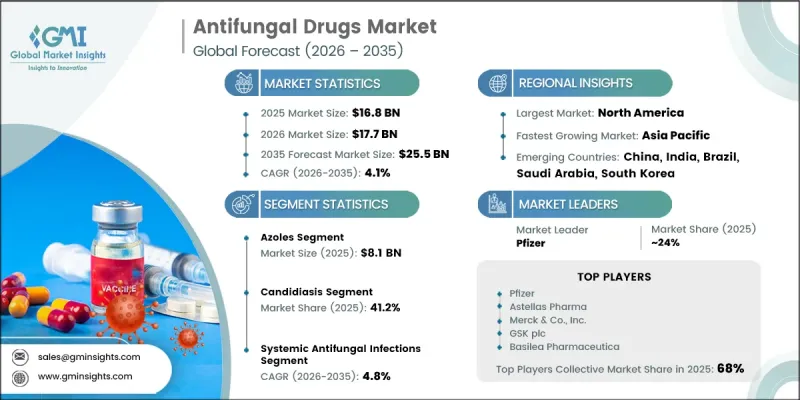
의료 현장에서 진균 감염증의 발생이 증가하는 데다, 전 세계에서 면역결핍 환자 수가 늘어나고 있으며, 시장이 꾸준히 확대되고 있습니다. 병원내 감염으로 인한 진균 감염증 사례의 증가와 침습성 진균 감염증의 조기 진단 및 치료에 대한 의식의 향상 역시 시장 확대를 더욱 지원하고 있습니다. 또한 다제내성 진균 병원체의 급속한 확산으로 인해 항진균제 내성에 대한 우려가 커지고 있으며, 이에 따라 보다 효과적인 치료법에 대한 수요가 높아지고 있습니다. 또한 제약 연구의 지속적인 발전, 의료 서비스에 대한 접근성 개선, 그리고 선진국 및 신흥 국가에서의 항진균 치료법 보급 확대 역시 이 업계에 긍정적인 영향을 미치고 있습니다. 감염병 관리에 대한 투자 증가와 예방 의료 대책에 대한 중요성이 부각되면서, 이는 장기적인 시장 성장에 더욱 기여하고 있습니다. 의료 제공자들이 첨단 치료 프로토콜과 조기 개입 전략에 지속적으로 주력함에 따라 혁신적인 항진균제에 대한 수요는 예측 기간 중 견고한 추세를 보일 것으로 전망됩니다.
| 시장 범위 | |
|---|---|
| 시작연도 | 2025년 |
| 예측 기간 | 2026-2035년 |
| 시작 금액 | 168억 달러 |
| 예측 금액 | 255억 달러 |
| CAGR | 4.1% |
항진균제 시장은 여러 치료제 범주를 통해 표재성, 전신성 및 침습성 진균 감염의 예방, 치료 및 관리에 중점을 두고 있습니다. 이러한 약물은 신체의 다양한 부위에 영향을 미치는 광범위한 진균 감염증에 대해 널리 처방되고 있습니다. 내성 곰팡이 균주에 대한 우려가 커지면서 업계의 경쟁 구도가 크게 변화하고 있습니다. 의료 시설 전반에 걸쳐 다제내성 진균이 급속히 확산됨에 따라 효과적인 치료법과 첨단 항진균제에 대한 필요성이 시급해지고 있습니다. 또한 의료에 대한 인식이 높아지고 진단 기술이 발전함에 따라 조기 발견과 신속한 치료 시작이 가능해졌습니다. 또한 이 시장에서는 효능 향상, 안전성 프로파일 개선, 그리고 보다 광범위한 항진균 효과를 제공하는 치료법에 대한 임상적 수요가 증가하고 있으며, 이는 전 세계적인 제품 혁신 및 상용화 활동을 지속적으로 견인하고 있습니다.
아졸 계열 부문은 광범위한 항진균 활성과 모든 의료 현장에서의 높은 임상적 수용성 덕분에 2025년에는 81억 달러의 시장 규모를 기록했습니다. 아졸계 항진균 요법은 치료 용도에서의 유연성과 다양한 제형의 이용 가능성 덕분에 계속해서 널리 사용되고 있습니다. 병원 환경, 외래 진료 시설 및 예방 치료 프로그램에서 이 기술이 광범위하게 활용되면서 해당 부문의 성장을 더욱 촉진하고 있습니다. 또한 의료진의 높은 숙련도, 우수한 흡수 특성, 입증된 치료 효과 역시 아졸계 항진균제의 광범위한 사용을 지속적으로 지원하고 있습니다. 또한 이 부문은 여러 진균 감염증에 대한 1차 치료제로서 지속적으로 사용되고 있는 점에서도 혜택을 보고 있으며, 전 세계 항진균제 시장에서 우위를 공고히 하고 있습니다.
칸디다증 부문은 2025년에 41.2%의 시장 점유율을 차지했습니다. 칸디다증은 전 세계에서 가장 많이 진단되는 진균 감염증 중 하나로 자리매김하고 있으며, 항진균 치료에 대한 수요를 크게 견인하고 있습니다. 진균성 질환의 유병률 증가와 중증화 추세로 인해 조기 진단 및 치료에 대한 인식이 높아지면서, 그 결과 항진균제 사용이 증가하고 있습니다. 감염 관리에 중점을 둔 의료 정책의 증가와 진균성 질환의 합병증에 대한 임상적 관심이 높아진 점도 이 부문의 성장을 지원하고 있습니다. 또한 취약한 환자 집단에서 진균 감염의 부담이 증가함에 따라 칸디다증에 대한 효과적인 치료법에 대한 수요가 계속해서 증가하고 있습니다.
2025년, 북미의 항진균제 시장은 38.6%의 점유율을 차지했습니다. 이 지역은 첨단인 의료 인프라, 높은 진단 및 치료율, 그리고 항진균제 개발 및 상용화에 주력하는 대형 제약사들의 강력한 입지 덕분에 계속해서 업계를 선도하고 있습니다. 면역결핍 환자, 고령 인구, 암 환자, 장기 이식 수혜자에서 진균 감염증의 사례 수가 증가하고 있는 것이 해당 지역 전체의 시장 수요에 크게 기여하고 있습니다. 또한 유리한 상환 제도, 의료비 증가, 감염병 조사에 대한 지속적인 투자가 북미 전역에서 시장의 지속적인 성장을 지원하고 있습니다.
자주 묻는 질문
목차
제1장 조사 방법과 범위
제2장 개요
제3장 업계 인사이트
제4장 경쟁 구도
제5장 시장 추산·예측 : 약제 클래스별, 2022-2035년
제6장 시장 추산·예측 : 적응증별, 2022-2035년
제7장 시장 추산·예측 : 감염 유형별, 2022-2035년
제8장 시장 추산·예측 : 투여 경로별, 2022-2035년
제9장 시장 추산·예측 : 약제별, 2022-2035년
제10장 시장 추산·예측 : 유형별, 2022-2035년
제11장 시장 추산·예측 : 유통 채널별, 2022-2035년
제12장 시장 추산·예측 : 지역별, 2022-2035년
제13장 기업 개요
KSA 26.06.24The Global Antifungal Drugs Market was valued at USD 16.8 billion in 2025 and is estimated to grow at a CAGR of 4.1% to reach USD 25.5 billion by 2035.
The market is steadily advancing due to the growing occurrence of fungal infections across healthcare settings, coupled with the increasing population of immunocompromised patients worldwide. Rising cases of hospital-associated fungal infections and growing awareness regarding timely diagnosis and treatment of invasive fungal diseases are further supporting market expansion. In addition, concerns surrounding antifungal resistance have intensified due to the rapid spread of multidrug-resistant fungal pathogens, creating strong demand for more effective therapeutic solutions. The industry is also benefiting from ongoing advancements in pharmaceutical research, improved access to healthcare services, and expanding adoption of antifungal therapies in both developed and emerging economies. Increasing investments in infectious disease management and rising emphasis on preventive healthcare measures are further contributing to long-term market growth. As healthcare providers continue focusing on advanced treatment protocols and early intervention strategies, the demand for innovative antifungal medications is expected to remain strong throughout the forecast period.
| Market Scope | |
|---|---|
| Start Year | 2025 |
| Forecast Year | 2026-2035 |
| Start Value | $16.8 Billion |
| Forecast Value | $25.5 Billion |
| CAGR | 4.1% |
The antifungal drugs market focuses on the prevention, treatment, and management of superficial, systemic, and invasive fungal infections through multiple therapeutic drug categories. These medications are widely prescribed for a broad range of fungal conditions affecting different parts of the body. Growing concern regarding resistant fungal strains is significantly transforming the competitive landscape of the industry. The rapid spread of highly resistant fungal organisms across healthcare facilities has increased the urgency for effective treatment approaches and advanced antifungal formulations. In addition, rising healthcare awareness and improvements in diagnostic technologies are supporting earlier detection and faster treatment initiation. The market is also witnessing increased clinical demand for therapies that offer enhanced efficacy, improved safety profiles, and broader antifungal coverage, which continues to drive product innovation and commercialization activities globally.
The azoles segment generated USD 8.1 billion in 2025 owing to its broad-spectrum antifungal activity and strong clinical acceptance across healthcare settings. Azole-based antifungal therapies continue to be widely utilized because of their flexibility in treatment applications and availability in multiple formulations. Their extensive use in hospital environments, outpatient care facilities, and preventive treatment programs has further strengthened segment growth. In addition, physician familiarity, favorable absorption characteristics, and established therapeutic effectiveness continue to support the widespread adoption of azole antifungal medications. The segment is also benefiting from continued use in first-line treatment approaches for multiple fungal conditions, reinforcing its dominance in the global antifungal drugs market.
The candidiasis segment accounted for 41.2% share in 2025. Candidiasis remains one of the most diagnosed fungal infections worldwide, contributing significantly to the demand for antifungal therapies. The growing prevalence and increasing severity of fungal diseases have improved awareness regarding early diagnosis and treatment, resulting in greater utilization of antifungal medications. Rising healthcare initiatives focused on infection management and increasing clinical attention toward fungal disease complications are also supporting segment expansion. Furthermore, the increasing burden of fungal infections among vulnerable patient populations continues to accelerate the demand for effective treatment solutions targeting candidiasis.
North America Antifungal Drugs Market held 38.6% share in 2025. The region continues to dominate the industry due to its advanced healthcare infrastructure, high diagnosis and treatment rates, and the strong presence of major pharmaceutical companies engaged in antifungal drug development and commercialization. The growing number of fungal infection cases among immunocompromised individuals, aging populations, oncology patients, and organ transplant recipients is significantly contributing to market demand across the region. In addition, favorable reimbursement systems, increasing healthcare expenditure, and ongoing investments in infectious disease research are supporting continued market expansion throughout North America.
Key companies operating in the Antifungal Drugs Market include Pfizer, Merck & Co., Gilead Sciences, Novartis AG, Sanofi, Astellas Pharma, Bayer AG, GlaxoSmithKline, Cipla, Hikma Pharmaceuticals, Glenmark Pharmaceuticals, Sun Pharmaceutical Industries, and Scynexis. Companies active in the antifungal drugs market are implementing several strategic initiatives to strengthen their market position and expand their global footprint. Leading pharmaceutical manufacturers are increasing investments in research and development activities to introduce advanced antifungal therapies capable of addressing resistant fungal strains and improving treatment outcomes. Strategic collaborations, licensing agreements, and partnerships with research institutions are also helping companies accelerate product innovation and clinical development programs. In addition, businesses are focusing on expanding their product portfolios through new drug approvals, formulation enhancements, and geographic expansion into high-growth healthcare markets. Manufacturers are also prioritizing the development of therapies with improved efficacy, broader antifungal coverage, and enhanced patient safety profiles.
Table of Contents
Chapter 1 Methodology and Scope
- 1.1 Market scope and definition
- 1.2 Research approach
- 1.3 Quality commitments
- 1.3.1 GMI AI policy and data integrity commitment
- 1.3.1.1 Source consistency protocol
- 1.3.1 GMI AI policy and data integrity commitment
- 1.4 Research trail and confidence scoring
- 1.4.1 Research trail components
- 1.4.2 Scoring components
- 1.5 Data collection
- 1.5.1 Partial list of primary sources
- 1.6 Data mining sources
- 1.6.1 Paid sources
- 1.6.1.1 Sources, by region
- 1.6.1 Paid sources
- 1.7 Base estimates and calculations
- 1.7.1 Revenue share analysis
- 1.7.2 Base year calculation
- 1.8 Forecast model
- 1.9 Research transparency addendum
- 1.9.1 Source attribution framework
- 1.9.2 Quality assurance metrics
- 1.9.3 Our commitment to trust
Chapter 2 Executive Summary
- 2.1 Industry 360° synopsis
- 2.2 Key market trends
- 2.2.1 Regional trends
- 2.2.2 Drug class trends
- 2.2.3 Indication trends
- 2.2.4 Infection type trends
- 2.2.5 Route of administration trends
- 2.2.6 Medication trends
- 2.2.7 Type trends
- 2.2.8 Distribution channel trends
- 2.3 CXO perspectives: Strategic imperatives
Chapter 3 Industry Insights
- 3.1 Industry ecosystem analysis
- 3.2 Industry impact forces
- 3.2.1 Growth drivers
- 3.2.1.1 Rising prevalence of invasive and opportunistic fungal infections
- 3.2.1.2 Growing immunocompromised patient population
- 3.2.1.3 Advancements in antifungal drug development
- 3.2.1.4 Expansion of rapid fungal diagnostic technologies
- 3.2.1.5 Growing awareness regarding antifungal resistance
- 3.2.2 Industry pitfalls and challenges
- 3.2.2.1 Rising antifungal resistance
- 3.2.2.2 High treatment costs for advanced antifungal therapies
- 3.2.2.3 Limited awareness and delayed diagnosis
- 3.2.3 Market opportunities
- 3.2.3.1 Expansion of novel antifungal pipelines
- 3.2.3.2 Increasing healthcare investments in emerging markets
- 3.2.1 Growth drivers
- 3.3 Growth potential analysis
- 3.4 Regulatory landscape
- 3.4.1 North America
- 3.4.2 Europe
- 3.4.3 Asia Pacific
- 3.4.4 Latin America
- 3.4.5 Middle East & Africa
- 3.5 Technology and innovation landscape
- 3.5.1 Current technologies
- 3.5.2 Emerging technologies (Driven by Primary Research)
- 3.6 Pricing analysis (Driven by Primary Research)
- 3.6.1 Historical price trend analysis
- 3.6.2 Pricing strategy, by drug class
- 3.7 Pipeline analysis and clinical trial landscape
- 3.8 Impact of AI & Generative AI on the market
- 3.9 Porter's analysis
- 3.10 PESTEL analysis
Chapter 4 Competitive Landscape, 2025
- 4.1 Introduction
- 4.2 Company market share analysis
- 4.2.1 North America
- 4.2.2 Europe
- 4.2.3 Asia Pacific
- 4.3 Company matrix analysis
- 4.4 Competitive analysis of major market players
- 4.5 Competitive positioning matrix
- 4.6 Key developments
- 4.6.1 Merger and acquisition
- 4.6.2 Partnership and collaboration
- 4.6.3 New product launches
- 4.6.4 Expansion plans
Chapter 5 Market Estimates and Forecast, By Drug Class, 2022 - 2035 ($ Mn)
- 5.1 Key trends
- 5.2 Azoles
- 5.3 Echinocandins
- 5.4 Polyenes
- 5.5 Allylamines
- 5.6 Other drug classes
Chapter 6 Market Estimates and Forecast, By Indication, 2022 - 2035 ($ Mn)
- 6.1 Key trends
- 6.2 Dermatophytosis
- 6.3 Aspergillosis
- 6.4 Candidiasis
- 6.5 Mucormycosis
- 6.6 Other indications
Chapter 7 Market Estimates and Forecast, By Infection Type, 2022 - 2035 ($ Mn)
- 7.1 Key trends
- 7.2 Systemic antifungal infections
- 7.3 Superficial antifungal infections
Chapter 8 Market Estimates and Forecast, By Route of Administration, 2022 - 2035 ($ Mn)
- 8.1 Key trends
- 8.2 Oral
- 8.3 Topical
- 8.4 Injectable
Chapter 9 Market Estimates and Forecast, By Medication, 2022 - 2035 ($ Mn)
- 9.1 Key trends
- 9.2 Prescription
- 9.3 OTC
Chapter 10 Market Estimates and Forecast, By Type, 2022 - 2035 ($ Mn)
- 10.1 Key trends
- 10.2 Branded
- 10.3 Generic
Chapter 11 Market Estimates and Forecast, By Distribution Channel, 2022 - 2035 ($ Mn)
- 11.1 Key trends
- 11.2 Hospital pharmacies
- 11.3 Retail pharmacies
- 11.4 Online pharmacies
Chapter 12 Market Estimates and Forecast, By Region, 2022 - 2035 ($ Mn)
- 12.1 Key trends
- 12.2 North America
- 12.2.1 U.S.
- 12.2.2 Canada
- 12.3 Europe
- 12.3.1 Germany
- 12.3.2 UK
- 12.3.3 France
- 12.3.4 Spain
- 12.3.5 Italy
- 12.3.6 Netherlands
- 12.4 Asia Pacific
- 12.4.1 China
- 12.4.2 Japan
- 12.4.3 India
- 12.4.4 Australia
- 12.4.5 South Korea
- 12.5 Latin America
- 12.5.1 Brazil
- 12.5.2 Mexico
- 12.5.3 Argentina
- 12.6 Middle East and Africa
- 12.6.1 South Africa
- 12.6.2 Saudi Arabia
- 12.6.3 UAE
Chapter 13 Company Profiles
- 13.1 Astellas Pharma
- 13.2 Bayer AG
- 13.3 Cipla
- 13.4 Gilead Sciences
- 13.5 Glenmark Pharmaceuticals
- 13.6 GlaxoSmithKline
- 13.7 Hikma Pharmaceuticals
- 13.8 Merck & Co.
- 13.9 Novartis AG
- 13.10 Pfizer
- 13.11 Scynexis
- 13.12 Sun Pharmaceutical Industries
- 13.13 Sanofi


