|
시장보고서
상품코드
2061424
자폐 스펙트럼 장애 치료 시장 기회, 성장 촉진요인, 업계 동향 분석 및 예측(2026-2035년)Autism Spectrum Disorder Treatment Market Opportunity, Growth Drivers, Industry Trend Analysis, and Forecast 2026 - 2035 |
||||||

세계의 자폐 스펙트럼 장애 치료 시장은 2025년에 372억 달러로 평가되고 CAGR 5.1%로 성장하며, 2035년까지 607억 달러에 달할 것으로 추정되고 있습니다.
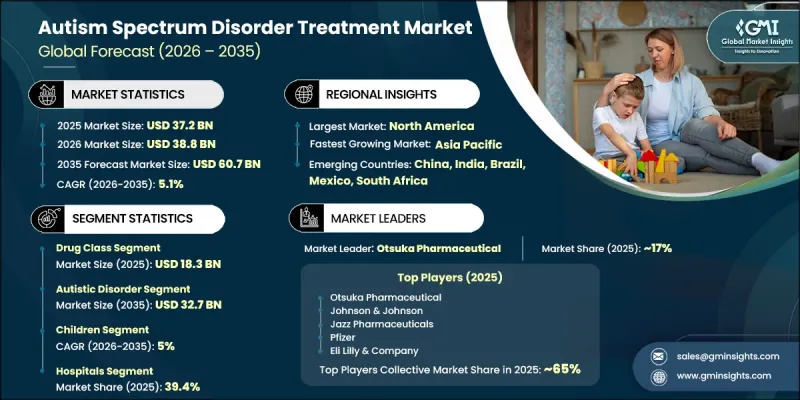
이 시장은 전 세계 자폐 스펙트럼 장애(ASD) 유병률의 증가, 조기 진단에 대한 의식의 향상, 그리고 신경발달장애에 대한 임상적 이해의 심화로 인해 꾸준히 성장하고 있습니다. 선별 검사 체계의 강화와 발달 건강 평가의 보급이 많은 지역에서 진단율 향상에 기여하고 있습니다. 유전학 연구, 신경 영상 진단 기술 및 표준화된 진단 체계의 지속적인 발전으로 인해 자폐 스펙트럼 장애(ASD)를 더 조기에 정확하게 파악할 수 있게 되었으며, 이는 중재 및 돌봄 서비스에 대한 수요를 직접적으로 지원하고 있습니다. 장기적인 인지 기능, 행동, 사회적 성과 개선에 있으며, 조기 개입 프로그램이 수행하는 역할을 지원하는 증거가 잇달아 제시됨에 따라 의료제도에서는 이러한 프로그램의 우선순위가 높아지고 있습니다. 또한 행동 치료, 교육 지원, 의학적 관리를 통합한 다직종 연계 치료 모델에 대한 접근성이 확대되면서 치료 방식의 패턴이 형성되고 있습니다. 개별화된 돌봄 계획과 장기적인 발달 지원에 대한 중요성이 커지고 있는 데다, 자폐증에 특화된 의료 인프라와 전문 돌봄 서비스에 대한 투자 증가까지 더해지면서 전 세계 시장의 성장이 더욱 가속화되고 있습니다.
| 시장 범위 | |
|---|---|
| 시작연도 | 2025년 |
| 예측 기간 | 2026-2035 |
| 시작 금액 | 372억 달러 |
| 예측 금액 | 607억 달러 |
| CAGR | 5.1% |
자폐 스펙트럼 장애(ASD)는 의사소통, 사회적 상호작용, 행동 조절, 감각 처리 측면에서 지속적인 어려움을 특징으로 하는 복잡한 신경발달 장애로 정의됩니다. 치료 전략으로는 일반적으로 행동 치료, 언어 치료 및 작업 치료, 교육 지원 시스템, 그리고 증상 관리와 기능적 능력 향상을 목적으로 하는 약물 치료를 결합한 접근법이 채택되고 있습니다. 전 세계에서 자폐 스펙트럼 장애(ASD)에 대한 인식이 높아짐에 따라 진단률이 크게 상승했고, 체계적인 치료 프로그램과 장기적인 지원 서비스에 대한 수요가 증가하고 있습니다. 진단 툴와 임상 선별 기법의 발전으로 조기 발견 능력이 더욱 향상되어, 적시에 치료에 나설 수 있게 되었습니다. 조기 발견은 자폐 스펙트럼 장애(ASD)를 가진 개인의 발달 과정, 의사소통 능력, 행동 측면에서의 성과, 그리고 전반적인 삶의 질을 향상시키기 위한 중요한 요소로 널리 인식되고 있습니다.
2025년, 의약품 부문은 183억 달러 규모의 시장을 기록했습니다. 이 부문에는 항정신병약, 자극제, 선택적 세로토닌 재흡수 억제제(SSRI) 및 기타 관련 약제 클래스 등 여러 치료 범주가 포함됩니다. 약물 요법은 과민성, 불안, 과다활동, 기분 장애, 행동 조절 곤란, 의사소통 곤란과 같은 관련 증상을 관리하는 데 널리 사용되고 있습니다. 자폐 스펙트럼 장애에 대한 결정적인 치료법은 없지만, 약물 치료는 특히 행동 치료나 그 밖의 치료적 개입과 병행할 때 증상 조절 및 개선과 일상생활 기능 유지에 있으며, 매우 중요한 역할을 하고 있습니다.
자폐 스펙트럼 장애 부문은 2035년까지 327억 달러에 달할 것으로 예상되며, 전체 시장에서 큰 비중을 차지하게 될 것입니다. 이 부문의 성장은 자폐 스펙트럼 장애의 더 심각한 증상에 따른 복잡한 돌봄 요구 사항에 힘입어 이루어지고 있습니다. 이 범주에 속하는 사람들은 행동 치료, 체계적인 교육 프로그램, 임상적 개입, 그리고 장기 요양 서비스를 포함한 포괄적이고 지속적인 지원이 필요한 경우가 많습니다. 발달 개선, 의사소통 능력 향상 및 기능적 자립에 중점을 둔 통합적인 치료 접근법에 대한 수요가 증가함에 따라 이 부문의 지속적인 성장이 지원되고 있습니다.
2025년 기준, 북미의 자폐 스펙트럼 장애 치료 시장은 48.1%의 점유율을 차지했습니다. 이 지역의 시장 강점은 확립된 보험 적용 제도, 첨단인 의료 인프라, 그리고 전문적인 자폐증 치료 및 재활 서비스의 폭넓은 이용 가능성 덕분에 지원되고 있습니다. 이 지역은 높은 진단 인식, 조기 개입 프로그램의 적극적인 도입, 그리고 첨단인 치료 방식의 활용 확대를 통해 계속해서 혜택을 누리고 있습니다. 디지털 헬스 솔루션, 원격 치료 플랫폼 및 하이브리드형 진료 제공 모델의 통합을 통해 지역 전체의 접근성과 치료 효율성이 더욱 향상되고 있습니다.
자주 묻는 질문
목차
제1장 조사 방법과 범위
제2장 개요
제3장 업계 인사이트
제4장 경쟁 구도
제5장 시장 추산·예측 : 치료 유형별, 2022-2035년
제6장 시장 추산·예측 : 질환별, 2022-2035년
제7장 시장 추산·예측 : 연령층별, 2022-2035년
제8장 시장 추산·예측 : 최종 용도별, 2022-2035년
제9장 시장 추산·예측 : 지역별, 2022-2035년
제10장 기업 개요
KSA 26.06.24The Global Autism Spectrum Disorder Treatment Market was valued at USD 37.2 billion in 2025 and is estimated to grow at a CAGR of 5.1% to reach USD 60.7 billion by 2035.
The market is expanding steadily due to the increasing global prevalence of autism spectrum disorder, rising awareness around early-stage diagnosis, and improved clinical understanding of neurodevelopmental conditions. Strengthened screening practices and broader acceptance of developmental health assessments are contributing to higher diagnosis rates across multiple regions. Continuous improvements in genetic research, neuroimaging techniques, and standardized diagnostic frameworks are enabling earlier and more accurate identification of ASD, which is directly supporting demand for intervention and care services. Healthcare systems are increasingly prioritizing early intervention programs as evidence continues to highlight their role in improving long-term cognitive, behavioral, and social outcomes. In addition, expanding access to multidisciplinary care models that integrate behavioral therapy, educational support, and medical management is shaping treatment adoption patterns. Growing emphasis on individualized care planning and long-term developmental support is further strengthening market expansion globally, along with rising investments in autism-focused healthcare infrastructure and specialized care services.
| Market Scope | |
|---|---|
| Start Year | 2025 |
| Forecast Year | 2026-2035 |
| Start Value | $37.2 Billion |
| Forecast Value | $60.7 Billion |
| CAGR | 5.1% |
Autism spectrum disorder is defined as a complex neurodevelopmental condition marked by persistent challenges in communication, social interaction, behavior regulation, and sensory processing. Treatment strategies typically combine behavioral therapies, speech and occupational interventions, educational support systems, and medication-based approaches designed to manage symptoms and enhance functional abilities. The rising global awareness of ASD has significantly increased diagnostic rates, leading to higher demand for structured treatment programs and long-term support services. Advances in diagnostic tools and clinical screening methods have further improved early detection capabilities, enabling timely therapeutic intervention. Early identification is widely recognized as a key factor in improving developmental progress, communication skills, behavioral outcomes, and overall quality of life for individuals affected by ASD.
The drug class segment generated USD 18.3 billion in 2025. This segment includes multiple therapeutic categories such as antipsychotic medications, stimulants, selective serotonin reuptake inhibitors, and other related drug classes. Pharmacological interventions are widely used to manage associated symptoms, including irritability, anxiety, hyperactivity, mood disturbances, behavioral dysregulation, and communication difficulties. While autism spectrum disorder does not have a definitive cure, medication-based treatments play a critical role in improving symptom control and supporting daily functioning, particularly when combined with behavioral and therapeutic interventions.
The autistic disorder segment is projected to reach USD 32.7 billion by 2035, representing a significant share of the overall market. Growth in this segment is driven by the complex care requirements associated with more severe manifestations of autism spectrum disorder. Individuals within this category often require comprehensive and continuous support involving behavioral therapies, structured educational programs, clinical interventions, and long-term care services. The increasing demand for integrated treatment approaches focused on developmental improvement, communication enhancement, and functional independence is supporting sustained expansion within this segment.
North America Autism Spectrum Disorder Treatment Market accounted for 48.1% share in 2025. Market strength in the region is supported by well-established insurance coverage systems, advanced healthcare infrastructure, and widespread availability of specialized autism care and rehabilitation services. The region continues to benefit from high diagnostic awareness, strong adoption of early intervention programs, and increasing use of advanced therapeutic approaches. The integration of digital health solutions, remote therapy platforms, and hybrid care delivery models is further enhancing accessibility and treatment efficiency across the region.
Major companies operating in the Global Autism Spectrum Disorder Treatment Market include Mayo Foundation for Medical Education and Research (MFMER), Cleveland Clinic, Child Mind Institute, Autism Research Institute, The General Hospital, Jazz Pharmaceuticals, Pfizer, Novartis, Bristol Myers Squibb, AbbVie, Eli Lilly & Company, Viatris, Neurim Pharmaceuticals. Companies operating in the autism spectrum disorder treatment market are focusing on multiple strategic initiatives to strengthen their competitive position and expand long-term market reach. Leading organizations are increasing investments in clinical research, neurodevelopmental studies, and innovative therapeutic development to improve treatment effectiveness and patient outcomes. Strategic collaborations between pharmaceutical manufacturers, healthcare institutions, and research organizations are enhancing the development of advanced intervention models and expanding access to care. Companies are also prioritizing digital health integration, including telehealth-based therapy platforms and remote monitoring solutions, to improve accessibility and continuity of care. In addition, expanding early diagnosis programs, strengthening behavioral therapy networks, and enhancing patient support ecosystems are key priorities. The growing focus on personalized treatment approaches, combined therapeutic models, and data-driven care planning continues to drive innovation and competitive differentiation across the autism spectrum disorder treatment market.
Table of Contents
Chapter 1 Methodology and Scope
- 1.1 Market scope and definition
- 1.2 Research approach
- 1.3 Quality commitments
- 1.3.1 GMI AI policy and data integrity commitment
- 1.3.1.1 Source consistency protocol
- 1.3.1 GMI AI policy and data integrity commitment
- 1.4 Research trail and confidence scoring
- 1.4.1 Research trail components
- 1.4.2 Scoring components
- 1.5 Data collection
- 1.5.1 Partial list of primary sources
- 1.6 Data mining sources
- 1.6.1 Paid sources
- 1.6.1.1 Sources, by region
- 1.6.1 Paid sources
- 1.7 Base estimates and calculations
- 1.7.1 Revenue share analysis
- 1.7.2 Base year calculation
- 1.8 Forecast model
- 1.9 Research transparency addendum
- 1.9.1 Source attribution framework
- 1.9.2 Quality assurance metrics
- 1.9.3 Our commitment to trust
Chapter 2 Executive Summary
- 2.1 Industry 360° synopsis
- 2.2 Key market trends
- 2.2.1 Regional trends
- 2.2.2 Treatment type trends
- 2.2.3 Disease trends
- 2.2.4 Age group trends
- 2.2.5 End use trends
- 2.3 CXO perspectives: Strategic imperatives
Chapter 3 Industry Insights
- 3.1 Industry ecosystem analysis
- 3.2 Industry impact forces
- 3.2.1 Growth drivers
- 3.2.1.1 Increasing prevalence of autism
- 3.2.1.2 Advancements in diagnostic tools
- 3.2.1.3 Innovation in therapeutics
- 3.2.1.4 Growing integration of digital & remote therapy models
- 3.2.2 Industry pitfalls & challenges
- 3.2.2.1 High cost of treatment
- 3.2.2.2 Variability in treatment efficacy
- 3.2.3 Market opportunities
- 3.2.3.1 Expansion of precision-based and biomarker-driven therapies
- 3.2.3.2 Growing demand for adult autism care ecosystems
- 3.2.1 Growth drivers
- 3.3 Growth potential analysis
- 3.4 Regulatory landscape
- 3.4.1 North America
- 3.4.2 Europe
- 3.4.3 Asia Pacific
- 3.4.4 Latin America
- 3.4.5 MEA
- 3.5 Future market trends
- 3.6 Technological and innovation landscape
- 3.6.1 Current technological trends
- 3.6.2 Emerging technologies (Driven by Primary Research)
- 3.7 Pipeline analysis (Driven by Primary Research)
- 3.8 Impact of AI and generative AI on the market (Driven by Primary Research)
- 3.9 Porter's analysis
- 3.10 PESTEL analysis
Chapter 4 Competitive Landscape, 2025
- 4.1 Introduction
- 4.2 Company market share analysis
- 4.2.1 North America
- 4.2.2 Europe
- 4.2.3 Asia Pacific
- 4.3 Company matrix analysis
- 4.4 Competitive analysis of major market players
- 4.5 Competitive positioning matrix
- 4.6 Key developments
- 4.6.1 Merger and acquisition
- 4.6.2 Partnership and collaboration
- 4.6.3 New product launches
- 4.6.4 Expansion plans
Chapter 5 Market Estimates and Forecast, By Treatment Type, 2022 - 2035 ($ Mn)
- 5.1 Key trends
- 5.2 Drug class
- 5.2.1 Antipsychotic drugs
- 5.2.2 Selective serotonin reuptake inhibitors
- 5.2.3 Stimulants
- 5.2.4 Other drug classes
- 5.3 Therapy
- 5.3.1 Behavior and communication therapies
- 5.3.2 Chelation therapy
- 5.3.3 Other therapies
- 5.4 Assistive apps
Chapter 6 Market Estimates and Forecast, By Disease, 2022 - 2035 ($ Mn)
- 6.1 Key trends
- 6.2 Autistic disorder
- 6.3 Asperger syndrome
- 6.4 Pervasive developmental disorder (PDD)
- 6.5 Other diseases
Chapter 7 Market Estimates and Forecast, By Age Group, 2022 - 2035 ($ Mn)
- 7.1 Key trends
- 7.2 Children
- 7.3 Adult
Chapter 8 Market Estimates and Forecast, By End Use, 2022 - 2035 ($ Mn)
- 8.1 Key trends
- 8.2 Hospitals
- 8.3 Homecare settings
- 8.4 Rehabilitation centers
- 8.5 Other end users
Chapter 9 Market Estimates and Forecast, By Region, 2022 - 2035 ($ Mn)
- 9.1 Key trends
- 9.2 North America
- 9.2.1 U.S.
- 9.2.2 Canada
- 9.3 Europe
- 9.3.1 Germany
- 9.3.2 UK
- 9.3.3 France
- 9.3.4 Spain
- 9.3.5 Italy
- 9.3.6 Netherlands
- 9.4 Asia Pacific
- 9.4.1 China
- 9.4.2 Japan
- 9.4.3 India
- 9.4.4 Australia
- 9.4.5 South Korea
- 9.5 Latin America
- 9.5.1 Brazil
- 9.5.2 Mexico
- 9.5.3 Argentina
- 9.6 Middle East and Africa
- 9.6.1 South Africa
- 9.6.2 Saudi Arabia
- 9.6.3 UAE
Chapter 10 Company Profiles
- 10.1 Service Provider
- 10.1.1 Autism Research Institute
- 10.1.2 Child Mind Institute
- 10.1.3 Cleveland Clinic
- 10.1.4 Mayo Foundation for Medical Education and Research (MFMER).
- 10.1.5 The General Hospital
- 10.2 Medication Manufacturer
- 10.2.1 Jazz Pharmaceuticals
- 10.2.2 Bristol Myers Squibb
- 10.2.3 Pfizer
- 10.2.4 Novartis
- 10.2.5 AbbVie
- 10.2.6 Viatris
- 10.2.7 Eli Lilly & Company
- 10.2.8 Neurim Pharmaceuticals