

|
시장보고서
상품코드
2061427
화장품 용도용 단백질 가수분해물 시장 기회, 성장 촉진요인, 업계 동향 분석 및 예측(2026-2035년)Protein Hydrolysates in Cosmetic Applications Market Opportunity, Growth Drivers, Industry Trend Analysis, and Forecast 2026 - 2035 |
||||||

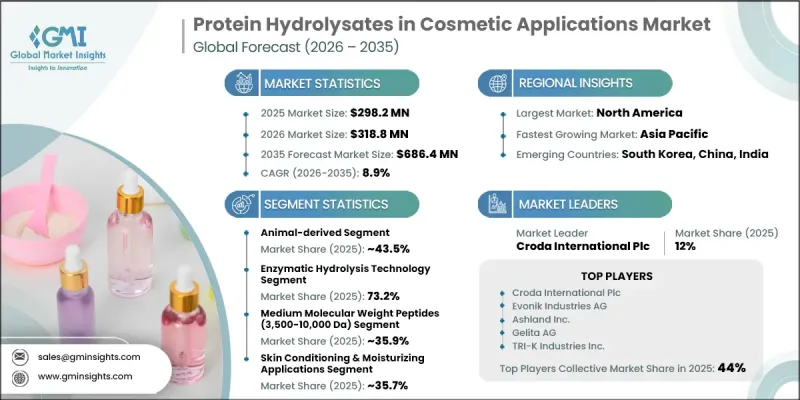
세계의 화장품 용도용 단백질 가수분해물 시장은 2025년에 2억 9,820만 달러로 평가되고 CAGR 8.9%로 성장하며, 2035년까지 6억 8,640만 달러에 달할 것으로 추정되고 있습니다.
피부 영양 공급, 노화 방지 효과, 보습 지원, 장벽 기능 강화에 중점을 둔 화장품 및 퍼스널 케어 제품의 제형 개발에서 생리활성 펩티드에 대한 수용도가 높아짐에 따라 시장이 확대되고 있습니다. 첨단 가수분해 기술을 통해 제조된 단백질 가수분해물은, 효과를 중시하고 과학적으로 입증된 미용 솔루션을 추구하는 소비자의 선호 변화에 부응하기 위해 개발된 스킨케어 제품에 점점 더 많이 함유되고 있습니다. 피부과학에서 영감을 얻은 화장품과 웰빙 지향적인 스킨케어에 대한 관심이 높아짐에 따라 각 제조사들은 생체 이용률이 높고 특정 기능을 지닌 성분의 개발을 추진하고 있습니다. 또한 소비자들 사이에서 천연 유래의 지속가능한 화장품 원료에 대한 수요가 높아지고 있으며, 환경을 고려한 원료에서 추출한 단백질 가수분해물의 활용 확대를 지원하고 있습니다. 펩티드 연구, 피부 생물학 및 추출 기술의 발전 덕분에 기업은 안정성과 효능이 향상된 고도로 전문화된 제형을 개발할 수 있게 되었습니다. 성분의 투명성, 클린 라벨 전략, 그리고 다기능 스킨케어 제품에 대한 관심이 높아지고 있는 것이 시장 성장을 더욱 가속화하고 있습니다. 가수분해 단백질이 보습을 돕고, 피부 결을 개선하며, 화장품의 효과를 높이는 능력은 차세대 미용 및 퍼스널 케어 분야에서 그 중요성을 계속해서 높여가고 있습니다.
| 시장 범위 | |
|---|---|
| 시작연도 | 2025년 |
| 예측 기간 | 2026-2035년 |
| 시작 금액 | 2억 9,820만 달러 |
| 예측 금액 | 6억 8,640만 달러 |
| CAGR | 8.9% |
동물 유래 단백질 가수분해물 부문은 43.5%의 시장 점유율을 차지하고 있으며, 2035년까지 연평균 성장률(CAGR) 7.9%로 성장할 것으로 예상됩니다. 이러한 가수분해물은 피부와 모발의 컨디셔닝을 목적으로 한 화장품 제형에 오랫동안 사용되어 온 덕분에, 여전히 시장에서 강력한 입지를 유지하고 있습니다. 그 아미노산 조성 및 기존 화장품 베이스와의 뛰어난 호환성 덕분에, 효과적인 처방 성분을 찾는 제조사들 사이에서 높은 지지를 얻고 있습니다. 효과 중심의 스킨케어 및 헤어케어 제품에 대한 꾸준한 수요가 화장품 업계 전반에서 동물 유래 가수분해물의 사용을 지속적으로 촉진하고 있습니다.
효소 가수분해 부문은 2025년에 73.2%의 시장 점유율을 차지하며, 2026-2035년 연평균 성장률(CAGR) 9.3%로 성장할 것으로 전망됩니다. 이 가공법은 생물학적 활성과 배합 적합성을 유지하면서 특정 펩티드 구조를 생성할 수 있으므로 여전히 널리 선호되고 있습니다. 효소 가수분해는 진화하는 스킨케어의 요구 사항에 부합하는 분자 구성이 제어된 특수 펩티드의 개발을 지원하고 있습니다. 각 제조사는 제품의 안정성과 처방의 안전성을 유지하면서, 보습 및 안티에이징 효과와 피부 장벽 기능 개선을 돕는 화장품 원료를 제조하기 위해 이 기법에 대한 의존도를 높이고 있습니다.
북미 화장품 분야의 단백질 가수분해물 시장은 2025년에 35.4%의 점유율을 차지했습니다. 과학적 근거에 기반한 스킨케어 제품과 생리활성 화장품 원료에 대한 소비자들의 강력한 지지가 해당 지역 전체의 시장 확대를 지속적으로 견인하고 있습니다. 펩티드와 첨단 유효 성분이 함유된 프리미엄 스킨케어 제품에 대한 수요는 특히 미국에서 두드러집니다. 해당 국가에서는 소비자들이 제품의 눈에 보이는 효과와 클린 라벨 성분을 점점 더 중요하게 여기고 있습니다. 피부 건강, 안티에이징 솔루션, 다기능 화장품에 대한 관심이 높아짐에 따라 프리미엄 시장과 대중 시장 모두의 뷰티 카테고리에서 효소 유래 펩티드의 채택이 확대되고 있습니다. 화장품 과학 분야의 지속적인 혁신과 성분 투명성에 대한 관심이 높아짐에 따라 세계 시장에서 북미의 입지는 더욱 공고해지고 있습니다.
자주 묻는 질문
목차
제1장 조사 방법과 범위
제2장 개요
제3장 업계 인사이트
제4장 경쟁 구도
제5장 시장 추산·예측 : 단백원별, 2022-2035년
제6장 시장 추산·예측 : 가공 방법별, 2022-2035년
제7장 시장 추산·예측 : 분자량별, 2022-2035년
제8장 시장 추산·예측 : 분자량별, 2022-2035년
제9장 시장 추산·예측 : 지역별, 2022-2035년
제10장 기업 개요
KSA 26.06.24The Global Protein Hydrolysates in Cosmetic Applications Market was valued at USD 298.2 million in 2025 and is estimated to grow at a CAGR of 8.9% to reach USD 686.4 million by 2035.
The market is witnessing expansion as bioactive peptides gain stronger acceptance in cosmetic and personal care formulations focused on skin nourishment, anti-aging benefits, hydration support, and barrier enhancement. Protein hydrolysates produced through advanced hydrolysis techniques are increasingly incorporated into skincare products developed to address evolving consumer preferences for performance-driven and science-backed beauty solutions. Growing interest in dermatology-inspired cosmetics and wellness-oriented skincare is encouraging manufacturers to develop ingredients with enhanced bioavailability and targeted functionality. Consumers are also showing rising demand for naturally sourced and sustainable cosmetic ingredients, supporting wider use of protein hydrolysates derived from environmentally responsible sources. Advancements in peptide research, skin biology, and extraction technologies are enabling companies to create highly specialized formulations with improved stability and effectiveness. Increasing focus on ingredient transparency, clean-label positioning, and multifunctional skincare products is further accelerating market growth. The ability of hydrolyzed proteins to support moisture retention, improve skin texture, and enhance cosmetic performance continues to strengthen their importance in next-generation beauty and personal care applications.
| Market Scope | |
|---|---|
| Start Year | 2025 |
| Forecast Year | 2026-2035 |
| Start Value | $298.2 Million |
| Forecast Value | $686.4 Million |
| CAGR | 8.9% |
The animal-derived protein hydrolysates segment held a 43.5% share and is expected to grow at a CAGR of 7.9% through 2035. These hydrolysates continue to maintain strong market presence due to their long-standing use in cosmetic formulations designed for skin and hair conditioning applications. Their amino acid composition and compatibility with conventional cosmetic bases make them highly preferred among manufacturers seeking effective formulation ingredients. Consistent demand for performance-oriented skincare and haircare products continues to support the adoption of animal-derived hydrolysates across the cosmetics industry.
The enzymatic hydrolysis segment held a share of 73.2% in 2025 and is anticipated to grow at a CAGR of 9.3% between 2026 and 2035. This processing method remains widely preferred because it allows the production of targeted peptide structures while preserving biological activity and formulation compatibility. Enzymatic hydrolysis supports the development of specialized peptides with controlled molecular profiles that align with evolving skincare requirements. Manufacturers increasingly rely on this method to create cosmetic ingredients that support hydration, anti-aging performance, and skin barrier improvement while maintaining product stability and formulation safety.
North America Protein Hydrolysates in Cosmetic Applications Market accounted for 35.4% share in 2025. Strong consumer preference for scientifically supported skincare products and bioactive cosmetic ingredients continues to drive market expansion across the region. Demand for premium skincare formulations featuring peptides and advanced active ingredients is particularly strong in the U.S., where consumers increasingly prioritize visible product performance and clean-label formulations. Rising awareness regarding skin health, anti-aging solutions, and multifunctional cosmetic products is encouraging broader adoption of enzymatically derived peptides in both premium and mass-market beauty categories. Continued innovation in cosmetic science and increasing focus on ingredient transparency further strengthen North America's position within the global market.
Major companies operating in the Global Protein Hydrolysates in Cosmetic Applications Market include Croda International Plc, Evonik Industries AG, Ashland Inc., Gelita AG, TRI-K Industries Inc., Kelisema Srl, SILAB, Lucas Meyer Cosmetics, NEW ALLIANCE FINE CHEM PVT LTD, Innovative Healthcare India Pvt. Ltd., Cosmacon GmbH, and Aqua Bio Technology ASA. Companies operating in the protein hydrolysates in cosmetic applications market are implementing several strategies to strengthen their market position and expand their global presence. Leading manufacturers are investing heavily in research and development activities to create advanced peptide-based ingredients with enhanced functionality, stability, and skin compatibility. Businesses are also focusing on sustainable sourcing practices and environmentally responsible production methods to meet rising consumer demand for clean-label and eco-conscious cosmetic ingredients. Strategic collaborations with skincare brands, cosmetic formulators, and biotechnology firms are helping companies accelerate product innovation and expand application capabilities. In addition, manufacturers are increasing investments in advanced extraction and purification technologies to improve ingredient quality and performance.
Table of Contents
Chapter 1 Methodology & Scope
- 1.1 Market scope and definition
- 1.2 Research design
- 1.2.1 Research approach
- 1.2.2 Data collection methods
- 1.3 Data mining sources
- 1.3.1 Global
- 1.3.2 Regional/Country
- 1.4 Base estimates and calculations
- 1.4.1 Base year calculation
- 1.4.2 Key trends for market estimation
- 1.5 Primary research and validation
- 1.5.1 Primary sources
- 1.6 Forecast model
- 1.7 Research assumptions and limitations
Chapter 2 Executive Summary
- 2.1 Industry 360° synopsis
- 2.2 Key market trends
- 2.2.1 Regional trends
- 2.2.2 Protein source trends
- 2.2.3 Processing method trends
- 2.2.4 Molecular weight trends
- 2.2.5 Cosmetic application trends
- 2.3 TAM Analysis, 2025-2035
- 2.4 CXO perspectives: Strategic imperatives
- 2.4.1 Executive decision points
- 2.4.2 Critical success factors
- 2.5 Future Outlook and Strategic Recommendations
Chapter 3 Industry Insights
- 3.1 Industry ecosystem analysis
- 3.1.1 Supplier landscape
- 3.1.2 Profit margin
- 3.1.3 Value addition at each stage
- 3.1.4 Factor affecting the value chain
- 3.1.5 Disruptions
- 3.2 Industry impact forces
- 3.2.1 Growth drivers
- 3.2.1.1 Rising demand for natural & sustainable cosmetic ingredients
- 3.2.1.2 Increasing consumer awareness of anti-aging benefits
- 3.2.1.3 Growing preference for vegan & cruelty-free alternatives
- 3.2.2 Industry pitfalls and challenges
- 3.2.2.1 Stringent molecular weight regulations (EU-3.5 KDA restriction)
- 3.2.2.2 Allergenicity concerns & safety assessment requirements
- 3.2.3 Market opportunities
- 3.2.3.1 Emerging bioactive peptide applications in cosmeceuticals
- 3.2.3.2 Untapped potential in marine-derived protein sources
- 3.2.1 Growth drivers
- 3.3 Growth potential analysis
- 3.4 Regulatory landscape
- 3.4.1 North America
- 3.4.2 Europe
- 3.4.3 Asia Pacific
- 3.4.4 Latin America
- 3.4.5 Middle East & Africa
- 3.5 Porter’s analysis
- 3.6 PESTEL analysis
- 3.7 Price trends
- 3.7.1 By region
- 3.7.2 By Protein source
- 3.8 Future market trends
- 3.9 Technology and Innovation landscape
- 3.9.1 Current technological trends
- 3.9.2 Emerging technologies
- 3.10 Patent Landscape
- 3.11 Trade statistics (HS code)
- 3.11.1 Major importing countries
- 3.11.2 Major exporting countries
- 3.12 Sustainability and environmental aspects
- 3.12.1 Sustainable practices
- 3.12.2 Waste reduction strategies
- 3.12.3 Energy efficiency in production
- 3.12.4 Eco-friendly initiatives
- 3.13 Carbon footprint consideration
Chapter 4 Competitive Landscape, 2025
- 4.1 Introduction
- 4.2 Company market share analysis
- 4.2.1 By region
- 4.2.1.1 North America
- 4.2.1.2 Europe
- 4.2.1.3 Asia Pacific
- 4.2.1.4 LATAM
- 4.2.1.5 MEA
- 4.2.1 By region
- 4.3 Company matrix analysis
- 4.4 Competitive analysis of major market players
- 4.5 Competitive positioning matrix
- 4.6 Key developments
- 4.6.1 Mergers & acquisitions
- 4.6.2 Partnerships & collaborations
- 4.6.3 New Product Launches
- 4.6.4 Expansion Plans
Chapter 5 Market Estimates and Forecast, By Protein Source, 2022-2035 (USD Million) (Kilo Tons)
- 5.1 Key trends
- 5.2 Animal-derived
- 5.2.1 Marine collagen hydrolysates
- 5.2.1.1 Fish Collagen Hydrolysates
- 5.2.1.2 Shellfish & Mollusc Protein Hydrolysates
- 5.2.2 Bovine collagen hydrolysates
- 5.2.3 Milk protein hydrolysates
- 5.2.4 Keratin hydrolysates (wool & feather)
- 5.2.1 Marine collagen hydrolysates
- 5.3 Plant-derived
- 5.3.1 Soy protein hydrolysates
- 5.3.2 Wheat protein hydrolysates
- 5.3.3 Rice protein hydrolysates
- 5.3.4 Emerging sources (pea, hemp, quinoa)
- 5.3.5 Oat & corn protein hydrolysates
- 5.4 Marine-derived
- 5.4.1 Microalgae Protein Hydrolysates (Spirulina, Chlorella)
- 5.4.2 Macroalgae (Seaweed) Protein Hydrolysates
- 5.5 Microbial & fermentation-derived
- 5.5.1 Yeast protein hydrolysates
- 5.5.2 Bacterial fermentation products
- 5.5.3 Precision Fermentation-Derived Cosmetic Peptides
Chapter 6 Market Estimates and Forecast, By Processing Method, 2022-2035 (USD Million) (Kilo Tons)
- 6.1 Key trends
- 6.2 Enzymatic hydrolysis technology
- 6.3 Acid hydrolysis methods
- 6.4 Alkaline hydrolysis applications
- 6.5 Combination & sequential processing
Chapter 7 Market Estimates and Forecast, By Molecular Weight, 2022-2035 (USD Million) (Kilo Tons)
- 7.1 Key trends
- 7.2 High Molecular Weight Peptides (>10,000 Da)
- 7.3 Medium Molecular Weight Peptides (3,500-10,000 Da)
- 7.4 Low Molecular Weight Peptides (500-3,500 Da)
- 7.5 Free Amino Acids (<500 Da)
Chapter 8 Market Estimates and Forecast, By Molecular Weight, 2022-2035 (USD Million) (Kilo Tons)
- 8.1 Key trends
- 8.2 Skin conditioning & moisturizing applications
- 8.3 Hair conditioning & repair applications
- 8.4 Film-forming & protective applications
- 8.5 Anti-aging & wrinkle reduction
- 8.6 Anti-irritant & soothing applications
- 8.7 Scalp Care & Hair Loss Prevention
Chapter 9 Market Estimates and Forecast, By Region, 2022-2035 (USD Million) (Kilo Tons)
- 9.1 Key trends
- 9.2 North America
- 9.2.1 U.S.
- 9.2.2 Canada
- 9.3 Europe
- 9.3.1 Germany
- 9.3.2 UK
- 9.3.3 France
- 9.3.4 Spain
- 9.3.5 Italy
- 9.3.6 Rest of Europe
- 9.4 Asia Pacific
- 9.4.1 China
- 9.4.2 India
- 9.4.3 Japan
- 9.4.4 Australia
- 9.4.5 South Korea
- 9.4.6 Rest of Asia Pacific
- 9.5 Latin America
- 9.5.1 Brazil
- 9.5.2 Mexico
- 9.5.3 Argentina
- 9.5.4 Rest of Latin America
- 9.6 Middle East and Africa
- 9.6.1 Saudi Arabia
- 9.6.2 South Africa
- 9.6.3 UAE
- 9.6.4 Rest of Middle East and Africa
Chapter 10 Company Profiles
- 10.1 Croda International Plc
- 10.2 Evonik Industries AG
- 10.3 Ashland Inc.
- 10.4 Gelita AG
- 10.5 TRI-K Industries Inc.
- 10.6 Kelisema Srl
- 10.7 SILAB
- 10.8 Lucas Meyer Cosmetics
- 10.9 NEW ALLIANCE FINE CHEM PVT LTD
- 10.10 Innovative Healthcare India Pvt. Ltd.
- 10.11 Cosmacon GmbH
- 10.12 Aqua Bio Technology ASA


