
|
시장보고서
상품코드
2061428
세라믹 잉크 시장 기회, 성장 촉진요인, 업계 동향 분석 및 예측(2026-2035년)Ceramic Inks Market Opportunity, Growth Drivers, Industry Trend Analysis, and Forecast 2026 - 2035 |
||||||

세계의 세라믹 잉크 시장은 2025년에 22억 달러로 평가되고 CAGR 5.5%로 성장하며, 2035년까지 38억 달러에 달할 것으로 추정되고 있습니다.
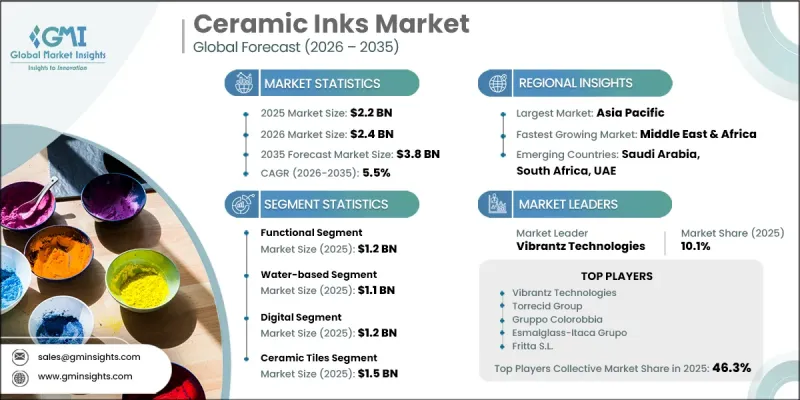
주택, 상업, 산업 등 각 분야에서 장식용 및 기능성 세라믹 제품에 대한 수요가 증가함에 따라 세라믹 잉크 업계는 성장하고 있습니다. 세라믹 잉크는 고온 처리 조건에서도 내구성을 유지하면서 세라믹 표면에 인쇄, 코팅 및 장식을 하기 위해 특별히 개발된 배합제입니다. 이러한 잉크는 일반적으로 미세하게 가공된 안료, 액체 운반체, 그리고 디자인을 세라믹 기판에 영구적으로 고정시키는 성능 향상 첨가제로 구성되어 있습니다. 그 결과, 인쇄된 표면은 장기적인 색상 안정성, 내마모성 및 시각적 품질을 유지합니다. 각 제조사들은 디지털 인쇄, 롤 인쇄, 스크린 인쇄 등 첨단 인쇄 기법을 통해 세라믹 잉크를 점점 더 많이 활용함으로써 정교한 질감, 맞춤형 패턴, 고정밀 마감을 실현하고 있습니다. 고급 인테리어 가공제, 건축자재, 내구성이 뛰어난 장식 제품에 대한 수요가 증가함에 따라 시장 성장이 지속적으로 지원되고 있습니다. 또한 디지털 세라믹 인쇄 기술의 지속적인 발전으로 생산 효율이 향상되고 재료 낭비가 줄어들면서, 제조업체들은 다양한 용도에 맞춰 더욱 세련되고 맞춤화된 디자인을 제공할 수 있게 되었습니다.
| 시장 범위 | |
|---|---|
| 시작연도 | 2025년 |
| 예측 기간 | 2026-2035년 |
| 시작 금액 | 22억 달러 |
| 예측 금액 | 38억 달러 |
| CAGR | 5.5% |
기능성 세라믹 잉크 부문은 2025년에 12억 달러의 시장 규모를 기록하며, 시장내 최대 카테고리가 되었습니다. 산업 분야에서 장식성과 성능 향상을 모두 갖춘 소재가 중요시됨에 따라 기능성 세라믹 잉크에 대한 수요가 증가하고 있습니다. 이 잉크들은 마모, 화학 물질, 습기 및 환경적 요인에 대한 뛰어난 내성을 발휘하도록 설계되어 있으며, 산업용 표면, 건축 구조물 및 특수 코팅 용도에 매우 적합합니다. 이러한 뛰어난 내구성과 가혹한 조건에서도 외관을 유지하는 능력 덕분에, 상업 및 산업 프로젝트에서의 채택이 지속적으로 확대되고 있습니다.
2025년, 세라믹 타일 부문은 15억 달러를 차지했습니다. 맞춤형 타일 디자인 및 질감 마감을 위한 디지털 세라믹 인쇄 기술의 채택 확대가 세라믹 잉크 수요 증가에 크게 기여하고 있습니다. 각 제조사들은 주거 및 상업 환경 모두에서 고해상도의 표면 마감, 자연스러운 질감 재현, 그리고 제품 내구성 향상에 점점 더 주력하고 있습니다. 동시에, 장식적 및 기능적 표면 처리 분야에서 세라믹 잉크에 대한 수요가 증가함에 따라 유리 용도 부문도 꾸준한 성장을 달성하고 있습니다. 건축용 유리나 특수 표면 용도 분야에서 접착 성능 향상, 투명도 조절, 내구성 강화가 요구되고 있는 점이 시장 수요를 지원하고 있습니다.
2025년 미국 세라믹 잉크 시장 규모는 2억 4,070만 달러로 평가되었습니다. 해당 국가의 성장은 세라믹 생산 설비의 현대화가 진행되고 있는 점과, 다양한 산업 분야에서 맞춤형 장식 표면에 대한 수요가 증가하고 있는 점에 힘입고 있습니다. 미국의 여러 제조사들은 생산 정밀도 향상, 가동 중단 시간 단축, 그리고 일관된 장식 품질 달성을 목표로 디지털 세라믹 인쇄 기술을 꾸준히 도입하고 있습니다. 효율적이고 정밀한 인쇄 기법에 대한 관심이 높아지고 있는 점도 산업용 및 건축용 분야에서 세라믹 잉크의 더 광범위한 도입에 기여하고 있습니다.
자주 묻는 질문
목차
제1장 조사 방법과 범위
제2장 개요
제3장 업계 인사이트
제4장 경쟁 구도
제5장 시장 추산·예측 : 제품별, 2022-2035년
제6장 시장 추산·예측 : 제제별, 2022-2035년
제7장 시장 추산·예측 : 기술별, 2022-2035년
제8장 시장 추산·예측 : 기재별, 2022-2035년
제9장 시장 추산·예측 : 최종 용도별, 2022-2035년
제10장 시장 추산·예측 : 지역별, 2022-2035년
제11장 기업 개요
KSA 26.06.24The Global Ceramic Inks Market was valued at USD 2.2 billion in 2025 and is estimated to grow at a CAGR of 5.5% to reach USD 3.8 billion by 2035.
The ceramic inks industry is expanding due to rising demand for decorative and functional ceramic applications across residential, commercial, and industrial sectors. Ceramic inks are specially developed formulations designed for printing, coating, and decorating ceramic surfaces while maintaining durability under high-temperature processing conditions. These inks typically consist of finely processed pigments, liquid carriers, and performance-enhancing additives that allow the design to permanently bond with ceramic substrates. As a result, the printed surfaces maintain long-term color stability, wear resistance, and visual quality. Manufacturers increasingly utilize ceramic inks through advanced printing methods such as digital, rotary, and screen printing to achieve detailed textures, customized patterns, and high-precision finishes. Growing demand for premium interior surfaces, architectural materials, and durable decorative products continues to support market growth. In addition, ongoing advancements in digital ceramic printing technologies are improving production efficiency, reducing material waste, and enabling manufacturers to deliver more sophisticated and customized designs for a wide range of applications.
| Market Scope | |
|---|---|
| Start Year | 2025 |
| Forecast Year | 2026-2035 |
| Start Value | $2.2 Billion |
| Forecast Value | $3.8 Billion |
| CAGR | 5.5% |
The functional ceramic inks segment generated USD 1.2 billion in 2025, making it the leading category within the market. Demand for functional ceramic inks is increasing as industries prioritize materials that deliver both decorative appeal and enhanced performance characteristics. These inks are designed to provide superior resistance against abrasion, chemicals, moisture, and environmental exposure, making them highly suitable for industrial surfaces, architectural structures, and specialty coating applications. Their long-lasting durability and ability to maintain appearance under demanding conditions continue to strengthen adoption across commercial and industrial projects.
The ceramic tiles segment accounted for USD 1.5 billion in 2025. Rising adoption of digital ceramic printing technologies for customized tile designs and textured finishes is significantly contributing to demand for ceramic inks. Manufacturers are increasingly focusing on high-definition surface finishes, natural texture replication, and improved product durability for both residential and commercial environments. At the same time, the glass application segment is witnessing steady growth as ceramic inks gain traction for decorative and functional surface treatments. Market demand is being supported by the need for improved adhesion performance, controlled transparency, and enhanced durability in architectural glass and specialty surface applications.
U.S. Ceramic Inks Market was valued at USD 240.7 million in 2025. Growth in the country is being driven by increasing modernization of ceramic production facilities and rising demand for customized decorative surfaces across multiple industries. Manufacturers in the U.S. are steadily adopting digital ceramic printing technologies to improve production precision, reduce operational downtime, and achieve consistent decorative quality. The growing preference for efficient and high-accuracy printing methods is also contributing to the wider integration of ceramic inks across industrial and architectural applications.
Major companies operating in the Ceramic Inks Market include Torrecid Group, Vibrantz Technologies, Gruppo Colorobbia, Esmalglass-Itaca Grupo, Fritta S.L., Sun Chemical Corporation, Zschimmer & Schwarz, Sicer S.p.A., Kao Chimigraf, Tecglass, Dip-Tech Digital, Marabu GmbH, and FENZI SpA. Companies active in the ceramic inks market are implementing several strategic initiatives to strengthen their market position and expand their global presence. Leading manufacturers are investing heavily in research and development to introduce advanced ink formulations that provide improved durability, color consistency, and environmental resistance. Businesses are also focusing on expanding digital ceramic printing capabilities to meet growing demand for customized and high-definition decorative surfaces. Strategic partnerships with ceramic tile manufacturers, glass processors, and architectural material suppliers are helping companies broaden their customer base and improve product integration. In addition, market participants are increasing investments in sustainable production technologies and eco-friendly ink formulations to align with evolving environmental standards.
Table of Contents
Chapter 1 Methodology & Scope
- 1.1 Market scope and definition
- 1.2 Research design
- 1.2.1 Research approach
- 1.2.2 Data collection methods
- 1.3 Data mining sources
- 1.3.1 Global
- 1.3.2 Regional/Country
- 1.4 Base estimates and calculations
- 1.4.1 Base year calculation
- 1.4.2 Key trends for market estimation
- 1.5 Primary research and validation
- 1.5.1 Primary sources
- 1.6 Forecast model
- 1.7 Research assumptions and limitations
Chapter 2 Executive Summary
- 2.1 Industry 360° synopsis
- 2.2 Key market trends
- 2.2.1 Product
- 2.2.2 Formulation
- 2.2.3 Technology
- 2.2.4 Substrate
- 2.2.5 End Use
- 2.2.6 Regional
- 2.3 TAM Analysis, 2026-2035
- 2.4 CXO perspectives: Strategic imperatives
- 2.5 Future outlook and strategic recommendations
Chapter 3 Industry Insights
- 3.1 Industry ecosystem analysis
- 3.1.1 Supplier landscape
- 3.1.2 Profit margin
- 3.1.3 Value addition at each stage
- 3.1.4 Factor affecting the value chain
- 3.1.5 Disruptions
- 3.2 Industry impact forces
- 3.2.1 Growth drivers
- 3.2.1.1 Rising demand for digitally printed ceramic surfaces
- 3.2.1.2 Increasing construction activities boosting tile consumption
- 3.2.1.3 Growing focus on customized aesthetic design solutions
- 3.2.2 Industry pitfalls and challenges
- 3.2.2.1 High raw material costs affecting production stability
- 3.2.2.2 Environmental concerns related to chemical ink compositions
- 3.2.3 Market opportunities
- 3.2.3.1 Expansion of digital printing technologies in ceramics
- 3.2.3.2 Development of eco-friendly and low-emission ink formulations
- 3.2.3.3 Increasing use in advanced architectural and interior applications
- 3.2.1 Growth drivers
- 3.3 Growth potential analysis
- 3.4 Regulatory landscape
- 3.4.1 North America
- 3.4.2 Europe
- 3.4.3 Asia Pacific
- 3.4.4 Latin America
- 3.4.5 Middle East & Africa
- 3.5 Porter's analysis
- 3.6 PESTEL analysis
- 3.7 Technology and innovation landscape
- 3.7.1 Current technological trends
- 3.7.2 Emerging technologies
- 3.8 Price trends
- 3.8.1 By region
- 3.8.2 By product
- 3.9 Future market trends
- 3.10 Patent landscape
- 3.11 Trade statistics (HS code)
- 3.11.1 Major importing countries
- 3.11.2 Major exporting countries
- 3.12 Sustainability and environmental aspects
- 3.12.1 Sustainable practices
- 3.12.2 Waste reduction strategies
- 3.12.3 Energy efficiency in production
- 3.12.4 Eco-friendly initiatives
- 3.13 Carbon footprint consideration
Chapter 4 Competitive Landscape, 2025
- 4.1 Introduction
- 4.2 Company market share analysis
- 4.2.1 By region
- 4.2.1.1 North America
- 4.2.1.2 Europe
- 4.2.1.3 Asia Pacific
- 4.2.1.4 LATAM
- 4.2.1.5 MEA
- 4.2.1 By region
- 4.3 Company matrix analysis
- 4.4 Competitive analysis of major market players
- 4.5 Competitive positioning matrix
- 4.6 Key developments
- 4.6.1 Mergers & acquisitions
- 4.6.2 Partnerships & collaborations
- 4.6.3 New product launches
- 4.6.4 Expansion plans
Chapter 5 Market Estimates and Forecast, By Product, 2022-2035 (USD Million) (Kilo Tons)
- 5.1 Key trends
- 5.2 Functional
- 5.3 Decorative
Chapter 6 Market Estimates and Forecast, By Formulation, 2022-2035 (USD Million) (Kilo Tons)
- 6.1 Key trends
- 6.2 Solvent-based
- 6.3 Water-based
- 6.4 Oil-based
Chapter 7 Market Estimates and Forecast, By Technology, 2022-2035 (USD Million) (Kilo Tons)
- 7.1 Key trends
- 7.2 Digital
- 7.3 Analog
Chapter 8 Market Estimates and Forecast, By Substrate, 2022-2035 (USD Million) (Kilo Tons)
- 8.1 Key trends
- 8.2 Ceramic tiles
- 8.3 Glass
- 8.4 Table wear
- 8.5 Others
Chapter 9 Market Estimates and Forecast, By End use, 2022-2035 (USD Million) (Kilo Tons)
- 9.1 Key trends
- 9.2 Building & construction
- 9.3 Automotive
- 9.4 Food & beverage containers
- 9.5 Others (consumer goods packaging, pottery, etc.)
Chapter 10 Market Estimates and Forecast, By Region, 2022-2035 (USD Million) (Kilo Tons)
- 10.1 Key trends
- 10.2 North America
- 10.2.1 U.S.
- 10.2.2 Canada
- 10.3 Europe
- 10.3.1 Germany
- 10.3.2 UK
- 10.3.3 France
- 10.3.4 Spain
- 10.3.5 Italy
- 10.3.6 Rest of Europe
- 10.4 Asia Pacific
- 10.4.1 China
- 10.4.2 India
- 10.4.3 Japan
- 10.4.4 Australia
- 10.4.5 South Korea
- 10.4.6 Rest of Asia Pacific
- 10.5 Latin America
- 10.5.1 Brazil
- 10.5.2 Mexico
- 10.5.3 Argentina
- 10.5.4 Rest of Latin America
- 10.6 Middle East and Africa
- 10.6.1 Saudi Arabia
- 10.6.2 South Africa
- 10.6.3 UAE
- 10.6.4 Rest of Middle East and Africa
Chapter 11 Company Profiles
- 11.1 Vibrantz Technologies
- 11.2 Torrecid Group
- 11.3 Gruppo Colorobbia
- 11.4 Esmalglass-Itaca Grupo
- 11.5 Fritta S.L.
- 11.6 Sun Chemical Corporation
- 11.7 Zschimmer & Schwarz
- 11.8 Sicer S.p.A.
- 11.9 Kao Chimigraf
- 11.10 Tecglass
- 11.11 Dip-Tech Digital
- 11.12 Marabu GmbH
- 11.13 FENZI SpA