

|
시장보고서
상품코드
2061446
철도 유지보수 기계 시장 기회, 성장요인, 업계 동향 분석 및 예측(2026-2035년)Railway Maintenance Machinery Market Opportunity, Growth Drivers, Industry Trend Analysis, and Forecast 2026 - 2035 |
||||||

세계의 철도 유지보수 기계 시장은 2025년에 59억 달러로 평가되고 CAGR 8.2%로 성장하며, 2035년까지 132억 달러에 달할 것으로 추정되고 있습니다.
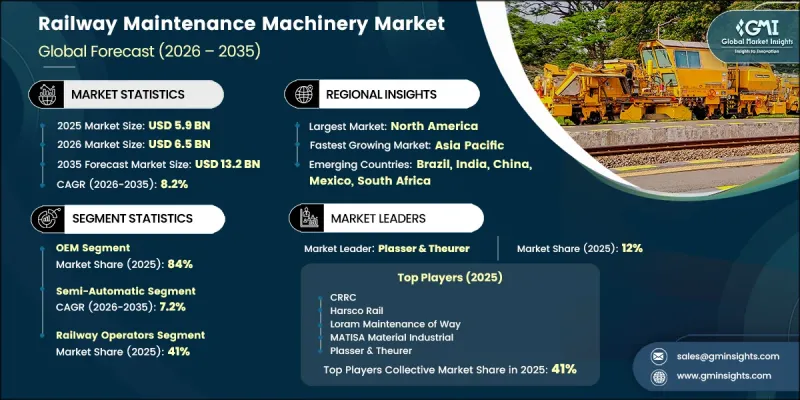
철도 유지보수 장비 시장의 성장은 철도 인프라 현대화를 위한 투자 확대, 여객 및 화물 철도 네트워크의 확장, 그리고 노후화된 철도 자산을 효율적으로 유지 관리해야 할 필요성이 커짐에 따라 주도되고 있습니다. 철도 유지보수 장비는 건설, 점검, 수리 및 유지보수 활동을 지원함으로써 네트워크의 안전성, 운영 성능, 그리고 선로의 장기적인 신뢰성을 확보하는 데 중요한 역할을 하고 있습니다. 철도 사업자들이 선로의 기하학적 형상, 자갈의 안정성, 레일 표면의 품질 및 인프라 전반의 성능 향상에 주력함에 따라 첨단 기계에 대한 수요는 계속해서 증가하고 있습니다. 또한 자동화, 디지털 모니터링 기능, 예측 유지보수 소프트웨어, GPS 지원 위치 측정 시스템 및 에너지 효율이 높은 파워트레인을 갖춘 기술적으로 진보된 유지보수 솔루션의 도입 확대 역시 업계에 긍정적인 영향을 미치고 있습니다. 각 제조사는 가동 중지 시간을 최소화하고 유지보수 생산성을 높이기 위해, 고정밀도이며 내구성이 뛰어나고 비용 효율이 우수한 장비를 개발하고 있습니다. 자동화 및 반자율형 유지보수 업무로의 전환은 안전 기준을 향상시키는 동시에, 보다 신속하고 효율적인 철도 자산 관리를 가능하게 하여 향후 수년간의 시장 성장 전망을 더욱 공고히 하고 있습니다.
| 시장 범위 | |
|---|---|
| 시작연도 | 2025년 |
| 예측 기간 | 2026-2035년 |
| 개시 금액 | 59억 달러 |
| 예측액 | 132억 달러 |
| CAGR | 8.2% |
철도 유지보수 기계 산업에는 정밀성, 효율성 및 운영상의 신뢰성을 제공하기 위해 설계된 다양한 전문 장비가 포함됩니다. 현대 유지보수 시스템에서는 유지보수 활동을 최적화하기 위해 지능형 모니터링 기술, 자동 진단, 예측 유지보수 기능, 첨단 위치 파악 솔루션이 점점 더 많이 도입되고 있습니다. 장비 제조업체들은 성능을 향상시키면서 운영 비용과 수명 주기 비용을 절감하기 위해 자동화, 경량 구조재, 디지털 통합을 중시하고 있습니다. 기존의 유지보수 방식에서 기술을 활용한 시스템으로의 전환은 전 세계 철도 사업에서 생산성 향상, 정확도 향상, 안전성 향상을 지속적으로 지원하고 있습니다.
OEM 부문은 2025년에 84%의 점유율을 차지하며, 2026-2035년 연평균 성장률(CAGR) 7.8%로 성장할 것으로 전망됩니다. 이 부문은 제조업체 및 공식 판매망을 통해 직접 공급되는 신제품 장비의 판매를 나타내며, 업계의 주요 수입원입니다. 철도 사업자와 유지보수 도급업체는 첨단 기술의 통합, 운용 능력 향상, 포괄적인 보증 범위와 같은 이점 때문에 계속해서 신규 장비 구매를 우선시하고 있습니다. 출고시 상태의 신품 기계에 대한 강한 선호는 신뢰성, 효율성 및 장기적인 자산 성과에 대한 업계의 지속적인 노력을 반영하고 있습니다.
반자동 부문은 2025년에 43.8%의 시장 점유율을 차지하며, 2035년까지 연평균 성장률(CAGR) 7.2%로 성장할 것으로 전망됩니다. 반자동식 철도 유지보수 장비는 자동화된 작업 공정과 운영자의 감시를 결합한 것으로, 업계 전반에서 가장 널리 채택되고 있는 장비 범주 중 하나입니다. 이러한 시스템은 주요 유지보수 기능을 자동화하는 한편, 운영자가 중요한 공정을 직접 제어할 수 있도록 합니다. 이러한 광범위한 보급은 확립된 운영 관행, 입증된 신뢰성, 작업자의 높은 숙련도, 그리고 수십년에 걸친 도입 실적을 바탕으로 이루어졌습니다. 철도 사업자들이 자동화와 운영의 유연성 사이의 균형을 모색하는 가운데, 반자동식 기계에 대한 수요는 계속해서 견고한 양상을 보이고 있습니다.
미국의 철도 유지보수 장비 시장은 2025년에 18억 달러 규모에 달하며, 2026-2035년 연평균 성장률(CAGR) 7.2%로 성장할 것으로 전망됩니다. 해당 국가의 시장 확대는 철도 인프라 개선, 현대화 계획 및 안전 강화 프로그램에 대한 지속적인 투자에 힘입어 이루어지고 있습니다. 철도 네트워크의 성능 향상과 인프라 품질 유지에 대한 중요성이 커지고 있는 것이 첨단 유지보수 장비의 도입 확대를 지원하고 있습니다. 철도 사업자들은 선로 상태를 개선하고, 운행의 신뢰성을 높이며, 네트워크의 장기적인 지속가능성을 지원하기 위해 첨단 장비를 도입하고 있습니다. 이 국가의 광범위한 철도 운송망과 지속적인 인프라 개발 노력은 시장 성장에 유리한 기회를 지속적으로 창출하고 있습니다.
자주 묻는 질문
목차
제1장 조사 방법
제2장 개요
제3장 업계 인사이트
제4장 경쟁 구도
제5장 시장 추산·예측 : 제품별, 2022-2035년
제6장 시장 추산·예측 : 용도별, 2022-2035년
제7장 시장 추산·예측 : 기술별, 2022-2035년
제8장 시장 추산·예측 : 판매 채널별, 2022-2035년
제9장 시장 추산·예측 : 최종 사용별, 2022-2035년
제10장 시장 추산·예측 : 지역별, 2022-2035년
제11장 기업 개요
KSA 26.06.24The Global Railway Maintenance Machinery Market was valued at USD 5.9 billion in 2025 and is estimated to grow at a CAGR of 8.2% to reach USD 13.2 billion by 2035.
Growth across the railway maintenance machinery market is fueled by rising investments in rail infrastructure modernization, the expansion of passenger and freight rail networks, and the growing need to maintain aging railway assets efficiently. Railway maintenance equipment plays a critical role in ensuring network safety, operational performance, and long-term track reliability by supporting construction, inspection, repair, and maintenance activities. Demand for advanced machinery continues to increase as railway operators focus on improving track geometry, ballast stability, rail surface quality, and overall infrastructure performance. The industry is also benefiting from the growing adoption of technologically advanced maintenance solutions equipped with automation, digital monitoring capabilities, predictive maintenance software, GPS-enabled positioning systems, and energy-efficient powertrains. Manufacturers are developing highly accurate, durable, and cost-effective equipment to minimize downtime and improve maintenance productivity. The transition toward automated and semi-autonomous maintenance operations is enhancing safety standards while enabling faster and more efficient railway asset management, further strengthening market growth prospects over the coming years.
| Market Scope | |
|---|---|
| Start Year | 2025 |
| Forecast Year | 2026-2035 |
| Start Value | $5.9 Billion |
| Forecast Value | $13.2 Billion |
| CAGR | 8.2% |
The railway maintenance machinery industry includes a broad portfolio of specialized equipment engineered to deliver precision, efficiency, and operational reliability. Modern maintenance systems increasingly incorporate intelligent monitoring technologies, automated diagnostics, predictive maintenance capabilities, and advanced positioning solutions to optimize maintenance activities. Equipment manufacturers are emphasizing automation, lightweight construction materials, and digital integration to improve performance while lowering operating and lifecycle costs. The shift away from conventional maintenance approaches toward technology-enabled systems continues to support higher levels of productivity, improved accuracy, and enhanced safety across railway operations worldwide.
The OEM segment accounted for 84% share in 2025 and is anticipated to grow at a CAGR of 7.8% between 2026 and 2035. This segment represents the sale of newly manufactured equipment supplied directly by manufacturers and authorized distribution networks, making it the primary revenue contributor within the industry. Railway operators and maintenance contractors continue to prioritize new equipment purchases due to the benefits of advanced technology integration, enhanced operational capabilities, and comprehensive warranty coverage. The strong preference for factory-new machinery reflects the industry's ongoing focus on reliability, efficiency, and long-term asset performance.
The semi-automatic segment captured 43.8% share in 2025 and is forecast to grow at a CAGR of 7.2% through 2035. Semi-automatic railway maintenance equipment combines automated work processes with operator supervision, making it one of the most widely adopted equipment categories across the industry. These systems automate key maintenance functions while allowing operators to maintain direct control over critical processes. Their widespread acceptance is supported by established operational practices, proven reliability, extensive workforce familiarity, and decades of deployment experience. As railway operators seek a balance between automation and operational flexibility, demand for semi-automatic machinery remains strong.
United States Railway Maintenance Machinery Market generated USD 1.8 billion in 2025 and is expected to grow at a CAGR of 7.2% from 2026 to 2035. Market expansion in the country is being supported by continued investments in railway infrastructure upgrades, modernization initiatives, and safety enhancement programs. Growing emphasis on improving rail network performance and maintaining infrastructure quality is driving increased deployment of advanced maintenance equipment. Railway operators are adopting sophisticated machinery to improve track conditions, strengthen operational reliability, and support long-term network sustainability. The country's extensive rail transportation network and ongoing infrastructure development efforts continue to create favorable opportunities for market growth.
Key companies operating in the Global Railway Maintenance Machinery Market include CRRC, Speno International, Plasser & Theurer, Harsco Rail, ROBEL Bahnbaumaschinen, Strukton Rail, MERMEC, MATISA Material Industrial, Loram Maintenance of Way, and Geatech. Companies operating in the railway maintenance machinery market are focusing on product innovation, automation, and digitalization to strengthen their market position and expand their customer base. Manufacturers are investing heavily in advanced maintenance technologies that improve operational efficiency, predictive maintenance capabilities, and equipment reliability. Strategic partnerships with railway operators, infrastructure developers, and maintenance contractors are helping companies secure long-term contracts and enhance service offerings. Businesses are also expanding their global footprint through acquisitions, regional expansion initiatives, and localized manufacturing capabilities. Integration of smart monitoring systems, data analytics, and remote diagnostics is becoming a key competitive strategy. In addition, companies are prioritizing sustainable and energy-efficient equipment development to align with evolving industry requirements while improving productivity, reducing maintenance costs, and enhancing overall customer value.
Table of Contents
Chapter 1 Methodology
- 1.1 Research approach
- 1.2 Quality Commitments
- 1.2.1 GMI AI policy & data integrity commitment
- 1.2.1.1 Source consistency protocol
- 1.2.1 GMI AI policy & data integrity commitment
- 1.3 Research Trail & Confidence Scoring
- 1.3.1 Research Trail Components
- 1.3.2 Scoring Components
- 1.4 Data Collection
- 1.4.1 Partial list of primary sources
- 1.5 Data mining sources
- 1.5.1 Paid sources
- 1.5.1.1 Sources, by region
- 1.5.1 Paid sources
- 1.6 Base estimates and calculations
- 1.6.1 Base year calculation
- 1.7 Forecast
- 1.7.1 Quantified market impact analysis
- 1.7.1.1 Mathematical impact of growth parameters on forecast
- 1.7.1 Quantified market impact analysis
- 1.8 Research transparency addendum
- 1.8.1 Source attribution framework
- 1.8.2 Quality assurance metrics
- 1.8.3 Our commitment to trust
Chapter 2 Executive Summary
- 2.1 Industry 360° synopsis, 2022 - 2035
- 2.2 Key market trends
- 2.2.1 Regional
- 2.2.2 Product
- 2.2.3 Technology
- 2.2.4 Application
- 2.2.5 Sales Channel
- 2.2.6 End Use
- 2.3 TAM Analysis, 2026-2035
- 2.4 CXO perspectives: Strategic imperatives
Chapter 3 Industry Insights
- 3.1 Industry ecosystem analysis
- 3.1.1 Supplier landscape
- 3.1.2 Profit margin analysis
- 3.1.3 Cost structure
- 3.1.4 Value addition at each stage
- 3.1.5 Factor affecting the value chain
- 3.1.6 Disruptions
- 3.2 Industry impact forces
- 3.2.1 Growth drivers
- 3.2.1.1 Aging railway infrastructure in developed economies
- 3.2.1.2 High-speed rail network expansion in emerging markets
- 3.2.1.3 Government investment in rail modernization programs
- 3.2.1.4 Shifts toward predictive & automated maintenance solutions
- 3.2.1.5 Growing freight rail traffic & infrastructure demand
- 3.2.2 Industry pitfalls and challenges
- 3.2.2.1 High capital investment requirements
- 3.2.2.2 Long equipment lifecycle & replacement intervals
- 3.2.2.3 Skilled operator shortage & training challenges
- 3.2.2.4 Regulatory compliance & safety certification complexity
- 3.2.3 Market opportunities
- 3.2.3.1 Electrification of rail networks driving overhead line equipment demand
- 3.2.3.2 Integration of IoT & digital twins for predictive maintenance
- 3.2.3.3 Public-private partnerships in railway infrastructure development
- 3.2.3.4 Refurbishment & aftermarket services growth
- 3.2.3.5 Autonomous & remote-controlled maintenance equipment
- 3.2.1 Growth drivers
- 3.3 Technology and innovation landscape
- 3.3.1 Current technological trends
- 3.3.2 Emerging technologies
- 3.4 Growth potential analysis
- 3.5 Pricing Analysis (Driven by Primary Research)
- 3.5.1 Historical Price Trend Analysis
- 3.5.2 Pricing Strategy by Player Type (Premium / Value / Cost-plus)
- 3.6 Regulatory landscape
- 3.6.1 North America
- 3.6.1.1 US- Federal Railroad Administration (FRA) Track Safety Standards
- 3.6.1.2 Canada - Transport Canada Railway Safety Act & Regulations
- 3.6.2 Europe
- 3.6.2.1 Germany- Eisenbahn-Bau- und Betriebsordnung (EBO) & EU Rail Directives
- 3.6.2.2 UK- Railways and Other Guided Transport Systems (Safety) Regulations & National Standards
- 3.6.2.3 France- Code des Transports & Decarbonization Rail Strategy
- 3.6.2.4 Italy- Rete Ferroviaria Italiana (RFI) Maintenance Standards
- 3.6.3 Asia Pacific
- 3.6.3.1 China- National Railway Administration Track Maintenance Standards
- 3.6.3.2 India- Indian Railways Track Maintenance Regulations & Electrification Standards
- 3.6.3.3 Japan- Ministry of Land, Infrastructure, Transport & Tourism (MLIT) Rail Safety Standards
- 3.6.3.4 Australia- National Rail Safety Law & Environmental Regulations
- 3.6.4 LATAM
- 3.6.4.1 Mexico- SCT Rail Safety & NOM-121-SCT Regulations
- 3.6.4.2 Argentina- National Rail Safety Law & Environmental Regulations
- 3.6.5 MEA
- 3.6.5.1 South Africa- Railway Safety Regulator Act & Track Safety Standards
- 3.6.5.2 Saudi Arabia- Railway Law & Vision 2030 Transport Modernization Initiatives
- 3.6.1 North America
- 3.7 Porter's analysis
- 3.8 PESTEL analysis
- 3.9 Trade Data Analysis (Driven by Paid Database)
- 3.9.1 Import/Export Volume & Value Trends
- 3.9.2 Key Trade Corridors & Tariff Impact
- 3.10 Capacity & Production Landscape (Driven by Primary Research)
- 3.10.1 Installed Capacity by Region & Key Producer
- 3.10.2 Capacity Utilization Rates & Expansion Pipelines
- 3.11 Cost breakdown analysis
- 3.12 Patent analysis (Driven by Primary Research)
- 3.13 Sustainability and environmental aspects
- 3.13.1 Sustainable Practices
- 3.13.2 Waste Reduction Strategies
- 3.13.3 Energy Efficiency in Production
- 3.13.4 Eco-friendly Initiatives
- 3.13.5 Carbon Footprint Considerations
- 3.14 Impact of AI & generative AI on the market
- 3.14.1 AI-driven disruption of existing business models
- 3.14.2 GenAI use cases & adoption roadmap by segment
- 3.14.3 Risks, limitations & regulatory considerations
- 3.15 Forecast assumptions & scenario analysis (Driven by Primary Research)
- 3.15.1 Base Case- Key Macro & Industry Variables Driving CAGR
- 3.15.2 Optimistic Scenarios- Favorable macro and industry tailwinds
- 3.15.3 Pessimistic Scenario - Macroeconomic slowdown or industry headwinds
- 3.16 Maintenance contracting & outsourcing trends
- 3.16.1 In-house vs. outsourced maintenance models
- 3.16.2 Equipment leasing & performance-based contracting
- 3.16.3 Public-private partnership (PPP) structures in railway maintenance
- 3.16.4 Regional variations in outsourcing penetration
Chapter 4 Competitive Landscape, 2025
- 4.1 Introduction
- 4.2 Company market share analysis
- 4.2.1 North America
- 4.2.2 Europe
- 4.2.3 Asia Pacific
- 4.2.4 LATAM
- 4.2.5 MEA
- 4.3 Competitive analysis of major market players
- 4.4 Competitive positioning matrix
- 4.5 Company Tier Benchmarking
- 4.5.1 Tier Classification Criteria & Qualifying Thresholds
- 4.5.2 Tier Positioning Matrix by Revenue, Geography & Innovation
- 4.6 Key developments
- 4.6.1 Mergers & acquisitions
- 4.6.2 Partnerships & collaborations
- 4.6.3 New product launches
- 4.6.4 Expansion plans and funding
Chapter 5 Market Estimates & Forecast, By Product, 2022 - 2035 ($Mn, Units)
- 5.1 Key trends
- 5.2 Track laying & renewal machines
- 5.3 Tamping machine
- 5.4 Stabilizing machinery
- 5.5 Ballast cleaning machinery
- 5.6 Rail grinding & milling machinery
- 5.7 Surfacing machinery
- 5.8 Overhead Line Maintenance Equipment
- 5.9 Others
Chapter 6 Market Estimates & Forecast, By Application, 2022 - 2035 ($Mn, Units)
- 6.1 Key trends
- 6.2 New construction
- 6.3 Preventive maintenance
- 6.4 Corrective maintenance
- 6.5 Track renewal/rehabilitation
Chapter 7 Market Estimates & Forecast, By Technology, 2022 - 2035 ($Mn, Units)
- 7.1 Key trends
- 7.2 Manual
- 7.3 Semi-automatic
- 7.4 Fully automatic
Chapter 8 Market Estimates & Forecast, By Sales Channel, 2022 - 2035 ($Mn, Units)
- 8.1 Key trends
- 8.2 OEM
- 8.3 Aftermarket
Chapter 9 Market Estimates & Forecast, By End Use, 2022 - 2035 ($Mn, Units)
- 9.1 Key trends
- 9.2 Railway infrastructure companies
- 9.3 Contractors
- 9.4 Railway operators
- 9.5 Others
Chapter 10 Market Estimates & Forecast, By Region, 2022 - 2035 ($Bn, Units)
- 10.1 Key trends
- 10.2 North America
- 10.2.1 US
- 10.2.2 Canada
- 10.3 Europe
- 10.3.1 Germany
- 10.3.2 UK
- 10.3.3 France
- 10.3.4 Italy
- 10.3.5 Spain
- 10.3.6 Russia
- 10.3.7 Netherlands
- 10.3.8 Sweden
- 10.3.9 Denmark
- 10.3.10 Poland
- 10.4 Asia Pacific
- 10.4.1 China
- 10.4.2 India
- 10.4.3 Japan
- 10.4.4 Australia
- 10.4.5 South Korea
- 10.4.6 Singapore
- 10.4.7 Thailand
- 10.4.8 Indonesia
- 10.4.9 Vietnam
- 10.5 Latin America
- 10.5.1 Brazil
- 10.5.2 Mexico
- 10.5.3 Argentina
- 10.5.4 Colombia
- 10.6 MEA
- 10.6.1 South Africa
- 10.6.2 Saudi Arabia
- 10.6.3 UAE
- 10.6.4 Israel
Chapter 11 Company Profiles
- 11.1 Global Players
- 11.1.1 CRCC
- 11.1.2 Harsco Rail
- 11.1.3 Loram Maintenance of Way
- 11.1.4 MATISA Material Industrial
- 11.1.5 Plasser and Theurer
- 11.1.6 Progress Rail
- 11.1.7 ROBEL Bahnbaumaschinen
- 11.1.8 Wabtec
- 11.2 Regional Players
- 11.2.1 Geatech
- 11.2.2 Holland
- 11.2.3 Knox Kershaw
- 11.2.4 MER MEC
- 11.2.5 Sinara Transport Machines
- 11.2.6 Speno International
- 11.2.7 Strukton
- 11.3 Emerging Players
- 11.3.1 American Equipment
- 11.3.2 Beijing Yan Hong Da Railway Equipment
- 11.3.3 Coril Holdings
- 11.3.4 Gemac Engineering Machinery
- 11.3.5 Knox Kershaw


