

|
시장보고서
상품코드
2061463
수동 절단 장비 시장 기회, 성장요인, 업계 동향 분석 및 예측(2026-2035년)Manual Cutting Equipment Market Opportunity, Growth Drivers, Industry Trend Analysis, and Forecast 2026 - 2035 |
||||||

세계의 수동 절단 장비 시장은 2025년에 110억 달러로 평가되고 CAGR 7.1%로 성장하며, 2035년까지 217억 달러에 달할 것으로 추정되고 있습니다.
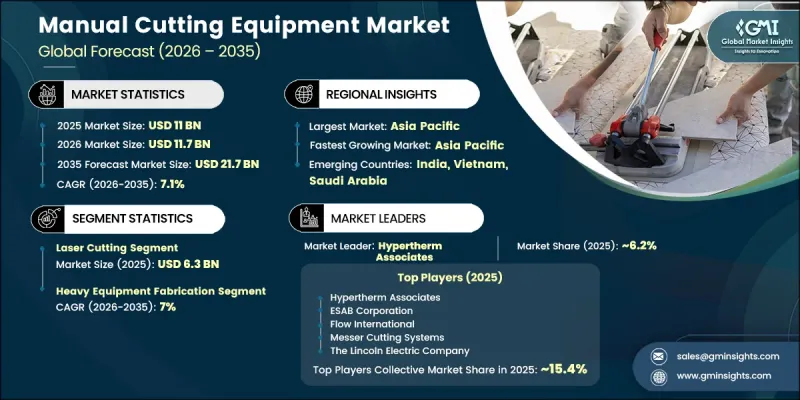
수동 절단 장비 시장의 성장은 산업 제조 활동의 지속적인 확대와 정밀도를 중시하는 제조 공정에 대한 수요 증가에 힘입고 있습니다. 금속 가공, 건설, 운송 장비 제조 및 산업 제조 분야에 종사하는 업계에서는 생산성 향상과 작업 정밀도 제고를 위해 첨단 절단 솔루션의 도입이 점점 더 확대되고 있습니다. 효율적인 소재 가공, 제조 품질 향상 및 생산 워크플로우 최적화에 대한 관심이 높아지면서 시장 확대에 유리한 환경이 조성되고 있습니다. 또한 급속한 산업 발전과 제조 인프라에 대한 지속적인 투자로 인해, 성능 향상과 안정적인 결과를 가져다주는 최신 절단 기술의 보급이 촉진되고 있습니다. 각 업계가 폐기물과 생산 비용을 최소화하면서 처리량을 높이기 위해 노력하는 가운데, 고성능 절단 장치에 대한 수요는 전 세계 시장에서 계속해서 증가하고 있습니다. 첨단 가공 능력에 대한 관심이 높아지고 있는 데다 산업 운영의 현대화까지 더해지면서, 예측 기간 중 수동 절단 장비 업계에 큰 성장 기회가 생길 것으로 전망됩니다.
| 시장 범위 | |
|---|---|
| 시작연도 | 2025년 |
| 예측 기간 | 2026-2035 |
| 개시 금액 | 110억 달러 |
| 예측액 | 217억 달러 |
| CAGR | 7.1% |
수동 절단 장비 시장도 산업 분야 전반에 걸친 제조 활동의 확대에 힘입어 성장하고 있습니다. 생산량 증가와 정밀 가공에 대한 요구가 높아짐에 따라 제조업체들은 뛰어난 속도, 유연성 및 운영 효율성을 갖춘 절단 시스템에 대한 투자를 확대하고 있습니다. 자동화 지원 기능, CNC 지원 및 에너지 효율이 높은 가동 능력의 통합을 통해 전반적인 제조 성능이 향상될 뿐만 아니라, 자재 손실 감소에도 기여하고 있습니다. 또한 제조 시설 및 산업용 가공 업무에 대한 투자 확대에 힘입어, 복잡한 생산 요건을 충족할 수 있는 절단 기술에 대한 수요가 지원되고 있습니다. 제조업체들이 생산성 향상과 공정 최적화를 우선시하는 가운데, 다양한 산업 분야에서 첨단 절단 장비에 대한 수요는 계속해서 증가하고 있습니다.
레이저 절단 부문은 2025년에 63억 달러의 시장 규모를 기록했습니다. 이 부문은 뛰어난 정밀도, 빠른 가공 속도, 다양한 소재에 대한 대응 능력을 갖추고 있으며, 수동 절단 장비 시장에서 지배적인 위치를 유지하고 있습니다. 제조업체들은 생산 정밀도 향상, 모서리 품질 개선, 재료 낭비 최소화를 도모할 수 있으므로 레이저 기반 시스템을 점점 더 선호하고 있습니다. 자동화된 제조 환경 및 CNC 지원 생산 시스템과의 원활한 통합은 현대 산업 시설에서의 도입을 더욱 촉진하고 있습니다. 기업이 효율성과 품질 향상에 지속적으로 주력함에 따라 레이저 절단 솔루션에 대한 수요는 계속해서 견고할 것으로 예상됩니다.
중장비 제조 부문은 2025년에 27.9%의 시장 점유율을 차지하며, 2026-2035년 연평균 성장률(CAGR) 7%로 성장할 것으로 전망됩니다. 이 부문은 산업용 기계 및 설비 제조 업무 전반에 걸쳐 정밀 금속 가공에 대한 수요가 증가하고 있음에 따라 계속해서 시장 수요를 주도하고 있습니다. 제조업체들은 높은 정밀도와 생산성을 유지하면서 두꺼운 재질이나 복잡한 구조의 부품을 효율적으로 가공할 수 있는 첨단 절단 기술을 필요로 하고 있습니다. 재료 활용의 최적화와 제조 공정의 효율화에 대한 수요가 높아짐에 따라 전 세계 제조 시설에서 첨단 절단 솔루션의 도입이 지속적으로 확대되고 있습니다.
중국의 수동 절단 장비 시장은 2025년에 28억 달러 규모에 달하며, 2035년까지 연평균 성장률(CAGR) 6.7%를 기록하며 성장할 것으로 전망됩니다. 이 국가의 확고한 시장 지위는 광범위한 산업 기반과 다양한 분야에서 기록적인 제조 생산량에 의해 지원되고 있습니다. 지속적인 산업 확대, 인프라 개발 노력, 그리고 현대적인 생산 시설에 대한 투자가 해당 지역 전체에서 첨단 절단 기술에 대한 수요를 견인하고 있습니다. 각 제조사는 업무 효율 향상, 제품 품질 향상, 그리고 대량 생산 요건에 대응하기 위해 정밀성을 중시하는 설비를 점점 더 많이 도입하고 있습니다. 이러한 요인들은 중국 전역에서 시장 성장을 위한 큰 기회를 지속적으로 창출하고 있습니다.
자주 묻는 질문
목차
제1장 조사 방법과 범위
제2장 개요
제3장 업계 인사이트
제4장 경쟁 구도
제5장 시장 추산·예측 : 기술 유형별, 2022-2035년
제6장 시장 추산·예측 : 용도별, 2022-2035년
제7장 시장 추산·예측 : 유통 채널별, 2022-2035년
제8장 시장 추산·예측 : 지역별, 2022-2035년
제9장 기업 개요
KSA 26.06.24The Global Manual Cutting Equipment Market was valued at USD 11 billion in 2025 and is estimated to grow at a CAGR of 7.1% to reach USD 21.7 billion by 2035.
Growth in the manual cutting equipment market is supported by the continued expansion of industrial manufacturing activities and the increasing requirement for precision-driven fabrication processes. Industries involved in metal processing, construction, transportation equipment production, and industrial manufacturing are increasingly adopting advanced cutting solutions to improve productivity and achieve greater operational accuracy. The growing emphasis on efficient material processing, enhanced manufacturing quality, and optimized production workflows is creating favorable conditions for market expansion. Furthermore, rapid industrial development and ongoing investments in manufacturing infrastructure are encouraging wider adoption of modern cutting technologies capable of delivering improved performance and consistent results. As industries seek to increase throughput while minimizing waste and production costs, demand for high-performance cutting equipment continues to rise across global markets. The increasing focus on advanced fabrication capabilities, combined with the modernization of industrial operations, is expected to create significant growth opportunities for the manual cutting equipment industry throughout the forecast period.
| Market Scope | |
|---|---|
| Start Year | 2025 |
| Forecast Year | 2026-2035 |
| Start Value | $11 Billion |
| Forecast Value | $21.7 Billion |
| CAGR | 7.1% |
The manual cutting equipment market is also benefiting from the expansion of manufacturing activities across industrial sectors. Rising production volumes and increasing requirements for precise fabrication are encouraging manufacturers to invest in cutting systems that offer superior speed, flexibility, and operational efficiency. The integration of automation-assisted functionality, CNC compatibility, and energy-efficient operating capabilities is improving overall manufacturing performance while helping reduce material losses. In addition, growing investments in fabrication facilities and industrial processing operations are supporting demand for cutting technologies capable of handling complex production requirements. As manufacturers prioritize productivity improvements and process optimization, the need for advanced cutting equipment continues to gain momentum across a broad range of industrial applications.
The laser cutting segment generated USD 6.3 billion in 2025. The segment maintains a dominant position within the manual cutting equipment market due to its ability to deliver exceptional precision, rapid processing speeds, and compatibility with diverse materials. Manufacturers increasingly prefer laser-based systems because they enhance production accuracy, improve edge quality, and minimize material waste. Their seamless integration with automated manufacturing environments and CNC-enabled production systems further strengthens their adoption across modern industrial facilities. As companies continue to focus on efficiency and quality improvements, demand for laser cutting solutions is expected to remain strong.
The heavy equipment fabrication segment accounted for 27.9% share in 2025 and is forecast to grow at a CAGR of 7% between 2026 and 2035. This segment continues to lead market demand due to the growing requirement for precise metal fabrication across industrial machinery and equipment manufacturing operations. Fabricators require advanced cutting technologies that can efficiently process thick materials and intricate structural components while maintaining high levels of accuracy and productivity. The increasing need for optimized material utilization and streamlined manufacturing processes continues to support the adoption of advanced cutting solutions across fabrication facilities worldwide.
China Manual Cutting Equipment Market generated USD 2.8 billion in 2025 and is anticipated to grow at a CAGR of 6.7% through 2035. The country's strong position is supported by its extensive industrial base and significant manufacturing output across multiple sectors. Continued industrial expansion, infrastructure development initiatives, and investments in modern production facilities are driving demand for advanced cutting technologies throughout the region. Manufacturers are increasingly adopting precision-oriented equipment to improve operational efficiency, enhance product quality, and support high-volume production requirements. These factors continue to create substantial opportunities for market growth across China.
Key participants operating in the Global Manual Cutting Equipment Market include Hypertherm Associates, Flow International, ESAB Corporation, Koike Aronson, Inc., The Lincoln Electric Company, Messer Cutting Systems, Kjellberg Finsterwalde, DAIHEN Corporation, Panasonic Connect - Welding Division, Ador Welding Ltd., Voortman Steel Machinery, Cebora S.p.A., Hornet Cutting Systems, Esprit Automation, WARDJet, Jet Edge, Inc., ZINSER GmbH, KMT Waterjet, GENSTAR TECHNOLOGIES, Techni Waterjet, and Torchmate CNC. Companies active in the manual cutting equipment market are focusing on technological innovation, product portfolio expansion, and operational efficiency improvements to strengthen their market position. Leading manufacturers are investing in advanced cutting technologies that enhance precision, productivity, and energy efficiency while reducing operating costs for end users. Strategic collaborations with industrial customers and manufacturing organizations are helping companies expand their market reach and strengthen long-term business relationships. Many market participants are also increasing investments in research and development to introduce cutting systems with enhanced automation capabilities, improved software integration, and greater processing flexibility. Geographic expansion initiatives, distribution network strengthening, and customer support enhancements remain important growth strategies.
Table of Contents
Chapter 1 Methodology & Scope
- 1.1 Market scope and definition
- 1.2 Research design
- 1.2.1 Research approach
- 1.2.2 Data collection methods
- 1.3 Data mining sources
- 1.3.1 Global
- 1.3.2 Regional/Country
- 1.4 Base estimates and calculations
- 1.4.1 Base year calculation
- 1.4.2 Key trends for market estimation
- 1.5 Primary research and validation
- 1.5.1 Primary sources
- 1.6 Forecast model
- 1.7 Research assumptions and limitations
Chapter 2 Executive Summary
- 2.1 Industry 360° synopsis
- 2.2 Key market trends
- 2.2.1 Regional
- 2.2.2 Product Type
- 2.2.3 Application
- 2.2.4 Distribution channel
Chapter 3 Industry Insights
- 3.1 Industry ecosystem analysis
- 3.1.1 Supplier landscape
- 3.1.2 Profit margin
- 3.1.3 Value addition at each stage
- 3.1.4 Factor affecting the value chain
- 3.2 Industry impact forces
- 3.2.1 Growth drivers
- 3.2.1.1 Rising industrial manufacturing and metal fabrication activities
- 3.2.1.2 Expansion of automotive, transportation, and heavy machinery production
- 3.2.1.3 Growing investments in infrastructure and industrial automation
- 3.2.2 Pitfalls & Challenges
- 3.2.2.1 High capital investment and maintenance costs for advanced cutting systems
- 3.2.2.2 Skilled labor requirements and operational complexity
- 3.2.3 Opportunities
- 3.2.3.1 Rising adoption of automation-integrated and CNC-compatible cutting systems
- 3.2.3.2 Growing demand for energy-efficient and high-precision cutting technologies
- 3.2.1 Growth drivers
- 3.3 Growth potential analysis
- 3.4 Future market trends
- 3.5 Technology and innovation landscape
- 3.5.1 Current technological trends
- 3.5.2 Emerging technologies
- 3.6 Regulatory landscape
- 3.6.1 Standards and compliance requirements
- 3.6.2 Regional regulatory frameworks
- 3.6.3 Certification standards
- 3.7 Porter's analysis
- 3.8 PESTEL analysis
- 3.9 Pricing analysis (driven by primary research)
- 3.9.1 Historical price trend analysis (driven by primary research)
- 3.9.2 Pricing strategy by player type (premium / value / cost-plus) (driven by primary research)
- 3.9.3 Regional price variations and drivers
- 3.9.4 Price sensitivity by end-user segment
- 3.10 Trade data analysis (driven paid data base)
- 3.10.1 Import/export volume and value trends (driven by paid data base)
- 3.10.2 Key trade corridors and tariff impact (driven by paid data base)
- 3.10.3 Trade policy changes and market access
- 3.11 Impact of AI and generative AI on the market
- 3.11.1 AI-driven disruption of existing business models
- 3.11.2 GenAI use cases and adoption roadmap by segment
- 3.11.3 Predictive maintenance for manual equipment
- 3.11.4 AI-assisted operator training and skill development
- 3.11.5 Design optimization and material usage efficiency
- 3.11.6 Risks, limitations, and regulatory considerations
- 3.12 Capacity and production landscape (driven by primary research)
- 3.12.1 Installed capacity by region and key producer (driven by primary research)
- 3.12.2 Capacity utilization rates and expansion pipelines (driven by primary research)
Chapter 4 Competitive Landscape, 2025
- 4.1 Introduction
- 4.2 Company market share analysis
- 4.2.1 By Region
- 4.2.1.1 North America
- 4.2.1.2 Europe
- 4.2.1.3 Asia Pacific
- 4.2.1.4 Latin America
- 4.2.1.5 Middle East & Africa
- 4.2.1 By Region
- 4.3 Company matrix analysis
- 4.4 Competitive analysis of major market players
- 4.5 Competitive positioning matrix
- 4.6 Key developments
- 4.6.1 Mergers & acquisitions
- 4.6.2 Partnerships & collaborations
- 4.6.3 New product launches
- 4.6.4 Expansion plans
Chapter 5 Market Estimates & Forecast, By Technology type, 2022 - 2035, (USD Billion) (Thousand Units)
- 5.1 Key trends
- 5.2 Laser Cutting
- 5.3 Plasma Cutting
- 5.4 Waterjet Cutting
- 5.5 Oxy-Fuel Cutting
- 5.6 Carbon Arc Cutting
Chapter 6 Market Estimates & Forecast, By Application, 2022 - 2035, (USD Billion) (Thousand Units)
- 6.1 Key trends
- 6.2 Heavy Equipment Fabrication
- 6.3 Automotive & Transportation
- 6.4 Construction
- 6.5 Shipbuilding & Offshore
- 6.6 Others
Chapter 7 Market Estimates & Forecast, By Distribution Channel, 2022 - 2035, (USD Billion) (Thousand Units)
- 7.1 Key trends
- 7.2 Direct
- 7.3 Indirect
Chapter 8 Market Estimates & Forecast, By Region, 2022 - 2035, (USD Billion) (Thousand Units)
- 8.1 Key trends
- 8.2 North America
- 8.2.1 U.S.
- 8.2.2 Canada
- 8.3 Europe
- 8.3.1 Germany
- 8.3.2 UK
- 8.3.3 France
- 8.3.4 Italy
- 8.3.5 Spain
- 8.4 Asia Pacific
- 8.4.1 China
- 8.4.2 India
- 8.4.3 Japan
- 8.4.4 South Korea
- 8.4.5 Australia
- 8.5 Latin America
- 8.5.1 Brazil
- 8.5.2 Mexico
- 8.5.3 Argentina
- 8.6 MEA
- 8.6.1 Saudi Arabia
- 8.6.2 UAE
- 8.6.3 South Africa
Chapter 9 Company Profiles
- 9.1 Top Global Players
- 9.1.1 Hypertherm Associates
- 9.1.2 ESAB Corporation
- 9.1.3 The Lincoln Electric Company
- 9.1.4 Messer Cutting Systems
- 9.1.5 Koike Aronson, Inc.
- 9.1.6 Kjellberg Finsterwalde
- 9.1.7 Flow International
- 9.2 Regional Champions
- 9.2.1 DAIHEN Corporation
- 9.2.2 Ador Welding Ltd.
- 9.2.3 Voortman Steel Machinery
- 9.2.4 Cebora S.p.A.
- 9.2.5 Panasonic Connect - Welding Division
- 9.2.6 Hornet Cutting Systems
- 9.2.7 Esprit Automation
- 9.3 Emerging & Specialized Players
- 9.3.1 Jet Edge, Inc.
- 9.3.2 WARDJet
- 9.3.3 ZINSER GmbH
- 9.3.4 GENSTAR TECHNOLOGIES
- 9.3.5 KMT Waterjet
- 9.3.6 Torchmate CNC
- 9.3.7 Techni Waterjet


