|
시장보고서
상품코드
2061471
정제 프레스기 시장 기회, 성장요인, 업계 동향 분석 및 예측(2026-2035년)Tablet Press Machines Market Opportunity, Growth Drivers, Industry Trend Analysis, and Forecast 2026 - 2035 |
||||||

세계의 정제 프레스기 시장은 2025년에 15억 2,000만 달러로 평가되고 CAGR 5.3%로 성장하며, 2035년까지 25억 6,000만 달러에 달할 것으로 추정되고 있습니다.
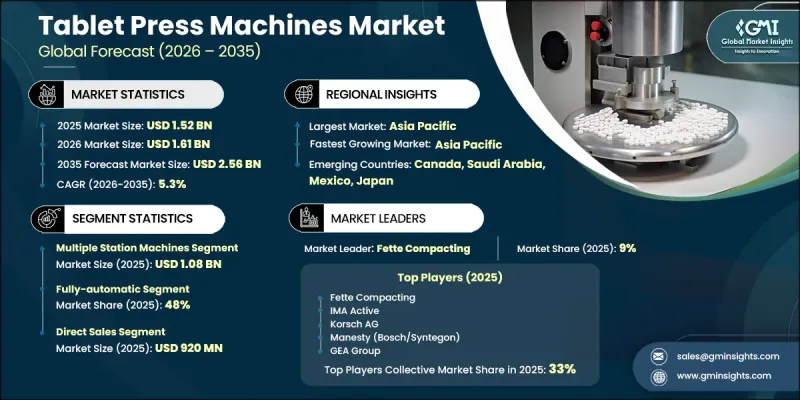
시장 확대는 제약 부문의 지속적인 성장과 경구용 고형 제제의 생산 증가에 힘입어 이루어지고 있습니다. 정제는 저렴한 가격, 투여의 용이성, 장기 보존성 덕분에 여전히 가장 널리 사용되는 약물 투여 형태 중 하나입니다. 전 세계에서 만성질환의 유병률이 증가하고 있는 것은 제약 기업이 정제 생산을 더욱 확대하도록 촉진하고 있으며, 그 결과 대용량이자 고성능의 압축 장치에 대한 수요가 높아지고 있습니다. 또한 제네릭 의약품의 생산 확대는 특히 수많은 환자층에 비용 대비 효과가 높은 의약품을 공급하는 데 주력하고 있는 신흥 국가에서 설비 도입에 크게 기여하고 있습니다. 위탁 제조 기업(CMO) 역시 다양한 제형과 배치 규모에 대응할 수 있는 유연하고 다기능적인 정제 압축 시스템에 대한 투자를 통해 수요를 지원하고 있습니다. 이러한 변화에 따라 제약 밸류체인 전반에 걸친 대규모 생산 요건을 충족하면서도 일관된 제품 품질을 보장할 수 있는 첨단 기계에 대한 수요가 증가하고 있습니다.
| 시장 범위 | |
|---|---|
| 시작연도 | 2025년 |
| 예측 기간 | 2026-2035년 |
| 개시 금액 | 15억 2,000만 달러 |
| 예측액 | 25억 6,000만 달러 |
| CAGR | 5.3% |
멀티 스테이션 프레스 부문은 2025년에 10억 8,000만 달러의 시장 규모를 기록했습니다. 일반적으로 로터리식 정제 프레스라고 알려진 이 유형은 대량 생산 환경에서 여전히 최적의 선택지로 남아 있습니다. 이 기계들은 여러 개의 공구 스테이션을 갖춘 회전식 터렛을 사용하여 작동하며, 각 사이클마다 정제 압축을 동시에 수행할 수 있습니다. 이 설계는 단일 스테이션 시스템에 비해 생산 효율을 대폭 향상시키기 때문에 높은 처리량이 필수적인 대규모 의약품 및 건강기능식품 제조 업무에 가장 적합합니다.
2025년, 완전 자동화 부문은 시장 점유율의 48%를 차지했습니다. 이 부문은 인적 개입을 최소화하면서도 정제 제조 공정 전체를 자동화할 수 있으므로 계속해서 성장하고 있습니다. 분말 공급, 압축, 중량 조절, 정제 배출 등의 기능이 완벽하게 동기화되어 있으며, 일관된 제품 품질과 업무 효율 향상을 보장합니다. 이러한 시스템은 정밀도, 규정 준수, 대규모 생산량이 중요한 요건인 의약품 및 뉴트라슈티컬(기능성 식품) 제조 현장에서 널리 채택되고 있습니다.
미국 정제 압축기 시장은 75.8%의 점유율을 차지했으며, 2025년에는 3억 6,000만 달러의 시장 규모를 기록했습니다. 이 국가의 시장 성장은 견고한 의약품 수요, 확립된 의료 인프라, 그리고 첨단 제조 역량에 힘입어 이루어지고 있습니다. 생산은 주로 만성질환이나 장기적인 질환의 치료에 사용되는 고품질의 경구용 고형 제제에 중점을 두고 있습니다. 또한 FDA(미국 식품의약국)가 시행하고 있는 엄격한 규제 기준에 따라 제조업체들은 생산 주기 전반에 걸쳐 규정 준수, 정밀도 및 제품의 균일성을 확보하기 위한 첨단 정제 압축 기술에 대한 투자를 확대하고 있습니다.
자주 묻는 질문
목차
제1장 조사 방법과 범위
제2장 개요
제3장 산업 인사이트
제4장 경쟁 구도
제5장 시장 추정·예측 : 기계 유형별, 2022-2035년
제6장 시장 추정·예측 : 운영 모드별, 2022-2035년
제7장 시장 추정·예측 : 생산능력별, 2022-2035년
제8장 시장 추정·예측 : 최종 용도 산업별, 2022-2035년
제9장 시장 추정·예측 : 유통 채널별, 2022-2035년
제10장 시장 추정·예측 : 지역별, 2022-2035년
제11장 기업 개요
KSA 26.06.24The Global Tablet Press Machines Market was valued at USD 1.52 billion in 2025 and is estimated to grow at a CAGR of 5.3% to reach USD 2.56 billion by 2035.
Market expansion is driven by the continuous growth of the pharmaceutical sector and the rising production of oral solid dosage drugs. Tablets remain one of the most widely used drug delivery formats due to their affordability, ease of administration, and extended shelf life. Increasing global prevalence of chronic diseases is further pushing pharmaceutical companies to scale up tablet production, thereby increasing demand for high-capacity and high-performance compression equipment. In addition, the expansion of generic drug manufacturing is contributing significantly to equipment adoption, particularly in emerging economies focused on delivering cost-effective medicines to large patient populations. Contract manufacturing organizations are also strengthening demand by investing in flexible and multi-functional tablet compression systems capable of handling varied formulations and batch sizes. This shift is reinforcing the need for advanced machinery that ensures consistent output quality while supporting large-scale production requirements across the pharmaceutical value chain.
| Market Scope | |
|---|---|
| Start Year | 2025 |
| Forecast Year | 2026-2035 |
| Start Value | $1.52 Billion |
| Forecast Value | $2.56 Billion |
| CAGR | 5.3% |
The multiple station machines segment generated USD 1.08 billion in 2025. This category, commonly known as rotary tablet presses, remains the preferred choice for high-volume production environments. These machines operate using a rotating turret equipped with multiple tooling stations that allow simultaneous tablet compression during each cycle. This design significantly enhances production efficiency compared to single-station systems, making them ideal for large-scale pharmaceutical and nutraceutical manufacturing operations where high throughput is essential.
The fully-automatic segment accounted for 48% share in 2025. This segment continues to expand due to its ability to automate the entire tablet production process with minimal human intervention. Functions such as powder feeding, compression, weight adjustment, and tablet ejection are fully synchronized, ensuring consistent product quality and improved operational efficiency. Such systems are widely adopted in pharmaceutical and nutraceutical production environments where precision, regulatory compliance, and large-scale output are critical requirements.
U.S. Tablet Press Machines Market held a 75.8% share, generating USD 0.36 billion in 2025. Market growth in the country is supported by strong pharmaceutical demand, a well-established healthcare infrastructure, and advanced manufacturing capabilities. Production is largely focused on high-quality oral solid dosage forms used in the treatment of chronic and long-term conditions. In addition, strict regulatory standards enforced by the FDA are encouraging manufacturers to invest in advanced tablet compression technologies that ensure compliance, precision, and product consistency across production cycles.
Major players operating in the Global Tablet Press Machines Industry include Fette Compacting, IMA Active, GEA Group, Korsch AG, Romaco, ACG Pharma Technologies, Manesty (Bosch/Syntegon), Sejong Pharmatech, Cadmach Machinery, Elizabeth Hata, Stokes, Shanghai Tianhe, Riddhi Pharma, Riva S.A., Glatt, PTK-GB, Fluid Pack, Karnavati/Rimek, Prism Pharma, Chamunda Pharma, and Compression Components & Service. Companies in the tablet press machines market are focusing on advancing automation and precision engineering to improve production efficiency and product consistency. Manufacturers are integrating digital monitoring systems, real-time process control, and predictive maintenance capabilities to reduce downtime and enhance operational reliability. Expansion of modular machine designs is enabling flexible production setups that accommodate different tablet sizes and formulations. Firms are also investing in high-speed rotary systems to meet growing demand for large-scale pharmaceutical manufacturing. Strategic partnerships with pharmaceutical companies and contract manufacturers are strengthening market penetration. Additionally, emphasis on regulatory compliance, energy-efficient systems, and reduced material wastage is helping companies improve competitiveness.
Table of Contents
Chapter 1 Methodology and Scope
- 1.1 Market scope and definition
- 1.2 Research design
- 1.2.1 Research approach
- 1.2.2 Data collection methods
- 1.3 Data mining sources
- 1.3.1 Global
- 1.3.2 Regional/Country
- 1.4 Base estimates and calculations
- 1.4.1 Base year calculation
- 1.4.2 Key trends for market estimation
- 1.5 Primary research and validation
- 1.5.1 Primary sources
- 1.6 Forecast model
- 1.7 Research assumptions and limitations
Chapter 2 Executive Summary
- 2.1 Industry 360° synopsis
- 2.2 Key market trends
- 2.2.1 Regional
- 2.2.2 Machine type
- 2.2.3 Mode of operation
- 2.2.4 Production capacity
- 2.2.5 End use industry
- 2.2.6 Distribution channel
Chapter 3 Industry Insights
- 3.1 Industry ecosystem analysis
- 3.1.1 Supplier landscape
- 3.1.2 Profit margin
- 3.1.3 Value addition at each stage
- 3.1.4 Factor affecting the value chain
- 3.2 Industry impact forces
- 3.2.1 Growth drivers
- 3.2.1.1 Pharmaceutical industry expansion
- 3.2.1.2 Technological advancements
- 3.2.1.3 Regulatory emphasis on quality & compliance
- 3.2.2 Industry pitfalls & challenges
- 3.2.2.1 High capital investment
- 3.2.2.2 Maintenance & operational complexity
- 3.2.3 Opportunities
- 3.2.3.1 Integration with smart manufacturing
- 3.2.3.2 Sustainability & energy efficiency
- 3.2.1 Growth drivers
- 3.3 Growth potential analysis
- 3.4 Regulatory framework
- 3.4.1 FDA regulations & 21 CFR Part 11 compliance
- 3.4.2 cGMP (current good manufacturing practice) standards
- 3.4.3 EU GMP Annex 15 (qualification & validation)
- 3.4.4 China NMPA equipment registration requirements
- 3.4.5 OEB (occupational exposure band) standards for containment
- 3.5 Pricing analysis
- 3.5.1 Historical price trend analysis (driven by primary research)
- 3.5.2 Pricing strategy by player type (premium / value / cost-plus)
- 3.5.3 Regional price variations
- 3.6 Trade data analysis (driven by paid database) (84798970)
- 3.6.1 Import/export volume & value trends
- 3.6.2 Key trade corridors & tariff impact
- 3.6.3 Cross-border logistics challenges
- 3.7 Impact of AI & generative AI on the market
- 3.7.1 AI-driven disruption of existing business models
- 3.7.2 GenAI use cases & adoption roadmap by segment
- 3.7.2.1 Real-time pressure feedback & adaptive control
- 3.7.2.2 Predictive maintenance & downtime reduction
- 3.7.2.3 Algorithm-driven yield optimization
- 3.7.2.4 Quality control & defect detection (capping, lamination)
- 3.7.3 Risks, limitations & regulatory considerations
- 3.8 Capacity & production landscape (driven by primary research)
- 3.8.1 Installed capacity by region & key producer
- 3.8.2 Capacity utilization rates & expansion pipelines
Chapter 4 Competitive Landscape, 2025
- 4.1 Introduction
- 4.2 Company market share analysis
- 4.2.1 By region
- 4.2.1.1 North America
- 4.2.1.2 Europe
- 4.2.1.3 Asia Pacific
- 4.2.1.4 Latin America
- 4.2.1.5 Middle East and Africa
- 4.2.1 By region
- 4.3 Company matrix analysis
- 4.4 Competitive analysis of major market players
- 4.5 Competitive positioning matrix
- 4.6 Key developments
- 4.6.1 Mergers & acquisitions
- 4.6.2 Partnerships & collaborations
- 4.6.3 New product launches
- 4.6.4 Expansion plans
Chapter 5 Market Estimates and Forecast, By Machine Type, 2022 - 2035 (USD Billion)
- 5.1 Key trends
- 5.2 Single station presses
- 5.3 Multi-station presses
Chapter 6 Market Estimates and Forecast, By Mode of Operation, 2022 - 2035 (USD Billion)
- 6.1 Key trends
- 6.2 Manual
- 6.3 Semi-automatic
- 6.4 Fully automatic
Chapter 7 Market Estimates and Forecast, By Production Capacity, 2022 - 2035 (USD Billion)
- 7.1 Key trends
- 7.2 Below 50,000 pcs/hr
- 7.3 50,000 - 100,000 pcs/hr
- 7.4 100,000 - 200,000 pcs/hr
- 7.5 Above 200,000 pcs/hr
Chapter 8 Market Estimates and Forecast, By End Use Industry, 2022 - 2035 (USD Billion)
- 8.1 Key trends
- 8.2 Pharmaceutical
- 8.3 Nutraceuticals & dietary supplements
- 8.4 Food & beverages
- 8.5 Cosmetics & personal care
- 8.6 Others
Chapter 9 Market Estimates and Forecast, By Distribution Channel, 2022 - 2035 (USD Billion)
- 9.1 Key trends
- 9.2 Direct sales
- 9.3 Indirect sales
Chapter 10 Market Estimates and Forecast, By Region, 2022 - 2035 (USD Billion)
- 10.1 Key trends
- 10.2 North America
- 10.2.1 U.S.
- 10.2.2 Canada
- 10.3 Europe
- 10.3.1 Germany
- 10.3.2 UK
- 10.3.3 France
- 10.3.4 Italy
- 10.3.5 Spain
- 10.4 Asia Pacific
- 10.4.1 China
- 10.4.2 Japan
- 10.4.3 India
- 10.4.4 Australia
- 10.4.5 South Korea
- 10.5 Latin America
- 10.5.1 Brazil
- 10.5.2 Mexico
- 10.5.3 Argentina
- 10.6 Middle East and Africa
- 10.6.1 South Africa
- 10.6.2 Saudi Arabia
- 10.6.3 UAE
Chapter 11 Company Profiles
- 11.1 Global players
- 11.1.1 Fette Compacting
- 11.1.2 IMA Active
- 11.1.3 Korsch AG
- 11.1.4 GEA Group
- 11.1.5 Romaco
- 11.1.6 Manesty (Bosch/Syntegon)
- 11.1.7 ACG Pharma Technologies
- 11.2 Regional players
- 11.2.1 Cadmach Machinery
- 11.2.2 Sejong Pharmatech
- 11.2.3 Elizabeth Hata
- 11.2.4 Stokes
- 11.2.5 Shanghai Tianhe
- 11.2.6 Riddhi Pharma
- 11.2.7 Riva S.A.
- 11.3 Emerging players
- 11.3.1 PTK-GB
- 11.3.2 Glatt
- 11.3.3 Fluid Pack
- 11.3.4 Karnavati/Rimek
- 11.3.5 Prism Pharma
- 11.3.6 Chamunda Pharma
- 11.3.7 Compression Components & Service