

|
시장보고서
상품코드
2071204
채소 및 특용작물 종자 시장 기회, 성장 촉진요인, 산업 동향 분석, 예측(2026-2035년)Vegetable and Specialty Crop Seeds Market Opportunity, Growth Drivers, Industry Trend Analysis, and Forecast 2026 - 2035 |
||||||

세계의 채소 및 특용작물 종자 시장은 2025년에 81억 달러 규모에 달하고, CAGR 6%로 성장하여 2035년까지 145억 달러에 달할 것으로 추정됩니다.
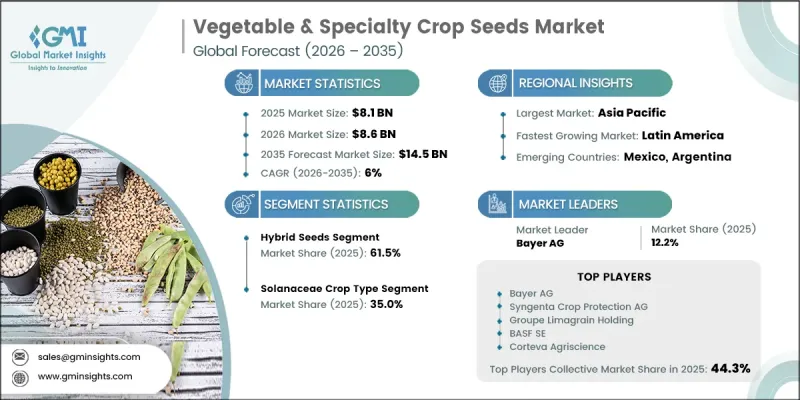
세계 채소 및 특용작물 종자 시장의 성장은 상업 농업 분야의 수요 증가, 보호 재배 활동의 확대, 그리고 생산성 및 작물 성능 향상을 목적으로 한 유전자 개량 종자의 채택 확대에 힘입어 이루어지고 있습니다. 또한, 고품질 신선 농산물에 대한 소비자의 수요가 증가하고 있으며, 개량된 종묘를 통해 농업 생산성을 높이려는 지속적인 노력도 시장 성장에 기여하고 있습니다. 식물 육종 기술의 발전으로 고성능 종자 품종의 개발이 가속화되고 있으며, 종자 생산자들은 기존의 육종 기법보다 더 효율적으로 적응성, 수확량 잠재력 및 내성을 향상시킨 제품을 시장에 출시할 수 있게 되었습니다. 식량 안보, 농업의 현대화, 그리고 종자 시스템 개발에 중점을 둔 정부의 노력 또한 인증된 상업용 종자로의 전환을 더욱 촉진하고 있습니다. 또한, 식품 유통 네트워크의 발전과 소비 패턴의 변화에 따라 수확 후 특성이 개선되고, 제품의 품질이 안정화되며, 시장성이 향상된 작물 품종에 대한 수요가 증가하고 있어, 채소 및 특산 작물용 종자 산업의 장기적인 확장을 위한 유리한 여건이 조성되어 있습니다.
| 시장 규모 | |
|---|---|
| 시작 연도 | 2025년 |
| 예측 기간 | 2026-2035년 |
| 개시 금액 | 81억 달러 |
| 예측 금액 | 145억 달러 |
| CAGR | 6% |
하이브리드 종자 부문은 2025년에 61.5%의 시장 점유율을 차지했으며, 2035년까지 연평균 성장률(CAGR) 6.5%로 성장할 것으로 전망됩니다. 상업 농가에서는 뛰어난 생산성, 작물의 균일성 향상, 그리고 환경적·생물학적 문제에 대한 내성 강화와 같은 장점 덕분에 하이브리드 품종이 여전히 선호되고 있습니다. 이러한 장점은 더 확실한 수확 성과, 생산 위험의 감소, 그리고 운영 효율의 향상에 기여하고 있습니다. 하이브리드 종자는 투입 비용을 절감하면서도 높은 수확량을 보장하는 능력을 갖추고 있으며, 이는 상업적 재배 시스템 전반에 걸친 보급을 이끄는 중요한 요인으로 계속해서 작용하고 있습니다.
가지과 작물 부문은 2025년에 35%의 시장 점유율을 차지했습니다. 이 부문은 주곡 생산과 고급 신선식품 시장 모두에서 중요한 위치를 차지하고 있어, 견고한 입지를 유지하고 있습니다. 종자 개발 및 육종 프로그램에 대한 막대한 투자가 이 작물 부문의 혁신을 지속적으로 뒷받침하고 있습니다.
2025년, 북미의 채소 및 특용작물 종자 시장은 17%의 점유율을 차지했습니다. 이 시장은 고도로 상업화된 채소 생산 시스템과 고부가가치 작물 부문에서 선진적인 종자 기술을 적극적으로 도입한 덕분에 혜택을 보고 있습니다. 하이브리드 종자의 광범위한 활용은 해당 지역의 농업 부문 전반에 걸쳐 생산성 향상과 품질 향상을 지속적으로 뒷받침하고 있습니다. 또한, 제어 환경 농업 및 보호 재배 인프라에 대한 투자 확대에 따라, 집약형 생산 시스템을 위해 특별히 개발된 특수 종자 품종에 대한 수요가 증가하고 있습니다. 이러한 추세에 따라, 전 세계 채소 및 특용작물 종자 업계에서 북미의 입지는 계속해서 공고해지고 있습니다.
자주 묻는 질문
목차
제1장 조사 방법과 범위
제2장 주요 요약
제3장 업계 인사이트
제4장 경쟁 구도
제5장 시장 추정 및 예측 : 종자 유형별, 2022-2035년
제6장 시장 추정 및 예측 : 작물 유형별, 2022-2035년
제7장 시장 추정 및 예측 : 최종사용자별, 2022-2035년
제8장 시장 추정 및 예측 : 지역별, 2022-2035년
제9장 기업 개요
KSM 26.07.03The Global Vegetable & Specialty Crop Seeds Market was valued at USD 8.1 billion in 2025 and is estimated to grow at a CAGR of 6% to reach USD 14.5 billion by 2035.
Growth in the global vegetable & specialty crop seeds market is supported by rising demand from commercial farming operations, expanding protected cultivation activities, and increasing adoption of genetically enhanced seed varieties designed to improve productivity and crop performance. The market is also benefiting from growing consumer demand for premium-quality fresh produce and ongoing efforts to strengthen agricultural productivity through improved planting materials. Advances in plant breeding technologies have accelerated the development of high-performance seed varieties, allowing seed producers to introduce products with improved adaptability, yield potential, and resilience more efficiently than traditional breeding methods. Government initiatives focused on food security, agricultural modernization, and seed system development are further encouraging the transition toward certified commercial seeds. Additionally, evolving food distribution networks and changing consumption patterns are increasing demand for crop varieties that offer improved post-harvest characteristics, enhanced product consistency, and greater marketability, creating favorable conditions for long-term expansion of the vegetable and specialty crop seeds industry.
| Market Scope | |
|---|---|
| Start Year | 2025 |
| Forecast Year | 2026-2035 |
| Start Value | $8.1 Billion |
| Forecast Value | $14.5 Billion |
| CAGR | 6% |
The hybrid seeds segment accounted for 61.5% share in 2025 and is projected to grow at a CAGR of 6.5% through 2035. Commercial growers continue to favor hybrid varieties because they provide superior productivity, greater crop uniformity, and enhanced resistance to environmental and biological challenges. These advantages contribute to more reliable harvest outcomes, lower production risks, and improved operational efficiency. The ability of hybrid seeds to support higher yields while reducing input-related costs remains a key factor driving widespread adoption across commercial cultivation systems.
The solanaceae crop category held a 35% share in 2025. This segment maintains a strong position due to its importance within both staple food production and premium fresh produce markets. Significant investments in seed development and breeding programs continue to support innovation within this crop category.
North America Vegetable & Specialty Crop Seeds Market held 17% share in 2025. The market benefits from highly commercialized vegetable production systems and strong adoption of advanced seed technologies across high-value crop segments. The widespread use of hybrid seeds continues to support productivity improvements and quality enhancements throughout the region's agricultural sector. Additionally, growing investments in controlled-environment agriculture and protected cultivation infrastructure are contributing to increased demand for specialized seed varieties developed specifically for intensive production systems. These trends continue to strengthen North America's position within the global vegetable and specialty crop seeds industry.
Major companies operating in the global vegetable & specialty crop seeds market include Advanta Seeds, American Takii, Inc., Axia Vegetable Seeds, BASF SE, Bayer AG, Bejo Zaden, Corteva Agriscience, East-West Seed, Enza Zaden, Fedco Seeds, Groupe Limagrain Holding, Johnny's Selected Seeds, Namdhari Seeds, Rijk Zwaan, Sakata Seed Corporation, and Syngenta Crop Protection AG. Companies participating in the vegetable & specialty crop seeds market are implementing several strategic initiatives to strengthen their competitive position and expand market presence. Research and development investments remain a primary focus, with seed producers working to develop high-yielding, climate-resilient, and disease-resistant varieties that meet evolving agricultural requirements. Product portfolio expansion through advanced breeding technologies and genetic improvement programs is helping companies address diverse grower needs across multiple regions. Strategic partnerships, distribution network enhancements, and geographic expansion initiatives are also being used to improve market penetration and customer access.
Table of Contents
Chapter 1 Methodology & Scope
- 1.1 Research approach
- 1.2 Quality Commitments
- 1.2.1 GMI AI policy & data integrity commitment
- 1.2.1.1 Source consistency protocol
- 1.2.1 GMI AI policy & data integrity commitment
- 1.3 Research Trail & Confidence Scoring
- 1.3.1 Research Trail Components
- 1.3.2 Scoring Components
- 1.4 Data Collection
- 1.4.1 Partial list of primary sources
- 1.5 Data mining sources
- 1.5.1 Paid sources
- 1.5.1.1 Sources, by region
- 1.5.1 Paid sources
- 1.6 Base estimates and calculations
- 1.6.1 Base year calculation for any one approach
- 1.7 Forecast model
- 1.7.1 Quantified market impact analysis
- 1.7.1.1 Mathematical impact of growth parameters on forecast
- 1.7.1 Quantified market impact analysis
- 1.8 Research transparency addendum
- 1.8.1 Source attribution framework
- 1.8.2 Quality assurance metrics
- 1.8.3 Our commitment to trust
Chapter 2 Executive Summary
- 2.1 Industry 360° synopsis
- 2.2 Key market trends
- 2.2.1 Regional
- 2.2.2 Seed type
- 2.2.3 Crop type
- 2.2.4 End user
- 2.3 TAM Analysis, 2026-2035
- 2.4 CXO perspectives: Strategic imperatives
Chapter 3 Industry Insights
- 3.1 Industry ecosystem analysis
- 3.1.1 Supplier landscape
- 3.1.2 Profit margin
- 3.1.3 Value addition at each stage
- 3.1.4 Factor affecting the value chain
- 3.1.5 Disruptions
- 3.2 Industry impact forces
- 3.2.1 Growth drivers
- 3.2.2 Industry pitfalls and challenges
- 3.2.3 Market opportunities
- 3.3 Growth potential analysis
- 3.4 Regulatory landscape
- 3.4.1 North America
- 3.4.2 Europe
- 3.4.3 Asia Pacific
- 3.4.4 Latin America
- 3.4.5 Middle East & Africa
- 3.5 Porter's analysis
- 3.6 PESTEL analysis
- 3.7 Price trends
- 3.7.1 By region
- 3.7.2 By seed type
- 3.8 Future market trends
- 3.9 Technology and Innovation landscape
- 3.9.1 Current technological trends
- 3.9.2 Emerging technologies
- 3.10 Patent Landscape
- 3.11 Trade statistics (HS code)
- 3.11.1 Major importing countries
- 3.11.2 Major exporting countries
- 3.12 Sustainability and environmental aspects
- 3.12.1 Sustainable practices
- 3.12.2 Waste reduction strategies
- 3.12.3 Energy efficiency in production
- 3.12.4 Eco-friendly initiatives
- 3.13 Carbon footprint consideration
Chapter 4 Competitive Landscape, 2025
- 4.1 Introduction
- 4.2 Company market share analysis
- 4.2.1 By region
- 4.2.1.1 North America
- 4.2.1.2 Europe
- 4.2.1.3 Asia Pacific
- 4.2.1.4 LATAM
- 4.2.1.5 MEA
- 4.2.1 By region
- 4.3 Company matrix analysis
- 4.4 Competitive analysis of major market players
- 4.5 Competitive positioning matrix
- 4.6 Key developments
- 4.6.1 Mergers & acquisitions
- 4.6.2 Partnerships & collaborations
- 4.6.3 New Product Launches
- 4.6.4 Expansion Plans
Chapter 5 Market Estimates and Forecast, By Seed Type, 2022-2035 (USD Billion) (Kilo Tons)
- 5.1 Key trends
- 5.2 Hybrid seeds
- 5.3 Open-pollinated varieties (OPV)
- 5.4 Organic seeds
- 5.5 Genetically modified (GM) seeds
Chapter 6 Market Estimates and Forecast, By Crop Type, 2022-2035 (USD Billion) (Kilo Tons)
- 6.1 Key trends
- 6.2 Solanaceae
- 6.2.1 Tomato seeds
- 6.2.2 Pepper seeds
- 6.2.3 Eggplant seeds
- 6.2.4 Chili seeds
- 6.3 Brassica
- 6.3.1 Cabbage seeds
- 6.3.2 Cauliflower seeds
- 6.3.3 Broccoli seeds
- 6.3.4 Kale seeds
- 6.3.5 Brussels sprouts seeds
- 6.3.6 Kohlrabi seeds
- 6.4 Leafy greens
- 6.4.1 Lettuce seeds
- 6.4.2 Spinach seeds
- 6.4.3 Kale & microgreens seeds
- 6.4.4 Arugula seeds
- 6.4.5 Herbs & aromatic plant seeds
- 6.5 Cucurbit
- 6.5.1 Cucumber seeds
- 6.5.2 Melon seeds
- 6.5.3 Squash seeds
- 6.5.4 Zucchini seeds
- 6.5.5 Pumpkin seeds
- 6.6 Root & bulb
- 6.6.1 Onion seeds
- 6.6.2 Carrot seeds
- 6.6.3 Radish seeds
- 6.6.4 Beetroot seeds
- 6.6.5 Celery seeds
- 6.7 Others
Chapter 7 Market Estimates and Forecast, By End User, 2022-2035 (USD Billion) (Kilo Tons)
- 7.1 Key trends
- 7.2 Commercial growers
- 7.3 Home gardeners
- 7.4 Research & educational institutions
Chapter 8 Market Estimates and Forecast, By Region, 2022-2035 (USD Billion) (Kilo Tons)
- 8.1 Key trends
- 8.2 North America
- 8.2.1 U.S.
- 8.2.2 Canada
- 8.3 Europe
- 8.3.1 Germany
- 8.3.2 UK
- 8.3.3 France
- 8.3.4 Spain
- 8.3.5 Italy
- 8.3.6 Rest of Europe
- 8.4 Asia Pacific
- 8.4.1 China
- 8.4.2 India
- 8.4.3 Japan
- 8.4.4 Australia
- 8.4.5 South Korea
- 8.4.6 Rest of Asia Pacific
- 8.5 Latin America
- 8.5.1 Brazil
- 8.5.2 Mexico
- 8.5.3 Argentina
- 8.5.4 Rest of Latin America
- 8.6 Middle East and Africa
- 8.6.1 Saudi Arabia
- 8.6.2 South Africa
- 8.6.3 UAE
- 8.6.4 Rest of Middle East and Africa
Chapter 9 Company Profiles
- 9.1 Advanta Seeds
- 9.2 American Takii, Inc.
- 9.3 Axia Vegetable Seeds
- 9.4 BASF SE
- 9.5 Bayer AG
- 9.6 Bejo Zaden
- 9.7 Corteva Agriscience
- 9.8 East-West Seed
- 9.9 Enza Zaden
- 9.10 Fedco Seeds
- 9.11 Groupe Limagrain Holding
- 9.12 Johnny's Selected Seeds
- 9.13 Namdhari Seeds
- 9.14 Rijk Zwaan
- 9.15 Sakata Seed Corporation
- 9.16 Syngenta Crop Protection AG


