

|
시장보고서
상품코드
2071250
식품 이력 추적 솔루션 시장 기회, 성장요인, 업계 동향 분석 및 예측(2026-2035년)Food Traceability Solutions Market Opportunity, Growth Drivers, Industry Trend Analysis, and Forecast 2026 - 2035 |
||||||

세계의 식품 이력 추적 솔루션 시장은 2025년에 262억 달러에 이르고, CAGR 7.5%로 성장하여 2035년까지 645억 달러에 달할 것으로 예측됩니다.

이러한 상승 추세는 디지털화된 공급망 인프라에 대한 투자 증가와 생산, 가공, 유통의 각 단계에 걸친 종합적인 제품 추적에 대한 수요 증가를 반영하고 있습니다. 각 조직은 규정 준수 요건을 충족하고 공급망에 대한 책임성을 유지하기 위해 로트 단위의 가시성 향상을 최우선 과제로 삼고 있습니다. 추적성 기술의 도입이 초기 단계에서 대규모 상용화로 전환되고 있는 점도 시장 성장을 더욱 뒷받침하고 있습니다. 게다가 이해관계자들의 압력이 거세지고 있는 만큼, 식품 기업들은 시장 진입의 전제조건으로 투명성이 높은 추적 시스템의 도입을 요구받고 있습니다. 규제 준수는 여전히 필수적이며 피할 수 없는 투자 분야로, 전 세계 식품 산업 전반에 걸쳐 첨단 추적 시스템에 대한 장기적인 수요를 뒷받침하고 있습니다.
| 시장 범위 | |
|---|---|
| 개시 연도 | 2025년 |
| 예측 기간 | 2026-2035년 |
| 개시 연도 시장 규모 | 262억 달러 |
| 예측액 | 645억 달러 |
| CAGR | 7.5% |
규제 체계는 주요 지역에서 식품 추적성 솔루션 도입을 촉진하는 주요 요인으로 작용하고 있습니다. 미국에서는 엄격한 규정 준수 요건으로 인해 수천 개의 식품 기업에서 디지털 추적 시스템이 대규모로 도입되고 있으며, 이에 따라 수요가 급격히 증가하고 있습니다. 마찬가지로, 유럽에서도 규제 요건의 변화에 따라 규정 준수 의무가 확대되고 있어, 기업들은 국내외 사업에서 더욱 정교하고 검증 가능한 공급망 추적 메커니즘을 도입할 수밖에 없는 상황입니다.
바코드 시스템 부문은 2025년에 29.5%의 시장 점유율을 차지할 것으로 예상되며, 2035년까지 연평균 성장률(CAGR) 6.9%로 성장할 것으로 전망됩니다. 식품 생산, 보관, 소매 등 다양한 분야에서 광범위하게 도입되고 있는 것이 이 부문의 지속적인 우위를 뒷받침하고 있습니다. 이러한 시스템은 로트 단위의 필수적인 추적성을 제공하며, 대부분 시장에서 요구되는 기본적인 규정 준수 요건을 충족합니다. 이러한 높은 비용 대비 효과, 구하기 쉬움, 그리고 운영 면에서의 친숙함 덕분에, 특히 중소기업이나 신흥 경제국의 사업자들에게 있어 이는 바람직한 선택지가 되고 있습니다.
신선식품 부문은 2025년에 22.2%의 시장 점유율을 차지할 것으로 예상되며, 2035년까지 연평균 성장률(CAGR) 9.7%로 성장할 것으로 전망됩니다. 이 부문의 확고한 입지는 규제 감독의 강화와 신선식품의 오염 위험에 따른 경제적 영향에 힘입어 유지되고 있습니다. 공급망 내에서 신속한 파악과 대응의 필요성이 높아짐에 따라, 추적성 시스템의 도입이 확대되면서 생산 및 유통 채널 전반에 걸친 모니터링 체계 구축과 업무 효율 향상이 가능해졌습니다.
북미 식품 추적성 솔루션 시장은 2025년에 34.5%의 점유율을 차지할 것으로 예상되며, 2035년까지 연평균 성장률(CAGR) 8.1%로 성장할 것으로 전망됩니다. 이 지역의 성장은 주로 많은 식품 기업들이 디지털 추적성 플랫폼 도입을 가속화하고 있는 엄격한 규제 요건에 힘입어 이루어지고 있습니다. 2026년까지 이어지는 도입 일정에 따라, 각 조직은 당면한 업무 및 자본 계획 전략의 일환으로 추적성에 대한 투자를 우선시하고 있습니다.
자주 묻는 질문
목차
제1장 조사 방법과 범위
제2장 주요 요약
제3장 업계 인사이트
제4장 경쟁 구도
제5장 시장 추산 및 예측 : 기술 유형별, 2022년-2035년
제6장 시장 추산 및 예측 : 컴포넌트별, 2022년-2035년
제7장 시장 추산 및 예측 : 용도별, 2022년-2035년
제8장 시장 추산 및 예측 : 최종사용자별, 2022년-2035년
제9장 시장 추산 및 예측 : 지역별, 2022년-2035년
제10장 기업 개요
LSH 26.07.02The Global Food Traceability Solutions Market was valued at USD 26.2 billion in 2025 and is estimated to grow at a CAGR of 7.5% to reach USD 64.5 billion by 2035.
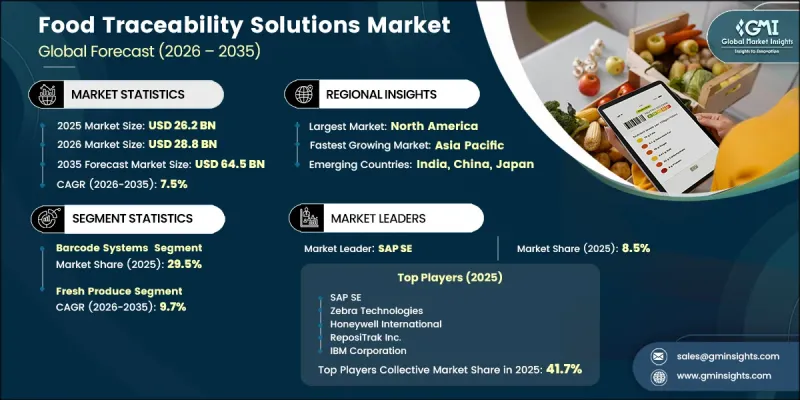
This upward trajectory reflects increasing investment in digitized supply chain infrastructure and the growing demand for comprehensive product tracking across production, processing, and distribution stages. Organizations are prioritizing enhanced visibility at the lot level to meet compliance requirements and maintain supply chain accountability. The shift from early-stage implementation to large-scale commercial deployment of traceability technologies is further strengthening market growth. Additionally, mounting pressure from commercial stakeholders is pushing food companies to adopt transparent tracking systems as a prerequisite for market participation. Regulatory compliance continues to be a critical and non-optional investment area, reinforcing the long-term demand for advanced traceability systems across the global food industry.
| Market Scope | |
|---|---|
| Start Year | 2025 |
| Forecast Year | 2026-2035 |
| Start Value | $26.2 Billion |
| Forecast Value | $64.5 Billion |
| CAGR | 7.5% |
Regulatory frameworks are acting as a major catalyst for the adoption of food traceability solutions across key regions. In the United States, stringent compliance requirements are driving large-scale implementation of digital traceability systems across thousands of food businesses, creating a significant demand surge. Similarly, evolving regulatory mandates in Europe are expanding compliance obligations, compelling companies to implement more advanced and verifiable supply chain tracking mechanisms across domestic and international operations.
The barcode-based systems segment accounted for 29.5% share in 2025 and is projected to grow at a CAGR of 6.9% through 2035. Their continued dominance is supported by widespread adoption across food production, storage, and retail environments. These systems provide essential traceability at the lot level, meeting baseline compliance requirements in most markets. Their cost-effectiveness, accessibility, and established operational familiarity make them a preferred choice, particularly for small and mid-sized enterprises and participants in emerging economies.
The fresh produce segment held a 22.2% share in 2025 and is anticipated to grow at a CAGR of 9.7% through 2035. This segment's strong position is driven by heightened regulatory oversight and the economic impact associated with contamination risks in perishable goods. The need for rapid identification and response within supply chains has increased the adoption of traceability systems, enabling improved monitoring and operational efficiency across production and distribution channels.
North America Food Traceability Solutions Market accounted for 34.5% share in 2025 and is expected to grow at a CAGR of 8.1% through 2035. The region's growth is primarily supported by strict regulatory requirements that are accelerating the adoption of digital traceability platforms across many food enterprises. Implementation timelines extending into 2026 are prompting organizations to prioritize traceability investments as part of their immediate operational and capital planning strategies.
Key companies operating in the Global Food Traceability Solutions Market include SAP SE, Honeywell International Inc., Zebra Technologies Corporation, IBM Corporation, Cognex Corporation, SGS SA, OPTEL Group, FoodLogiQ, rfxcel Corporation, Mojix Inc., Kezzler AS, ReposiTrak Inc., osapiens AG, TradeEdge (EdgeVerve Systems), and Verdara. Companies in the food traceability solutions market are focusing on strengthening their competitive position through innovation, strategic partnerships, and global expansion initiatives. Market players are investing in advanced digital technologies to enhance real-time tracking, data analytics, and system integration capabilities. Collaborations with supply chain stakeholders are enabling seamless interoperability and faster deployment of traceability platforms. Firms are also expanding their service portfolios to address evolving compliance requirements and industry-specific needs.
Table of Contents
Chapter 1 Methodology & Scope
- 1.1 Market scope and definition
- 1.2 Research design
- 1.2.1 Research approach
- 1.2.2 Data collection methods
- 1.3 Data mining sources
- 1.3.1 Global
- 1.3.2 Regional/Country
- 1.4 Base estimates and calculations
- 1.4.1 Base year calculation
- 1.4.2 Key trends for market estimation
- 1.5 Primary research and validation
- 1.5.1 Primary sources
- 1.6 Forecast model
- 1.7 Research assumptions and limitations
Chapter 2 Executive Summary
- 2.1 Industry 360° synopsis
- 2.2 Key market trends
- 2.2.1 Technology type
- 2.2.2 Component
- 2.2.3 Application
- 2.2.4 End user
- 2.2.5 Regional
- 2.3 TAM Analysis, 2026-2035
- 2.4 CXO perspectives: Strategic imperatives
- 2.5 Future outlook and strategic recommendations
Chapter 3 Industry Insights
- 3.1 Industry ecosystem analysis
- 3.1.1 Supplier landscape
- 3.1.2 Profit margin
- 3.1.3 Value addition at each stage
- 3.1.4 Factor affecting the value chain
- 3.1.5 Disruptions
- 3.2 Industry impact forces
- 3.2.1 Growth drivers
- 3.2.1.1 Increasing demand for food safety transparency
- 3.2.1.2 Rising regulatory compliance requirements globally
- 3.2.1.3 Growing adoption of digital supply chains
- 3.2.2 Industry pitfalls and challenges
- 3.2.2.1 Integration with blockchain and IoT technologies
- 3.2.2.2 Expansion in emerging food export markets
- 3.2.3 Market opportunities
- 3.2.3.1 High implementation and maintenance costs
- 3.2.3.2 Data management and system integration challenges
- 3.2.3.3 Limited awareness among small-scale producers
- 3.2.1 Growth drivers
- 3.3 Growth potential analysis
- 3.4 Regulatory landscape
- 3.4.1 North America
- 3.4.2 Europe
- 3.4.3 Asia Pacific
- 3.4.4 Latin America
- 3.4.5 Middle East & Africa
- 3.5 Porter's analysis
- 3.6 PESTEL analysis
- 3.7 Technology and innovation landscape
- 3.7.1 Current technological trends
- 3.7.2 Emerging technologies
- 3.8 Price trends
- 3.8.1 By region
- 3.8.2 By technology type
- 3.9 Future market trends
- 3.10 Patent landscape
- 3.11 Trade statistics (HS code)
- 3.11.1 Major importing countries
- 3.11.2 Major exporting countries
- 3.12 Sustainability and environmental aspects
- 3.12.1 Sustainable practices
- 3.12.2 Waste reduction strategies
- 3.12.3 Energy efficiency in production
- 3.12.4 Eco-friendly initiatives
- 3.13 Carbon footprint consideration
Chapter 4 Competitive Landscape, 2025
- 4.1 Introduction
- 4.2 Company market share analysis
- 4.2.1 By region
- 4.2.1.1 North America
- 4.2.1.2 Europe
- 4.2.1.3 Asia Pacific
- 4.2.1.4 LATAM
- 4.2.1.5 MEA
- 4.2.1 By region
- 4.3 Company matrix analysis
- 4.4 Competitive analysis of major market players
- 4.5 Competitive positioning matrix
- 4.6 Key developments
- 4.6.1 Mergers & acquisitions
- 4.6.2 Partnerships & collaborations
- 4.6.3 New product launches
- 4.6.4 Expansion plans
Chapter 5 Market Estimates and Forecast, By Technology Type, 2022-2035 (USD Million) (Kilo Tons)
- 5.1 Key trends
- 5.2 Barcode systems
- 5.3 RFID/RTLS
- 5.4 IOT sensor-based systems
- 5.5 Blockchain-based platforms
- 5.6 EPCIS software platforms
- 5.7 Others
Chapter 6 Market Estimates and Forecast, By Component, 2022-2035 (USD Million) (Kilo Tons)
- 6.1 Key trends
- 6.2 Hardware
- 6.3 Software
- 6.4 Services
- 6.5 Others
Chapter 7 Market Estimates and Forecast, By Application, 2022-2035 (USD Million) (Kilo Tons)
- 7.1 Key trends
- 7.2 Fresh produce
- 7.3 Seafood
- 7.4 Dairy & eggs
- 7.5 Meat & poultry
- 7.6 Processed foods
- 7.7 Beverages
- 7.8 Others
Chapter 8 Market Estimates and Forecast, By End user, 2022-2035 (USD Million) (Kilo Tons)
- 8.1 Key trends
- 8.2 Farms & growers
- 8.3 Manufacturers & processors
- 8.4 Distributors & importers
- 8.5 Retailers & foodservice
- 8.6 Others
Chapter 9 Market Estimates and Forecast, By Region, 2022-2035 (USD Million) (Kilo Tons)
- 9.1 Key trends
- 9.2 North America
- 9.2.1 U.S.
- 9.2.2 Canada
- 9.3 Europe
- 9.3.1 Germany
- 9.3.2 UK
- 9.3.3 France
- 9.3.4 Spain
- 9.3.5 Italy
- 9.3.6 Rest of Europe
- 9.4 Asia Pacific
- 9.4.1 China
- 9.4.2 India
- 9.4.3 Japan
- 9.4.4 Australia
- 9.4.5 South Korea
- 9.4.6 Rest of Asia Pacific
- 9.5 Latin America
- 9.5.1 Brazil
- 9.5.2 Mexico
- 9.5.3 Argentina
- 9.5.4 Rest of Latin America
- 9.6 Middle East and Africa
- 9.6.1 Saudi Arabia
- 9.6.2 South Africa
- 9.6.3 UAE
- 9.6.4 Rest of Middle East and Africa
Chapter 10 Company Profiles
- 10.1 Honeywell International Inc.
- 10.2 Zebra Technologies Corporation
- 10.3 IBM Corporation
- 10.4 SAP SE
- 10.5 Cognex Corporation
- 10.6 SGS SA
- 10.7 OPTEL Group
- 10.8 FoodLogiQ
- 10.9 rfxcel Corporation
- 10.10 Mojix Inc.
- 10.11 Kezzler AS
- 10.12 ReposiTrak Inc.
- 10.13 osapiens AG
- 10.14 TradeEdge (EdgeVerve Systems)
- 10.15 Verdara


