

|
시장보고서
상품코드
2071271
갠트리 크레인 시장 기회, 성장요인, 업계 동향 분석 및 예측(2026-2035년)Gantry Crane Market Opportunity, Growth Drivers, Industry Trend Analysis, and Forecast 2026 - 2035 |
||||||

세계의 갠트리 크레인 시장은 2025년에 24억 달러로 평가되었고, CAGR 5.3%로 성장하여 2035년까지 41억 달러에 달할 것으로 추정되고 있습니다.
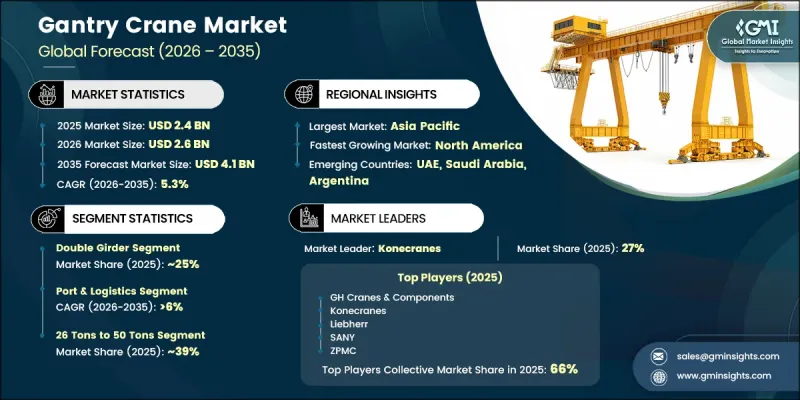
시장 확대는 세계 무역 활동의 지속적인 성장, 항만 인프라의 현대화, 그리고 주요 해운 허브의 컨테이너 처리 능력에 대한 투자 증가에 힘입어 이루어지고 있습니다. 해상 화물 취급량이 증가함에 따라, 중량물을 효율적이고 정확하게 취급할 수 있는 대용량 리프팅 시스템에 대한 수요가 높아지고 있습니다. 동시에, 전 세계 전자상거래의 급속한 확대로 인해 물류 허브, 복합 일괄 운송 시설, 유통 네트워크의 개발이 가속화되고 있으며, 이 모든 분야에서 유연한 자재관리 장비가 요구되고 있습니다. 갠트리 크레인은 신흥국과 선진국을 막론하고 산업단지, 에너지 시설, 건설 현장, 교통 인프라 프로젝트 등에서 도입이 점점 더 확대되고 있습니다. 수동식 크레인 시스템이 자동화 및 원격 제어형 솔루션으로 점차 대체되면서, 운영 효율, 안전 성능, 비용 최적화 등이 향상되는 등 큰 구조적 변화가 진행되고 있습니다. 또한, 자동화를 통해 처리 능력이 향상되고, 노동력에 대한 의존도가 낮아지며, 24시간 연속 가동이 가능해짐에 따라 항만 및 산업 환경 전반에서 생산성이 크게 향상되고 있습니다. 이러한 요인들이 복합적으로 작용함에 따라, 전 세계 갠트리 크레인 업계에는 장기적으로 안정적인 성장 전망이 자리 잡아가고 있습니다.
| 시장 범위 | |
|---|---|
| 개시 연도 | 2025년 |
| 예측 기간 | 2026-2035년 |
| 개시 연도 시장 규모 | 24억 달러 |
| 예측액 | 41억 달러 |
| CAGR | 5.3% |
2025년 기준으로 더블 거더 갠트리 크레인 부문은 시장의 약 25%를 차지하고 있으며, 2026년부터 2035년까지 연평균 성장률(CAGR) 5% 이상으로 성장할 것으로 예측됩니다. 이 부문은 극도로 무거운 하중을 처리하고, 긴 스팬에서의 리프팅 작업에 대응할 수 있기 때문에 계속해서 널리 채택되고 있습니다. 주로 높은 적재 능력, 구조적 강도 및 운용상의 신뢰성이 필수적인 중공업 분야에서 활용되고 있습니다. 이러한 구성에 대한 수요는 고도의 리프팅 능력이 필요한 중공업이나 대규모 제조 현장에서 특히 높습니다.
제조 부문 시장 점유율은 2025년에 22.7%를 차지할 것으로 예상되며, 2035년까지 연평균 성장률(CAGR) 6%로 성장할 것으로 전망됩니다. 이 부문의 성장은 효율적인 자재관리 시스템이 필요한 산업 생산 환경 전반에 걸친 광범위한 활용에 힘입고 있습니다. 갠트리 크레인은 제조 시설에서 조립, 물류 및 중량 부품의 이동을 지원하기 위해 널리 사용되고 있으며, 현대 산업 운영에 있어 필수적인 요소로 자리 잡고 있습니다.
유럽의 갠트리 크레인 시장은 2026년부터 2035년까지 연평균 성장률(CAGR) 4%로 성장할 것으로 전망됩니다. 이 지역의 성장은 항만, 산업 시설, 물류 센터 전반에 걸친 자동화된 자재관리 시스템의 도입 확대에 힘입고 있습니다. 또한, 환경 대책 및 배기가스 감축 정책 역시 전기식 및 에너지 효율이 높은 크레인 시스템으로의 전환을 촉진하고 있으며, 항만 인프라와 산업 운영 전반의 현대화를 뒷받침하고 있습니다.
자주 묻는 질문
목차
제1장 조사 방법
제2장 주요 요약
제3장 업계 인사이트
제4장 경쟁 구도
제5장 시장 추산 및 예측 : 제품별, 2022년-2035년
제6장 시장 추산 및 예측 : 적재 능력별, 2022년-2035년
제7장 시장 추산 및 예측 : 용도별, 2022년-2035년
제8장 시장 추산 및 예측 : 최종 용도별, 2022년-2035년
제9장 시장 추산 및 예측 : 구동 방식별, 2022년-2035년
제10장 시장 추산 및 예측 : 지역별, 2022년-2035년
제11장 기업 개요
LSH 26.07.02The Global Gantry Crane Market was valued at USD 2.4 billion in 2025 and is estimated to grow at a CAGR of 5.3% to reach USD 4.1 billion by 2035.
Market expansion is driven by sustained growth in global trade activity, modernization of port infrastructure, and rising investments in container handling capacity across major maritime hubs. Increasing volumes of seaborne cargo are reinforcing the need for high-capacity lifting systems capable of handling heavy loads with efficiency and precision. At the same time, the rapid rise of global e-commerce is accelerating the development of logistics hubs, intermodal freight facilities, and distribution networks, all of which require flexible material handling equipment. Gantry cranes are increasingly being deployed in industrial parks, energy installations, construction sites, and transportation infrastructure projects across emerging and developed economies. A major structural shift is underway as manual crane systems are being replaced with automated and remotely operated solutions, improving operational efficiency, safety performance, and cost optimization. Automation is also enabling higher throughput, reduced labor dependency, and continuous 24-hour operations, significantly enhancing productivity across port and industrial environments. These combined factors are establishing a stable long-term growth outlook for the global gantry crane industry.
| Market Scope | |
|---|---|
| Start Year | 2025 |
| Forecast Year | 2026-2035 |
| Start Value | $2.4 Billion |
| Forecast Value | $4.1 Billion |
| CAGR | 5.3% |
The double girder gantry crane segment accounted for approximately 25% of the market in 2025 and is expected to grow at a CAGR of over 5% between 2026 and 2035. This segment remains widely adopted due to its ability to handle extremely heavy loads and support large-span lifting operations. It is primarily utilized in heavy industrial environments where high load capacity, structural strength, and operational reliability are essential. Demand for this configuration is particularly strong in heavy manufacturing and large-scale fabrication operations that require advanced lifting capabilities.
Manufacturing applications held 22.7% share in 2025 and is projected to grow at a CAGR of 6% through 2035. Growth in this segment is supported by widespread use across industrial production environments that require efficient material handling systems. Gantry cranes are extensively used in manufacturing facilities to support assembly, logistics, and heavy component movement, making them an essential part of modern industrial operations.
European Gantry Crane Market is projected to grow at a CAGR of 4% between 2026 and 2035. Growth in the region is supported by increasing adoption of automated material handling systems across ports, industrial facilities, and logistics centers. Environmental and emissions reduction policies are also encouraging the transition toward electric and energy-efficient crane systems, supporting modernization across port infrastructure and industrial operations.
Major companies operating in the global gantry crane market include Konecranes, ZPMC, SANY, Liebherr, GH Cranes & Components, Gorbel, and Street Crane. Companies operating in the gantry crane market are focusing on strengthening their competitive position through technological innovation, automation integration, and global expansion strategies. A key focus area is the development of automated and remotely operated crane systems that enhance operational efficiency, safety, and productivity. Manufacturers are investing in electrification and energy-efficient technologies to meet evolving environmental standards and reduce operational emissions. Strategic partnerships with port operators, logistics companies, and industrial end users are helping expand deployment across high-demand regions. Companies are also enhancing product portfolios with high-capacity and customized crane solutions tailored for specific industrial applications. Expansion into emerging markets with growing infrastructure development is further supporting revenue growth.
Table of Contents
Chapter 1 Methodology
- 1.1 Research approach
- 1.2 Quality Commitments
- 1.2.1 GMI AI policy & data integrity commitment
- 1.2.1.1 Source consistency protocol
- 1.2.1 GMI AI policy & data integrity commitment
- 1.3 Research Trail & Confidence Scoring
- 1.3.1 Research Trail Components
- 1.3.2 Scoring Components
- 1.4 Data Collection
- 1.4.1 Partial list of primary sources
- 1.5 Data mining sources
- 1.5.1 Paid sources
- 1.5.2 Sources, by region
- 1.6 Base estimates and calculations
- 1.6.1 Base year calculation
- 1.7 Forecast model
- 1.7.1 Quantified market impact analysis
- 1.7.1.1 Mathematical impact of growth parameters on forecast
- 1.7.1 Quantified market impact analysis
- 1.8 Research transparency addendum
- 1.8.1 Source attribution framework
- 1.8.2 Quality assurance metrics
- 1.8.3 Our commitment to trust
Chapter 2 Executive Summary
- 2.1 Industry 360° synopsis, 2022 - 2035
- 2.2 Key market trends
- 2.2.1 Regional
- 2.2.2 Product
- 2.2.3 Lifting Capacity
- 2.2.4 Application
- 2.2.5 End Use
- 2.2.6 Drive
- 2.3 TAM Analysis, 2026-2035
- 2.4 CXO perspectives: Strategic imperatives
Chapter 3 Industry Insights
- 3.1 Industry ecosystem analysis
- 3.1.1 Supplier landscape
- 3.1.2 Profit margin analysis
- 3.1.3 Cost structure
- 3.1.4 Value addition at each stage
- 3.1.5 Factor affecting the value chain
- 3.1.6 Disruptions
- 3.2 Industry impact forces
- 3.2.1 Growth drivers
- 3.2.1.1 Rising global port infrastructure investment and trade volume growth
- 3.2.1.2 E-commerce expansion driving warehousing and logistics infrastructure demand
- 3.2.1.3 Accelerating automation adoption across ports and manufacturing facilities
- 3.2.1.4 Large-scale infrastructure and urbanization projects in emerging economies
- 3.2.2 Industry pitfalls and challenges
- 3.2.2.1 High upfront capital expenditure and extended payback periods
- 3.2.2.2 Volatility in steel and electronic component prices impacting project costs and profitability
- 3.2.3 Market opportunities
- 3.2.3.1 Smart port development and automated terminal upgrades creating retrofit demand
- 3.2.3.2 Electrification and hybrid propulsion mandates creating demand for premium crane solutions
- 3.2.3.3 Greenfield port and industrial park development in Asia Pacific, Middle East & Africa, and Latin America
- 3.2.3.4 Predictive maintenance-as-a-service and digital after-sales revenue models
- 3.2.1 Growth drivers
- 3.3 Growth potential analysis
- 3.4 Regulatory landscape
- 3.4.1 North America
- 3.4.1.1 Occupational Safety and Health Administration (OSHA)
- 3.4.1.2 American Society of Mechanical Engineers (ASME) B30 Standards
- 3.4.1.3 U.S. Department of Labor - Crane and Derrick Regulations
- 3.4.1.4 Canadian Standards Association (CSA) Crane Safety Standards
- 3.4.1.5 U.S. Department of Transportation (DOT) Oversized Load & Heavy Equipment Transport Regulations
- 3.4.2 Europe
- 3.4.2.1 EU Machinery Regulation
- 3.4.2.2 CE Marking Compliance
- 3.4.2.3 European Standards (EN 15011 - Bridge and Gantry Cranes)
- 3.4.2.4 EU Low Voltage Directive (LVD)
- 3.4.2.5 EU Electromagnetic Compatibility (EMC) Directive
- 3.4.3 Asia Pacific
- 3.4.3.1 China Special Equipment Safety Law & China Compulsory Certification (CCC)
- 3.4.3.2 Indian Factories Act & Bureau of Indian Standards (BIS) Crane Standards
- 3.4.3.3 Japanese Industrial Standards (JIS) for Cranes
- 3.4.3.4 ASEAN Harmonized Machinery Safety Regulations
- 3.4.3.5 Australian Standards (AS 1418 - Cranes, Hoists and Winches)
- 3.4.4 Latin America
- 3.4.4.1 Brazilian National Institute of Metrology, Quality and Technology (INMETRO)
- 3.4.4.2 Brazilian Regulatory Standards (NR-11 and NR-12)
- 3.4.4.3 Mexican Official Standards (NOM) for Lifting Equipment
- 3.4.4.4 Regional Occupational Safety & Machinery Certification Requirements
- 3.4.5 Middle East & Africa
- 3.4.5.1 GCC Standardization Organization (GSO) Machinery Safety Regulations
- 3.4.5.2 Saudi Standards, Metrology and Quality Organization (SASO)
- 3.4.5.3 South African National Regulator for Compulsory Specifications (NRCS)
- 3.4.5.4 South African Occupational Health and Safety Act (OHSA)
- 3.4.5.5 UAE Machinery Safety and Industrial Equipment Regulations
- 3.4.1 North America
- 3.5 Porter's analysis
- 3.6 PESTEL analysis
- 3.7 Technology and innovation landscape
- 3.7.1 Current technological trends
- 3.7.2 Emerging technologies
- 3.8 Price analysis (Driven by Primary Research)
- 3.8.1 Historical Price Trend Analysis
- 3.8.2 Pricing Strategy by Player Type (Premium / Value / Cost-plus)
- 3.9 Trade data analysis (Driven by Paid Research)
- 3.9.1 Import/export volume & value trends
- 3.9.2 Key trade corridors & tariff impact
- 3.10 Cost breakdown analysis
- 3.11 Patent analysis (Driven by Primary Research)
- 3.12 Impact of AI & generative AI on the market
- 3.12.1 AI-driven disruption of existing business models
- 3.12.2 GenAI use cases & adoption roadmap by segment
- 3.12.3 Risks, limitations & regulatory considerations
- 3.13 Capacity & production landscape (Driven by Primary Research)
- 3.13.1 Installed capacity by region & key producer
- 3.13.2 Capacity utilization rates & expansion pipelines
- 3.14 Sustainability and environmental aspects
- 3.14.1 Sustainable practices
- 3.14.2 Waste reduction strategies
- 3.14.3 Energy efficiency in production
- 3.14.4 Eco-friendly Initiatives
- 3.14.5 Carbon footprint considerations
- 3.15 Forecast assumptions & scenario analysis (Driven by Primary Research)
- 3.15.1 Base Case - key macro & industry variables driving CAGR
- 3.15.2 Optimistic Scenarios - Favorable macro and industry tailwinds
- 3.15.3 Pessimistic Scenario - Macroeconomic slowdown or industry headwinds
Chapter 4 Competitive Landscape, 2025
- 4.1 Introduction
- 4.2 Company market share analysis
- 4.2.1 North America
- 4.2.2 Europe
- 4.2.3 Asia Pacific
- 4.2.4 LATAM
- 4.2.5 MEA
- 4.3 Competitive analysis of major market players
- 4.4 Competitive positioning matrix
- 4.5 Key developments
- 4.5.1 Mergers & acquisitions
- 4.5.2 Partnerships & collaborations
- 4.5.3 New Product Launches
- 4.5.4 Expansion Plans and funding
- 4.6 Company tier benchmarking
- 4.6.1 Tier classification criteria & qualifying thresholds
- 4.6.2 Tier positioning matrix by revenue, geography & innovation
Chapter 5 Market Estimates & Forecast, By Product, 2022 - 2035 ($Mn, Units)
- 5.1 Key trends
- 5.2 Single Girder Gantry Crane
- 5.3 Double Girder Gantry Crane
- 5.4 Semi-Gantry Crane
- 5.5 Rail-Mounted Gantry (RMG) Crane
- 5.6 Rubber-Tyred Gantry (RTG) Crane
- 5.7 Portable/Adjustable Gantry Crane
Chapter 6 Market Estimates & Forecast, By Lifting Capacity, 2022 - 2035 ($Mn, Units)
- 6.1 Key trends
- 6.2 Below 25 Tons
- 6.3 26 Tons to 50 Tons
- 6.4 51 Tons to 80 Tons
- 6.5 Above 80 Tons
Chapter 7 Market Estimates & Forecast, By Application, 2022 - 2035 ($Mn, Units)
- 7.1 Key trends
- 7.2 Port & Logistics
- 7.3 Construction
- 7.4 Manufacturing
- 7.5 Shipbuilding & Repair
- 7.6 Mining
- 7.7 Warehousing & Distribution
- 7.8 Others
Chapter 8 Market Estimates & Forecast, By End Use, 2022 - 2035 ($Mn, Units)
- 8.1 Key trends
- 8.2 Transportation & Logistics
- 8.3 Construction & Infrastructure
- 8.4 Industrial Manufacturing
- 8.5 Shipbuilding & Marine
- 8.6 Mining & Metals
- 8.7 Energy & Utilities
- 8.8 Others
Chapter 9 Market Estimates & Forecast, By Drive, 2022 - 2035 ($Mn, Units)
- 9.1 Key trends
- 9.2 Electric Drive
- 9.3 Diesel Drive
- 9.4 Hydraulic Drive
Chapter 10 Market Estimates & Forecast, By Region, 2022 - 2035 ($Mn, Units)
- 10.1 Key trends
- 10.2 North America
- 10.2.1 US
- 10.2.2 Canada
- 10.3 Europe
- 10.3.1 UK
- 10.3.2 Germany
- 10.3.3 France
- 10.3.4 Italy
- 10.3.5 Spain
- 10.3.6 Russia
- 10.3.7 Nordics
- 10.4 Asia Pacific
- 10.4.1 China
- 10.4.2 India
- 10.4.3 Japan
- 10.4.4 South Korea
- 10.4.5 Southeast Asia
- 10.4.6 ANZ
- 10.5 Latin America
- 10.5.1 Brazil
- 10.5.2 Argentina
- 10.5.3 Mexico
- 10.6 MEA
- 10.6.1 UAE
- 10.6.2 Saudi Arabia
- 10.6.3 South Africa
Chapter 11 Company Profiles
- 11.1 Global Players
- 11.1.1 Gantrex
- 11.1.2 GH Cranes
- 11.1.3 Gorbel
- 11.1.4 Konecranes
- 11.1.5 Liebherr
- 11.1.6 Sany
- 11.1.7 Street Crane
- 11.1.8 ZPMC
- 11.2 Regional Players
- 11.2.1 Anupam Industries
- 11.2.2 EMH
- 11.2.3 Kuenz
- 11.2.4 Mi-Jack Products
- 11.2.5 NIKO
- 11.2.6 Paceco
- 11.2.7 Spanco
- 11.2.8 Vestil Manufacturing
- 11.2.9 Wallace Cranes
- 11.3 Emerging Players
- 11.3.1 HSCRANE
- 11.3.2 LOADMATE
- 11.3.3 Nucleon Crane


