
|
시장보고서
상품코드
2071281
특수 섬유 작물 종자 시장 기회, 성장요인, 업계 동향 분석 및 예측(2026-2035년)Specialty Fiber Crop Seeds Market Opportunity, Growth Drivers, Industry Trend Analysis, and Forecast 2026 - 2035 |
||||||

세계의 특수 섬유 작물 종자 시장은 2025년에 24억 달러 규모에 이르고, CAGR 5.6%로 성장하여 2035년에는 41억 6,000만 달러에 달할 것으로 추정되고 있습니다.
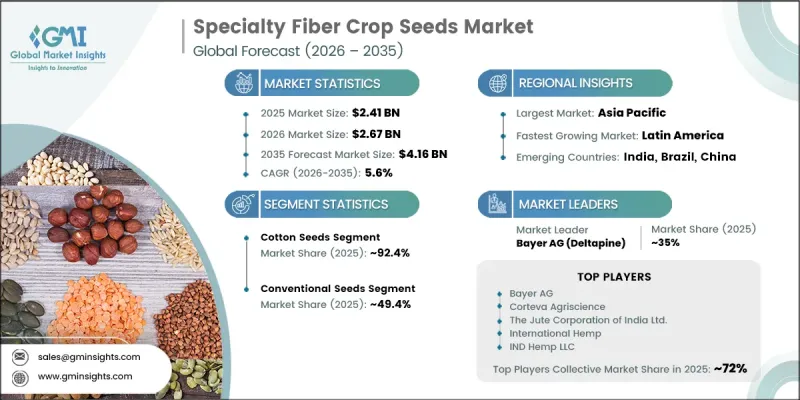
시장의 확대는 세계 섬유 소비 패턴의 근본적인 구조적 변화에 힘입어 이루어지고 있습니다. 하류 산업의 지속가능성 노력, 대마 재배에 대한 규제 당국의 장려, 그리고 정밀 육종의 발전이 맞물리면서, 이 분야는 기존의 상품 중심 종자 공급망에서 혁신 주도형 농업 자재 시장으로 변모하고 있습니다. 합성 섬유에서 천연 소재로의 전환이 진행되고 있는 점이 특수 섬유 작물용 종자의 성장에 있어 핵심적인 원동력으로 부상하고 있습니다. 의류 제조업체, 산업 생산자, 포장 기업은 규제 체계, ESG 투자 기준, 그리고 소비자 취향의 변화로 인해 폴리에스터나 나일론과 같은 합성 소재에 대한 의존도를 낮추라는 점점 더 강력한 압박에 직면하고 있습니다. 동시에, 자동차 내장재나 건축자재 분야에서 바이오 복합재료가 점차 보급되면서, 대마, 황마, 케나프 등의 섬유 작물에 대한 수요가 증가하고 있습니다. 이러한 소재들은 내장 패널이나 단열 구조 등 경량 자동차 부품에 점점 더 많이 적용되고 있으며, 이는 자동차 업계 전체의 배출량 감축 목표 및 지속가능성 목표에 부합하는 것입니다.
| 시장 범위 | |
|---|---|
| 개시 연도 | 2025년 |
| 예측 기간 | 2026-2035년 |
| 개시 연도 시장 규모 | 24억 달러 |
| 예측액 | 41억 6,000만 달러 |
| CAGR | 5.6% |
2025년, 면화 종자 부문은 92.4%의 시장 점유율을 차지했습니다. 이러한 압도적인 시장 점유율은 수확량 향상 및 해충 저항성 강화와 같은 특성을 갖춘 첨단 면화 종자 품종이 널리 채택되고 있는 데 힘입은 것입니다. 이 부문은 높은 상용화 수준, 체계화된 유통망, 그리고 주요 면화 생산 지역 전반에 걸쳐 생산성과 내성이라는 두 가지 이점을 모두 제공하는 유전자 변형 종자 품종에 대한 강력한 수요가 특징입니다. 생명공학을 통한 형질 도입으로 작물의 안정성이 향상되고 대규모 상업 재배가 촉진됨에 따라, 면화 종자 시장 내 입지는 더욱 공고해졌습니다.
유기농 인증 종자는 2025년에 1.9%의 시장 점유율을 차지했습니다. 이 부문의 성장은 환경적으로 지속 가능한 농업 자재에 대한 수요 증가, 유기농 섬유 생산을 위한 인증 요건, 그리고 지속 가능한 방식으로 조달된 원자재에 대한 소비자의 선호도 상승에 힘입어 이루어지고 있습니다. 현재는 틈새 시장 규모에 그치고 있지만, 이 부문은 높은 가격 프리미엄과, 특히 선진국 시장에서 환경 의식이 높은 농업 시스템에서의 도입 확대에 힘입어 꾸준히 성장하고 있습니다.
2025년, 북미의 특수 섬유 작물 종자 시장은 19.7%의 점유율을 차지했습니다. 이는 미국의 면화 생산과 캐나다의 대마 및 아마 재배 확대에 힘입은 결과입니다. 미국 시장은 첨단 종자 생명공학의 도입, 확립된 상업용 종자 유통 시스템, 그리고 생산성과 작물 관리 효율을 높이는 디지털 농업 솔루션의 통합과 같은 혜택을 누리고 있습니다. 대마 재배는 규제 승인 체계에 이어, 체계적인 면허 제도와 품질 준수 기준에 힘입어 대폭 확대되었습니다. 또한, 이 지역에서는 다양한 산업용도에 맞추어 설계된 다목적 종자 품종의 혁신도 지속적으로 추진되고 있습니다.
자주 묻는 질문
목차
제1장 조사 방법과 범위
제2장 주요 요약
제3장 업계 인사이트
제4장 경쟁 구도
제5장 시장 추산 및 예측 : 작물 유형별, 2022년-2035년
제6장 시장 추산 및 예측 : 종자 기술 및 육종 방법별, 2022년-2035년
제7장 시장 추산 및 예측 : 최종 용도별, 2022년-2035년
제8장 시장 추산 및 예측 : 지역별, 2022년-2035년
제9장 기업 개요
LSH 26.07.02The Global Specialty Fiber Crop Seeds Market was valued at USD 2.4 billion in 2025 and is estimated to grow at a CAGR of 5.6% to reach USD 4.16 billion in 2035.
Market expansion is driven by a deep structural transition in global fiber consumption patterns, where sustainability commitments from downstream industries, regulatory encouragement of hemp cultivation, and advances in precision breeding are collectively reshaping the sector from a conventional commodity-based seed supply chain into a more innovation-led agricultural input market. The increasing replacement of synthetic fibers with natural alternatives is emerging as the central growth catalyst for specialty fiber crop seeds. Apparel manufacturers, industrial producers, and packaging firms are facing rising pressure from regulatory frameworks, ESG investment criteria, and shifting consumer preferences to reduce dependence on synthetic materials such as polyester and nylon. At the same time, bio-based composites are gaining traction in automotive interiors and construction materials, strengthening demand for fiber crops like hemp, jute, and kenaf. These materials are increasingly integrated into lightweight automotive components such as interior panels and insulation structures, aligning with emissions reduction targets and sustainability goals across the automotive sector.
| Market Scope | |
|---|---|
| Start Year | 2025 |
| Forecast Year | 2026-2035 |
| Start Value | $2.4 Billion |
| Forecast Value | $4.16 Billion |
| CAGR | 5.6% |
The cotton segment held a 92.4% share in 2025. This dominance is supported by widespread adoption of advanced cotton seed varieties featuring improved yield performance and enhanced pest resistance traits. The segment is characterized by high commercialization levels, structured distribution networks, and strong demand for genetically improved seed varieties that offer both productivity and resilience advantages across major cotton-producing regions. The integration of biotechnology traits has further strengthened the market position of cotton seeds by improving crop reliability and supporting large-scale commercial cultivation practices.
The organic-certified seeds accounted for 1.9% share in 2025. Growth in this category is being driven by increasing demand for environmentally sustainable agricultural inputs, certification requirements for organic textile production, and rising consumer preference for sustainably sourced materials. Although currently niche in scale, this segment is expanding steadily due to strong pricing premiums and growing adoption across environmentally conscious agricultural systems, particularly in developed markets.
North America Specialty Fiber Crop Seeds Market held a 19.7% share in 2025, supported by cotton production in the United States and expanding hemp and flax cultivation in Canada. The United States market benefits from advanced seed biotechnology adoption, well-established commercial seed distribution systems, and integration of digital agronomy solutions that enhance productivity and crop management efficiency. Hemp cultivation has expanded significantly following regulatory approval frameworks, supported by structured licensing systems and quality compliance standards. The region also continues to advance innovation in multi-purpose seed varieties designed for diversified industrial applications.
Major companies operating in the global specialty fiber crop seeds market include Corteva Agriscience, Bayer AG, IND Hemp LLC, The Jute Corporation of India Ltd., NWG Genetics, FiberAgro, Legacy Hemp, Kanda Hemp, International Hemp, Prairie Premium Products, Horizon Specialty Seeds, Precision Plants, Kenaf Green Industries, Saluna AG, and Manitoba Flax Growers Association. Companies operating in the specialty fiber crop seeds market are focusing on several strategic initiatives to strengthen their competitive positioning and expand market share. A key strategy involves the development of high-yield, pest-resistant, and climate-adaptive seed varieties through advanced biotechnology and precision breeding techniques. Firms are also investing in genetic improvement programs to enhance fiber quality and crop consistency for industrial applications. Expansion of contract farming models and structured distribution networks is helping improve seed accessibility and adoption across emerging markets. Strategic collaborations with textile manufacturers, bio-composite producers, and agricultural cooperatives are supporting integrated value chain development.
Table of Contents
Chapter 1 Methodology & Scope
- 1.1 Market scope and definition
- 1.2 Research design
- 1.2.1 Research approach
- 1.2.2 Data collection methods
- 1.3 Data mining sources
- 1.3.1 Global
- 1.3.2 Regional/Country
- 1.4 Base estimates and calculations
- 1.4.1 Base year calculation
- 1.4.2 Key trends for market estimation
- 1.5 Primary research and validation
- 1.5.1 Primary sources
- 1.6 Forecast model
- 1.7 Research assumptions and limitations
Chapter 2 Executive Summary
- 2.1 Industry 360° synopsis
- 2.2 Key market trends
- 2.2.1 Regional
- 2.2.2 Component
- 2.2.3 Blockchain type
- 2.2.4 Application
- 2.3 TAM Analysis, 2026-2035
- 2.4 CXO perspectives: Strategic imperatives
- 2.4.1 Executive decision points
Chapter 3 Industry Insights
- 3.1 Industry ecosystem analysis
- 3.1.1 Supplier landscape
- 3.1.2 Profit margin
- 3.1.3 Value addition at each stage
- 3.1.4 Factor affecting the value chain
- 3.1.5 Disruptions
- 3.2 Industry impact forces
- 3.2.1 Growth drivers
- 3.2.2 Industry pitfalls and challenges
- 3.2.3 Market opportunities
- 3.3 Growth potential analysis
- 3.4 Regulatory landscape
- 3.4.1 North America
- 3.4.2 Europe
- 3.4.3 Asia Pacific
- 3.4.4 Latin America
- 3.4.5 Middle East & Africa
- 3.5 Porter's analysis
- 3.6 PESTEL analysis
- 3.7 Price trends
- 3.7.1 By region
- 3.7.2 By type
- 3.8 Future market trends
- 3.9 Technology and Innovation landscape
- 3.9.1 Current technological trends
- 3.9.2 Emerging technologies
- 3.10 Patent Landscape
- 3.11 Trade statistics (HS code)
- 3.11.1 Major importing countries
- 3.11.2 Major exporting countries
- 3.12 Sustainability and environmental aspects
- 3.12.1 Sustainable practices
- 3.12.2 Waste reduction strategies
- 3.12.3 Energy efficiency in production
- 3.12.4 Eco-friendly initiatives
- 3.13 Carbon footprint consideration
Chapter 4 Competitive Landscape, 2025
- 4.1 Introduction
- 4.2 Company market share analysis
- 4.2.1 By region
- 4.2.1.1 North America
- 4.2.1.2 Europe
- 4.2.1.3 Asia Pacific
- 4.2.1.4 LATAM
- 4.2.1.5 MEA
- 4.2.1 By region
- 4.3 Company matrix analysis
- 4.4 Competitive analysis of major market players
- 4.5 Competitive positioning matrix
- 4.6 Key developments
- 4.6.1 Mergers & acquisitions
- 4.6.2 Partnerships & collaborations
- 4.6.3 New Product Launches
- 4.6.4 Expansion Plans
Chapter 5 Market Estimates and Forecast, By Crop Type, 2022-2035 (USD Million)
- 5.1 Key trends
- 5.2 Cotton Seeds
- 5.3 Flax Seeds
- 5.4 Hemp Seeds
- 5.5 Jute Seeds
- 5.6 Kenaf Seeds
- 5.7 Others
Chapter 6 Market Estimates and Forecast, By Seed Technology & Breeding Method, 2022-2035 (USD Million)
- 6.1 Key trends
- 6.2 Conventional Seeds
- 6.3 Hybrid Seeds
- 6.4 Biotechnology-Enhanced Seeds
- 6.5 Organic Certified Seeds
Chapter 7 Market Estimates and Forecast, By End-Use Application, 2022-2035 (USD Million)
- 7.1 Key trends
- 7.2 Textile Industry
- 7.3 Food & Nutrition
- 7.4 Automotive
- 7.5 Construction
- 7.6 Paper & Pulp
- 7.7 Others
Chapter 8 Market Estimates and Forecast, By Region, 2022-2035 (USD Million)
- 8.1 Key trends
- 8.2 North America
- 8.2.1 U.S.
- 8.2.2 Canada
- 8.3 Europe
- 8.3.1 Germany
- 8.3.2 UK
- 8.3.3 France
- 8.3.4 Spain
- 8.3.5 Italy
- 8.3.6 Rest of Europe
- 8.4 Asia Pacific
- 8.4.1 China
- 8.4.2 India
- 8.4.3 Japan
- 8.4.4 Australia
- 8.4.5 South Korea
- 8.4.6 Rest of Asia Pacific
- 8.5 Latin America
- 8.5.1 Brazil
- 8.5.2 Mexico
- 8.5.3 Argentina
- 8.5.4 Rest of Latin America
- 8.6 Middle East and Africa
- 8.6.1 Saudi Arabia
- 8.6.2 South Africa
- 8.6.3 UAE
- 8.6.4 Rest of Middle East and Africa
Chapter 9 Company Profiles
- 9.1 Bayer AG
- 9.2 Corteva Agriscience
- 9.3 The Jute Corporation of India Ltd.
- 9.4 International Hemp
- 9.5 IND Hemp LLC
- 9.6 Horizon Specialty Seeds
- 9.7 Prairie Premium Products
- 9.8 Kenaf Green Industries
- 9.9 Legacy Hemp
- 9.10 Manitoba Flax Growers Association
- 9.11 Precision Plants
- 9.12 Kanda Hemp
- 9.13 NWG Genetics
- 9.14 Saluna AG
- 9.15 FiberAgro