

|
시장보고서
상품코드
2071286
주택용 태양광 에너지 저장 시장 : 비즈니스 기회, 성장요인, 업계 동향 분석 및 예측(2026-2035년)Residential Solar Energy Storage Market Opportunity, Growth Drivers, Industry Trend Analysis, and Forecast 2026 - 2035 |
||||||

세계의 주택용 태양광 에너지 저장 시장은 2025년에 705억 달러 규모가 되어, 2035년까지 연평균 복합 성장률(CAGR) 20.3%로 성장하여 3,577억 달러에 이를 것으로 추정되고 있습니다.
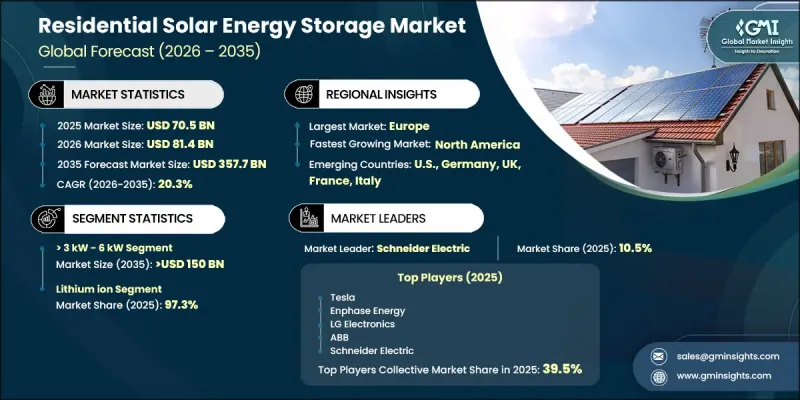
시장 확대는 도시 및 교외 가정의 에너지 효율에 대한 소비자 인식이 높아진 데다, 재생에너지 도입을 촉진하는 정부의 지원 정책에 힘입어 이루어지고 있습니다. 도시화의 진전과 인센티브가 제공되는 태양광 발전 프로그램 및 보조금과의 시너지 효과로 인해, 주택용 에너지 저장 시스템에 대한 수요가 더욱 가속화되고 있습니다. 또한, 전력망의 신뢰성에 대한 우려가 커지고 정전이 빈번해짐에 따라, 각 가정에서는 태양광 발전과 에너지 저장을 결합한 솔루션의 도입이 확대되고 있습니다. 또한, 지붕 설치형 태양광 발전 시스템의 보급률 향상도 전반적인 도입을 뒷받침하고 있습니다. 주택용 태양광 발전·축전 시스템은 태양광 패널에서 발전된 잉여 전력을 저장하여 나중에 사용할 수 있도록 설계되어 있으며, 야간이나 전력 수요가 가장 많은 시간대, 혹은 전력망 장애 시에도 끊김 없는 전력 공급을 보장합니다. 이러한 시스템은 높은 에너지 밀도와 효율성 덕분에 주로 리튬 이온 배터리 기술을 채택하고 있습니다. 에너지 관리 시스템과 스마트 모니터링 기술의 발전으로 인해 시스템의 성능과 사용자의 제어성이 더욱 향상되고 있습니다. 넷 미터링 제도, 세제 우대 조치, 고정가격 임베디드 제도(FIT) 등 지원적인 정책 체계가 시장의 매력을 지속적으로 높이고 있습니다. 동시에, 대규모 생산과 기술 발전으로 인한 배터리 비용의 하락이 합리적인 가격을 실현하고, 시장 침투율을 대폭 확대되고 있습니다.
| 시장 범위 | |
|---|---|
| 시작 연도 | 2025년 |
| 예측 기간 | 2026-2035년 |
| 시작 연도 시장 규모 | 705억 달러 |
| 예측 금액 | 3,577억 달러 |
| CAGR | 20.3% |
3kW 초과-6kW 용량대의 주택용 태양광 발전 및 저장 시장은 2035년까지 1,500억 달러에 달할 것으로 예측됩니다. 이 부문은 비용 효율성과 전원 백업 기능의 최적의 균형을 제공하며, 정전 시에도 가정에서 조명이나 소형 가전제품 등 필수 전력 부하를 유지할 수 있게 해주기 때문에 강력한 성장세를 보이고 있습니다. 하이브리드 인버터 시스템의 보급 확대와 설치 기술의 간소화로 인해, 이 용량 대역 수요는 더욱 증가하고 있으며, 신뢰성이 높고 확장성이 뛰어난 에너지 저장 솔루션을 찾는 주택 사용자들 사이에서 선호되는 선택지가 되고 있습니다.
리튬 이온 배터리 부문은 2025년에 97.3%의 시장 점유율을 차지하며, 업계 전반에서 압도적인 입지를 유지하고 있습니다. 이러한 선도적 지위는 뛰어난 에너지 밀도, 컴팩트한 설계, 급속 충전 및 방전 능력, 그리고 시스템 전체의 효율성에 기인합니다. 대량 생산을 통한 비용 절감과 지속적인 기술 개선을 통해 합리적인 가격이 실현됨에 따라 시장 침투는 더욱 강화되었습니다. 그 결과, 리튬 이온 기술은 전 세계 주택용 에너지 저장 분야에서 여전히 가장 선호되는 선택지로 자리 잡고 있습니다.
미국의 주택용 태양광 발전 및 에너지 저장 시장은 탈탄소화와 에너지 효율에 중점을 둔 강력한 정책 체계에 힘입어 2025년에는 184억 달러 규모에 달했습니다. 청정 에너지 도입을 촉진하는 정부의 인센티브와 지속 가능한 에너지 솔루션에 대한 일반 가정의 인식 제고가 맞물려 시장의 꾸준한 성장에 기여하고 있습니다. 주택용 태양광 발전 설비의 확대와 이를 뒷받침하는 규제 조치에 힘입어, 전미에서 주택용 에너지 저장 시스템에 대한 수요가 계속해서 증가하고 있습니다.
자주 묻는 질문
목차
제1장 조사 방법과 범위
제2장 주요 요약
제3장 업계 인사이트
제4장 경쟁 구도
제5장 시장 규모 및 예측 : 정격 출력별, 2022-2035년
제6장 시장 규모 및 예측 : 기술별, 2022-2035년
제7장 시장 규모 및 예측 : 지역별, 2022-2035년
제8장 기업 개요
JHS 26.07.01The Global Residential Solar Energy Storage Market was valued at USD 70.5 billion in 2025 and is estimated to grow at a CAGR of 20.3% to reach USD 357.7 billion by 2035.
Market expansion is driven by increasing consumer awareness regarding energy efficiency across urban and suburban households, along with supportive government initiatives promoting renewable energy adoption. Expanding urbanization, coupled with incentive-based solar programs and subsidies, is further accelerating demand for residential storage systems. In addition, rising concerns over grid reliability and the growing frequency of power outages are encouraging households to integrate solar-plus-storage solutions. The increasing penetration of rooftop solar installations is also strengthening overall adoption. Residential solar energy storage systems are designed to store surplus electricity generated from solar panels for later use, ensuring uninterrupted power supply during nighttime, peak demand hours, or grid disruptions. These systems primarily rely on lithium-ion battery technology due to its high energy density and efficiency. Advancements in energy management systems and smart monitoring technologies are further improving system performance and user control. Supportive policy frameworks, including net metering mechanisms, tax incentives, and feed-in tariff structures, continue to enhance market attractiveness. At the same time, declining battery costs driven by large-scale manufacturing and technological advancements are significantly improving affordability and expanding market penetration.
| Market Scope | |
|---|---|
| Start Year | 2025 |
| Forecast Year | 2026-2035 |
| Start Value | $70.5 Billion |
| Forecast Value | $357.7 Billion |
| CAGR | 20.3% |
The residential solar energy storage market for the > 3 kW - 6 kW capacity range is projected to reach USD 150 billion by 2035. This segment is gaining strong traction as it provides an optimal balance between cost efficiency and power backup capability, enabling households to support essential electrical loads such as lighting and small appliances during outages. Growing adoption of hybrid inverter systems and simplified installation technologies is further enhancing demand within this capacity range, making it a preferred choice among residential users seeking reliable and scalable energy storage solutions.
The lithium-ion battery segment accounted for 97.3% share in 2025, maintaining a dominant position across the industry. Its leadership is attributed to superior energy density, compact design, rapid charging and discharging capabilities, and overall system efficiency. Increasing affordability driven by mass production scale and ongoing technological improvements has further strengthened its market penetration. As a result, lithium-ion technology continues to remain the preferred choice for residential energy storage applications worldwide.
United States Residential Solar Energy Storage Market was valued at USD 18.4 billion in 2025, supported by strong policy frameworks focused on decarbonization and energy efficiency. Government incentives promoting clean energy adoption, combined with increasing household awareness of sustainable energy solutions, are contributing to steady market growth. The expansion of solar installations across residential properties, along with supportive regulatory mechanisms, continues to reinforce demand for residential energy storage systems across the country.
Major companies operating in the global residential solar energy storage industry include Tesla, Enphase Energy, SolarEdge Technologies, Schneider Electric, ABB, LG Electronics, Samsung SDI, Huawei, Eaton, Johnson Controls, Fluence, Toshiba, Saft, EnerSys, Leclanche, Primus Power, Pure Energy, Maxwell Energy, iNVERGY Ltd., Uniper, and Honeywell. Companies in the residential solar energy storage market are focusing on strategic initiatives to strengthen their market presence and enhance competitive positioning. A major focus is on technological innovation, with firms developing high-efficiency battery systems, advanced inverters, and integrated energy management platforms. Cost optimization through large-scale production and supply chain efficiency improvements is also a key strategy to enhance affordability and expand adoption. Companies are increasingly investing in lithium-ion technology advancements to improve battery life, performance, and safety. Expansion of distribution networks and partnerships with solar installers and utility providers is helping improve market reach. Digital integration, including smart monitoring and AI-based energy optimization, is being adopted to enhance user experience and system efficiency.
Table of Contents
Chapter 1 Methodology & Scope
- 1.1 Research approach
- 1.2 Quality commitments
- 1.2.1 GMI AI policy & data integrity commitment
- 1.2.1.1 Source consistency protocol
- 1.2.1 GMI AI policy & data integrity commitment
- 1.3 Research trail & confidence scoring
- 1.3.1 Research trail components
- 1.3.2 Scoring components
- 1.4 Data collection
- 1.4.1 Partial list of primary sources
- 1.5 Data mining sources
- 1.5.1 Paid sources
- 1.5.1.1 Sources, by region
- 1.5.1 Paid sources
- 1.6 Base estimates and calculations
- 1.6.1 Base year calculation for any one approach
- 1.7 Market estimates & forecasts parameters
- 1.8 Forecast model
- 1.8.1 Quantified market impact analysis
- 1.8.1.1 Mathematical impact of growth parameters on forecast
- 1.8.1 Quantified market impact analysis
- 1.9 Research transparency addendum
- 1.9.1 Source attribution framework
- 1.9.2 Quality assurance metrics
- 1.9.3 Our commitment to trust
- 1.10 Market definitions
Chapter 2 Executive Summary
- 2.1 Industry synopsis, 2022 - 2035
- 2.1.1 Business trends
- 2.1.2 Power rating trends
- 2.1.3 Technology trends
- 2.1.4 Regional trends
Chapter 3 Industry Insights
- 3.1 Industry ecosystem analysis
- 3.1.1 Raw material availability & sourcing analysis
- 3.1.2 Manufacturing capacity assessment
- 3.1.3 Supply chain resilience & risk factors
- 3.1.4 Distribution network analysis
- 3.2 Industry impact forces
- 3.2.1 Growth drivers
- 3.2.2 Industry pitfalls & challenges
- 3.3 Regulatory landscape
- 3.4 Growth potential analysis
- 3.5 Porter's analysis
- 3.5.1 Bargaining power of suppliers
- 3.5.2 Bargaining power of buyers
- 3.5.3 Threat of new entrants
- 3.5.4 Threat of substitutes
- 3.6 PESTEL analysis
- 3.6.1 Political factors
- 3.6.2 Economic factors
- 3.6.3 Social factors
- 3.6.4 Technological factors
- 3.6.5 Legal factors
- 3.6.6 Environmental factors
- 3.7 Cost structure analysis of residential solar energy storage
- 3.8 Emerging opportunities & trends
- 3.9 Digitalization & IoT integration
- 3.9.1 Growth in untapped markets & applications
- 3.10 Investment analysis & future prospects
- 3.11 Price trend analysis (USD/MW) (Driven by Primary Research)
- 3.11.1 By region (Driven by Primary Research)
- 3.11.2 By power rating (Driven by Primary Research)
- 3.12 Impact of AI & Generative AI on the market (Driven by Primary Research)
- 3.12.1 AI-Driven production optimization (Driven by Primary Research)
- 3.12.2 Predictive maintenance & fault detection (Driven by Primary Research)
Chapter 4 Competitive Landscape, 2026
- 4.1 Introduction
- 4.2 Company market share analysis, by region, 2025
- 4.2.1 North America
- 4.2.2 Europe
- 4.2.3 Asia Pacific
- 4.2.4 Middle East & Africa
- 4.2.5 Latin America
- 4.3 Competitive analysis of major market players
- 4.4 Competitive positioning matrix
- 4.5 Key developments
- 4.5.1 Mergers & acquisitions
- 4.5.2 Partnerships & collaborations
- 4.5.3 New product launches
- 4.5.4 Expansion plans & funding
- 4.6 Company tier benchmarking
- 4.6.1 Tier classification criteria & qualifying thresholds
- 4.6.2 Tier positioning matrix by revenue, geography & innovation
Chapter 5 Market Size and Forecast, By Power Rating, 2022 - 2035 (USD Million & MW)
- 5.1 Key trends
- 5.2 ≤ 3 kW
- 5.3 > 3 kW - 6 kW
- 5.4 > 6 kW
Chapter 6 Market Size and Forecast, By Technology, 2022 - 2035 (USD Million & MW)
- 6.1 Key trends
- 6.2 Lithium ion
- 6.3 Lead acid
Chapter 7 Market Size and Forecast, By Region, 2022 - 2035 (USD Million & MW)
- 7.1 Key trends
- 7.2 North America
- 7.2.1 U.S.
- 7.2.2 Canada
- 7.3 Europe
- 7.3.1 Germany
- 7.3.2 France
- 7.3.3 Italy
- 7.3.4 Spain
- 7.3.5 UK
- 7.3.6 Switzerland
- 7.3.7 Austria
- 7.4 Asia Pacific
- 7.4.1 China
- 7.4.2 Japan
- 7.4.3 India
- 7.4.4 Australia
- 7.4.5 South Korea
- 7.5 Middle East & Africa
- 7.5.1 Saudi Arabia
- 7.5.2 UAE
- 7.5.3 South Africa
- 7.6 Latin America
- 7.6.1 Brazil
- 7.6.2 Argentina
Chapter 8 Company Profiles
- 8.1 ABB
- 8.2 Eaton
- 8.3 EnerSys
- 8.4 Enphase Energy
- 8.5 Fluence
- 8.6 Honeywell
- 8.7 Huawei
- 8.8 iNVERGY Ltd.
- 8.9 Johnson Controls
- 8.10 Leclanche
- 8.11 LG Electronics
- 8.12 Maxwell Energy
- 8.13 Primus Power
- 8.14 PURE Energy
- 8.15 Saft
- 8.16 SAMSUNG SDI
- 8.17 Schneider Electric
- 8.18 SolarEdge Technologies
- 8.19 Toshiba
- 8.20 Uniper


