

|
시장보고서
상품코드
2071308
쓰레기 수거차 시장 : 비즈니스 기회, 성장요인, 업계 동향 분석 및 예측(2026-2035년)Garbage Truck Market Opportunity, Growth Drivers, Industry Trend Analysis, and Forecast 2026 - 2035 |
||||||

세계의 쓰레기 수거차 시장은 2025년에 162억 달러 규모가 되어, CAGR 4%로 확대되어 2035년까지 238억 달러에 이를 것으로 예측됩니다.
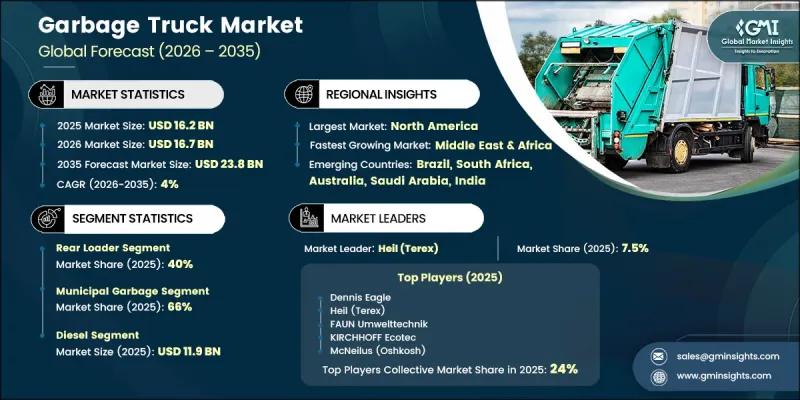
시장 확대는 도시 지역의 인구 증가, 도시 쓰레기 발생량 증가, 그리고 효율적인 쓰레기 수거·운송 시스템에 대한 수요 증가에 힘입어 이루어지고 있습니다. 도시가 계속 확장되는 가운데, 지방 자치단체와 민간 폐기물 관리 업체들은 수거 효율을 높이고 끊임없이 변화하는 환경 기준에 대응하기 위해 최신 차량 솔루션에 대한 투자를 확대되고 있습니다. 또한, 지자체들이 탄소 배출 감축 목표 달성과 더욱 엄격한 배출 규제 준수를 추구하는 가운데, 업계에서는 지속 가능한 차량 기술로의 대대적인 전환이 진행되고 있습니다. 잦은 출발과 정지를 반복하는 운행 주기에 적합하기 때문에 배터리식 전기 쓰레기 수거차의 보급이 확대되고 있으며, 선진국과 신흥국을 막론하고 차량 현대화를 위한 노력이 가속화되고 있습니다. 이와 더불어, 첨단 텔레매틱스, GPS 기반 차량 관리 시스템, 예측 유지보수 도구, 경로 최적화 기술의 통합을 통해 운영 성과가 혁신적으로 변화하고 있습니다. 이러한 디지털 솔루션을 통해 사업자는 차량 이용률을 높이고, 운영 비용을 절감하며, 서비스 신뢰성을 향상시키고, 쓰레기 수거 업무를 효율화할 수 있습니다. 스마트 시티 인프라 및 친환경 폐기물 관리 방식에 대한 투자 확대에 힘입어, 장기적인 시장 성장이 더욱 가속화될 것으로 예측됩니다.
| 시장 범위 | |
|---|---|
| 시작 연도 | 2025년 |
| 예측 기간 | 2026-2035년 |
| 시작 연도 시장 규모 | 162억 달러 |
| 예측 금액 | 238억 달러 |
| CAGR | 4% |
리어 로더 부문은 2025년에 40%의 시장 점유율을 차지하고, 2035년까지 연평균 성장률(CAGR) 2.5%로 성장할 것으로 전망됩니다. 이러한 선도적인 지위는 주거용 폐기물 수거 업무에서 광범위하게 채택되고 있는 데서 비롯되며, 범용성과 기존 폐기물 처리 시스템과의 호환성은 여전히 주요 장점으로 꼽히고 있습니다. 지자체 차량 교체 프로그램 및 폐기물 수거 인프라 업그레이드에 대한 지속적인 투자로 인해, 리어 로더 차량에 대한 수요는 유지될 것으로 예측됩니다. 전 세계적으로 가정 쓰레기 발생량이 계속 증가하는 가운데, 이 부문은 주택 폐기물 관리 업무에서 앞으로도 중요한 요소로 남아 있을 것으로 예측됩니다.
산업폐기물 부문은 2025년에 34%의 점유율을 차지했습니다. 수요를 견인하고 있는 요인은 산업 활동의 확대, 창고 및 물류 업무 증가, 상업 개발의 진전, 그리고 진행 중인 인프라 건설 프로젝트입니다. 제조 시설, 물류 센터, 소매점, 상업시설 등에서 발생하는 폐기물 양이 증가함에 따라, 첨단 폐기물 수거·운송 솔루션에 대한 수요가 높아지고 있습니다. 이러한 추세에 따라, 산업 폐기물 관리 용도로 설계된 전용 쓰레기 수거차에 대한 지속적인 투자가 촉진될 것으로 예측됩니다.
2025년, 미국의 쓰레기 수거차 시장은 40억 달러 규모에 달했으며, 북미에서 가장 큰 기여도를 보였습니다. 시장의 성장은 공공 보건 부문과 대규모 수거 차량을 운영하는 민간 폐기물 관리 기업의 막대한 투자에 힘입어 이루어지고 있습니다. 이 지역에서는 강력한 차량 현대화 프로그램, 저공해 차량 도입 확대, 그리고 무공해 운송 솔루션으로의 전환을 촉진하는 규제적 조치가 계속해서 긍정적인 요인으로 작용하고 있습니다. 지속가능성, 업무 효율성, 그리고 첨단 차량 관리 기술에 대한 관심이 높아짐에 따라, 미국 시장 전체의 장기적인 수요가 더욱 증가할 것으로 예측됩니다.
자주 묻는 질문
목차
제1장 조사 방법과 범위
제2장 주요 요약
제3장 업계 인사이트
제4장 경쟁 구도
제5장 시장 추산 및 예측 : 트럭 보디별, 2022-2035년
제6장 시장 추산 및 예측 : 페이로드 용량별, 2022-2035년
제7장 시장 추산 및 예측 : 추진력별, 2022-2035년
제8장 시장 추산 및 예측 : 기술별, 2022-2035년
제9장 시장 추산 및 예측 : 최종 용도별, 2022-2035년
제10장 시장 추산 및 예측 : 지역별, 2022-2035년
제11장 기업 개요
JHS 26.07.01The Global Garbage Truck Market was valued at USD 16.2 billion in 2025 and is estimated to grow at a CAGR of 4% to reach USD 23.8 billion by 2035.
Market expansion is supported by rising urban populations, increasing municipal waste generation, and the growing requirement for efficient waste collection and transportation systems. As cities continue to expand, local authorities and private waste management operators are investing in modern fleet solutions to improve collection efficiency and meet evolving environmental standards. The industry is also experiencing a significant transition toward sustainable vehicle technologies as municipalities pursue carbon reduction goals and stricter emissions compliance. Battery-electric garbage trucks are gaining traction due to their suitability for frequent stop-and-start operating cycles, while fleet modernization initiatives are accelerating across developed and emerging economies. In parallel, the integration of advanced telematics, GPS-enabled fleet management systems, predictive maintenance tools, and route optimization technologies is transforming operational performance. These digital solutions allow operators to enhance vehicle utilization, lower operating costs, improve service reliability, and streamline waste collection activities. Growing investments in smart city infrastructure and environmentally responsible waste management practices are expected to further strengthen long-term market growth.
| Market Scope | |
|---|---|
| Start Year | 2025 |
| Forecast Year | 2026-2035 |
| Start Value | $16.2 Billion |
| Forecast Value | $23.8 Billion |
| CAGR | 4% |
The rear loader segment accounted for 40% share in 2025 and is anticipated to grow at a CAGR of 2.5% through 2035. Its leadership position is supported by widespread adoption in residential waste collection operations, where versatility and compatibility with existing waste handling systems remain key advantages. Continued investments in municipal fleet replacement programs and waste collection infrastructure upgrades are expected to sustain demand for rear loader vehicles. As household waste volumes continue to increase globally, this segment is expected to remain a critical component of residential waste management operations.
The industrial garbage segment generated 34% share in 2025. Demand is being driven by expanding industrial activity, rising warehouse and logistics operations, increasing commercial development, and ongoing infrastructure construction projects. Growing waste volumes generated across manufacturing facilities, distribution centers, retail establishments, and commercial properties are creating a greater need for advanced waste collection and transportation solutions. This trend is expected to support sustained investment in specialized garbage truck fleets designed for industrial waste management applications.
U.S. Garbage Truck Market generated USD 4 billion in 2025, making it the largest contributor within North America. Market growth is being supported by substantial investments from public sanitation departments and private waste management companies operating large-scale collection fleets. The region continues to benefit from strong fleet modernization programs, increasing adoption of low-emission vehicles, and regulatory initiatives encouraging the transition toward zero-emission transportation solutions. The growing focus on sustainability, operational efficiency, and advanced fleet management technologies is expected to reinforce long-term demand across the U.S. market.
Key companies operating in the global garbage truck market include XCMG Group, Dennis Eagle, Zoomlion Special Vehicles, FAUN Umwelttechnik, ESG/Heil (Terex), McNeilus (Oshkosh), and Kirchhoff/Terberg RosRoca. Companies operating in the garbage truck market are focusing on product innovation, fleet electrification, and digital technology integration to strengthen their competitive position. Manufacturers are investing heavily in electric and low-emission vehicle development to align with evolving environmental regulations and sustainability goals. Strategic partnerships with municipalities, waste management companies, and technology providers are helping expand market reach and secure long-term contracts. Many players are enhancing vehicle performance through telematics, predictive maintenance systems, GPS tracking, and route optimization capabilities to improve operational efficiency. Businesses are also expanding manufacturing capacity, strengthening aftermarket service networks, and introducing customized vehicle solutions tailored to residential, commercial, and industrial applications.
Table of Contents
Chapter 1 Methodology & Scope
- 1.1 Research approach
- 1.2 Quality Commitments
- 1.2.1 GMI AI policy & data integrity commitment
- 1.2.1.1 Source consistency protocol
- 1.2.1 GMI AI policy & data integrity commitment
- 1.3 Research Trail & Confidence Scoring
- 1.3.1 Research Trail Components
- 1.3.2 Scoring Components
- 1.4 Data Collection
- 1.4.1 Partial list of primary sources
- 1.5 Data mining sources
- 1.5.1 Paid sources
- 1.5.1.1 Sources, by region
- 1.5.1 Paid sources
- 1.6 Base estimates and calculations
- 1.6.1 Base year calculation
- 1.7 Forecast model
- 1.7.1 Quantified market impact analysis
- 1.7.1.1 Mathematical impact of growth parameters on forecast
- 1.7.1 Quantified market impact analysis
- 1.8 Research transparency addendum
- 1.8.1 Source attribution framework
- 1.8.2 Quality assurance metrics
- 1.8.3 Our commitment to trust
Chapter 2 Executive Summary
- 2.1 Industry 360° synopsis
- 2.2 Key market trends
- 2.2.1 Truck Body
- 2.2.2 Payload Capacity
- 2.2.3 Propulsion
- 2.2.4 Technology
- 2.2.5 End Use
- 2.2.6 Region
- 2.3 TAM Analysis, 2026-2035
- 2.4 CXO perspectives: Strategic imperatives
Chapter 3 Industry Insights
- 3.1 Industry ecosystem analysis
- 3.1.1 Supplier landscape
- 3.1.1.1 Technology & platform providers
- 3.1.1.2 Sensor & IIoT hardware vendors
- 3.1.1.3 System integrators & implementation partners
- 3.1.1.4 End-use industries & asset operators
- 3.1.2 Cost structure
- 3.1.3 Profit margin
- 3.1.4 Value addition at each stage
- 3.1.5 Vertical integration trends
- 3.1.6 Disruptors
- 3.1.1 Supplier landscape
- 3.2 Impact forces
- 3.2.1 Growth drivers
- 3.2.1.1 Growing urbanization and municipal waste generation
- 3.2.1.2 Increasing government investments in waste management infrastructure
- 3.2.1.3 Fleet replacement demand for aging waste collection vehicles
- 3.2.1.4 Expansion of commercial and industrial waste collection services
- 3.2.2 Industry pitfalls & challenges
- 3.2.2.1 High acquisition cost of advanced garbage trucks
- 3.2.2.2 Labor shortages and operational challenges
- 3.2.3 Market opportunities
- 3.2.3.1 Rising adoption of electric garbage trucks
- 3.2.3.2 Integration of smart fleet management and telematics
- 3.2.3.3 Growing demand for automated collection systems
- 3.2.3.4 Expansion of alternative fuel refuse fleets
- 3.2.1 Growth drivers
- 3.3 Growth potential analysis
- 3.4 Pricing Analysis (Driven by Primary Research)
- 3.4.1 Historical Price Trend Analysis
- 3.4.2 Pricing Strategy by Player Type (Premium / Value / Cost-plus)
- 3.5 Regulatory landscape
- 3.5.1 North America
- 3.5.1.1 NWRA (National Waste & Recycling Association)
- 3.5.1.2 Waste Equipment Technology Association (WASTEC)
- 3.5.1.3 Environmental Industry Associations (EIA)
- 3.5.2 Europe
- 3.5.2.1 ANFIA (National Automotive Industry Association)
- 3.5.2.2 VAK (Verband der Arbeitsgerate- und Kommunalfahrzeug-Industrie)
- 3.5.2.3 ACEA (European Automobile Manufacturers' Association)
- 3.5.2.4 T&E (Transport & Environment)
- 3.5.3 Asia-Pacific
- 3.5.3.1 China Vehicle Security Law (DSL)
- 3.5.3.2 Japan Industrial Safety and Health Act
- 3.5.3.3 India Digital Vehicle Act
- 3.5.3.4 Singapore Vehicle Act
- 3.5.4 Latin America
- 3.5.4.1 UCRUS (Union of Urban Waste Pickers - Uruguay)
- 3.5.4.2 DINAMA (National Directorate for the Environment - Uruguay)
- 3.5.5 MEA
- 3.5.5.1 Saudi National Vehicle Authority
- 3.5.5.2 UAE Vehicle Assurance Standards
- 3.5.1 North America
- 3.6 Technology and Innovation Landscape
- 3.6.1 Current technologies
- 3.6.2 Emerging technologies
- 3.7 Porter's analysis
- 3.8 PESTEL analysis
- 3.9 Patent analysis (Driven by Primary Research)
- 3.10 Use cases
- 3.11 Impact of AI & generative AI on the market
- 3.11.1 AI-Driven Disruption of Existing Business Models
- 3.11.2 Automated design optimization
- 3.11.3 Supply chain AI for demand forecasting
- 3.11.4 GenAI use cases & adoption roadmap by segment
- 3.11.5 Risks, Limitations & Regulatory Considerations
- 3.12 Forecast assumptions & scenario analysis (Driven by Primary Research)
- 3.12.1 Base Case - key macro & industry variables driving CAGR
- 3.12.2 Optimistic Scenarios - Favorable Macro and Industry Tailwinds
- 3.12.3 Pessimistic Scenario - Macroeconomic slowdown or industry headwinds
- 3.13 Sustainability and environmental aspects
- 3.13.1 Sustainable practices
- 3.13.2 Waste reduction strategies
- 3.13.3 Energy efficiency in production
- 3.13.4 Eco-friendly Initiatives
- 3.13.5 Carbon footprint considerations
Chapter 4 Competitive Landscape, 2025
- 4.1 Introduction
- 4.2 Company market share analysis
- 4.2.1 North America
- 4.2.2 Europe
- 4.2.3 Asia-Pacific
- 4.2.4 Latin America
- 4.2.5 Middle East & Africa
- 4.3 Competitive positioning matrix
- 4.4 Strategic outlook matrix
- 4.5 Key developments
- 4.5.1 Mergers & acquisitions
- 4.5.2 Partnerships & collaborations
- 4.5.3 New product launches
- 4.5.4 Expansion plans and funding
- 4.6 Company Tier Benchmarking
- 4.6.1 Tier Classification Criteria & Qualifying Thresholds
- 4.6.2 Tier Positioning Matrix by Revenue, Geography & Innovation
Chapter 5 Market Estimates & Forecast, By Truck Body, 2022 - 2035 ($Bn, Units)
- 5.1 Key trends
- 5.2 Rear Loader
- 5.2.1 Standard Rear Loader
- 5.2.2 Split-Body Rear Loader
- 5.2.3 Automated Rear Loader
- 5.3 Front Loader
- 5.3.1 Standard Front Loader
- 5.3.2 Dual-Compartment Front Loader
- 5.3.3 Automated Front Loader with Robotic Arm
- 5.4 Side Loader
- 5.4.1 Manual Side Loader
- 5.4.2 Semi-Automated Side Loader
- 5.4.3 Automated Side Loader (ASL)
- 5.5 Roll-off & Container Handler
- 5.5.1 Cable Roll-off Truck
- 5.5.2 Hook Lift Truck
- 5.5.3 Roll-off Trailer
Chapter 6 Market Estimates & Forecast, By Payload Capacity, 2022 - 2035 ($Bn, Units)
- 6.1 Key trends
- 6.2 below 10 cu yd
- 6.3 10-15 cu yd
- 6.4 15-20 cu yd
- 6.5 above 20 cu yd
Chapter 7 Market Estimates & Forecast, By Propulsion, 2022 - 2035 ($Bn, Units)
- 7.1 Key trends
- 7.2 Diesel
- 7.3 Compressed Natural Gas
- 7.4 Electric
- 7.5 Hybrid
Chapter 8 Market Estimates & Forecast, By Technology, 2022 - 2035 ($Bn, Units)
- 8.1 Key trends
- 8.2 Manual
- 8.3 Automatic
- 8.4 Semi-automatic
Chapter 9 Market Estimates & Forecast, By End use, 2022 - 2035 ($Bn, Units)
- 9.1 Key trends
- 9.2 Municipal Garbage
- 9.3 Industrial Garbage
Chapter 10 Market Estimates & Forecast, By Region, 2022 - 2035 ($Mn, Units)
- 10.1 North America
- 10.1.1 US
- 10.1.2 Canada
- 10.2 Europe
- 10.2.1 UK
- 10.2.2 Germany
- 10.2.3 France
- 10.2.4 Italy
- 10.2.5 Spain
- 10.2.6 Belgium
- 10.2.7 Netherlands
- 10.2.8 Sweden
- 10.2.9 Russia
- 10.3 Asia Pacific
- 10.3.1 China
- 10.3.2 India
- 10.3.3 Japan
- 10.3.4 Australia
- 10.3.5 Singapore
- 10.3.6 South Korea
- 10.3.7 Vietnam
- 10.3.8 Indonesia
- 10.3.9 Thailand
- 10.4 Latin America
- 10.4.1 Brazil
- 10.4.2 Mexico
- 10.4.3 Argentina
- 10.5 MEA
- 10.5.1 South Africa
- 10.5.2 Saudi Arabia
- 10.5.3 UAE
- 10.5.4 Turkey
Chapter 11 Company Profiles
- 11.1 Global Players
- 11.1.1 Bucher Municipal
- 11.1.2 Dennis Eagle
- 11.1.3 E-Z Pack Manufacturing
- 11.1.4 FAUN Umwelttechnik
- 11.1.5 Heil Environmental
- 11.1.6 KIRCHHOFF Ecotec
- 11.1.7 Labrie Environmental
- 11.1.8 McNeilus Truck & Manufacturing
- 11.1.9 Terberg Environmental (formerly Terberg RosRoca)
- 11.1.10 New Way Trucks
- 11.2 Regional players
- 11.2.1 Electra Commercial Vehicles
- 11.2.2 Hidro-Mak
- 11.2.3 NTM
- 11.2.4 XCMG
- 11.2.5 Yuchai Special Vehicles
- 11.2.6 Zoomlion Heavy Industry S&T
- 11.3 Emerging players
- 11.3.1 Autocar
- 11.3.2 Kann Manufacturing
- 11.3.3 Pak-Mor
- 11.3.4 Zoeller (ZOELLER)


