

|
시장보고서
상품코드
2071311
하이브리드 종자 시장 : 기회, 성장요인, 업계 동향 분석 및 예측(2025-2036년)Hybrid Seed Market Opportunity, Growth Drivers, Industry Trend Analysis, and Forecast 2025 - 2036 |
||||||

세계의 하이브리드 종자 시장은 2025년에 478억 달러 규모가 되어, CAGR 5.7%로 확대되어 2035년까지 838억 달러에 이를 것으로 추정되고 있습니다.
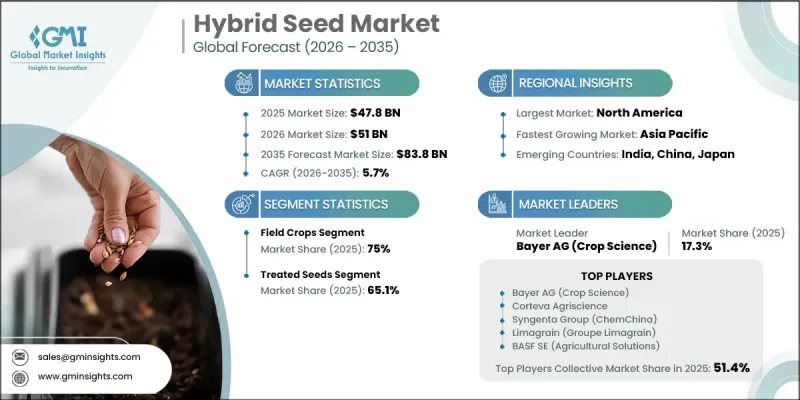
이러한 성장은 인구 증가에 따른 전 세계 식량 수요 증가, 정밀 농업 도구의 보급 확대, 그리고 아시아, 아프리카, 중동 전역에서 정부 주도로 이루어지는 식량 안보에 대한 투자 증가에 힘입어 이루어지고 있습니다. 민관 협력을 통한 종자 유통 체계와 디지털 농업 보급 플랫폼에 힘입어 소규모 농가를 위한 농업 시스템이 개선됨에 따라, 기존의 상업 농업 지역 이외의 지역에서도 인증된 하이브리드 품종에 대한 접근성이 확대되고 있습니다. 잡종 우세를 이끌어내기 위해 통제된 교배를 통해 생산된 하이브리드 종자는 일관되게 높은 수확량, 뛰어난 균일성, 강력한 병해 저항성, 그리고 환경 스트레스에 대한 내성 향상을 가져옵니다. 기계화의 진전, 정밀 관개 도입, 그리고 디지털 농업 솔루션 덕분에, 그동안 투입량이 적었던 농업 시스템에 하이브리드 종자의 보급이 더욱 확대되고 있습니다.
2025년에는 밭작물 부문이 75%의 점유율을 차지하며 업계의 주요 수익 기반을 형성했습니다. 이 부문은 전 세계 식량, 사료 및 산업용 공급 시스템의 중심 역할을 계속하고 있는 옥수수, 쌀, 밀, 해바라기, 수수, 카놀라 등 주요 작물에 대한 전 세계적 수요가 지속되고 있는 것을 배경으로, 2035년까지 연평균 성장률(CAGR) 4.9%로 성장할 것으로 전망됩니다.
가공된 종자 부문은 2025년에 65.1%의 시장 점유율을 차지하고, 2035년까지 연평균 성장률(CAGR) 6.9%로 성장할 것으로 전망됩니다. 이러한 성장은 기후 변화가 심해지는 상황에서 종자 차원의 보호가 비용 대비 효과가 높은 위험 완화 전략이라는 인식이 생산자들 사이에서 높아지고 있기 때문입니다. 처리 비용은 작물의 생육 초기 단계에서 피할 수 있는 잠재적 경제적 손실에 비해 상대적으로 낮기 때문에 비용 대비 효과는 여전히 양호하며, 이로 인해 처리된 종자는 다양한 농업 시스템과 지역에서 널리 채택되고 있습니다.
북미의 하이브리드 종자 시장은 2025년에 27%의 점유율을 차지하고, 2035년까지 연평균 성장률(CAGR) 4%로 성장할 것으로 전망됩니다. 미국은 콘벨트나 노던 플레인스 등 주요 농업 지대에서 옥수수, 대두, 카놀라를 대규모로 재배함으로써 지역 시장을 독점하고 있습니다. 시장 구조는 매우 성숙한 단계에 이르렀으며, 주요 작물의 하이브리드 종자 보급률은 이미 99%를 넘어섰기 때문에 경쟁의 초점은 채택량 확대가 아니라 형질 혁신, 수확량 최적화, 그리고 디지털 농업의 통합으로 옮겨가고 있습니다.
자주 묻는 질문
목차
제1장 조사 방법과 범위
제2장 주요 요약
제3장 업계 인사이트
제4장 경쟁 구도
제5장 시장 추산 및 예측 : 작물 유형별, 2022-2035년
제6장 시장 추산 및 예측 : 종자 처리별, 2022-2035년
제7장 시장 추산 및 예측 : 기간별, 2022-2035년
제8장 시장 추산 및 예측 : 유통 채널별, 2022-2035년
제9장 시장 추산 및 예측 : 지역별, 2022-2035년
제10장 기업 개요
JHS 26.07.01The Global Hybrid Seed Market was valued at USD 47.8 billion in 2025 and is estimated to grow at a CAGR of 5.7% to reach USD 83.8 billion by 2035.
The expansion is driven by rising global food demand linked to population growth, stronger adoption of precision agriculture tools, and increasing government-led food security investments across Asia, Africa, and the Middle East. Improvements in smallholder farming systems supported by public-private seed distribution frameworks and digital agricultural extension platforms are broadening access to certified hybrid varieties beyond conventional commercial farming regions. Hybrid seeds, produced through controlled cross-pollination to express heterosis, consistently deliver higher yields, better uniformity, stronger disease resistance, and improved tolerance to environmental stress. Growing mechanization, precision irrigation adoption, and digital farming solutions are further expanding hybrid seed penetration into previously low-input agricultural systems.
The field crops segment held a 75% share in 2025, forming the core revenue base of the industry. This segment is projected to grow at a CAGR of 4.9% through 2035, supported by sustained global demand for key crops including maize, rice, wheat, sunflower, sorghum, and canola, which remain central to global food, feed, and industrial supply systems.
The treated seeds segment held a 65.1% share in 2025 and is projected to grow at a CAGR of 6.9% through 2035. This growth is driven by increasing recognition among growers that seed-level protection provides a cost-efficient risk mitigation strategy under fluctuating climatic conditions. The cost-benefit structure remains favorable, as treatment expenses are relatively low compared to the potential financial losses avoided during early crop establishment stages, making treated seeds widely adopted across diverse farming systems and geographies.
North America Hybrid Seed Market accounted for 27% share in 2025 and is expected to grow at a CAGR of 4% through 2035. The United States dominates the regional landscape, supported by large-scale cultivation of maize, soybean, and canola across major agricultural belts such as the Corn Belt and Northern Plains. Market structure is highly mature, with hybrid seed penetration already exceeding 99% in major crops, shifting competitive focus toward trait innovation, yield optimization, and digital agriculture integration rather than expansion of adoption volume.
Key players involved in the hybrid seed market include Enza Zaden, Rijk Zwaan, East-West Seed, Advanta Seeds (UPL Group), Nuziveedu Seeds, Rallis India Limited (Tata Group), and Seed Co Limited. Key strategies adopted by hybrid seed companies focus on strengthening R&D investments in trait development, disease resistance, and climate-resilient genetics. Firms are expanding digital agriculture ecosystems to integrate farm analytics, decision support tools, and precision agronomy with seed offerings. Strategic acquisitions and global breeding collaborations are enhancing germplasm diversity and accelerating product pipelines. Companies are also localizing breeding programs to adapt hybrids to regional agro-climatic conditions and consumer preferences. Integrated seed-treatment combinations are being developed to improve early-stage crop performance and risk management. In addition, partnerships with governments and agricultural institutions are expanding market access through certified seed distribution networks.
Table of Contents
Chapter 1 Methodology & Scope
- 1.1 Market scope and definition
- 1.2 Research design
- 1.2.1 Research approach
- 1.2.2 Data collection methods
- 1.3 Data mining sources
- 1.3.1 Global
- 1.3.2 Regional/Country
- 1.4 Base estimates and calculations
- 1.4.1 Base year calculation
- 1.4.2 Key trends for market estimation
- 1.5 Primary research and validation
- 1.5.1 Primary sources
- 1.6 Forecast model
- 1.7 Research assumptions and limitations
Chapter 2 Executive Summary
- 2.1 Industry 360° synopsis
- 2.2 Key market trends
- 2.2.1 Crop type
- 2.2.2 Seed treatment
- 2.2.3 Duration
- 2.2.4 Distribution Channel
- 2.2.5 Regional
- 2.3 TAM Analysis, 2026-2035
- 2.4 CXO perspectives: Strategic imperatives
- 2.5 Future outlook and strategic recommendations
Chapter 3 Industry Insights
- 3.1 Industry ecosystem analysis
- 3.1.1 Supplier landscape
- 3.1.2 Profit margin
- 3.1.3 Value addition at each stage
- 3.1.4 Factor affecting the value chain
- 3.1.5 Disruptions
- 3.2 Industry impact forces
- 3.2.1 Growth drivers
- 3.2.1.1 Increasing demand for high-yield crops
- 3.2.1.2 Adoption of advanced agricultural practices
- 3.2.1.3 Rising global population and food demand
- 3.2.2 Industry pitfalls and challenges
- 3.2.2.1 High cost associated with hybrid seeds
- 3.2.2.2 Dependence on seasonal and climatic conditions
- 3.2.3 Market opportunities
- 3.2.3.1 Expansion in emerging agricultural economies
- 3.2.3.2 Development of climate-resilient hybrid varieties
- 3.2.3.3 Growing demand for specialty crop seeds
- 3.2.1 Growth drivers
- 3.3 Growth potential analysis
- 3.4 Regulatory landscape
- 3.4.1 North America
- 3.4.2 Europe
- 3.4.3 Asia Pacific
- 3.4.4 Latin America
- 3.4.5 Middle East & Africa
- 3.5 Porter's analysis
- 3.6 PESTEL analysis
- 3.7 Technology and innovation landscape
- 3.7.1 Current technological trends
- 3.7.2 Emerging technologies
- 3.8 Price trends
- 3.8.1 By region
- 3.8.2 By Crop type
- 3.9 Future market trends
- 3.10 Patent landscape
- 3.11 Trade statistics (HS code)
- 3.11.1 Major importing countries
- 3.11.2 Major exporting countries
- 3.12 Sustainability and environmental aspects
- 3.12.1 Sustainable practices
- 3.12.2 Waste reduction strategies
- 3.12.3 Energy efficiency in production
- 3.12.4 Eco-friendly initiatives
- 3.13 Carbon footprint consideration
Chapter 4 Competitive Landscape, 2025
- 4.1 Introduction
- 4.2 Company market share analysis
- 4.2.1 By region
- 4.2.1.1 North America
- 4.2.1.2 Europe
- 4.2.1.3 Asia Pacific
- 4.2.1.4 LATAM
- 4.2.1.5 MEA
- 4.2.1 By region
- 4.3 Company matrix analysis
- 4.4 Competitive analysis of major market players
- 4.5 Competitive positioning matrix
- 4.6 Key developments
- 4.6.1 Mergers & acquisitions
- 4.6.2 Partnerships & collaborations
- 4.6.3 New product launches
- 4.6.4 Expansion plans
Chapter 5 Market Estimates and Forecast, By Crop Type, 2022-2035 (USD Million) (Kilo Tons)
- 5.1 Key trends
- 5.2 Field Crops
- 5.2.1 Cereals
- 5.2.1.1 Corn (Maize)
- 5.2.1.2 Rice
- 5.2.1.3 Millet
- 5.2.1.4 Sorghum
- 5.2.2 Oilseeds
- 5.2.2.1 Sunflower
- 5.2.2.2 Rapeseed (Canola)
- 5.2.2.3 Safflower
- 5.2.3 Fiber Crops
- 5.2.3.1 Cotton
- 5.2.4 Pulses
- 5.2.4.1 Pigeon Pea
- 5.2.4.2 Chickpea
- 5.2.4.3 Others (Fodder Crops, Specialty Grains)
- 5.2.1 Cereals
- 5.3 Fruits & Vegetable Crops
- 5.3.1 Solanaceous Vegetables
- 5.3.1.1 Tomato
- 5.3.1.2 Chilli (Pepper)
- 5.3.1.3 Eggplant (Brinjal)
- 5.3.2 Cucurbits
- 5.3.2.1 Cucumber
- 5.3.2.2 Watermelon
- 5.3.2.3 Gourds (Bottle Gourd, Bitter Gourd)
- 5.3.2.4 Pumpkin & Squash
- 5.3.3 Brassicas
- 5.3.3.1 Cabbage
- 5.3.3.2 Cauliflower
- 5.3.3.3 Broccoli
- 5.3.4 Others (Okra, Leafy Vegetables, Melons)
- 5.3.1 Solanaceous Vegetables
Chapter 6 Market Estimates and Forecast, By Seed Treatment, 2022-2035 (USD Million) (Kilo Tons)
- 6.1 Key trends
- 6.2 Treated seeds
- 6.2.1 Fungicide-treated
- 6.2.2 Insecticide-treated
- 6.2.3 Multi-protection (combined treatment)
- 6.2.4 Bio-based treatments
- 6.3 Untreated seeds
Chapter 7 Market Estimates and Forecast, By Duration, 2022-2035 (USD Million) (Kilo Tons)
- 7.1 Key trends
- 7.2 Short-term (Annual Crops, <1 Year)
- 7.3 Medium-term (1-5 Years)
- 7.4 Long-term (Perennial Crops, ≥5 Years)
Chapter 8 Market Estimates and Forecast, By Distribution Channel, 2022-2035 (USD Million) (Kilo Tons)
- 8.1 Key trends
- 8.2 Direct sales
- 8.3 Distributors & retailers
- 8.4 Online platforms
- 8.5 Others
Chapter 9 Market Estimates and Forecast, By Region, 2022-2035 (USD Million) (Kilo Tons)
- 9.1 Key trends
- 9.2 North America
- 9.2.1 U.S.
- 9.2.2 Canada
- 9.3 Europe
- 9.3.1 Germany
- 9.3.2 UK
- 9.3.3 France
- 9.3.4 Spain
- 9.3.5 Italy
- 9.3.6 Rest of Europe
- 9.4 Asia Pacific
- 9.4.1 China
- 9.4.2 India
- 9.4.3 Japan
- 9.4.4 Australia
- 9.4.5 South Korea
- 9.4.6 Rest of Asia Pacific
- 9.5 Latin America
- 9.5.1 Brazil
- 9.5.2 Mexico
- 9.5.3 Argentina
- 9.5.4 Rest of Latin America
- 9.6 Middle East and Africa
- 9.6.1 Saudi Arabia
- 9.6.2 South Africa
- 9.6.3 UAE
- 9.6.4 Rest of Middle East and Africa
Chapter 10 Company Profiles
- 10.1 Bayer AG (Crop Science)
- 10.2 Corteva Agriscience
- 10.3 Syngenta Group (ChemChina)
- 10.4 Limagrain (Groupe Limagrain)
- 10.5 BASF SE (Agricultural Solutions)
- 10.6 KWS SAAT SE & Co. KGaA
- 10.7 Sakata Seed Corporation
- 10.8 Takii & Co., Ltd.
- 10.9 Enza Zaden
- 10.10 Rallis India Limited (Tata Group)
- 10.11 Rijk Zwaan
- 10.12 Seed Co Limited
- 10.13 Advanta Seeds (UPL Group)
- 10.14 Nuziveedu Seeds
- 10.15 East-West Seed


