
|
시장보고서
상품코드
2071316
화물 자전거 시장 : 비즈니스 기회, 성장요인, 업계 동향 분석 및 예측(2026-2035년)Cargo Bike Market Opportunity, Growth Drivers, Industry Trend Analysis, and Forecast 2026 - 2035 |
||||||

세계의 화물 자전거 시장은 2025년에 44억 2,000만 달러 규모가 되어, CAGR 4.2%로 성장하여 2035년까지 66억 달러에 이를 것으로 예측됩니다.
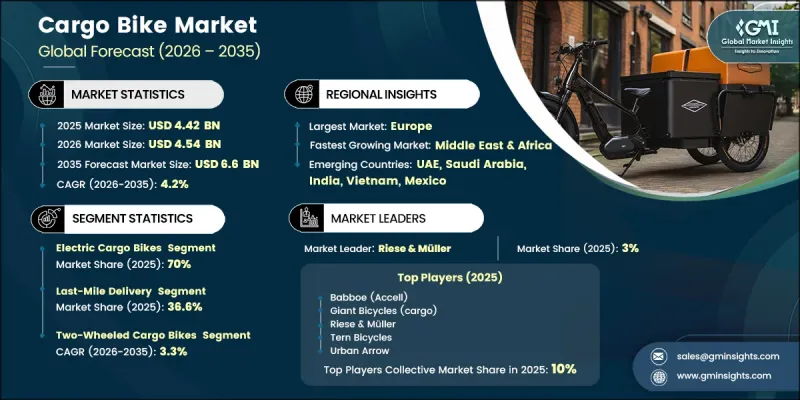
특히, 물류 사업자들이 효율적이고 저공해 운송 솔루션을 필요로 하는 도시 지역에서 업무용 도입이 주거용 도입을 계속해서 앞지르고 있어, 시장은 꾸준히 성장하고 있습니다. 기업들은 운영상의 신뢰성을 점점 더 중요시하게 되었으며, 차량 가동률은 도입 초기 단계를 지나 차량 대수가 증가함에 따라 구매 시 중요한 판단 기준이 되고 있습니다. 이에 따라 내구성이 뛰어난 설계, 신뢰성이 높은 제동 시스템, 일관된 정비 주기, 그리고 제조업체의 지원 체제가 갖춰진 정비 네트워크에 대한 수요가 높아지고 있습니다. 동시에, 커넥티드 기술의 통합으로 인해 차량 관리 방식이 혁신되고 있습니다. 디지털 모니터링 도구를 통해 자산을 효율적으로 활용하고, 예측 유지보수를 실시하며, 운영 효율을 높일 수 있게 되었습니다. 전자상거래 및 라스트 마일 배송 업무에서 수요가 확대되면서 시장 성장을 더욱 뒷받침하고 있으며, 화물 자전거는 유연한 이동, 교통 체증 완화, 환경 규제 준수 강화 등 도시 내 이동 수단으로서 많은 이점을 제공합니다. 도시 물류 인프라 확충과 지원적인 정책 환경이 화물 자전거 업계의 장기적인 성장 전망을 더욱 공고히 하고 있습니다.
| 시장 범위 | |
|---|---|
| 시작 연도 | 2025년 |
| 예측 기간 | 2026-2035년 |
| 시작 연도 시장 규모 | 44억 2,000만 달러 |
| 예측 금액 | 66억 달러 |
| CAGR | 4.2% |
전기 화물 자전거는 2025년에 70%의 시장 점유율을 차지하고, 2035년까지 연평균 성장률(CAGR) 5.7%로 성장할 것으로 전망됩니다. 이러한 인기의 상승은 신체적 부담을 줄이고 가동 범위를 확대할 수 있다는 점에 기인하며, 이로 인해 장거리 노선이나 높은 적재량에 적합합니다. 한편, 비전동 모델은 단순함과 유지보수의 용이성을 바탕으로, 비용을 중시하는 사용자나 단거리 용도에서 계속해서 수요를 유지하고 있습니다.
라스트 마일 배송 부문은 2025년에 36.6%의 시장 점유율을 차지하고, 2035년까지 연평균 성장률(CAGR) 6.9%로 성장할 것으로 전망됩니다. 효율적인 도심 배송 솔루션에 대한 수요가 증가함에 따라, 특히 운영 효율성이 매우 중요한 고밀도 환경에서 기업들은 기존 운송 수단을 대체할 현실적인 대안으로 화물 자전거 도입을 추진하고 있습니다.
유럽의 화물 자전거 시장은 2025년에 53%의 점유율을 차지하고, 2035년까지 연평균 성장률(CAGR) 3.2%로 성장할 것으로 전망됩니다. 독일은 견고한 인프라, 확립된 물류 체계, 그리고 지속 가능한 도시 이동성 솔루션을 촉진하는 유리한 규제 환경의 뒷받침을 받아 지역 시장의 45.3%를 차지했습니다.
자주 묻는 질문
목차
제1장 조사 방법과 범위
제2장 주요 요약
제3장 업계 인사이트
제4장 경쟁 구도
제5장 시장 추산 및 예측 : 제품별, 2022-2035년
제6장 시장 추산 및 예측 : 추진력별, 2022-2035년
제7장 시장 추산 및 예측 : 구동 시스템별, 2022-2035년
제8장 시장 추산 및 예측 : 적재 용량별, 2022-2035년
제9장 시장 추산 및 예측 : 용도별, 2022-2035년
제10장 시장 추산 및 예측 : 지역별, 2022-2035년
제11장 기업 개요
JHS 26.07.01The Global Cargo Bike Market was valued at USD 4.42 billion in 2025 and is estimated to grow at a CAGR of 4.2% to reach USD 6.6 billion by 2035.
The market is witnessing steady expansion as commercial adoption continues to outpace residential use, particularly in urban environments where logistics operators require efficient, low-emission transport solutions. Businesses are increasingly prioritizing operational reliability, making vehicle uptime a key purchasing consideration as fleets scale beyond initial deployment phases. This has led to rising demand for durable designs, dependable braking systems, consistent maintenance cycles, and accessible repair networks supported by manufacturers. At the same time, the integration of connected technologies is transforming fleet management practices, with digital monitoring tools enabling better asset utilization, predictive maintenance, and improved operational efficiency. Growing demand from e-commerce and last-mile delivery operations is further strengthening market growth, as cargo bikes offer advantages in urban mobility, including flexible navigation, reduced congestion impact, and improved compliance with environmental regulations. Expanding urban logistics frameworks and supportive policy environments continue to reinforce the long-term growth outlook for the cargo bike industry.
| Market Scope | |
|---|---|
| Start Year | 2025 |
| Forecast Year | 2026-2035 |
| Start Value | $4.42 Billion |
| Forecast Value | $6.6 Billion |
| CAGR | 4.2% |
Electric cargo bikes accounted for 70% share in 2025 and is expected to grow at a CAGR of 5.7% through 2035. Their increasing popularity is driven by their ability to reduce physical strain and extend operational range, making them suitable for longer routes and higher payload capacities. Meanwhile, non-electric variants continue to maintain relevance among cost-sensitive users and shorter-distance applications, supported by their simplicity and ease of maintenance.
The last-mile delivery segment held a share of 36.6% in 2025 and is projected to grow at a CAGR of 6.9% through 2035. Rising demand for efficient urban delivery solutions is encouraging businesses to adopt cargo bikes as a viable alternative to traditional transport methods, particularly in high-density environments where operational efficiency is critical.
Europe Cargo Bike Market represented 53% share in 2025 and is expected to grow at a CAGR of 3.2% through 2035. Germany accounted for 45.3% of the regional market, supported by strong infrastructure, established logistics frameworks, and favorable regulatory environments that promote sustainable urban mobility solutions.
Key players operating in the global cargo bike market include Babboe, Giant Bicycles, Rad Power Bikes, Raleigh UK, Riese & Muller, Tern Bicycles, Urban Arrow, Yuba Bicycles, Benno Bikes, Bergamont, Butchers & Bicycles, Christiania Bikes, Larry vs Harry, Madsen Cycles, Nihola, Xtracycle, Carqon, Douze Cycles, Omnium Cargo, and Triobike. Companies in the cargo bike market are adopting strategies centered on product innovation, strategic partnerships, and expansion into high-growth urban markets to strengthen their competitive positioning. Manufacturers are investing in advanced electric drivetrains, lightweight materials, and connected technologies to enhance performance and reliability. Collaborations with logistics providers and municipal authorities are helping companies scale deployment and secure long-term contracts. In addition, businesses are focusing on after-sales services, maintenance networks, and fleet management solutions to improve customer retention. Geographic expansion and entry into emerging markets are also key priorities.
Table of Contents
Chapter 1 Methodology & Scope
- 1.1 Research approach
- 1.2 Quality Commitments
- 1.2.1 GMI AI policy & data integrity commitment
- 1.2.1.1 Source consistency protocol
- 1.2.1 GMI AI policy & data integrity commitment
- 1.3 Research Trail & Confidence Scoring
- 1.3.1 Research Trail Components
- 1.3.2 Scoring Components
- 1.4 Data Collection
- 1.4.1 Partial list of primary sources
- 1.5 Data mining sources
- 1.5.1 Paid sources
- 1.5.1.1 Sources, by region
- 1.5.1 Paid sources
- 1.6 Base estimates and calculations
- 1.6.1 Base year calculation
- 1.7 Forecast model
- 1.7.1 Quantified market impact analysis
- 1.7.1.1 Mathematical impact of growth parameters on forecast
- 1.7.1 Quantified market impact analysis
- 1.8 Research transparency addendum
- 1.8.1 Source attribution framework
- 1.8.2 Quality assurance metrics
- 1.8.3 Our commitment to trust
Chapter 2 Executive Summary
- 2.1 Industry 360° synopsis
- 2.2 Key market trends
- 2.2.1 Regional
- 2.2.2 Product
- 2.2.3 Propulsion
- 2.2.4 Drive Systems
- 2.2.5 Load Capacity
- 2.2.6 Application
- 2.3 TAM Analysis, 2026-2035
- 2.4 CXO perspectives: Strategic imperatives
Chapter 3 Industry Insights
- 3.1 Industry ecosystem analysis
- 3.1.1 Supplier landscape
- 3.1.1.1 Raw material suppliers
- 3.1.1.2 Component suppliers
- 3.1.1.3 Manufacturers
- 3.1.1.4 Service providers
- 3.1.1.5 Distribution channel
- 3.1.1.6 End Use
- 3.1.2 Cost structure
- 3.1.3 Profit margin
- 3.1.4 Value addition at each stage
- 3.1.5 Vertical integration trends
- 3.1.6 Disruptors
- 3.1.1 Supplier landscape
- 3.2 Industry impact forces
- 3.2.1 Growth drivers
- 3.2.1.1 Rising fleet uptime optimization requirements
- 3.2.1.2 Growth of e-commerce & last-mile delivery fleets
- 3.2.1.3 Increasing telematics & connected vehicle adoption
- 3.2.1.4 Labor shortages in conventional repair workshops
- 3.2.2 Industry pitfalls & challenges
- 3.2.2.1 Fragmented service provider ecosystem
- 3.2.2.2 Limited skilled mobile technician availability
- 3.2.3 Market opportunities
- 3.2.3.1 AI-enabled predictive maintenance scheduling
- 3.2.3.2 Growth of OEM-authorized mobile service networks
- 3.2.3.3 Increasing adoption of app-based service booking
- 3.2.3.4 Remote diagnostics and virtual assistance integration
- 3.2.1 Growth drivers
- 3.3 Growth potential analysis
- 3.4 Pricing Analysis (Driven by Primary Research)
- 3.4.1 Historical Price Trend Analysis
- 3.4.2 Pricing Strategy by Player Type (Premium / Value / Cost-plus)
- 3.5 Regulatory landscape
- 3.5.1 North America
- 3.5.1.1 U.S.: National Highway Traffic Safety Administration (NHTSA)
- 3.5.1.2 U.S.: Vehicle Safety Standards (FMVSS)
- 3.5.1.3 Canada: Motor Vehicle Safety Regulations ( SOR /2013-198)
- 3.5.2 Europe
- 3.5.2.1 German Road Traffic Licensing Regulations
- 3.5.2.2 UK: Ministry of Transport (MOT) Test
- 3.5.2.3 EU Vehicle Labeling Regulation
- 3.5.2.4 REACH Compliance & Sustainable Material Standards
- 3.5.3 Asia-Pacific
- 3.5.3.1 Japan Low Rolling Resistance Vehicle Certification
- 3.5.3.2 Malaysia: JPJ Puspakom Mandatory Tread Depth
- 3.5.3.3 Australia: HVNL Defect Management
- 3.5.3.4 China Vehicle Quality Certification Standards
- 3.5.4 Latin America
- 3.5.4.1 Brazil INMETRO Vehicle Labeling Program
- 3.5.4.2 Mexico NOM Vehicle Safety Regulations
- 3.5.5 Middle East & Africa
- 3.5.5.1 GCC Tire Quality & Import Regulations
- 3.5.5.2 South Africa Vehicle Safety Compliance Standards
- 3.5.1 North America
- 3.6 Technology and Innovation landscape
- 3.6.1 Current technologies
- 3.6.2 Emerging technologies
- 3.7 Porter's analysis
- 3.8 PESTEL analysis
- 3.9 Patent analysis (Driven by Primary Research)
- 3.10 Trade Data Analysis (Based on Paid Database)
- 3.10.1 Import/Export Volume & Value Trends
- 3.10.2 Key Trade Corridors & Tariff Impact
- 3.11 Capacity & Production Landscape (Driven by Primary Research)
- 3.11.1 Production Capacity by Region & Key Producer
- 3.11.2 Capacity Utilization Rates & Expansion Pipelines
- 3.12 Impact of AI & generative AI on the market
- 3.12.1 AI-Driven Disruption of Existing Business Models
- 3.12.2 Automated design optimization
- 3.12.3 Supply chain AI for demand forecasting
- 3.12.4 GenAI use cases & adoption roadmap by segment
- 3.12.5 Risks, Limitations & Regulatory Considerations
- 3.13 Forecast assumptions & scenario analysis (Driven by Primary Research)
- 3.13.1 Base Case - key macro & industry variables driving CAGR
- 3.13.2 Optimistic Scenarios - Favorable Macro and Industry Tailwinds
- 3.13.3 Pessimistic Scenario - Macroeconomic slowdown or industry headwinds
- 3.14 Sustainability and environmental aspects
- 3.14.1 Sustainable practices
- 3.14.2 Waste reduction strategies
- 3.14.3 Energy efficiency in production
- 3.14.4 Eco-friendly Initiatives
- 3.14.5 Carbon footprint considerations
Chapter 4 Competitive Landscape, 2025
- 4.1 Introduction
- 4.2 Company market share analysis
- 4.2.1 North America
- 4.2.2 Europe
- 4.2.3 Asia-Pacific
- 4.2.4 Latin America
- 4.2.5 Middle East & Africa
- 4.3 Competitive positioning matrix
- 4.4 Key developments
- 4.4.1 Mergers & acquisitions
- 4.4.2 Partnerships & collaborations
- 4.4.3 New product launches
- 4.4.4 Expansion plans and funding
- 4.5 Company tier benchmarking
- 4.5.1 Tier classification criteria & qualifying thresholds
- 4.5.2 Tier positioning matrix by revenue, geography & innovation
Chapter 5 Market Estimates & Forecast, By Product, 2022 - 2035 ($Mn, Units)
- 5.1 Key trends
- 5.2 Two-Wheeled
- 5.3 Three-Wheeled
- 5.4 Four-Wheeled
Chapter 6 Market Estimates & Forecast, By Propulsion, 2022 - 2035 ($Mn, Units)
- 6.1 Key trends
- 6.2 Conventional
- 6.3 Electric
- 6.3.1 Pedal Assisted
- 6.3.2 Throttle Assisted
Chapter 7 Market Estimates & Forecast, By Drive Systems, 2022 - 2035 ($Mn, Units)
- 7.1 Key trends
- 7.2 Chain Drive
- 7.3 Belt Drive
- 7.4 Others
Chapter 8 Market Estimates & Forecast, By Load Capacity, 2022 - 2035 ($Mn, Units)
- 8.1 Key trends
- 8.2 Up to 100 Kg
- 8.3 100 to 200 Kg
- 8.4 Above 200 Kg
Chapter 9 Market Estimates & Forecast, By Application, 2022 - 2035 ($Mn, Units)
- 9.1 Key trends
- 9.2 Commercial Logistics
- 9.3 Last-Mile Delivery
- 9.4 Personal Transportation
- 9.5 Municipal Services
- 9.6 Others
Chapter 10 Market Estimates & Forecast, By Region, 2022 - 2035 ($Mn, Units)
- 10.1 North America
- 10.1.1 US
- 10.1.2 Canada
- 10.2 Europe
- 10.2.1 UK
- 10.2.2 Germany
- 10.2.3 France
- 10.2.4 Italy
- 10.2.5 Spain
- 10.2.6 Belgium
- 10.2.7 Netherlands
- 10.2.8 Sweden
- 10.2.9 Russia
- 10.3 Asia Pacific
- 10.3.1 China
- 10.3.2 India
- 10.3.3 Japan
- 10.3.4 Australia
- 10.3.5 Singapore
- 10.3.6 South Korea
- 10.3.7 Vietnam
- 10.3.8 Indonesia
- 10.3.9 Thailand
- 10.4 Latin America
- 10.4.1 Brazil
- 10.4.2 Mexico
- 10.4.3 Argentina
- 10.5 MEA
- 10.5.1 South Africa
- 10.5.2 Saudi Arabia
- 10.5.3 UAE
- 10.5.4 Turkey
Chapter 11 Company Profiles
- 11.1 Global players
- 11.1.1 Babboe
- 11.1.2 Giant Bicycles
- 11.1.3 Rad Power Bikes
- 11.1.4 Raleigh UK
- 11.1.5 Riese & Muller
- 11.1.6 Tern Bicycles
- 11.1.7 Urban Arrow
- 11.1.8 Yuba Bicycles
- 11.1.9 Benno Bikes
- 11.1.10 Bergamont
- 11.2 Regional players
- 11.2.1 Butchers & Bicycles
- 11.2.2 Christiania Bikes
- 11.2.3 Larry vs Harry (Bullitt)
- 11.2.4 Madsen Cycles
- 11.2.5 Nihola
- 11.2.6 Xtracycle
- 11.2.7 Carqon
- 11.3 Emerging players
- 11.3.1 Douze Cycles
- 11.3.2 Omnium Cargo
- 11.3.3 Triobike