|
시장보고서
상품코드
2071332
수의 종양학 시장 : 비즈니스 기회, 성장요인, 업계 동향 분석 및 예측(2026-2035년)Veterinary Oncology Market Opportunity, Growth Drivers, Industry Trend Analysis, and Forecast 2026 - 2035 |
||||||

세계의 수의 종양학 시장은 2025년에 20억 달러로 평가되었고 CAGR 10.3%로 성장하여 2035년까지 54억 달러에 이를 것으로 추정되고 있습니다.
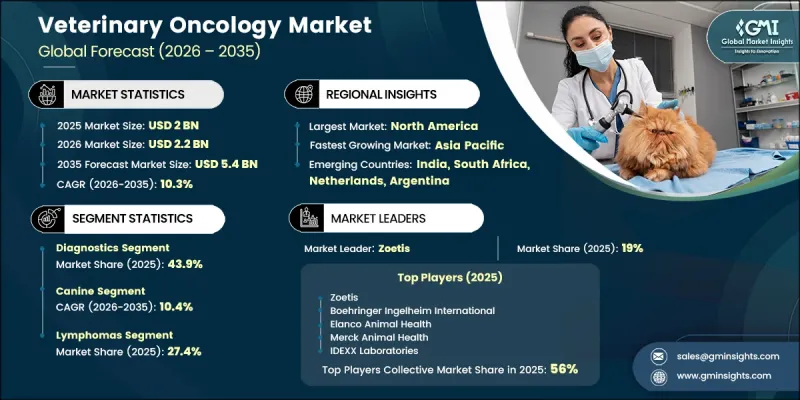
이러한 성장은 반려동물 사육 마릿수 증가, 동물 건강 관리에 대한 지출 확대, 그리고 수의 종양학 분야의 의약품 및 진단제 파이프라인이 꾸준히 확대되고 있는 데 힘입고 있습니다. 예방 의료의 발전으로 반려동물의 수명이 연장됨에 따라, 노화에 따른 암 발병률도 증가하고 있어 치료 대상이 되는 환자층이 직접적으로 확대되고 있습니다. 동시에, 반려동물 주인들 사이에서 단순한 대증요법이 아닌 적극적인 암 치료를 원하는 경향이 강해지면서, 치료에 대한 기대 방식이 변화하고 있습니다. CT, MRI, 디지털 X선 촬영 등의 영상 진단 기술의 발전은 분자 검사 및 저침습 생검 기법과 결합되어 조기 발견과 보다 정밀한 치료 계획 수립을 가능하게 하고 있습니다. 또한, 장비 비용의 하락으로 인해 일반 동물병원에서도 종양 선별 검사를 도입할 수 있게 되어, 전문 시설 이외의 곳에서도 이를 이용할 기회가 확대되고 있습니다.
| 시장 범위 | |
|---|---|
| 시작 연도 | 2025년 |
| 예측 기간 | 2026-2035년 |
| 시작 연도 시장 규모 | 20억 달러 |
| 예측 금액 | 54억 달러 |
| CAGR | 10.3% |
진단 분야는 2025년에 43.9%의 점유율을 차지하고, 2035년까지 연평균 성장률(CAGR) 10.4%로 성장할 것으로 전망됩니다. 이러한 확대는 전문 병원과 시설이 잘 갖춰진 일반 동물병원 모두에서 첨단 영상 진단 및 검사실 기반 진단 도구의 활용이 증가하고 있음을 반영합니다. 영상 진단 기술은 종양 감지, 병기 분류, 치료 계획 수립에 활용되는 CT, MRI, 초음파, 디지털 X선 촬영 시스템에 힘입어 여전히 주요 수익원으로 자리 잡고 있습니다. 초음파 유도 생검과 같은 저침습 시술도 진단 정확도를 높이는 동시에 환자의 위험을 줄여주고 있어, 이 부문의 성장을 더욱 뒷받침하고 있습니다.
림프종 부문은 2025년에 27.4%의 시장 점유율을 차지하고, 2035년까지 연평균 성장률(CAGR) 10.8%로 성장할 것으로 전망됩니다. 개 림프종은 여전히 가장 많이 진단되는 유형이며, 다중성, 소화관형, 종격동형 및 절외형으로 분류되지만, 그중에서도 침습성이 높은 다중성 림프종이 가장 빈번하게 관찰됩니다. 표준 치료법은 주로 인간 종양학에서 응용된 다제 병용 화학요법 프로토콜에 기반을 두고 있으며, 치료를 받은 동물에서 지속적으로 양호한 관해 결과와 생존 기간 연장을 가져오고 있습니다.
북미의 수의 종양학 시장은 49.8%의 점유율을 차지하고 있으며, 2035년까지 연평균 성장률(CAGR) 10.1%로 성장할 것으로 전망됩니다. 이 지역이 주도적인 위치를 차지하고 있는 배경에는 고도로 발달한 수의학 생태계, 풍부한 전문 종양 전문의 확보, 그리고 수의약품의 혁신과 승인을 지원하는 규제 체계가 있습니다. 미국은 여전히 핵심 시장이며, 임상 연구, 치료법 혁신, 그리고 종양학 치료 기준의 향상에 크게 기여하고 있는 주요 학술 기관 및 의뢰 의료 기관들의 지원을 받고 있습니다.
자주 묻는 질문
목차
제1장 조사 방법과 범위
제2장 주요 요약
제3장 업계 인사이트
제4장 경쟁 구도
제5장 시장 추산 및 예측 : 암 진단 및 치료별, 2022-2035년
제6장 시장 추산 및 예측 : 동물 유형별, 2022-2035년
제7장 시장 추산 및 예측 : 암 유형별, 2022-2035년
제8장 시장 추산 및 예측 : 지역별, 2022-2035년
제9장 기업 개요
JHS 26.07.01The Global Veterinary Oncology Market was valued at USD 2 billion in 2025 and is estimated to grow at a CAGR of 10.3% to reach USD 5.4 billion by 2035.
Growth is reinforced by expanding pet ownership, higher spending on animal healthcare, and a steadily broadening pipeline of veterinary oncology drugs and diagnostics. As pets live longer due to improved preventive care, the incidence of age-related cancers is also rising, directly expanding the treated patient pool. At the same time, growing willingness among pet owners to pursue active cancer therapies rather than purely supportive care is reshaping treatment expectations. Advances in diagnostic imaging, such as CT, MRI, and digital radiography, combined with molecular testing and minimally invasive biopsy tools, are enabling earlier detection and more precise treatment planning. Lower equipment costs are also allowing general veterinary clinics to adopt oncology screening capabilities, widening access beyond specialized centers.
| Market Scope | |
|---|---|
| Start Year | 2025 |
| Forecast Year | 2026-2035 |
| Start Value | $2 Billion |
| Forecast Value | $5.4 Billion |
| CAGR | 10.3% |
The diagnostics segment accounted for 43.9% share in 2025 and is projected to grow at a CAGR of 10.4% through 2035. Its expansion reflects the increasing use of advanced imaging and laboratory-based diagnostic tools across both specialty hospitals and well-equipped general veterinary practices. Imaging technologies remain the primary revenue contributor, supported by CT, MRI, ultrasound, and digital radiography systems used for tumor detection, staging, and treatment planning. Minimally invasive procedures such as ultrasound-guided sampling are also improving diagnostic accuracy while reducing patient risk, further supporting segment growth.
The lymphoma segment held a 27.4% share in 2025 and will grow at a CAGR of 10.8% through 2035. Canine lymphoma remains the most diagnosed form and is categorized into multicentric, alimentary, mediastinal, and extranodal types, with aggressive multicentric cases being the most frequently observed. Standard treatment practices are largely based on multi-agent chemotherapy protocols adapted from human oncology, which continue to deliver strong remission outcomes and extended survival periods in treated animals.
North America Veterinary Oncology Market held a 49.8% share and is projected to grow at a CAGR of 10.1% through 2035. The region's leadership is supported by a highly developed veterinary healthcare ecosystem, strong availability of specialist oncologists, and a regulatory framework that supports veterinary drug innovation and approvals. The United States remains the central market, backed by leading academic and referral institutions that contribute significantly to clinical research, treatment innovation, and the advancement of oncology care standards.
Major players operating in the global veterinary oncology market include Zoetis Inc., Boehringer Ingelheim International GmbH, Elanco Animal Health Incorporated, Merck Animal Health, AB Science S.A., IDEXX Laboratories, Inc., Siemens Healthineers (Varian Medical Systems), Accuray Incorporated, Elekta AB, PetCure Oncology, Virbac S.A., Dechra Pharmaceuticals PLC, and Nippon Zenyaku Kogyo Co., Ltd. (ZENOAQ). Companies in the veterinary oncology market are strengthening their position through expanded investment in drug development pipelines focused on targeted and immuno-oncology therapies designed specifically for companion animals. Strategic collaborations between pharmaceutical firms and veterinary research institutions are accelerating clinical validation and product approvals. Players are also enhancing diagnostic-treatment integration by combining imaging, molecular testing, and therapeutic solutions into unified oncology care pathways. Geographic expansion through specialty clinics and referral networks is improving treatment accessibility across emerging urban markets. Digital health platforms and tele-oncology services are being deployed to support remote consultation and treatment monitoring.
Table of Contents
Chapter 1 Methodology & Scope
- 1.1 Research approach
- 1.2 Quality commitments
- 1.2.1 GMI AI policy & data integrity commitment
- 1.2.1.1 Source consistency protocol
- 1.2.1 GMI AI policy & data integrity commitment
- 1.3 Research trail & confidence scoring
- 1.3.1 Research trail components
- 1.3.2 Scoring components
- 1.4 Data collection
- 1.4.1 Partial list of primary sources
- 1.5 Data mining sources
- 1.5.1 Paid sources
- 1.5.1.1 Sources, by region
- 1.5.1 Paid sources
- 1.6 Base estimates and calculations
- 1.6.1 Base year calculation for any one approach
- 1.7 Market estimates & forecasts parameters
- 1.8 Forecast model
- 1.8.1 Quantified market impact analysis
- 1.8.1.1 Mathematical impact of growth parameters on forecast
- 1.8.1 Quantified market impact analysis
- 1.9 Research transparency addendum
- 1.9.1 Source attribution framework
- 1.9.2 Quality assurance metrics
- 1.9.3 Our commitment to trust
Chapter 2 Executive Summary
- 2.1 Industry 3600 synopsis
- 2.1.1 Business trends
- 2.1.2 Cancer diagnostics & treatment trends
- 2.1.3 Animal type trends
- 2.1.4 Cancer type trends
- 2.1.5 Regional trends
- 2.2 CXO perspectives: Strategic imperatives
Chapter 3 Industry Insights
- 3.1 Industry ecosystem analysis
- 3.2 Industry impact forces
- 3.2.1 Growth drivers
- 3.2.1.1 Rising prevalence and incidence of cancer in animals
- 3.2.1.2 Technological advancements in pet cancer diagnosis
- 3.2.1.3 Growing research and investments in pet cancer therapy
- 3.2.1.4 Increasing pet insurance adoption
- 3.2.2 Industry pitfalls and challenges
- 3.2.2.1 High cost of cancer treatment and procedures
- 3.2.2.2 Adverse effects of drugs used for pet cancer treatment
- 3.2.3 Market opportunities
- 3.2.3.1 Development of personalized and targeted oncology therapies
- 3.2.3.2 Expansion of veterinary oncology infrastructure and specialty clinics
- 3.2.1 Growth drivers
- 3.3 Growth potential analysis
- 3.4 Technology and innovation landscape
- 3.4.1 Current technological trends
- 3.4.2 Emerging technologies
- 3.5 Pricing trend analysis (Driven by primary research)
- 3.6 Regulatory landscape (Driven by primary research)
- 3.6.1 North America
- 3.6.2 Europe
- 3.6.3 Asia Pacific
- 3.6.4 Latin America
- 3.6.5 MEA
- 3.7 Porter's analysis
- 3.8 PESTEL analysis
- 3.9 Patent analysis
- 3.10 Future market trends
- 3.11 Impact of AI and Generative AI on the market (Driven by primary research)
- 3.12 Investment & funding analysis (Driven by primary research)
- 3.13 Pet population statistics (Driven by primary research)
Chapter 4 Competitive Landscape, 2025
- 4.1 Introduction
- 4.2 Company market share analysis
- 4.2.1 North America
- 4.2.2 Europe
- 4.2.3 Asia Pacific
- 4.3 Company matrix analysis
- 4.4 Competitive analysis of major market players
- 4.5 Competitive positioning matrix
- 4.6 Key developments
- 4.6.1 Merger and acquisition
- 4.6.2 Partnership and collaboration
- 4.6.3 New product launches
- 4.6.4 Expansion plans
Chapter 5 Market Estimates and Forecast, By Cancer Diagnostics & Treatment, 2022 - 2035 ($ Mn)
- 5.1 Key trends
- 5.2 Diagnostics
- 5.2.1 By Type
- 5.2.1.1 Imaging
- 5.2.1.2 Biopsy
- 5.2.1.3 Endoscopy
- 5.2.1.4 Other diagnostics
- 5.2.2 By End Use
- 5.2.2.1 Veterinary hospitals & clinics
- 5.2.2.2 Diagnostics centers
- 5.2.2.3 Other end users
- 5.2.1 By Type
- 5.3 Treatment
- 5.3.1 By Type
- 5.3.1.1 Surgery
- 5.3.1.2 Radiotherapy
- 5.3.1.3 Chemotherapy
- 5.3.1.4 Immunotherapy
- 5.3.1.5 Other treatments
- 5.3.2 By End Use
- 5.3.2.1 Veterinary hospitals
- 5.3.2.2 Veterinary clinics
- 5.3.2.3 Other end users
- 5.3.1 By Type
Chapter 6 Market Estimates and Forecast, By Animal Type, 2022 - 2035 ($ Mn)
- 6.1 Key trends
- 6.2 Canine
- 6.3 Feline
- 6.4 Equine
- 6.5 Other animal types
Chapter 7 Market Estimates and Forecast, By Cancer Type, 2022 - 2035 ($ Mn)
- 7.1 Key trends
- 7.2 Mast cell tumors
- 7.3 Mammary tumors
- 7.4 Lymphomas
- 7.5 Melanoma
- 7.6 Other cancer types
Chapter 8 Market Estimates and Forecast, By Region, 2022 - 2035 ($ Mn)
- 8.1 Key trends
- 8.2 North America
- 8.2.1 U.S.
- 8.2.2 Canada
- 8.3 Europe
- 8.3.1 Germany
- 8.3.2 France
- 8.3.3 UK
- 8.3.4 Spain
- 8.3.5 Italy
- 8.3.6 Netherlands
- 8.4 Asia Pacific
- 8.4.1 China
- 8.4.2 Japan
- 8.4.3 India
- 8.4.4 Australia
- 8.4.5 South Korea
- 8.5 Latin America
- 8.5.1 Brazil
- 8.5.2 Mexico
- 8.5.3 Argentina
- 8.6 Middle East & Africa
- 8.6.1 Saudi Arabia
- 8.6.2 South Africa
- 8.6.3 UAE
Chapter 9 Company Profiles
- 9.1 Zoetis Inc.
- 9.2 AB Science S.A.
- 9.3 Elanco Animal Health Incorporated
- 9.4 Boehringer Ingelheim International GmbH
- 9.5 Merck Animal Health (Merck & Co., Inc.)
- 9.6 IDEXX Laboratories, Inc.
- 9.7 Siemens Healthineers (Varian Medical Systems)
- 9.8 Accuray Incorporated
- 9.9 Elekta AB
- 9.10 PetCure Oncology
- 9.11 Virbac S.A.
- 9.12 Dechra Pharmaceuticals PLC
- 9.13 Nippon Zenyaku Kogyo Co., Ltd. (ZENOAQ)