

|
시장보고서
상품코드
2071340
DC 전기차 급속 충전소 시장 기회, 성장요인, 업계 동향 분석 및 예측(2026-2035년)DC Fast Electric Vehicle Charging Station Market Opportunity, Growth Drivers, Industry Trend Analysis, and Forecast 2026 - 2035 |
||||||

세계의 DC 전기차 급속 충전소 시장은 2025년에 263억 달러에 이르고, 2035년까지 연평균 복합 성장률(CAGR) 26.1%로 성장하여 2,854억 달러에 이를 것으로 예측됩니다.
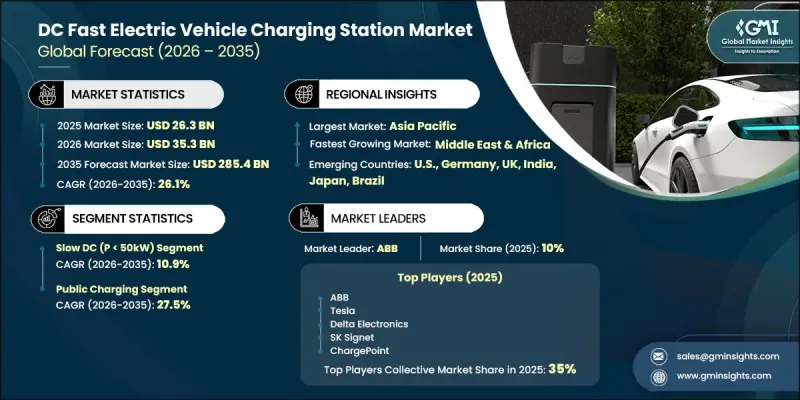
시장의 성장은 세 가지 주요 요인에 힘입어 이루어지고 있습니다. 즉, 30분 미만의 초고속 충전 주기에 대한 수요 증가, 주요 경제권에서 정부가 주도하는 인프라 구축 의무, 그리고 전력 전자 기술의 발전에 따른 고출력 충전 시스템 비용의 지속적인 감소입니다. 또한, 기업의 탄소중립 공약과 각국의 탈탄소화 목표에 따라 DC 급속 충전 인프라는 규정 준수를 목적으로 한 전략적 투자로 자리매김하고 있으며, 도입까지 걸리는 기간이 대폭 단축되고 있습니다. 승용차, 상용차, 대중교통 수단에서의 전기차 보급 확대는 대용량 충전 네트워크에 대한 지속적인 수요를 창출하고 있습니다. 도시 간 고속도로, 물류 회랑, 인구 밀집 도시 지역의 인프라 격차를 해소해야 할 필요성이 대규모 설비 투자를 촉진하고 있습니다. 실리콘 카바이드(SiC) 반도체, 차세대 전력 전자 장치, 양방향 충전 시스템 분야의 기술적 진보는 효율을 더욱 높이는 동시에 단위당 충전 비용을 절감하고 있습니다.
| 시장 범위 | |
|---|---|
| 개시 연도 | 2025년 |
| 예측 기간 | 2026-2035년 |
| 개시 연도 시장 규모 | 263억 달러 |
| 예측액 | 2,854억 달러 |
| CAGR | 26.1% |
50kW 미만의 시스템으로 정의되는 저속 DC 충전 부문은 2025년에 9.4%의 시장 점유율을 차지했습니다. 이 부문은 주로 구형 EV 플랫폼과, 적당한 충전 속도로 운영상 충분한 저용량 전동 모빌리티 용도에 대응하고 있습니다. EV 생태계가 아직 발전 단계에 있는 지역이나 초고속 충전 기능이 필요하지 않은 차종 부문에서 도입이 진행되고 있으며, 이는 꾸준하지만 비교적 완만한 성장을 뒷받침하고 있습니다.
공공 부문은 2025년에 66.3%의 점유율을 차지하며 174억 달러에 달할 것으로 예상되며, 2035년까지 연평균 성장률(CAGR) 27.5%로 성장할 것으로 전망됩니다. 이 부문에는 고속도로변, 대도시권의 충전 허브, 대중교통과 직결된 시설, 그리고 모든 전기차 사용자가 이용할 수 있는 상업용 주차장 내에 설치된 이용 빈도가 높은 충전 설비가 포함됩니다. 이러한 성장은 자택에 충전 시설이 없는 전기차 소유자 증가에 힘입어 크게 뒷받침되고 있으며, 특히 인구 밀도가 높은 도시 지역에서는 일상적인 이동 수요를 충족시키기 위해 공유 충전 인프라가 여전히 필수적입니다.
북미 시장은 2025년에 3.4%의 점유율을 차지하고 있으며, 연방 및 주 차원의 인프라 구축 계획이 기획 단계에서 대규모 시행 단계로 전환됨에 따라 향후 급속한 성장이 예상됩니다. 전국적인 충전 인프라 확충을 지원하는 정부의 자금 조달 체계에 따라, 주요 교통 노선변에 고출력 직류 급속 충전 설비의 설치가 의무화되어, 지역 전체의 장기적인 인프라 구축이 강화되고 있습니다.
자주 묻는 질문
목차
제1장 조사 방법과 범위
제2장 주요 요약
제3장 업계 인사이트
제4장 경쟁 구도
제5장 시장 규모와 예측 : 출력별, 2022년-2035년
제6장 시장 규모와 예측 : 용도별, 2022년-2035년
제7장 시장 규모와 예측 : 지역별, 2022년-2035년
제8장 기업 개요
LSH 26.07.02The Global DC Fast Electric Vehicle Charging Station Market was valued at USD 26.3 billion in 2025 and is estimated to grow at a CAGR of 26.1% to reach USD 285.4 billion by 2035.
Market growth is reinforced by three core forces: rising demand for ultra-fast charging cycles under 30 minutes, government-backed infrastructure deployment mandates across major economies, and continuous reductions in high-power charging system costs driven by advancements in power electronics. In addition, corporate net-zero commitments and national decarbonization targets are accelerating the positioning of DC fast charging infrastructure as a strategic compliance-driven investment, significantly shortening deployment timelines. Expanding EV penetration across passenger vehicles, commercial fleets, and public transportation is generating sustained demand for high-capacity charging networks. The need to bridge infrastructure gaps across intercity highways, logistics corridors, and dense urban regions is encouraging large-scale capital investment. Technological progress in silicon carbide (SiC) semiconductors, next-generation power electronics, and bidirectional charging systems is further enhancing efficiency while reducing per-unit charging costs.
| Market Scope | |
|---|---|
| Start Year | 2025 |
| Forecast Year | 2026-2035 |
| Start Value | $26.3 Billion |
| Forecast Value | $285.4 Billion |
| CAGR | 26.1% |
The slow DC charging segment, defined by systems below 50 kW, accounted for 9.4% share in 2025. This segment mainly supports earlier-generation EV platforms and lower-capacity electric mobility applications, where moderate charging speeds remain operationally sufficient. Its adoption continues in regions with evolving EV ecosystems and in vehicle categories that do not require ultra-fast charging capabilities, supporting steady but comparatively slower growth.
The public DC fast charging segment held a 66.3% share, representing USD 17.4 billion in 2025, and is projected to grow at a CAGR of 27.5% through 2035. This segment includes high-traffic charging installations located along highways, in metropolitan charging hubs, at transit-oriented facilities, and within commercial parking environments accessible to all EV users. Growth is strongly supported by the increasing number of EV owners who lack private home charging access, particularly in densely populated urban settings where shared charging infrastructure remains essential for daily mobility needs.
North America DC Fast Electric Vehicle Charging Station Market accounted for 3.4% share in 2025 and is expected to witness strong future acceleration as federal and state-level infrastructure initiatives shift from planning stages to large-scale deployment. Government funding frameworks supporting nationwide charging expansion are mandating high-power DC fast charging installations along key transportation routes, reinforcing long-term infrastructure buildout across the region.
Major players operating in the Global DC Fast Electric Vehicle Charging Station Market include ABB, ChargePoint, Tesla, Alpitronic, SK Signet, Delta Electronics, Blink Charging, Eaton, EVBox, Leviton Manufacturing, and Siemens. Companies in the DC Fast Electric Vehicle Charging Station Market are prioritizing large-scale expansion of high-power charging networks through strategic public-private partnerships to secure site access and accelerate deployment timelines. Many players are investing heavily in next-generation ultra-fast charging technologies supported by silicon carbide (SiC) semiconductors to improve efficiency and reduce charging duration. Firms are also focusing on interoperability and roaming agreements to ensure seamless cross-network charging experiences for EV users. Geographic expansion strategies into high-growth emerging EV markets are being supported by localized manufacturing and regional partnerships. Additionally, companies are strengthening long-term competitiveness through vertical integration of software platforms for energy management, predictive maintenance, and real-time load balancing.
Table of Contents
Chapter 1 Methodology & Scope
- 1.1 Research approach
- 1.2 Quality commitments
- 1.2.1 GMI AI policy & data integrity commitment
- 1.2.1.1 Source consistency protocol
- 1.2.1 GMI AI policy & data integrity commitment
- 1.3 Research trail & confidence scoring
- 1.3.1 Research trail components
- 1.3.2 Scoring components
- 1.4 Data collection
- 1.4.1 Partial list of primary sources
- 1.5 Data mining sources
- 1.5.1 Paid sources
- 1.5.1.1 Sources, by region
- 1.5.1 Paid sources
- 1.6 Base estimates and calculations
- 1.6.1 Base year calculation for any one approach
- 1.7 Market estimates & forecasts parameters
- 1.8 Forecast model
- 1.8.1 Quantified market impact analysis
- 1.8.1.1 Mathematical impact of growth parameters on forecast
- 1.8.1 Quantified market impact analysis
- 1.9 Research transparency addendum
- 1.9.1 Source attribution framework
- 1.9.2 Quality assurance metrics
- 1.9.3 Our commitment to trust
- 1.10 Market definitions
Chapter 2 Executive Summary
- 2.1 Industry synopsis, 2022 - 2035
- 2.1.1 Business trends
- 2.1.2 Power output trends
- 2.1.3 Application trends
- 2.1.4 Regional trends
Chapter 3 Industry Insights
- 3.1 Industry ecosystem analysis
- 3.1.1 Raw material availability & sourcing analysis
- 3.1.2 Manufacturing capacity assessment
- 3.1.3 Supply chain resilience & risk factors
- 3.1.4 Distribution network analysis
- 3.2 Regulatory landscape
- 3.3 Industry impact forces
- 3.3.1 Growth drivers
- 3.3.2 Industry pitfalls & challenges
- 3.4 Growth potential analysis
- 3.5 Porter's analysis
- 3.5.1 Bargaining power of suppliers
- 3.5.2 Bargaining power of buyers
- 3.5.3 Threat of new entrants
- 3.5.4 Threat of substitutes
- 3.6 PESTEL analysis
- 3.6.1 Political factors
- 3.6.2 Economic factors
- 3.6.3 Social factors
- 3.6.4 Technological factors
- 3.6.5 Legal factors
- 3.6.6 Environmental factors
- 3.7 Price trend analysis (USD/Unit) (Driven by primary research)
- 3.7.1 By power output
- 3.7.2 By Region
- 3.8 Impact of AI & Generative AI on the market (Core Solution)
- 3.8.1 AI-Driven production optimization
- 3.8.2 Predictive maintenance & fault detection
- 3.9 Emerging opportunities & trends
- 3.10 Investment analysis & future prospects
- 3.11 Sustainability initiatives & industry 4.0 integration
Chapter 4 Competitive Landscape, 2026
- 4.1 Introduction
- 4.2 Company market share analysis, by region, 2025
- 4.2.1 North America
- 4.2.2 Europe
- 4.2.3 Asia Pacific
- 4.2.4 Middle East & Africa
- 4.2.5 Latin America
- 4.3 Key developments
- 4.3.1 Key partnerships & collaborations
- 4.3.2 Major M&A activities
- 4.3.3 Product innovations & launches
- 4.3.4 Market expansion strategies
- 4.4 Competitive positioning matrix
Chapter 5 Market Size and Forecast, By power output, 2022 - 2035 (Units & USD Million)
- 5.1 Key trends
- 5.2 Slow DC (P < 50kW)
- 5.3 Fast DC (50kW ≤ P < 150kW)
- 5.4 Level 1 - Ultra-fast DC(150kW ≤ P < 350kW)
- 5.5 Level 2 - Ultra-fast DC (P ≥ 350kW)
Chapter 6 Market Size and Forecast, By Application, 2022 - 2035 (Units & USD Million)
- 6.1 Key trends
- 6.2 Public
- 6.3 Semi-public charging
- 6.4 Private/fleet
Chapter 7 Market Size and Forecast, By Region, 2022 - 2035 (Units & USD Million)
- 7.1 Key trends
- 7.2 North America
- 7.2.1 U.S.
- 7.2.2 Canada
- 7.2.3 Mexico
- 7.3 Europe
- 7.3.1 Norway
- 7.3.2 Germany
- 7.3.3 France
- 7.3.4 Netherlands
- 7.3.5 UK
- 7.3.6 Sweden
- 7.4 Asia Pacific
- 7.4.1 China
- 7.4.2 Japan
- 7.4.3 South Korea
- 7.4.4 India
- 7.4.5 Singapore
- 7.5 Middle East & Africa
- 7.5.1 Saudi Arabia
- 7.5.2 UAE
- 7.5.3 South Africa
- 7.6 Latin America
- 7.6.1 Brazil
- 7.6.2 Argentina
- 7.6.3 Chile
Chapter 8 Company Profiles
- 8.1 ABB
- 8.2 Alpitronic
- 8.3 Blink Charging
- 8.4 ChargePoint
- 8.5 Delta Electronics
- 8.6 Eaton
- 8.7 EON
- 8.8 EVBox
- 8.9 EVgo
- 8.10 Fortum
- 8.11 GreenWay Infrastructure
- 8.12 Kempower
- 8.13 Leviton Manufacturing
- 8.14 Schneider Electric
- 8.15 Siemens
- 8.16 SK Signet
- 8.17 Starvo Global Energi
- 8.18 Tesla
- 8.19 Tritium
- 8.20 Volta
- 8.21 Wallbox


