

|
시장보고서
상품코드
2071379
과일 수확 로봇 시장 : 기회, 성장요인, 업계 동향 분석 및 예측(2026-2035년)Fruit Picking Robots Market Opportunity, Growth Drivers, Industry Trend Analysis, and Forecast 2026 - 2035 |
||||||

세계의 과일 수확 로봇 시장은 2025년에 10억 달러 규모가 되어, CAGR 16.6%로 성장하여 2035년에는 48억 달러에 이를 것으로 추정되고 있습니다.
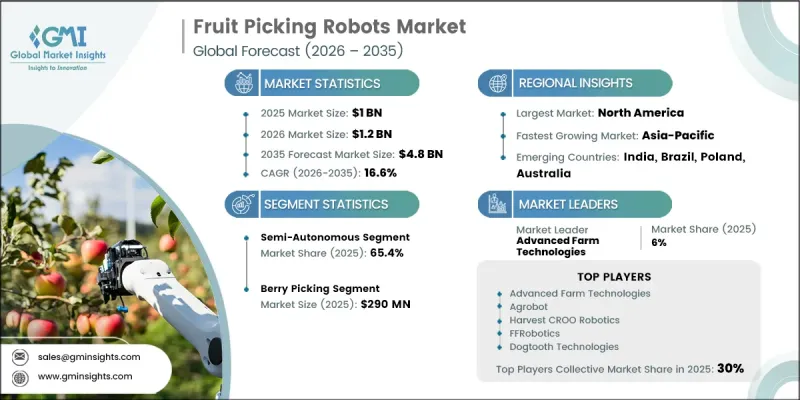
이 시장은 실험적·시범 사업 중심의 도입 단계에서 초기 상업적 확대 단계로 전환되고 있습니다. 특히 베리류나 사과와 같은 고부가가치 과일 부문에서는 노동 집약도가 높고 수확 시기가 민감하기 때문에 자동화의 경제적 타당성이 더욱 높아지고 있습니다. 중요한 구조적 변화로는 ‘Robotics-as-a-Service(RaaS)’라는 자금 조달 모델과 꾸준히 낮아지는 하드웨어 비용을 바탕으로, 도입 대상이 대형 농업 기업에서 중규모 농장으로 확대되고 있다는 점을 들 수 있습니다. 동시에, IoT 지원 농장 센서, 드론을 활용한 감시 시스템, 정밀 농업 플랫폼, 농장 관리 소프트웨어 등을 포함한 디지털 농업 생태계의 통합을 통해 대규모 로봇 수확 도입에 필요한 인프라가 점차 구축되고 있습니다. 농업 시스템 간의 데이터 연결성과 상호 운용성이 향상됨에 따라, 도입의 실현 가능성이 더욱 높아지고 있습니다. 시장 전반의 방향성은 노동력 부족 해소, 수확의 균일성 향상, 계절 노동력 확보에 대한 의존도 저감을 목적으로 하는 생산성 중심의 기계화로의 전환을 반영하고 있습니다.
| 시장 범위 | |
|---|---|
| 시작 연도 | 2025년 |
| 예측 기간 | 2026-2035년 |
| 시작 연도 시장 규모 | 10억 달러 |
| 예측 금액 | 48억 달러 |
| CAGR | 16.6% |
2025년에는 반자율 주행 부문이 65.4%의 점유율을 차지했습니다. 이러한 주도적인 지위는 품질 평가, 작물이 밀집된 환경 내에서의 이동 조정, 그리고 수확 물류 조정 과정에서 여전히 인간의 감독이 필요한 현재의 기술 단계에서 비롯된 것입니다. 반자율형 시스템은 과일 감지 및 수확 과정에서 로봇의 정밀도와 주요 제어 지점에서의 인간의 의사결정을 결합함으로써, 복잡한 농업 환경에서도 신뢰성을 유지하면서 업무 효율을 높이고 있습니다. 이러한 시스템은 자동화의 장점과 현장에서의 실용적인 적용 가능성 사이에서 균형을 잘 맞추고 있어 널리 채택되고 있습니다.
베리류 수확 용도 부문은 2025년에 2억 9,000만 달러 시장 규모를 기록했습니다. 이러한 우위는 베리류 수확에 수반되는 높은 노동 수요와 인건비가 급등하고 있는 지역으로의 생산 집중에 의해 주도되고 있으며, 이로 인해 자동화의 경제적 매력이 높아지고 있습니다. 베리류 작물은 세심한 관리와 빈번한 수확 주기가 필요하기 때문에 로봇 도입에 매우 적합합니다. 이 부문에서는 상업 농업 전반에 걸쳐 수확의 정확성, 속도 및 작물 처리 효율을 향상시키는 것을 목표로 한 대규모 기술 개발이 지속적으로 이루어지고 있습니다.
북미 과일 수확 로봇 시장은 2025년에 3억 3,000만 달러 시장 규모를 기록했습니다. 이는 노동 집약적이며, 계절적인 노동력 부족에 직면해 있는 주요 과일 생산 주들의 강력한 수요에 힘입은 결과입니다. 이 지역의 선도적 지위는 선진적인 농업 인프라, 자동화 기술의 조기 도입, 그리고 상업 농업에 로봇 기술을 통합하는 움직임이 활발히 진행됨에 따라 더욱 공고해지고 있습니다.
자주 묻는 질문
목차
제1장 조사 방법
제2장 주요 요약
제3장 업계 인사이트
제4장 경쟁 구도
제5장 시장 추산 및 예측 : 자동화 레벨별, 2022-2035년
제6장 시장 추산 및 예측 : 작물 유형별, 2022-2035년
제7장 시장 추산 및 예측 : 도입 환경별, 2022-2035년
제8장 시장 추산 및 예측 : 내비게이션 시스템별, 2022-2035년
제9장 시장 추산 및 예측 : 유통 채널별, 2022-2035년
제10장 &예측 : 지역별, 2022-2035년
제11장 기업 개요
JHS 26.07.01The Global Fruit Picking Robots Market was valued at USD 1 billion in 2025 and is estimated to grow at a CAGR of 16.6% to reach USD 4.8 billion in 2035.
The market is transitioning from experimental and pilot-focused deployments to early commercial scaling, particularly in high-value fruit categories such as berries and apples, where labor intensity and harvest timing sensitivity have strengthened the economic case for automation. A key structural evolution is the expansion of adoption beyond large agribusinesses to mid-sized farming operations, supported by Robotics-as-a-Service financing models and steadily declining hardware costs. At the same time, the integration of digital agriculture ecosystems, including IoT-enabled field sensors, drone-based monitoring systems, precision farming platforms, and farm management software, is establishing the infrastructure required for large-scale robotic harvesting adoption. Improved data connectivity and interoperability across agricultural systems are further enhancing deployment feasibility. The overall market direction reflects a shift toward productivity-driven mechanization aimed at addressing labor shortages, improving harvest consistency, and reducing operational dependence on seasonal workforce availability.
| Market Scope | |
|---|---|
| Start Year | 2025 |
| Forecast Year | 2026-2035 |
| Start Value | $1 Billion |
| Forecast Value | $4.8 Billion |
| CAGR | 16.6% |
The semi-autonomous segment held a 65.4% share in 2025. This leadership is attributed to the current technological stage, where human oversight remains necessary for quality assessment, navigation adjustments within dense crop environments, and harvest logistics coordination. Semi-autonomous systems combine robotic precision in fruit detection and picking with human decision-making at critical control points, enabling improved operational efficiency while maintaining reliability in complex agricultural settings. These systems are widely adopted due to their balance between automation benefits and practical field adaptability.
The berry picking application segment captured USD 290 million in 2025. This dominance is driven by the high labor requirements associated with berry harvesting and the concentration of production in regions where labor costs are elevated, increasing the financial attractiveness of automation. Berry crops require delicate handling and frequent harvesting cycles, making them well-suited for robotic intervention. The segment continues to attract significant technological development aimed at improving picking accuracy, speed, and crop handling efficiency across commercial farming operations.
North America Fruit Picking Robots Market generated USD 330 million in 2025, supported by strong demand from major fruit-producing states with intensive labor requirements and seasonal workforce constraints. The region's leadership is reinforced by advanced agricultural infrastructure, early adoption of automation technologies, and increasing integration of robotics into commercial farming practices.
Major companies operating in the fruit picking robots market include Robotics Plus, Agrobot, Advanced Farm Technologies, Harvest CROO Robotics, Tevel Aerobotics Technologies, Fieldwork Robotics, Ripe Robotics, FFRobotics, Four Growers, Dogtooth Technologies, Organifarms, Picker Agrobotics, NeuPeak Robotics, MetoMotion, Suzhou Botian Automation Technology, Nanovel, K2 Tech / Qogori, Zimmer Group, Zivid, J. Schmalz GmbH, and Gripwiq. Companies operating in the global fruit picking robots market are adopting several strategic initiatives to strengthen their competitive positioning and accelerate commercialization. A major focus is the development of AI-enabled vision systems that improve fruit detection accuracy and enable more efficient harvesting in complex canopy environments. Firms are increasingly shifting toward Robotics-as-a-Service business models to reduce upfront costs and expand adoption among mid-scale farmers. Strategic partnerships with agricultural cooperatives and farm operators are being used to facilitate real-world deployment and performance validation. Companies are also investing in modular robot designs that can be adapted for multiple crop types, improving asset utilization across seasons.
Table of Contents
Chapter 1 Research Methodology
- 1.1 Research approach
- 1.2 Quality Commitments
- 1.2.1 GMI AI policy & data integrity commitment
- 1.2.1.1 Source consistency protocol
- 1.2.1 GMI AI policy & data integrity commitment
- 1.3 Research Trail & Confidence Scoring
- 1.3.1 Research Trail Components
- 1.3.2 Scoring Components
- 1.4 Data Collection
- 1.4.1 Partial list of primary sources
- 1.5 Data mining sources
- 1.5.1 Paid sources
- 1.5.1.1 Sources, by region
- 1.5.1 Paid sources
- 1.6 Base estimates and calculations
- 1.6.1 Base year calculation for any one approach
- 1.7 Forecast model
- 1.7.1 Quantified market impact analysis
- 1.7.1.1 Mathematical impact of growth parameters on forecast
- 1.7.1 Quantified market impact analysis
- 1.8 Research transparency addendum
- 1.8.1 Source attribution framework
- 1.8.2 Quality assurance metrics
- 1.8.3 Our commitment to trust
Chapter 2 Executive Summary
- 2.1 Industry 360° synopsis, 2022 - 2035
- 2.2 Key market trends
- 2.2.1 Regional
- 2.2.2 Automation Level
- 2.2.3 Crop Type
- 2.2.4 Deployment Environment
- 2.2.5 Navigation System
- 2.2.6 Distribution Channel
Chapter 3 Industry Insights
- 3.1 Industry ecosystem analysis
- 3.1.1 Factor affecting the value chain
- 3.1.2 Profit margin analysis
- 3.1.3 Disruptions
- 3.1.4 Future outlook
- 3.1.5 Manufacturers
- 3.1.6 Distributors
- 3.2 Supplier landscape
- 3.3 Key news & initiatives
- 3.4 Technology & Innovation Landscape
- 3.5 Regulatory landscape
- 3.6 Impact on forces
- 3.6.1 Growth drivers
- 3.6.2 Industry pitfalls & challenges
- 3.6.3 Opportunities
- 3.7 Pricing analysis, 2025 (driven by primary research)
- 3.7.1 Historical price trend analysis (2022-2025)
- 3.7.2 Pricing strategy by player type (premium/value/cost-plus)
- 3.7.3 Regional price variation analysis
- 3.8 Growth potential analysis
- 3.9 Porter's analysis
- 3.10 PESTEL analysis
- 3.11 Trade data analysis (driven by paid database)
- 3.11.1 Import/export volume & value trends (Driven by Primary Research)
- 3.11.2 Key trade corridors & tariff impact (Driven by Primary Research)
- 3.12 Impact of AI & generative AI on the market
- 3.12.1 AI-driven disruption of existing business models
- 3.12.2 GenAI use cases & adoption roadmap by segment
- 3.12.3 Risks, limitations & regulatory considerations
- 3.13 Capacity & Production Landscape (Driven by Primary Research)
- 3.13.1 Installed Capacity by Region & Key Producer (Driven by Primary Research)
- 3.13.2 Capacity Utilization Rates & Expansion Pipelines (Driven by Primary Research)
Chapter 4 Competitive Landscape, 2025
- 4.1 Introduction
- 4.2 Company market share analysis
- 4.3 Competitive positioning matrix
- 4.4 Strategic outlook matrix
- 4.5 Competitive analysis of major market players
- 4.6 Key developments
- 4.6.1 Mergers & acquisitions
- 4.6.2 Partnerships & collaborations
- 4.6.3 New product launches
- 4.6.4 Expansion plans
Chapter 5 Market Estimates & Forecast, By Automation Level, 2022-2035 (USD Billion) (Million Units)
- 5.1 Key trends
- 5.2 Fully Autonomous Robots
- 5.3 Semi-Autonomous Robots
Chapter 6 Market Estimates & Forecast, By Crop Type, 2022-2035 (USD Billion) (Million Units)
- 6.1 Key trends
- 6.2 Berry Picking
- 6.3 Apple Picking
- 6.4 Grape & Vineyard Picking
- 6.5 Citrus Picking
- 6.6 Stone Fruit Picking
- 6.7 Others (Avocado, Kiwi, Mango & Emerging)
Chapter 7 Market Estimates & Forecast, By Deployment Environment, 2022-2035 (USD Billion) (Million Units)
- 7.1 Key trends
- 7.2 Open-Field Orchards
- 7.3 Greenhouses & Controlled Environment Agriculture (CEA)
- 7.4 Vineyards
- 7.5 Research Institutes & Trial Farms
Chapter 8 Market Estimates & Forecast, By Navigation System, 2022-2035 (USD Billion) (Million Units)
- 8.1 Key trends
- 8.2 Wheeled Mobile Robots
- 8.3 Rail-Based Systems
- 8.4 Multi-Robot Collaborative Systems
- 8.5 Aerial & Drone-Assisted Systems
- 8.6 Others (Emerging & Hybrid Navigation Platforms)
Chapter 9 Market Estimates & Forecast, By Distribution Channel, 2022-2035 (USD Billion) (Million Units)
- 9.1 Key trends
- 9.2 Direct Sales
- 9.3 Distributors & Dealers
- 9.3.1 Agricultural Equipment Dealers
- 9.3.2 Regional Agri-Tech Distributors
- 9.4 Online Sales
- 9.4.1 Manufacturer E-Commerce Platforms
- 9.4.2 Third-Party Agricultural Equipment Marketplaces
- 9.5 Others (Leasing, RaaS Models & Agri-Tech Incubator Partnerships)
Chapter 10 & Forecast, By Region, 2022 - 2035, (USD Billion) (Million Units)
- 10.1 Key trends
- 10.2 North America
- 10.2.1 U.S.
- 10.2.2 Canada
- 10.3 Europe
- 10.3.1 Germany
- 10.3.2 U.K.
- 10.3.3 France
- 10.3.4 Italy
- 10.3.5 Spain
- 10.4 Asia Pacific
- 10.4.1 China
- 10.4.2 India
- 10.4.3 Japan
- 10.4.4 South Korea
- 10.4.5 Australia
- 10.5 Latin America
- 10.5.1 Brazil
- 10.5.2 Mexico
- 10.5.3 Argentina
- 10.6 MEA
- 10.6.1 UAE
- 10.6.2 Saudi Arabia
- 10.6.3 South Africa
Chapter 11 Company Profiles (Business Overview, Financial Data, Product Landscape, Strategic Outlook, SWOT Analysis)
- 11.1 Global players
- 11.1.1 Dogtooth Technologies
- 11.1.2 Harvest CROO Robotics
- 11.1.3 Advanced Farm Technologies
- 11.1.4 Zimmer Group
- 11.1.5 J. Schmalz GmbH
- 11.1.6 Zivid
- 11.1.7 FFRobotics
- 11.1.8 Tevel Aerobotics Technologies
- 11.2 Regional players
- 11.2.1 Fieldwork Robotics
- 11.2.2 Agrobot
- 11.2.3 MetoMotion
- 11.2.4 Organifarms
- 11.2.5 Ripe Robotics
- 11.2.6 Robotics Plus
- 11.2.7 Suzhou Botian Automation Technology
- 11.3 Emerging players
- 11.3.1 NeuPeak Robotics
- 11.3.2 Four Growers
- 11.3.3 Nanovel
- 11.3.4 Picker Agrobotics
- 11.3.5 Gripwiq
- 11.3.6 K2 Tech / Qogori


