

|
시장보고서
상품코드
2071392
가스 스프링 시장 기회, 성장 촉진요인, 산업 동향 분석, 예측(2026-2035년)Gas Springs Market Opportunity, Growth Drivers, Industry Trend Analysis, and Forecast 2026 - 2035 |
||||||

세계의 가스 스프링 시장은 2025년에 33억 달러 규모에 달하고, CAGR 5.7%로 성장하여 2035년까지 57억 달러에 달할 것으로 예측됩니다.
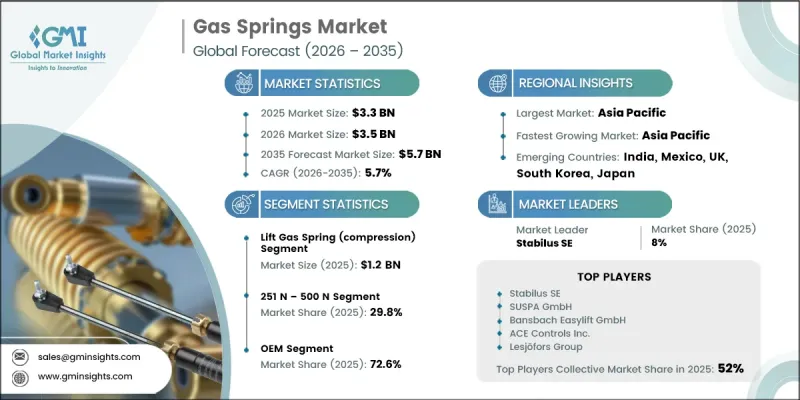
이러한 성장의 원동력은 인체공학에 기반한 솔루션의 도입 확대, 제조 자동화의 가속화, 그리고 가구 및 자동차 관련 두 부문에서의 지속적인 성장입니다. 가스 스프링은 기계 시스템에서 정밀한 힘 제어, 긴 수명, 그리고 일관된 작동 신뢰성 덕분에 점점 더 높은 평가를 받고 있습니다. 업계 관계자들은 진화하는 성능에 대한 기대에 부응하기 위해 내구성이 뛰어나고 다기능적인 모션 제어 기술의 개발을 우선시하고 있습니다. 동시에, 스마트 가구 시스템과 현대화된 업무 환경에 대한 수요가 증가함에 따라 상업 및 산업 분야에서 해당 제품의 도입이 확대되고 있습니다. 자동차 공학 및 설계의 발전 또한 여러 플랫폼에 걸쳐 이러한 구성요소들의 보다 광범위한 통합을 뒷받침하고 있습니다. 각 업계에서 핵심 부품의 품질과 기능적 성능을 더욱 중요시하게 됨에 따라, 신뢰성은 구매 결정의 결정적인 요인이 되고 있습니다. 전반적으로, 이 시장은 전 세계 산업 생태계 및 애플리케이션 시장 부문 전반에 걸친 강력한 산업 현대화 추세와 효율성을 중시하는 제품 설계에 대한 관심 증가의 혜택을 받고 있습니다.
| 시장 범위 | |
|---|---|
| 시작 연도 | 2025년 |
| 예측 기간 | 2026-2035년 |
| 개시 금액 | 33억 달러 |
| 예측 금액 | 57억 달러 |
| CAGR | 5.7% |
2025년, 리프트 가스 스프링 부문은 37.6%의 시장 점유율을 차지하며 12억 달러 규모의 시장을 기록했습니다. 이 카테고리는 산업용 모션 제어의 광범위한 요구 사항을 충족할 수 있는 범용성과 일관된 작동 효율을 바탕으로 계속해서 시장을 선도하고 있습니다. 뛰어난 중량 대비 성능과 안정적인 기능 특성 덕분에 시장 내 확고한 입지를 더욱 공고히 하고 있으며, 신뢰성 높은 모션 지원 시스템을 찾는 제조사들 사이에서 선호되는 솔루션으로 자리매김하고 있습니다.
2025년에는 251 N-500 N의 하중 용량 범위가 29.8%의 점유율을 차지했습니다. 이 부문은 균형 잡힌 성능 프로필 덕분에 광범위한 표준 엔지니어링 및 모션 제어 요구 사항을 효과적으로 지원할 수 있어 널리 채택되고 있습니다. 이러한 범용성과 최적화된 구조적 효율성이 산업 전반에 걸친 광범위한 보급에 기여하고 있습니다.
미국의 가스 스프링 시장은 79.2%의 점유율을 차지하며, 2025년에는 6억 달러 규모의 시장 규모를 기록함으로써 성숙하고 품질을 중시하는 지역 시장으로서의 입지를 확고히 다졌습니다. 수요는 견고한 산업 기반, 확립된 자동차 생산 생태계, 그리고 첨단 제조 기법에 대한 관심 증가에 힘입어 견인되고 있습니다. 현대적인 업무 환경 솔루션과 인체공학적 통합에 대한 관심이 높아지고 있는 점도, 미국 전역에서 가스 스프링 기술의 지속적인 채택을 더욱 뒷받침하고 있습니다.
세계 가스 스프링 업계에는 Stabilus SE, SUSPA GmbH, Bansbach Easylift GmbH, HAHN Gasfedern GmbH, Lesjofors Group, Camloc Motion Control, Dictator Technik GmbH, ACE Controls Inc., Ameritool Manufacturing Inc., AVM Industries, Hefei Land Gas Spring Co., Ltd., Shunde Huayang Gas Spring Co. Ltd., Lantan Gas Spring Co. Ltd., Industrial Gas Springs Ltd., Metrol Springs Ltd., Newtone Gas Springs, Vapsint S.r.l., The Industrial Solutions Group 등이 포함되어 있으며, 이들 모두는 시장의 경쟁력과 기술 발전에 기여하고 있습니다. 가스 스프링 시장에서 사업을 전개하는 기업들은 시장 내 입지를 강화하고 세계 사업 확장을 위해 여러 가지 전략적 노력에 주력하고 있습니다. 주요 노력으로는 제품의 성능, 내구성, 정밀도를 향상시키기 위한 연구 개발에 대한 지속적인 투자를 들 수 있습니다. 각 제조사는 다양한 용도에 걸친 특정 산업 요구 사항을 충족하기 위해 제품 맞춤화를 점점 더 중요하게 여기고 있습니다. 또한, 기술력 향상과 유통 네트워크 확대를 도모하기 위해 전략적 제휴, 파트너십, 합병도 추진되고 있습니다. 신흥 시장 진출 역시 우선 과제 중 하나이며, 현지 생산 및 공급망 최적화를 통해 뒷받침되고 있습니다.
자주 묻는 질문
목차
제1장 조사 방법과 범위
제2장 주요 요약
제3장 업계 인사이트
제4장 경쟁 구도
제5장 추정·예측 : 유형별, 2022-2035년
제6장 추정·예측 : 최대 하중별, 2022-2035년
제7장 시장 추정 및 예측 : 용도별, 2022-2035년
제8장 추정·예측 : 유통 채널별, 2022-2035년
제9장 시장 추정 및 예측 : 지역별, 2022-2035년
제10장 기업 개요
KSM 26.07.03The Global Gas Springs Market was valued at USD 3.3 billion in 2025 and is estimated to grow at a CAGR of 5.7% to reach USD 5.7 billion by 2035.
Growth momentum is fueled by rising adoption of ergonomic solutions, accelerating manufacturing automation, and ongoing expansion within both furniture-related and automotive-driven sectors. Gas springs are increasingly valued for their precise force regulation, long service life, and consistent operational reliability in mechanical systems. Industry participants are prioritizing the development of durable and multifunctional motion control technologies to align with evolving performance expectations. At the same time, increasing demand for smart furniture systems and modernized work environments is reinforcing product adoption across commercial and industrial settings. Advancements in automotive engineering and design are also supporting broader integration of these components across multiple platforms. Reliability has become a decisive purchasing factor as industries place greater emphasis on quality and functional performance in critical components. Overall, the market is benefiting from strong industrial modernization trends and growing emphasis on efficiency-driven product design across global industrial ecosystems and applications market segments.
| Market Scope | |
|---|---|
| Start Year | 2025 |
| Forecast Year | 2026-2035 |
| Start Value | $3.3 Billion |
| Forecast Value | $5.7 Billion |
| CAGR | 5.7% |
In 2025, the lift gas spring segment accounted for a 37.6% share and generated USD 1.2 billion. This category continues to dominate due to its broad applicability across industrial motion control requirements and its consistent operational efficiency. Its favorable force-to-weight performance and stable functional characteristics further reinforce its strong market position, making it a preferred solution among manufacturers seeking reliable motion support systems.
The 251 N - 500 N force capacity range held a 29.8% share in 2025. This segment is widely adopted due to its balanced performance profile, which effectively supports a wide spectrum of standard engineering and motion control requirements. Its versatility and optimized structural efficiency contribute to its widespread acceptance across industrial applications.
United States Gas Springs Market captured a 79.2% share, generating USD 600 million in 2025, establishing itself as a mature and highly quality-oriented regional market. Demand is driven by a strong industrial base, well-established automotive production ecosystem, and increasing emphasis on advanced manufacturing practices. Growing focus on modern workplace solutions and ergonomic integration further supports sustained adoption of gas spring technologies across the country.
The Global Gas Spring Industry includes key players such as Stabilus SE, SUSPA GmbH, Bansbach Easylift GmbH, HAHN Gasfedern GmbH, Lesjofors Group, Camloc Motion Control, Dictator Technik GmbH, ACE Controls Inc., Ameritool Manufacturing Inc., AVM Industries, Hefei Land Gas Spring Co., Ltd., Shunde Huayang Gas Spring Co. Ltd., Lantan Gas Spring Co. Ltd., Industrial Gas Springs Ltd., Metrol Springs Ltd., Newtone Gas Springs, Vapsint S.r.l., and The Industrial Solutions Group, all contributing to competitive dynamics and technological advancement in the market. Companies operating in the gas springs market are focusing on multiple strategic initiatives to strengthen their market position and expand global reach. Key approaches include continuous investment in research and development to enhance product performance, durability, and precision. Manufacturers are increasingly emphasizing product customization to meet specific industrial requirements across diverse applications. Strategic collaborations, partnerships, and mergers are also being pursued to improve technological capabilities and broaden distribution networks. Expansion into emerging markets is another priority, supported by localized production and supply chain optimization.
Table of Contents
Chapter 1 Methodology and Scope
- 1.1 Market scope and definition
- 1.2 Research design
- 1.2.1 Research approach
- 1.2.2 Data collection methods
- 1.3 Data mining sources
- 1.3.1 Region
- 1.3.2 Regional/Country
- 1.4 Base estimates and calculations
- 1.4.1 Base year calculation
- 1.4.2 Key trends for market estimation
- 1.5 Primary research and validation
- 1.5.1 Primary sources
- 1.6 Forecast model
- 1.7 Research assumptions and limitations
Chapter 2 Executive Summary
- 2.1 Industry 360° synopsis
- 2.2 Key market trends
- 2.2.1 Country
- 2.2.2 Type
- 2.2.3 Force Capacity
- 2.2.4 Application
- 2.2.5 Distribution Channel
Chapter 3 Industry Insights
- 3.1 Industry ecosystem analysis
- 3.1.1 Raw Material Suppliers (Steel, Nitrogen, Seals)
- 3.1.2 Component Manufacturers & Gas Spring Producers
- 3.1.3 Distributors & Channel Partners
- 3.1.4 OEM Integrators & End-Use Industries
- 3.1.5 Profit Margin Analysis Across Value Chain
- 3.1.6 Disruptions & Future Outlook
- 3.2 Industry impact forces
- 3.2.1 Growth drivers
- 3.2.2 Industry pitfalls & challenges
- 3.2.3 Opportunities
- 3.3 Growth potential analysis
- 3.4 Future market trends
- 3.5 Technology and innovation landscape
- 3.5.1 Smart & Sensor-Integrated Gas Springs
- 3.5.2 Stainless Steel & Corrosion-Resistant Material Advances
- 3.6 Pricing Analysis (Driven by Primary Research)
- 3.6.1 Historical Price Trend Analysis (Driven by Primary Research)
- 3.6.2 Pricing Strategy by Player Type (Premium / Mid-Range / Budget)
- 3.7 Regulatory landscape
- 3.7.1 Standards and compliance requirements
- 3.7.1.1 Safety & Performance Standards (ISO 11801, EN 1829)
- 3.7.1.2 Automotive Regulatory Impact (Euro 7, CAFE Standards)
- 3.7.1.3 Medical Device Compliance Requirements (FDA, CE Marking)
- 3.7.1.4 Environmental & RoHS Compliance
- 3.7.2 Certification Standards
- 3.7.3 Environmental & Sustainability Regulations
- 3.7.1 Standards and compliance requirements
- 3.8 Supply chain analysis
- 3.8.1 Critical Raw Material Sourcing (Steel, Compressed Nitrogen)
- 3.8.2 Supply Chain Risk Assessment & Resilience Strategies
- 3.9 Trade Data Analysis (Driven by Paid database)
- 3.9.1 Import/export volume & value trends by region
- 3.9.2 Key trade corridors & tariff impact
- 3.9.3 Major exporting countries
- 3.9.4 Major importing countries
- 3.10 Impact of AI & generative ai on the market
- 3.10.1 AI-Driven Disruption of Gas Spring Design & Manufacturing Workflows
- 3.10.2 GenAI Use Cases & Adoption Roadmap by End-Use Segment
- 3.10.3 Risks, limitations & regulatory considerations
- 3.11 Porter's analysis
- 3.12 PESTEL analysis
- 3.13 Capacity & Production Landscape (Driven by Primary Research)
- 3.13.1 Manufacturing Capacity Installed by Region & Key Producer (Driven by Primary Research)
- 3.13.2 Capacity Utilization Rates & Expansion Pipelines (Driven by Primary Research)
Chapter 4 Competitive Landscape, 2025
- 4.1 Introduction
- 4.2 Company market share analysis
- 4.2.1 North America
- 4.2.1.1 U.S.
- 4.2.1.2 Canada
- 4.2.2 Europe
- 4.2.2.1 UK
- 4.2.2.2 Germany
- 4.2.2.3 France
- 4.2.2.4 Italy
- 4.2.2.5 Spain
- 4.2.3 Asia Pacific
- 4.2.3.1 China
- 4.2.3.2 Japan
- 4.2.3.3 India
- 4.2.3.4 South Korea
- 4.2.3.5 Taiwan
- 4.2.4 Latin America
- 4.2.4.1 Brazil
- 4.2.4.2 Mexico
- 4.2.4.3 Argentina
- 4.2.5 MEA
- 4.2.5.1 Saudi Arabia
- 4.2.5.2 UAE
- 4.2.5.3 South Africa
- 4.2.1 North America
- 4.3 Company matrix analysis
- 4.4 Competitive analysis of major market players
- 4.5 Competitive positioning matrix
- 4.6 Key developments
- 4.6.1 Mergers & acquisitions
- 4.6.2 Partnerships & collaborations
- 4.6.3 New product launches
- 4.6.4 Expansion plans
Chapter 5 Estimates & Forecast, By Type, 2022 - 2035 (USD Billion) (Thousand Units)
- 5.1 Key trends
- 5.2 Lift Gas Spring (Compression)
- 5.3 Lockable Gas Spring
- 5.4 Swivel Chair Gas Spring
- 5.5 Gas Spring Damper
- 5.6 Tension & Traction Gas Spring
- 5.7 Others
Chapter 6 Estimates & Forecast, By Force Capacity, 2022 - 2035 (USD Billion) (Thousand Units)
- 6.1 Key trends
- 6.2 Up to 250 N
- 6.3 251 N - 500 N
- 6.4 501 N - 1,000 N
- 6.5 Above 1,000 N
Chapter 7 Market Estimates and Forecast, By Application, 2022 - 2035 (USD Billion) (Thousand Units)
- 7.1 Key trends
- 7.2 Automotive
- 7.3 Industrial Machinery & Automation
- 7.4 Home & Office Furniture
- 7.5 Healthcare & Medical Equipment
- 7.6 Aerospace, Marine & Rail
- 7.7 Agriculture & Construction Equipment
- 7.8 Others
Chapter 8 Estimates & Forecast, By Distribution Channel 2022 - 2035 (USD Billion) (Thousand Units)
- 8.1 Key trends
- 8.2 OEM
- 8.3 Aftermarket
Chapter 9 Market Estimates and Forecast, By Region, 2022 - 2035 (USD Billion) (Thousand Units)
- 9.1 Key trends
- 9.2 North America
- 9.2.1 U.S.
- 9.2.2 Canada
- 9.3 Europe
- 9.3.1 UK
- 9.3.2 Germany
- 9.3.3 France
- 9.3.4 Italy
- 9.3.5 Spain
- 9.3.6 Rest of Europe
- 9.4 Asia Pacific
- 9.4.1 China
- 9.4.2 India
- 9.4.3 Japan
- 9.4.4 South Korea
- 9.4.5 Taiwan
- 9.4.6 Rest of Asia Pacific
- 9.5 Latin America
- 9.5.1 Brazil
- 9.5.2 Mexico
- 9.5.3 Argentina
- 9.5.4 Rest of Latin America
- 9.6 MEA
- 9.6.1 Saudi Arabia
- 9.6.2 UAE
- 9.6.3 South Africa
- 9.6.4 Rest of MEA
Chapter 10 Company Profiles
- 10.1 Top Global Players
- 10.1.1 Stabilus SE
- 10.1.2 SUSPA GmbH
- 10.1.3 Bansbach Easylift GmbH
- 10.1.4 The Industrial Solutions Group
- 10.1.5 Lesjofors Group
- 10.1.6 Vapsint S.r.l.
- 10.2 Regional Champions
- 10.2.1 ACE Controls Inc.
- 10.2.2 AVM Industries
- 10.2.3 Dictator Technik GmbH
- 10.2.4 Metrol Springs Ltd.
- 10.2.5 HAHN Gasfedern GmbH
- 10.2.6 Camloc Motion Control
- 10.3 Emerging Players
- 10.3.1 Ameritool Manufacturing Inc.
- 10.3.2 Industrial Gas Springs Ltd.
- 10.3.3 Lantan Gas Spring Co. Ltd.
- 10.3.4 Shunde Huayang Gas Spring Co. Ltd.
- 10.3.5 Hefei Land Gas Spring Co., Ltd.
- 10.3.6 Newtone Gas Springs


