

|
시장보고서
상품코드
2083037
해충 저항성 종자 형질 시장 기회, 성장 촉진요인, 업계 동향 분석 및 예측(2026-2035년)Insect-Resistant (Bt) Seed Traits Market Opportunity, Growth Drivers, Industry Trend Analysis, and Forecast 2026 - 2035 |
||||||

세계의 해충 저항성(Bt) 종자 형질 시장은 2025년에 27억 달러로 평가되었으며, CAGR 8%로 성장하여 2035년까지 58억 달러에 달할 것으로 추정됩니다.
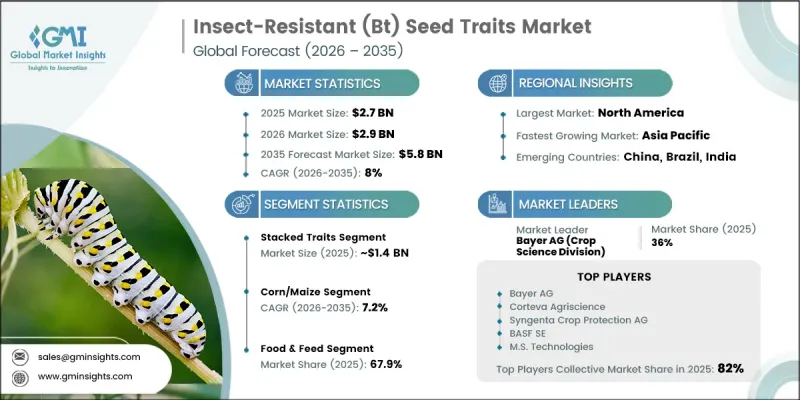
전 세계 해충 저항성(Bt) 종자 형질 시장의 성장은 기존 살충제를 이용한 해충 방제의 한계가 드러나고 있는 데서 비롯되고 있습니다. 특히, 일부 파괴적인 해충 종의 경우, 화학적 처리만으로는 해충 방제가 점점 더 어려워지고 있기 때문입니다. Bt 종자의 형질은 식물의 생육 기간 내내 해충 저항성 단백질을 발현함으로써, 생육기 전반에 걸쳐 내재형 작물 보호 기능을 제공하며, 농약의 반복적인 살포에 대한 의존도를 낮추는 동시에 생산자의 생산 비용을 절감합니다. 이러한 장점 덕분에 대규모 상업 농장에서 소규모 농업 경영에 이르기까지 도입이 지속적으로 확대되고 있습니다. 동시에, 업계는 지속적인 기술 혁신을 통해 진화하는 해충의 내성이라는 과제에 대응하고 있습니다. 시장에서는 1세대 단일 단백질형 Bt 형질에서, 여러 해충 방제 메커니즘과 RNA 간섭(RNAi)에 기반한 솔루션을 결합한 첨단 다형질 종자 기술로의 큰 전환이 나타나고 있습니다. 이러한 기술적 진보를 통해 해충 방제 성능이 향상되고, 제품의 효과 지속 기간이 연장되며, 장기적인 농업 생산성이 뒷받침되고 있습니다. 그 결과, 첨단 Bt 종자 형질은 지속가능한 작물 보호와 현대적인 농업 시스템에 있어 점점 더 중요한 요소가 되고 있습니다.
| 시장 범위 | |
|---|---|
| 시작 연도 | 2025년 |
| 예측 기간 | 2026-2035년 |
| 시작 시점 시장 규모 | 27억 달러 |
| 예측액 | 58억 달러 |
| CAGR | 8% |
스택형 형질 부문은 50.4%의 점유율을 차지했으며, 2025년에는 14억 달러의 매출을 올렸습니다. 이 부문은 여러 가지 Bt 단백질과 제초제 내성, 그리고 점점 더 널리 보급되고 있는 RNA 간섭(RNAi) 기술을 단일 종자 플랫폼에 결합함으로써, 현대 해충 저항성 종자 기술의 기반을 형성하고 있습니다. 다중 형질 종자 기술은 여러 가지 상호 보완적인 작용 기전을 제공하며, 단일 단백질 형질 솔루션에 비해 더 광범위한 해충 방제, 내성 관리 개선 및 장기적인 작물 보호 강화를 실현합니다.
식품·사료 용도 부문은 2025년에 67.9%의 점유율을 차지했으며, 2035년까지 연평균 성장률(CAGR) 7.9%로 성장할 것으로 전망됩니다. 이 부문의 지속적인 수요는 전 세계 단백질 소비량 증가, 축산 규모 확대, 그리고 식량 안보 강화에 대한 지속적인 필요성에 힘입어 유지되고 있습니다. 이러한 장기적인 농업적 요건은 Bt 작물의 재배를 지속적으로 촉진하며, 상품 가격의 변동과 관계없이 안정적인 수요를 뒷받침하고 있습니다.
북미의 해충 저항성(Bt) 종자 형질 시장은 2025년에 53%의 점유율을 차지하며 14억 달러의 시장 규모를 기록했으며, 2035년까지 연평균 성장률(CAGR) 3.9%로 성장할 것으로 전망됩니다. 이 지역은 유전자 변형 작물의 광범위한 도입과 첨단 종자 형질 기술에 대한 지속적인 투자를 통해 선도적인 위치를 유지하고 있습니다. 수익 증가는 1에이커당 재배 면적의 형질 가치 향상과 차세대 RNAi를 활용한 종자 기술의 도입에 힘입어 더욱 가속화되고 있습니다. 이는 제품의 교체 주기를 촉진하고, 생산자들이 보다 첨단적인 해충 방제 솔루션을 도입하도록 유도하고 있습니다. 또한, 지역 농업 시장 전반에 걸친 규제 측면의 진전도 향후 시장 확대를 뒷받침할 것으로 예상됩니다.
자주 묻는 질문
목차
제1장 조사 방법과 범위
제2장 주요 요약
제3장 업계 인사이트
제4장 경쟁 구도
제5장 시장 추정 및 예측 : 특성 유형별, 2022-2035년
제6장 시장 추정 및 예측 : 작물 유형별, 2022-2035년
제7장 시장 추정 및 예측 : 최종 용도별, 2022-2035년
제8장 시장 추정 및 예측 : 지역별, 2022-2035년
제9장 기업 개요
KSM 26.07.15The Global Insect-Resistant (Bt) Seed Traits Market was valued at USD 2.7 billion in 2025 and is estimated to grow at a CAGR of 8% to reach USD 5.8 billion by 2035.
Growth in the global insect-resistant (Bt) seed traits market is driven by the increasing limitations of conventional insecticide-based pest control, particularly as several destructive insect species have become more difficult to manage through chemical treatments alone. Bt seed traits provide built-in, season-long crop protection by expressing insect-resistant proteins throughout plant development, reducing dependence on repeated pesticide applications while lowering production costs for growers. These advantages continue to encourage adoption across both large-scale commercial farms and smaller agricultural operations. At the same time, the industry is responding to evolving pest resistance challenges through continuous technological innovation. The market is witnessing a significant transition from first-generation single-protein Bt traits toward advanced multi-trait seed technologies that combine multiple insect protection mechanisms with RNA interference (RNAi)-based solutions. This technological evolution is improving pest management performance, extending product effectiveness, and supporting long-term agricultural productivity, making advanced Bt seed traits increasingly important for sustainable crop protection and modern farming systems.
| Market Scope | |
|---|---|
| Start Year | 2025 |
| Forecast Year | 2026-2035 |
| Start Value | $2.7 Billion |
| Forecast Value | $5.8 Billion |
| CAGR | 8% |
The stacked traits segment held a 50.4% share, generating USD 1.4 billion in 2025. This segment forms the foundation of modern insect-resistant seed technology by combining multiple Bt proteins with herbicide tolerance and, increasingly, RNA interference (RNAi) technologies within a single seed platform. Multi-trait seed technologies provide several complementary modes of action, offering broader insect control, improved resistance management, and enhanced long-term crop protection compared with single-protein trait solutions.
The food and feed application segment held a 67.9% share in 2025 and is forecast to grow at a CAGR of 7.9% through 2035. Continued demand within this segment is supported by rising global protein consumption, expansion of livestock production, and the ongoing need to strengthen food security. These long-term agricultural requirements continue to encourage cultivation of Bt crops, supporting stable demand regardless of fluctuations in commodity pricing.
North America Insect-Resistant (Bt) Seed Traits Market accounted for 53% share in 2025, generating USD 1.4 billion, and is projected to grow at a CAGR of 3.9% through 2035. The region maintains its leading position due to the widespread adoption of genetically modified crops and continued investment in advanced seed trait technologies. Revenue growth is further supported by increasing trait value per cultivated acre and the introduction of next-generation RNAi-enabled seed technologies, which are driving product replacement cycles and encouraging growers to adopt more advanced insect protection solutions. Continued regulatory progress across regional agricultural markets is also expected to support future market expansion.
Major companies operating in the global insect-resistant (Bt) seed traits market include Corteva Agriscience, Bayer AG (Crop Science Division), BASF SE, Syngenta Crop Protection AG, M.S. Technologies, L.L.C., Beck's Superior Hybrids, Dyna-Gro Seed, Nuseed, Kaveri Seeds Company Limited, Rasi Seeds Private Limited, Nuziveedu Seeds Limited, Mahyco (Maharashtra Hybrid Seeds Company), Ankur Seeds Private Limited, Beijing Dabeinong Biotechnology Co., Ltd., and S&W Seed Company. Companies operating in the insect-resistant (Bt) seed traits market are strengthening their competitive position by investing heavily in biotechnology research, advanced trait development, and next-generation seed innovation. Industry participants are expanding multi-trait product portfolios that combine insect resistance, herbicide tolerance, and emerging biological technologies to improve crop performance and long-term pest management. Strategic collaborations with research institutions, seed producers, and agricultural distributors are helping companies accelerate product commercialization and expand market reach.
Table of Contents
Chapter 1 Methodology & Scope
- 1.1 Market scope and definition
- 1.2 Research design
- 1.2.1 Research approach
- 1.2.2 Data collection methods
- 1.3 Data mining sources
- 1.3.1 Global
- 1.3.2 Regional/Country
- 1.4 Base estimates and calculations
- 1.4.1 Base year calculation
- 1.4.2 Key trends for market estimation
- 1.5 Primary research and validation
- 1.5.1 Primary sources
- 1.6 Forecast model
- 1.7 Research assumptions and limitations
Chapter 2 Executive Summary
- 2.1 Industry 360° synopsis
- 2.2 Key market trends
- 2.2.1 Trait type
- 2.2.2 Crop type
- 2.2.3 Application
- 2.2.4 Regional
- 2.3 TAM Analysis, 2026-2035
- 2.4 CXO perspectives: Strategic imperatives
- 2.5 Future outlook and strategic recommendations
Chapter 3 Industry Insights
- 3.1 Industry ecosystem analysis
- 3.1.1 Supplier landscape
- 3.1.2 Profit margin
- 3.1.3 Value addition at each stage
- 3.1.4 Factor affecting the value chain
- 3.1.5 Disruptions
- 3.2 Industry impact forces
- 3.2.1 Growth drivers
- 3.2.2 Industry pitfalls and challenges
- 3.2.3 Market opportunities
- 3.3 Growth potential analysis
- 3.4 Regulatory landscape
- 3.4.1 North America
- 3.4.2 Europe
- 3.4.3 Asia Pacific
- 3.4.4 Latin America
- 3.4.5 Middle East & Africa
- 3.5 Porter's analysis
- 3.6 PESTEL analysis
- 3.7 Technology and innovation landscape
- 3.7.1 Current technological trends
- 3.7.2 Emerging technologies
- 3.8 Price trends
- 3.8.1 By region
- 3.8.2 By Trait type
- 3.9 Future market trends
- 3.10 Patent landscape
- 3.11 Trade statistics (HS code)
- 3.11.1 Major importing countries
- 3.11.2 Major exporting countries
- 3.12 Sustainability and environmental aspects
- 3.12.1 Sustainable practices
- 3.12.2 Waste reduction strategies
- 3.12.3 Energy efficiency in production
- 3.12.4 Eco-friendly initiatives
Chapter 4 Competitive Landscape, 2025
- 4.1 Introduction
- 4.2 Company market share analysis
- 4.2.1 By region
- 4.2.1.1 North America
- 4.2.1.2 Europe
- 4.2.1.3 Asia Pacific
- 4.2.1.4 LATAM
- 4.2.1.5 MEA
- 4.2.1 By region
- 4.3 Company matrix analysis
- 4.4 Competitive analysis of major market players
- 4.5 Competitive positioning matrix
- 4.6 Key developments
- 4.6.1 Mergers & acquisitions
- 4.6.2 Partnerships & collaborations
- 4.6.3 New product launches
- 4.6.4 Expansion plans
Chapter 5 Market Estimates and Forecast, By Trait Type, 2022-2035 (USD Million) (Kilo Tons)
- 5.1 Key trends
- 5.2 Single Bt Traits
- 5.3 Stacked Traits
- 5.4 RNAi-Based Insect Protection
- 5.5 Other Emerging Trait Technologies
Chapter 6 Market Estimates and Forecast, By Crop Type, 2022-2035 (USD Million) (Kilo Tons)
- 6.1 Key trends
- 6.2 Corn/Maize
- 6.3 Cotton
- 6.4 Soybean
- 6.5 Canola
- 6.6 Others
Chapter 7 Market Estimates and Forecast, By End-Use Application, 2022-2035 (USD Million) (Kilo Tons)
- 7.1 Key trends
- 7.2 Food & Feed
- 7.3 Biofuel Production
- 7.4 Industrial Processing
- 7.5 Others (Pharmaceutical & Research)
Chapter 8 Market Estimates and Forecast, By Region, 2022-2035 (USD Million) (Kilo Tons)
- 8.1 Key trends
- 8.2 North America
- 8.2.1 U.S.
- 8.2.2 Canada
- 8.3 Europe
- 8.3.1 Germany
- 8.3.2 UK
- 8.3.3 France
- 8.3.4 Spain
- 8.3.5 Italy
- 8.3.6 Rest of Europe
- 8.4 Asia Pacific
- 8.4.1 China
- 8.4.2 India
- 8.4.3 Japan
- 8.4.4 Australia
- 8.4.5 South Korea
- 8.4.6 Rest of Asia Pacific
- 8.5 Latin America
- 8.5.1 Brazil
- 8.5.2 Mexico
- 8.5.3 Argentina
- 8.5.4 Rest of Latin America
- 8.6 Middle East and Africa
- 8.6.1 Saudi Arabia
- 8.6.2 South Africa
- 8.6.3 UAE
- 8.6.4 Rest of Middle East and Africa
Chapter 9 Company Profiles
- 9.1 Bayer AG (Crop Science Division)
- 9.2 Corteva Agriscience
- 9.3 Syngenta Crop Protection AG
- 9.4 BASF SE
- 9.5 M.S. Technologies, L.L.C.
- 9.6 Kaveri Seeds Company Limited
- 9.7 Rasi Seeds Private Limited
- 9.8 Nuziveedu Seeds Limited
- 9.9 Beijing Dabeinong Biotechnology Co., Ltd.
- 9.10 Nuseed
- 9.11 Beck's Superior Hybrids
- 9.12 Dyna-Gro Seed
- 9.13 Ankur Seeds Private Limited
- 9.14 Mahyco (Maharashtra Hybrid Seeds Company)
- 9.15 S&W Seed Company


