
|
시장보고서
상품코드
2083085
식품 위생 및 제염 기술 시장 비즈니스 기회, 성장요인, 업계 동향 분석 및 예측(2026-2035년)Food Sanitation and Decontamination Technologies Market Opportunity, Growth Drivers, Industry Trend Analysis, and Forecast 2026 - 2035 |
||||||

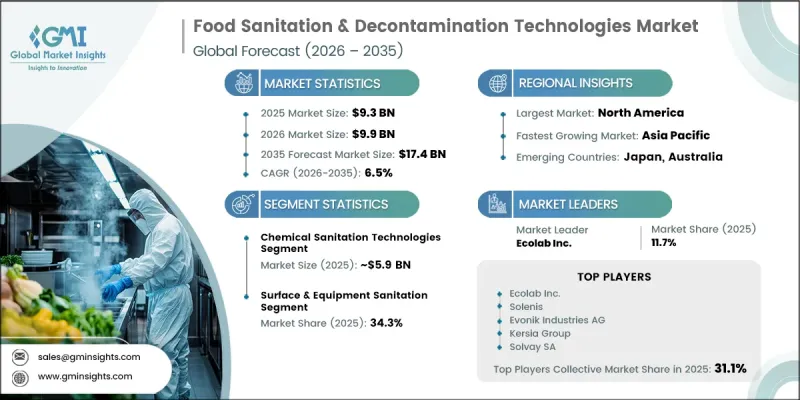
세계의 식품 위생 및 제염 기술 시장은 2025년에 93억 달러로 평가되었고, CAGR 6.5%로 성장하여 2035년까지 174억 달러에 달할 것으로 예측됩니다.
시장 확대를 주도하고 있는 요인은 점점 더 엄격해지는 식품 안전 규제, 즉석식품 및 최소한의 가공만 거친 식품의 소비 확대, 그리고 식품 업계 전반에 걸친 위생 공정의 지속적인 현대화입니다. 식품 제조업체들은 오염 예방 대책에 더욱 중점을 두고 있으며, 그 결과 첨단 위생 및 오염 제거 기술에 대한 수요가 증가하고 있습니다. 이러한 시스템은 더 이상 단순한 규제 준수를 위한 지출로만 간주되지 않고, 위험 완화, 사업 연속성 확보, 브랜드 보호에 필수적인 도구로 점점 더 인식되고 있습니다. 식품 유래 오염 사고와 그로 인한 경제적 영향에 대한 우려가 커짐에 따라, 가공 시설 전반에 걸친 위생 인프라에 대한 투자가 더욱 가속화되고 있습니다. 이와 동시에 규제 요건은 보다 종합적인 예방 관리 체계로 발전하고 있으며, 식품 생산자들에게는 강화된 안전 기준을 충족할 수 있는 첨단 위생 솔루션의 도입이 권장되고 있습니다. 식품 가공 사업에서 품질 보증, 업무 효율, 규제 준수가 계속해서 우선시되는 가운데, 혁신적인 식품 위생 및 오염 제거 기술에 대한 수요는 예측 기간 동안 견조한 추세를 보일 것으로 전망됩니다.
| 시장 범위 | |
|---|---|
| 개시연도 | 2025년 |
| 예측 기간 | 2026-2035년 |
| 개시 연도 시장 규모 | 93억 달러 |
| 예측액 | 174억 달러 |
| CAGR | 6.5% |
2025년에는 화학적 위생 관리 기술이 시장 점유율의 63.7%를 차지하며 59억 달러에 달했으며, 2035년까지 연평균 성장률(CAGR) 5.7%로 성장할 것으로 전망됩니다. 이 부문은 비용 효율성, 운영 효율성, 그리고 식품 가공 환경에서 폭넓은 수용성 덕분에 계속해서 시장을 선도하고 있습니다. 이러한 기술들은 신뢰할 수 있는 위생 성능을 제공할 뿐만 아니라 식품 안전 요건 준수를 지원하기 때문에 수요는 계속해서 견조한 추세를 보이고 있습니다. 현재 진행 중인 연구 개발 활동은 위생용 약제의 효능 향상, 운영 효율 증대, 그리고 위생 주기 내 화학 약품의 총 사용량 감축에 중점을 두고 있습니다. 이러한 발전으로 인해 식품 업계 전반에 걸쳐 화학 약품을 기반으로 한 오염 제거 솔루션의 장기적인 보급이 더욱 촉진될 것으로 예측됩니다.
2025년, 표면 및 설비 위생 관리 부문은 34.3%의 점유율을 차지했습니다. 위생적인 생산 환경의 유지는 식품 가공 업무 전반에 걸쳐 여전히 기본적인 요건이며, 생산용 표면, 가공 설비 및 운영 인프라를 위해 설계된 위생 관리 솔루션에 대한 꾸준한 수요를 뒷받침하고 있습니다. 이 부문에는 청결을 유지하고, 오염 위험을 최소화하며, 식품 안전 목표 달성을 지원하기 위해 활용되는 광범위한 기술과 위생 관리 기법이 포함됩니다. 예방적 위생 관리 프로그램에 대한 관심이 높아지고, 운영 위생 기준이 지속적으로 개선됨에 따라, 예측 기간 동안 이 용도 분야 수요는 지속될 것으로 전망됩니다.
2025년, 북미의 식품 위생 및 오염 제거 기술 시장은 39.3%의 점유율을 차지했습니다. 이 지역 시장은 높은 기술 도입률, 엄격한 식품 안전 요건, 그리고 식품 공급망 전반에 걸쳐 높은 수준의 위생 기준을 유지하려는 강력한 노력이 특징입니다. 이러한 성장은 최소한의 가공만 거친 식품에 대한 수요 증가와 식품 안전 인프라에 대한 투자 확대에 힘입어 계속해서 뒷받침되고 있습니다. 이 지역의 각 제조업체들은 가동 효율 향상, 규정 준수 체계 강화, 제품 품질 향상을 도모하기 위해 선진적인 위생 기술을 도입하고 있으며, 이것이 시장의 지속적인 확대에 기여하고 있습니다.
자주 묻는 질문
목차
제1장 조사 방법과 범위
제2장 주요 요약
제3장 업계 인사이트
제4장 경쟁 구도
제5장 시장 추산 및 예측 : 기술 유형별, 2022년-2035년
제6장 시장 추산 및 예측 : 용도별, 2022년-2035년
제7장 시장 추산 및 예측 : 최종 사용 산업별, 2022년-2035년
제8장 시장 추산 및 예측 : 지역별, 2022년-2035년
제9장 기업 개요
LSH 26.07.13The Global Food Sanitation & Decontamination Technologies Market was valued at USD 9.3 billion in 2025 and is estimated to grow at a CAGR of 6.5% to reach USD 17.4 billion by 2035.
Market expansion is driven by increasingly stringent food safety regulations, the growing consumption of ready-to-eat and minimally processed food products, and the ongoing modernization of sanitation processes across the food industry. Food manufacturers are placing greater emphasis on preventive contamination control measures, resulting in stronger demand for advanced sanitation and decontamination technologies. These systems are no longer viewed solely as compliance-related expenditures but are increasingly recognized as essential tools for risk mitigation, operational continuity, and brand protection. Rising concerns regarding foodborne contamination incidents and their financial implications have further accelerated investments in sanitation infrastructure throughout processing facilities. In parallel, regulatory requirements are evolving toward more comprehensive preventive control frameworks, encouraging food producers to adopt sophisticated sanitation solutions capable of supporting enhanced safety standards. As food processing operations continue to prioritize quality assurance, operational efficiency, and regulatory compliance, demand for innovative food sanitation and decontamination technologies is expected to remain strong throughout the forecast period.
| Market Scope | |
|---|---|
| Start Year | 2025 |
| Forecast Year | 2026-2035 |
| Start Value | $9.3 Billion |
| Forecast Value | $17.4 Billion |
| CAGR | 6.5% |
Chemical sanitation technologies accounted for 63.7% share in 2025, representing USD 5.9 billion, and is projected to grow at a CAGR of 5.7% through 2035. The segment continues to lead the market due to its cost efficiency, operational effectiveness, and widespread acceptance within food processing environments. Demand remains strong because these technologies provide reliable sanitation performance while supporting compliance with food safety requirements. Ongoing research and development activities are focused on improving the effectiveness of sanitation formulations, enhancing operational efficiency, and reducing overall chemical usage during sanitation cycles. These advancements are expected to strengthen the long-term adoption of chemical-based decontamination solutions across the food industry.
The surface and equipment sanitation segment held a 34.3% share in 2025. Maintaining hygienic production environments remains a fundamental requirement throughout food processing operations, supporting strong demand for sanitation solutions designed for production surfaces, processing equipment, and operational infrastructure. The segment encompasses a broad range of technologies and sanitation approaches utilized to maintain cleanliness, minimize contamination risks, and support food safety objectives. Growing emphasis on preventive sanitation programs and continuous improvements in operational hygiene standards are expected to sustain demand within this application category over the forecast period.
North America Food Sanitation & Decontamination Technologies Market accounted for 39.3% share in 2025. The regional market is characterized by high levels of technological adoption, rigorous food safety requirements, and a strong commitment to maintaining advanced hygiene standards throughout the food supply chain. Growth continues to be supported by rising demand for minimally processed food products and increasing investments in food safety infrastructure. Manufacturers across the region are adopting advanced sanitation technologies to improve operational performance, strengthen compliance capabilities, and enhance product quality, contributing to continued market expansion.
Major companies operating in the Global Food Sanitation & Decontamination Technologies Market include Solenis, Ecolab Inc., Neogen Corporation, Kersia Group, Lonza Group AG, Solvay SA, Evonik Industries AG, GEA Group AG, Intralytix Inc., PhageGuard, UV Pure Technologies Inc., Sanosil International GmbH, Fink Tec GmbH, and NCH Europe. Companies operating in the Food Sanitation & Decontamination Technologies Market are focusing on innovation, product development, and strategic partnerships to strengthen their competitive position. Significant investments in research and development are enabling manufacturers to introduce more effective, sustainable, and resource-efficient sanitation solutions. Companies are increasingly enhancing their product portfolios with advanced technologies that improve contamination control while reducing operational costs for food processors. Strategic collaborations with food manufacturers, distributors, and technology providers are helping market participants expand their customer base and increase market penetration.
Table of Contents
Chapter 1 Methodology & Scope
- 1.1 Research approach
- 1.2 Quality Commitments
- 1.2.1 GMI AI policy & data integrity commitment
- 1.2.1.1 Source consistency protocol
- 1.2.1 GMI AI policy & data integrity commitment
- 1.3 Research Trail & Confidence Scoring
- 1.3.1 Research Trail Components
- 1.3.2 Scoring Components
- 1.4 Data Collection
- 1.4.1 Partial list of primary sources
- 1.5 Data mining sources
- 1.5.1 Paid sources
- 1.5.1.1 Sources, by region
- 1.5.1 Paid sources
- 1.6 Base estimates and calculations
- 1.6.1 Base year calculation for any one approach
- 1.7 Forecast model
- 1.7.1 Quantified market impact analysis
- 1.7.1.1 Mathematical impact of growth parameters on forecast
- 1.7.1 Quantified market impact analysis
- 1.8 Research transparency addendum
- 1.8.1 Source attribution framework
- 1.8.2 Quality assurance metrics
- 1.8.3 Our commitment to trust
Chapter 2 Executive Summary
- 2.1 Industry 360° synopsis
- 2.2 Key market trends
- 2.2.1 Regional
- 2.2.2 Technology type
- 2.2.3 Application
- 2.2.4 End use industry
Chapter 3 Industry Insights
- 3.1 Industry ecosystem analysis
- 3.1.1 Supplier landscape
- 3.1.2 Profit margin
- 3.1.3 Value addition at each stage
- 3.1.4 Factor affecting the value chain
- 3.1.5 Disruptions
- 3.2 Industry impact forces
- 3.2.1 Growth drivers
- 3.2.2 Industry pitfalls and challenges
- 3.2.3 Market opportunities
- 3.3 Growth potential analysis
- 3.4 Regulatory landscape
- 3.4.1 North America
- 3.4.2 Europe
- 3.4.3 Asia Pacific
- 3.4.4 Latin America
- 3.4.5 Middle East & Africa
- 3.5 Porter's analysis
- 3.6 PESTEL analysis
- 3.7 Price trends
- 3.7.1 By region
- 3.7.2 By technology type
- 3.8 Future market trends
- 3.9 Technology and innovation landscape
- 3.9.1 Current technological trends
- 3.9.2 Emerging technologies
- 3.10 Patent Landscape
- 3.11 Trade statistics (HS code)
- 3.11.1 Major importing countries
- 3.11.2 Major exporting countries
- 3.12 Sustainability and environmental aspects
- 3.12.1 Sustainable practices
- 3.12.2 Waste reduction strategies
- 3.12.3 Energy efficiency in production
- 3.12.4 Eco-friendly initiatives
- 3.13 Carbon footprint consideration
Chapter 4 Competitive Landscape, 2025
- 4.1 Introduction
- 4.2 Company market share analysis
- 4.2.1 By region
- 4.2.1.1 North America
- 4.2.1.2 Europe
- 4.2.1.3 Asia Pacific
- 4.2.1.4 LATAM
- 4.2.1.5 MEA
- 4.2.1 By region
- 4.3 Competitive analysis of major market players
- 4.4 Competitive positioning matrix
- 4.5 Key developments
- 4.5.1 Mergers & acquisitions
- 4.5.2 Partnerships & collaborations
- 4.5.3 New Product Launches
- 4.5.4 Expansion Plans
Chapter 5 Market Estimates and Forecast, By Technology Type, 2022-2035 (USD Billion)
- 5.1 Key trends
- 5.2 Chemical sanitation technologies
- 5.3 Physical / non-chemical technologies
- 5.4 Biological decontamination technologies
Chapter 6 Market Estimates and Forecast, By Application, 2022-2035 (USD Billion)
- 6.1 Key trends
- 6.2 Surface & equipment sanitation
- 6.3 Food product decontamination
- 6.4 Packaging sanitation
- 6.5 Process water & wastewater treatment
- 6.6 Air & facility environment decontamination
Chapter 7 Market Estimates and Forecast, By End Use Industry, 2022-2035 (USD Billion)
- 7.1 Key trends
- 7.2 Meat, poultry & seafood processing
- 7.3 Dairy processing
- 7.4 Fruits, vegetables & fresh produce
- 7.5 Bakery, snacks & dry food processing
- 7.6 Beverage processing
- 7.7 Ready-to-eat (RTE) & processed food manufacturing
- 7.8 Food service & hospitality
Chapter 8 Market Estimates and Forecast, By Region, 2022-2035 (USD Billion)
- 8.1 Key trends
- 8.2 North America
- 8.2.1 U.S.
- 8.2.2 Canada
- 8.3 Europe
- 8.3.1 Germany
- 8.3.2 UK
- 8.3.3 France
- 8.3.4 Spain
- 8.3.5 Italy
- 8.3.6 Rest of Europe
- 8.4 Asia Pacific
- 8.4.1 China
- 8.4.2 India
- 8.4.3 Japan
- 8.4.4 Australia
- 8.4.5 South Korea
- 8.4.6 Rest of Asia Pacific
- 8.5 Latin America
- 8.5.1 Brazil
- 8.5.2 Mexico
- 8.5.3 Argentina
- 8.5.4 Rest of Latin America
- 8.6 Middle East and Africa
- 8.6.1 Saudi Arabia
- 8.6.2 South Africa
- 8.6.3 UAE
- 8.6.4 Rest of Middle East and Africa
Chapter 9 Company Profiles
- 9.1 Ecolab Inc.
- 9.2 Evonik Industries AG
- 9.3 Fink Tec GmbH
- 9.4 GEA Group AG
- 9.5 Intralytix Inc.
- 9.6 Kersia Group
- 9.7 Lonza Group AG
- 9.8 NCH Europe
- 9.9 Neogen Corporation
- 9.10 PhageGuard
- 9.11 Sanosil International GmbH
- 9.12 Solenis
- 9.13 Solvay SA
- 9.14 UV Pure Technologies Inc.

(주말 및 공휴일 제외)


