

|
시장보고서
상품코드
2083088
꿀 진위 및 혼입 검사 시장 기회, 성장 촉진요인, 업계 동향 분석 및 예측(2026-2035년)Honey Authentication and Adulteration Testing Market Opportunity, Growth Drivers, Industry Trend Analysis, and Forecast 2026 - 2035 |
||||||

세계의 꿀 진위 및 혼입 검사 시장은 2025년에 1억 130만 달러 규모에 달하고, CAGR 8.5%로 성장하여 2035년까지 2억 3,410만 달러에 달할 것으로 추정됩니다.
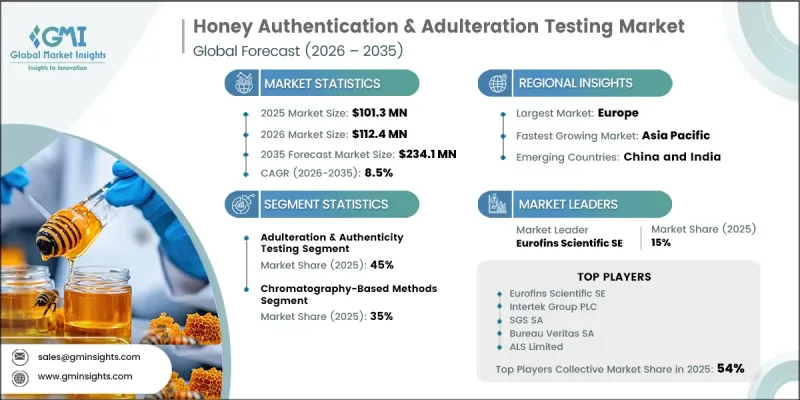
꿀 진위 및 혼입 검사 시장의 성장은 식품 위조에 대한 우려 증가, 꿀 수출입 규제 요건의 강화, 그리고 인증을 받은 고품질 꿀 제품에 대한 소비자 수요 확대에 힘입어 이루어지고 있습니다. 식물학적 및 지리적 원산지가 인증된 고급 꿀 품종은 시장 가치가 높기 때문에 밸류체인 전반의 이해관계자들은 진위 확인 및 품질 보증 절차를 더욱 중요하게 여기고 있습니다. 동시에 검사 기술도 고도화되어, 기존의 단일 매개변수 분석에서 더 광범위한 위조 기법을 탐지할 수 있는 정교한 다차원 분석 기법으로 전환되고 있습니다. 이러한 기술적 진보로 인해 검사의 정확도가 향상되고, 제공되는 서비스의 폭이 넓어지면서 검사 기관이 제공하는 검증 서비스의 가치가 높아지고 있습니다. 또한, 당국이 식품 안전 기준 강화, 제품 추적성 향상, 부정행위 감소를 추진하고 있는 만큼, 국제적인 꿀 무역에 대한 규제 당국의 감시가 강화되고 있으며, 시장도 그 혜택을 누리고 있습니다. 이러한 요인들이 복합적으로 작용하여 상업, 규제, 품질 보증 각 분야에서 시장의 지속적인 확장을 위한 유리한 환경이 조성되고 있습니다.
| 시장 범위 | |
|---|---|
| 시작 연도 | 2025년 |
| 예측 기간 | 2026-2035년 |
| 시작 시점 시장 규모 | 1억 130만 달러 |
| 예측액 | 2억 3,410만 달러 |
| CAGR | 8.5% |
2025년, 혼입 및 진위 검사 부문은 45%의 점유율을 차지했습니다. 이 부문이 주도적인 위치를 차지하고 있다는 사실은, 제품의 완전성을 검증하고 무단 변경이나 대체를 파악하는 데 있어 이러한 서비스가 수행하는 매우 중요한 역할을 반영하고 있습니다. 이 범주에는 꿀의 성분을 평가하고, 진위 여부를 확인하며, 부정행위의 가능성을 탐지하기 위해 고안된 고도로 전문화된 분석 절차가 포함됩니다. 식품 제조업체, 유통업체, 소매업체 및 규제 당국이 계속해서 제품 검증을 최우선 과제로 삼고 있는 가운데, 첨단 진위 확인 서비스에 대한 수요는 계속해서 견조할 것으로 예상됩니다. 꿀 공급망이 점점 더 복잡해지고, 소비자들의 품질에 대한 기대가 높아지고 있는 점도, 보다 광범위한 시장 상황 속에서 이 부문의 중요성을 더욱 부각시키고 있습니다.
2025년에는 크로마토그래피 기반 기술 부문이 35%의 점유율을 차지하며 주요 기술 부문으로 부상했습니다. 크로마토그래피 기술의 광범위한 채택은 규제 당국의 높은 수용성과 다양한 검사 용도에서 입증된 분석 성능에 힘입은 것입니다. 이러한 기법은 높은 정확도, 신뢰성 및 정량 정확도를 갖추고 있으며, 특히 오염 물질 검출, 잔류물 스크리닝 및 진위성 검증에 매우 유용합니다. 꿀 시료 내의 복잡한 화합물을 분리·동정하는 능력을 바탕으로, 크로마토그래피에 기반한 접근법은 실험실 검사 워크플로의 기반으로 자리 잡았습니다.
2025년, 북미의 꿀 진위 및 혼입 검사 시장은 25%의 점유율을 차지했습니다. 이 지역 시장은 막대한 꿀 수입량, 규제 감독 강화, 그리고 제품 검증 서비스에 대한 높은 수요의 혜택을 받고 있습니다. 식품 안전 당국과 이해관계자들은 품질 관리, 추적성, 그리고 수입 규제 준수를 계속해서 중시하고 있으며, 이는 검사 서비스 제공업체들에게 큰 비즈니스 기회를 창출하고 있습니다. 소비자와 기업 사이에서 꿀의 부정 행위 및 제품의 진위 여부에 대한 인식이 높아지고 있는 점도 해당 지역 전체의 검사량 증가에 기여하고 있습니다. 또한, 확립된 실험실 인프라와 인증을 받은 검사 시설이 북미 전역에서 진위 확인 및 혼입 검사 서비스의 지속적인 확장을 뒷받침하고 있습니다.
자주 묻는 질문
목차
제1장 조사 방법과 범위
제2장 주요 요약
제3장 업계 인사이트
제4장 경쟁 구도
제5장 시장 추정 및 예측 : 검사 유형별, 2022년에서 2035년
제6장 시장 추정 및 예측 : 기술별, 2022년에서 2035년
제7장 시장 추정 및 예측 : 최종사용자별, 2022년에서 2035년
제8장 시장 추정 및 예측 : 지역별, 2022년에서 2035년
제9장 기업 개요
KSM 26.07.16The Global Honey Authentication and Adulteration Testing Market was valued at USD 101.3 million in 2025 and is estimated to grow at a CAGR of 8.5% to reach USD 234.1 million by 2035.
Growth in the Honey Authentication and Adulteration Testing Market is driven by rising concerns regarding food fraud, increasingly stringent regulatory requirements governing honey imports and exports, and growing consumer demand for verified, high-quality honey products. As premium honey varieties with certified botanical and geographical origins command higher market value, stakeholders across the supply chain are placing greater emphasis on authentication and quality assurance procedures. At the same time, testing technologies are becoming more advanced, shifting from traditional single-parameter analyses toward sophisticated multi-dimensional analytical approaches capable of detecting a wider range of adulteration methods. These technological developments are improving testing accuracy, expanding service offerings, and increasing the value of laboratory-based verification services. The market is also benefiting from heightened regulatory scrutiny of international honey trade, as authorities seek to strengthen food safety standards, enhance product traceability, and reduce fraudulent practices. Together, these factors are creating a favorable environment for sustained market expansion across commercial, regulatory, and quality assurance applications.
| Market Scope | |
|---|---|
| Start Year | 2025 |
| Forecast Year | 2026-2035 |
| Start Value | $101.3 Million |
| Forecast Value | $234.1 Million |
| CAGR | 8.5% |
The adulteration and authenticity testing segment held 45% share in 2025. Its leading position reflects the critical role these services play in verifying product integrity and identifying unauthorized modifications or substitutions. This category includes highly specialized analytical procedures designed to assess honey composition, confirm authenticity, and detect potential fraudulent practices. As food manufacturers, distributors, retailers, and regulatory agencies continue to prioritize product verification, demand for advanced authenticity testing services is expected to remain strong. The increasing complexity of honey supply chains and rising quality expectations among consumers further reinforce the importance of this segment within the broader market landscape.
The chromatography-based technologies segment accounted for 35% share in 2025, making them the dominant technology segment. Their widespread adoption is supported by strong regulatory acceptance and proven analytical performance across a variety of testing applications. These methods offer high levels of precision, reliability, and quantitative accuracy, making them particularly valuable for contaminant detection, residue screening, and authenticity verification. Their ability to separate and identify complex compounds within honey samples has established chromatography-based approaches as a cornerstone of laboratory testing workflows.
North America Honey Authentication and Adulteration Testing Market held 25% share in 2025. The regional market benefits from substantial honey import volumes, increasing regulatory oversight, and strong demand for product verification services. Food safety authorities and industry stakeholders continue to emphasize quality control, traceability, and compliance with import regulations, creating significant opportunities for testing providers. Growing awareness regarding honey fraud and product authenticity among consumers and businesses has also contributed to higher testing volumes across the region. Furthermore, the presence of established laboratory infrastructure and accredited testing facilities supports the continued expansion of authentication and adulteration testing services throughout North America.
Major companies operating in the Global Honey Authentication and Adulteration Testing Market include Toray Films Europe, Solenis LLC, Mondi Group, Smurfit Kappa, and Amcor plc. Companies participating in the Honey Authentication and Adulteration Testing Market are implementing a range of strategies to strengthen their market presence and enhance competitive positioning. Investments in advanced analytical technologies remain a primary focus, enabling service providers to improve testing accuracy, expand detection capabilities, and address evolving regulatory requirements. Many organizations are increasing research and development efforts to introduce more sophisticated authentication methodologies and enhance laboratory efficiency. Strategic collaborations with food manufacturers, distributors, regulatory agencies, and certification bodies are helping companies broaden their customer base and strengthen industry relationships. Market participants are also expanding laboratory networks, enhancing accreditation standards, and investing in digital reporting solutions to improve customer experience and operational transparency. Additionally, geographic expansion initiatives, service portfolio diversification, and quality-focused branding strategies are supporting long-term growth while reinforcing credibility within the global food testing and authentication industry.
Table of Contents
Chapter 1 Methodology & Scope
- 1.1 Research approach
- 1.2 Quality Commitments
- 1.2.1 GMI AI policy & data integrity commitment
- 1.2.1.1 Source consistency protocol
- 1.2.1 GMI AI policy & data integrity commitment
- 1.3 Research Trail & Confidence Scoring
- 1.3.1 Research Trail Components
- 1.3.2 Scoring Components
- 1.4 Data Collection
- 1.4.1 Partial list of primary sources
- 1.5 Data mining sources
- 1.5.1 Paid sources
- 1.5.1.1 Sources, by region
- 1.5.1 Paid sources
- 1.6 Base estimates and calculations
- 1.6.1 Base year calculation for any one approach
- 1.7 Forecast model
- 1.7.1 Quantified market impact analysis
- 1.7.1.1 Mathematical impact of growth parameters on forecast
- 1.7.1 Quantified market impact analysis
- 1.8 Research transparency addendum
- 1.8.1 Source attribution framework
- 1.8.2 Quality assurance metrics
- 1.8.3 Our commitment to trust
Chapter 2 Executive Summary
- 2.1 Industry 360° synopsis
- 2.2 Key market trends
- 2.2.1 Regional
- 2.2.2 By Test Type
- 2.2.3 By Technology
- 2.2.4 By End User
- 2.3 TAM Analysis, 2026 2035
- 2.4 CXO perspectives: Strategic imperatives
Chapter 3 Industry Insights
- 3.1 Industry ecosystem analysis
- 3.1.1 Supplier landscape
- 3.1.2 Profit margin
- 3.1.3 Value addition at each stage
- 3.1.4 Factor affecting the value chain
- 3.1.5 Disruptions
- 3.2 Industry impact forces
- 3.2.1 Growth drivers
- 3.2.2 Industry pitfalls and challenges
- 3.2.3 Market opportunities
- 3.3 Growth potential analysis
- 3.4 Regulatory landscape
- 3.4.1 North America
- 3.4.2 Europe
- 3.4.3 Asia Pacific
- 3.4.4 Latin America
- 3.4.5 Middle East & Africa
- 3.5 Porter's analysis
- 3.6 PESTEL analysis
- 3.7 Price trends
- 3.7.1 By region
- 3.7.2 By technology
- 3.8 Future market trends
- 3.9 Technology and Innovation landscape
- 3.9.1 Current technological trends
- 3.9.2 Emerging technologies
- 3.10 Patent Landscape
- 3.11 Trade statistics (HS code)
- 3.11.1 Major importing countries
- 3.11.2 Major exporting countries
- 3.12 Sustainability and environmental aspects
- 3.12.1 Sustainable practices
- 3.12.2 Waste reduction strategies
- 3.12.3 Energy efficiency in production
- 3.12.4 Eco friendly initiatives
Chapter 4 Competitive Landscape, 2025
- 4.1 Introduction
- 4.2 Company market share analysis
- 4.2.1 By region
- 4.2.1.1 North America
- 4.2.1.2 Europe
- 4.2.1.3 Asia Pacific
- 4.2.1.4 LATAM
- 4.2.1.5 MEA
- 4.2.1 By region
- 4.3 Company matrix analysis
- 4.4 Competitive analysis of major market players
- 4.5 Competitive positioning matrix
- 4.6 Key developments
- 4.6.1 Mergers & acquisitions
- 4.6.2 Partnerships & collaborations
- 4.6.3 New Product Launches
- 4.6.4 Expansion Plans
Chapter 5 Market Estimates and Forecast, By Test Type, 2022 to 2035 (USD Million) (Tons)
- 5.1 Key trends
- 5.2 Adulteration & Authenticity Testing
- 5.3 Residue & Contaminant Testing
- 5.4 Quality & Compositional Analysis
- 5.5 Botanical & Geographical Origin Verification
- 5.6 Microbiological Testing
- 5.7 GMO Screening
Chapter 6 Market Estimates and Forecast, By Technology, 2022 to 2035 (USD Million) (Tons)
- 6.1 Key trends
- 6.2 Chromatography-Based Methods
- 6.3 Spectroscopy-Based Methods
- 6.4 Isotope Ratio Mass Spectrometry (IRMS)
- 6.5 Molecular/DNA-Based Methods
- 6.6 Biosensors & Electronic Systems
- 6.7 Traditional Physicochemical Methods
Chapter 7 Market Estimates and Forecast, By End User, 2022 to 2035 (USD Million) (Tons)
- 7.1 Key trends
- 7.2 Third-Party Testing Laboratories
- 7.3 Importers & Exporters
- 7.4 Food Manufacturers & Processors
- 7.5 Retailers, Wholesalers & E-Commerce
- 7.6 Regulatory Agencies & Government Bodies
- 7.7 Beekeepers & Honey Producers
Chapter 8 Market Estimates and Forecast, By Region, 2022 to 2035 (USD Million) (Tons)
- 8.1 Key trends
- 8.2 North America
- 8.2.1 U.S.
- 8.2.2 Canada
- 8.3 Europe
- 8.3.1 Germany
- 8.3.2 UK
- 8.3.3 France
- 8.3.4 Spain
- 8.3.5 Italy
- 8.3.6 Rest of Europe
- 8.4 Asia Pacific
- 8.4.1 China
- 8.4.2 India
- 8.4.3 Japan
- 8.4.4 Australia
- 8.4.5 South Korea
- 8.4.6 Rest of Asia Pacific
- 8.5 Latin America
- 8.5.1 Brazil
- 8.5.2 Mexico
- 8.5.3 Argentina
- 8.5.4 Rest of Latin America
- 8.6 Middle East and Africa
- 8.6.1 Saudi Arabia
- 8.6.2 South Africa
- 8.6.3 UAE
- 8.6.4 Rest of Middle East and Africa
Chapter 9 Company Profiles
- 9.1 Eurofins Scientific SE
- 9.2 Intertek Group PLC
- 9.3 SGS SA
- 9.4 Bureau Veritas SA
- 9.5 ALS Limited
- 9.6 Merieux NutriSciences
- 9.7 NSF International
- 9.8 QSI - Quality Services International
- 9.9 AsureQuality Limited
- 9.10 Analytica Laboratories

(주말 및 공휴일 제외)


