

|
시장보고서
상품코드
2083092
농업 해충용 유전자 드라이브 기술 : 시장 기회, 성장 촉진요인, 업계 동향 분석 및 예측(2026-2035년)Gene Drive Technology for Agricultural Pests Market Opportunity, Growth Drivers, Industry Trend Analysis, and Forecast 2026 - 2035 |
||||||

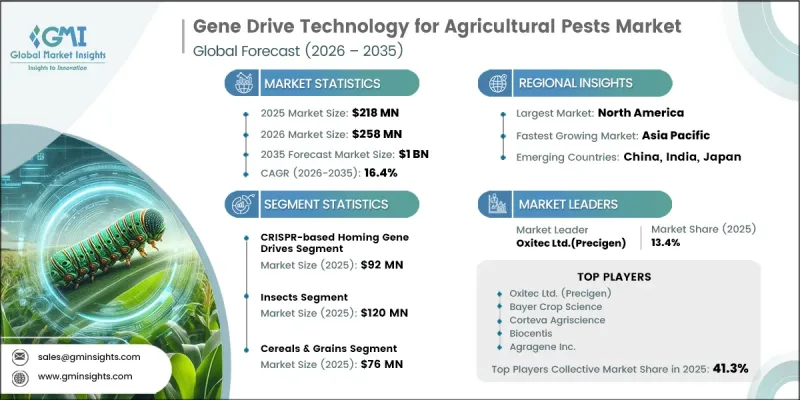
세계의 농업 해충용 유전자 드라이브 기술 시장은 2025년에 2억 1,800만 달러로 평가되었으며, CAGR 16.4%로 성장하여 2035년까지 10억 달러에 달할 것으로 추정됩니다.
시장의 성장은 작물 수확량 감소가 심화되고, 환경 및 공중보건상의 우려로 인해 광범위한 영향을 미치는 화학 농약 사용 규제가 강화되면서 세계 농업 시스템에 가해지는 압박이 커지고 있는 데 기인합니다. 유전자 드라이브 기술은 화학 약품을 살포하는 방식이 아니라, 유전적으로 전달되는 메커니즘을 통해 개체군 동태를 변화시키는, 근본적으로 다른 해충 방제 기법으로 부상하고 있습니다. 이러한 변화는 해충 방제 비용이 높고 내성 관리 문제가 심각해지고 있는 고부가가치 농업 시스템에서 특히 중요한 의미를 지닙니다. 유전자 공학의 발전과 연구 투자 확대에 힘입어, 이 기술은 여러 작물 분야에서 주목을 받고 있습니다. 주요 해충 종의 내성 증가로 인해 대체 해결책의 필요성이 더욱 시급해짐에 따라, 유전자 드라이브 시스템은 차세대 농업 생명공학 개발의 전략적 중점 분야로 부상하고 있습니다.
| 시장 범위 | |
|---|---|
| 시작 연도 | 2025년 |
| 예측 기간 | 2026-2035년 |
| 초기 시장 규모 | 2억 1,800만 달러 |
| 예측액 | 10억 달러 |
| CAGR | 16.4% |
CRISPR 기반 호밍 유전자 부문 시장은 2025년에 9,200만 달러에 달했습니다. 이 부문의 경쟁력은 CRISPR 플랫폼을 중심으로 한 활발한 연구개발 활동과, 첨단 유전공학 응용 분야에서의 적용 가능성에 의해 뒷받침되고 있습니다. CRISPR 기반 시스템의 지속적인 혁신으로 인해 주요 기술적 프레임워크로서의 위상이 강화되고 있는 반면, 서로 다른 유전자 편집 연구 기법이 필요한 특수한 사용 사례에 대해서는 CRISPR 이외의 대체 접근법이 여전히 평가 대상으로 남아 있습니다.
2025년, 곡물 부문의 시장 규모는 7,600만 달러에 달했습니다. 이러한 우위는 주곡 작물의 세계적 중요성과 해충 피해에 대한 높은 취약성에서 기인합니다. 이에 따라, 수확량의 안정성과 식량 안보 향상을 목적으로 한 유전자 기반 해충 방제 솔루션에 대한 연구가 지속적으로 추진되고 있습니다. 유지종자 및 콩류를 포함한 기타 작물 범주에 대해서도, 다양한 농업 시스템에서 해충의 위협이 생산성과 작물의 품질에 계속해서 영향을 미치고 있기 때문에 이에 대한 조사에 대한 관심이 높아지고 있습니다.
북미의 농업 해충용 유전자 드라이브 기술 시장은 2025년에 7,800만 달러 규모를 기록했으며, 2035년까지 3억 400만 달러에 달할 것으로 전망됩니다. 이 지역의 성장은 견고한 생명공학 투자 인프라, 확립된 농업 연구 네트워크, 그리고 첨단 유전자 해충 관리 솔루션에 대한 인식을 높이는 규제 환경에 힘입어 이루어지고 있습니다. 대규모 농업 시스템에서 농약 내성에 대한 우려가 커짐에 따라, 농업 주기 전반에 걸쳐 일관된 해충 방제 효과를 제공하는 장기적인 생물학적 대체 수단의 도입이 더욱 가속화되고 있습니다.
자주 묻는 질문
목차
제1장 조사 방법과 범위
제2장 주요 요약
제3장 업계 인사이트
제4장 경쟁 구도
제5장 시장 추정 및 예측 : 기술별, 2022-2035년
제6장 시장 추정 및 예측 : 해충별, 2022-2035년
제7장 시장 추정 및 예측 : 작물 유형별, 2022-2035년
제8장 시장 추정 및 예측 : 지역별, 2022-2035년
제9장 기업 개요
KSM 26.07.16The Global Gene Drive Technology for Agricultural Pests Market was valued at USD 218 million in 2025 and is estimated to grow at a CAGR of 16.4% to reach USD 1 billion by 2035.
Market growth is shaped by increasing pressure on global agricultural systems from rising crop losses and growing restrictions on broad-spectrum chemical pesticide usage due to environmental and public health concerns. Gene drive technology is emerging as a fundamentally different pest control approach that alters population dynamics through inherited genetic mechanisms rather than chemical application. This shift is particularly relevant for high-value agricultural systems where pest control costs are high and resistance management challenges are intensifying. The technology is gaining traction across multiple crop categories, supported by advancements in genetic engineering and expanding research investments. Increasing resistance across major pest species has further strengthened the urgency for alternative solutions, making gene drive systems a strategic focus area for next-generation agricultural biotechnology development.
| Market Scope | |
|---|---|
| Start Year | 2025 |
| Forecast Year | 2026-2035 |
| Start Value | $218 Million |
| Forecast Value | $1 Billion |
| CAGR | 16.4% |
The CRISPR-based homing gene segment reached USD 92 million in 2025. This segment's dominance is supported by strong research and development activity centered on CRISPR platforms and their adaptability in advanced genetic engineering applications. Continued innovation in CRISPR-compatible systems has reinforced their position as the leading technological framework, while alternative non-CRISPR approaches remain under evaluation for specialized use cases requiring different gene-editing methodologies.
The cereals and grains segment generated USD 76 million in 2025. This dominance is attributed to the global importance of staple crops and their high vulnerability to pest-related losses, which drives continued research into genetic pest control solutions aimed at improving yield stability and food security. Other crop categories, including oilseeds and pulses, are also witnessing increasing research interest as pest pressures continue to impact productivity and crop quality across diverse agricultural systems.
North America Gene Drive Technology for Agricultural Pests Market accounted for USD 78 million in 2025 and is projected to reach USD 304 million by 2035. The region's growth is supported by strong biotechnology investment infrastructure, established agricultural research networks, and a regulatory environment that facilitates the evaluation of advanced genetic pest management solutions. Rising concerns over pesticide resistance in large-scale farming systems are further encouraging adoption of long-term biological alternatives that provide consistent pest control performance across agricultural cycles.
Key companies operating in the Global Gene Drive Technology for Agricultural Pests Market include Bayer Crop Science, Corteva Agriscience, Oxitec Ltd. (Precigen), Genus plc, Synvect Inc., Agragene Inc., Biocentis, Genective (Limagrain Group), Innovative Genomics Institute (IGI), and Provivi. Companies operating in the Gene Drive Technology for Agricultural Pests Market are focusing on advanced genetic engineering innovation, strategic collaborations, and long-term research investments to strengthen their market position. A key strategy involves increasing funding for CRISPR-based gene editing platforms to enhance precision, scalability, and commercial readiness. Firms are actively forming partnerships with agricultural research institutions and biotechnology startups to accelerate development timelines and broaden application scope. Another important approach includes expanding field trial programs to validate efficacy across diverse crop systems and environmental conditions. Companies are also pursuing intellectual property expansion strategies through patent filings and technology licensing agreements to secure competitive advantages.
Table of Contents
Chapter 1 Methodology & Scope
- 1.1 Market scope and definition
- 1.2 Research design
- 1.2.1 Research approach
- 1.2.2 Data collection methods
- 1.3 Data mining sources
- 1.3.1 Global
- 1.3.2 Regional/Country
- 1.4 Base estimates and calculations
- 1.4.1 Base year calculation
- 1.4.2 Key trends for market estimation
- 1.5 Primary research and validation
- 1.5.1 Primary sources
- 1.6 Forecast model
- 1.7 Research assumptions and limitations
Chapter 2 Executive Summary
- 2.1 Industry 360° synopsis
- 2.2 Key market trends
- 2.2.1 Technology
- 2.2.2 Pest Organism
- 2.2.3 Crop System
- 2.2.4 Regional
- 2.3 TAM Analysis, 2026-2035
- 2.4 CXO perspectives: Strategic imperatives
- 2.5 Future outlook and strategic recommendations
Chapter 3 Industry Insights
- 3.1 Industry ecosystem analysis
- 3.1.1 Supplier landscape
- 3.1.2 Profit margin
- 3.1.3 Value addition at each stage
- 3.1.4 Factor affecting the value chain
- 3.1.5 Disruptions
- 3.2 Industry impact forces
- 3.2.1 Growth drivers
- 3.2.1.1 Sustainable pest control demand
- 3.2.1.2 Pesticide resistance escalation
- 3.2.1.3 Crop productivity imperatives
- 3.2.2 Industry pitfalls and challenges
- 3.2.2.1 Regulatory and ethical constraints
- 3.2.2.2 Environmental risk uncertainties
- 3.2.3 Market opportunities
- 3.2.3.1 Commercial scale-up in Latin America and Asia Pacific
- 3.2.3.2 Expansion into weed and fungal pathogen segments
- 3.2.3.3 Partnership-driven R&D acceleration between academic institutions and agrochemical majors
- 3.2.1 Growth drivers
- 3.3 Growth potential analysis
- 3.4 Regulatory landscape
- 3.4.1 North America
- 3.4.2 Europe
- 3.4.3 Asia Pacific
- 3.4.4 Latin America
- 3.4.5 Middle East & Africa
- 3.5 Porter’s analysis
- 3.6 PESTEL analysis
- 3.7 Technology and innovation landscape
- 3.7.1 Current technological trends
- 3.7.2 Emerging technologies
- 3.8 Price trends
- 3.8.1 By region
- 3.8.2 By technology
- 3.9 Future market trends
- 3.10 Patent landscape
- 3.11 Trade statistics (HS code)
- 3.11.1 Major importing countries
- 3.11.2 Major exporting countries
- 3.12 Sustainability and environmental aspects
- 3.12.1 Sustainable practices
- 3.12.2 Waste reduction strategies
- 3.12.3 Energy efficiency in production
- 3.12.4 Eco-friendly initiatives
- 3.13 Carbon footprint consideration
Chapter 4 Competitive Landscape, 2025
- 4.1 Introduction
- 4.2 Company market share analysis
- 4.2.1 By region
- 4.2.1.1 North America
- 4.2.1.2 Europe
- 4.2.1.3 Asia Pacific
- 4.2.1.4 LATAM
- 4.2.1.5 MEA
- 4.2.1 By region
- 4.3 Company matrix analysis
- 4.4 Competitive analysis of major market players
- 4.5 Competitive positioning matrix
- 4.6 Key developments
- 4.6.1 Mergers & acquisitions
- 4.6.2 Partnerships & collaborations
- 4.6.3 New product launches
- 4.6.4 Expansion plans
Chapter 5 Market Estimates and Forecast, By Technology, 2022-2035 (USD Million) (Kilo Tons)
- 5.1 Key trends
- 5.2 CRISPR-based Homing Gene Drives
- 5.3 Homing Endonuclease (Non-CRISPR)
- 5.4 Underdominance & Chromosomal Translocation
- 5.5 Self-Limiting Gene Drives
- 5.6 Wolbachia-based Systems
- 5.7 Others
Chapter 6 Market Estimates and Forecast, By Pest Organism, 2022-2035 (USD Million) (Kilo Tons)
- 6.1 Key trends
- 6.2 Insects
- 6.3 Weeds
- 6.4 Fungal Pathogens
- 6.5 Rodents
- 6.6 Others
Chapter 7 Market Estimates and Forecast, By Crop System, 2022-2035 (USD Million) (Kilo Tons)
- 7.1 Key trends
- 7.2 Cereals & Grains
- 7.3 Fruits & Vegetables
- 7.4 Oilseeds & Pulses
- 7.5 Specialty & Tree Crops
- 7.6 Others
Chapter 8 Market Estimates and Forecast, By Region, 2022-2035 (USD Million) (Kilo Tons)
- 8.1 Key trends
- 8.2 North America
- 8.2.1 U.S.
- 8.2.2 Canada
- 8.3 Europe
- 8.3.1 Germany
- 8.3.2 UK
- 8.3.3 France
- 8.3.4 Spain
- 8.3.5 Italy
- 8.3.6 Rest of Europe
- 8.4 Asia Pacific
- 8.4.1 China
- 8.4.2 India
- 8.4.3 Japan
- 8.4.4 Australia
- 8.4.5 South Korea
- 8.4.6 Rest of Asia Pacific
- 8.5 Latin America
- 8.5.1 Brazil
- 8.5.2 Mexico
- 8.5.3 Argentina
- 8.5.4 Rest of Latin America
- 8.6 Middle East and Africa
- 8.6.1 Saudi Arabia
- 8.6.2 South Africa
- 8.6.3 UAE
- 8.6.4 Rest of Middle East and Africa
Chapter 9 Company Profiles
- 9.1 Oxitec Ltd. (Precigen)
- 9.2 Bayer Crop Science
- 9.3 Corteva Agriscience
- 9.4 Agragene Inc.
- 9.5 Biocentis
- 9.6 Genective (Limagrain Group)
- 9.7 Innovative Genomics Institute (IGI)
- 9.8 Genus plc
- 9.9 Provivi
- 9.10 Synvect Inc.


