
|
시장보고서
상품코드
2083108
군용 수송기 시장 비즈니스 기회, 성장요인, 업계 동향 분석 및 예측(2026-2035년)Military Transport Aircraft Market Opportunity, Growth Drivers, Industry Trend Analysis, and Forecast 2026 - 2035 |
||||||

세계의 군용 수송기 시장은 2025년에 181억 달러로 평가되었고, CAGR 5.5%로 성장하여 2035년까지 311억 달러에 달할 것으로 예측됩니다.
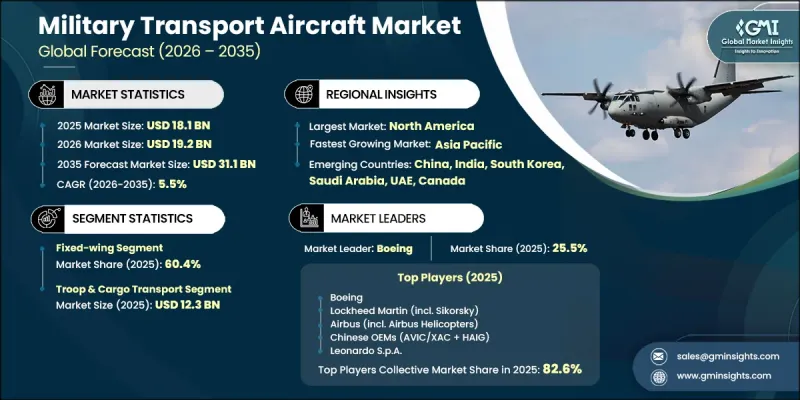
군용 수송기 시장은 전략적 및 전술적 항공 기동 능력 강화에 초점을 맞춘 국방 투자 증가에 힘입어 확대되고 있습니다. 전 세계 각국 정부는 변화하는 국방 요구 사항에 대응하기 위해 기체의 현대화, 노후화된 수송기의 교체, 그리고 작전 준비 태세 강화를 위해 더 많은 예산을 배정하고 있습니다. 신속한 전개 능력, 인도적 지원, 재난 대응, 해외 임무 및 특수 목적의 군사 작전에 대한 수요가 증가함에 따라, 첨단 수송기 조달이 계속해서 추진되고 있습니다. 또한, 이 시장은 수송 능력, 작전상의 유연성 및 임무 신뢰성 향상을 우선시하는 장기적인 국방 현대화 프로그램의 혜택도 받고 있습니다. 기동성을 중시하는 방위 전략에 대한 관심이 높아짐에 따라, 차세대 수송 플랫폼, 정비 프로그램 및 기체군의 유지 관리 이니셔티브에 대한 지속적인 투자가 촉진되고 있습니다. 또한, 방위 작전 및 비전투 작전 모두에서 군용 수송기의 가동률이 향상됨에 따라, 다양한 임무 요건에 대응할 수 있는 신뢰성이 높고 고성능인 공수 솔루션에 대한 필요성이 더욱 커지고 있습니다. 이러한 장기적인 조달 전략과 현대화 노력은 예측 기간 동안 전 세계 군용 수송기 시장에 긍정적인 성장 기회를 지속적으로 창출하고 있습니다.
| 시장 범위 | |
|---|---|
| 개시연도 | 2025년 |
| 예측 기간 | 2026-2035년 |
| 개시 연도 시장 규모 | 181억 달러 |
| 예측액 | 311억 달러 |
| CAGR | 5.5% |
2025년에는 고정익 항공기 부문이 시장 점유율의 60.4%를 차지했습니다. 이러한 주도적인 지위는 전략적 및 전술적 공수 임무에서 수행하는 중요한 역할에 의해 뒷받침되고 있으며, 이러한 임무에서는 장거리 비행 능력, 높은 적재 능력, 그리고 운용 효율성이 여전히 필수적인 요건으로 남아 있습니다. 고정익 군용 수송기는 중장비, 군용 차량, 인원 및 임무 수행에 필수적인 물자를 장거리로 수송하는 데 널리 활용되고 있습니다. 신속한 부대 전개, 병참 작전, 억제 전략, 그리고 지속적인 군사 준비 태세를 지원하는 이러한 능력은 현대 방위 조직 전반에서 그 중요성이 계속해서 커지고 있으며, 예측 기간 동안 꾸준한 조달 수요를 보장하고 있습니다.
2025년, 병력 및 물자 수송 부문은 123억 달러 규모를 기록했습니다. 이 부문은 전략적 및 전술적 임무 환경 모두에서 인원, 장비, 탄약 및 필수 물자의 수송을 지원함으로써 군사 공수 작전의 기반으로서의 역할을 수행하고 있습니다. 여기에는 대규모 장거리 수송뿐만 아니라, 지속적인 군사 활동을 지원하는 단거리 병참 작전도 포함됩니다. 이 부문의 조달 수요는 기체 수의 확대 및 교체 프로그램이 장기적인 국방 계획, 작전 부대의 구성, 그리고 국가의 군사 준비 태세 목표와 직접적으로 연계되어 있기 때문에 매우 안정적입니다. 해당 시장에서 차지하는 압도적인 위상은 전 세계 방위 작전에서 병력의 기동성과 물자 수송이 여전히 최우선 과제로 여겨지고 있음을 반영하고 있습니다.
2025년, 북미의 군용 수송기 시장은 42.3%의 점유율을 차지하며 최대 지역 시장이 되었습니다. 이 지역의 성장은 전략적 항공 기동 능력에 대한 지속적인 투자, 종합적인 기체 현대화 프로그램, 그리고 기존 군용 수송기의 지속적인 업그레이드를 통해 계속해서 뒷받침되고 있습니다. 이 지역의 방위 기관은 작전 준비 태세 강화, 병참 효율 향상, 그리고 진화하는 임무 요건에 대응하기 위해 첨단 공수 능력에 대한 장기적인 투자를 계속해서 우선시하고 있습니다. 항공기 현대화, 정비 및 역량 강화 프로그램에 대한 지속적인 자금 지원은 세계 군용 수송기 시장에서 북미의 주도적 지위를 더욱 공고히 하고 있습니다.
자주 묻는 질문
목차
제1장 조사 방법과 범위
제2장 주요 요약
제3장 업계 인사이트
제4장 경쟁 구도
제5장 시장 추산 및 예측 : 항공기 유형별, 2022년-2035년
제6장 시장 추산 및 예측 : 미션 용도별, 2022년-2035년
제7장 시장 추산 및 예측 : 지역별, 2022년-2035년
제8장 기업 개요
LSH 26.07.13The Global Military Transport Aircraft Market was valued at USD 18.1 billion in 2025 and is estimated to grow at a CAGR of 5.5% to reach USD 31.1 billion by 2035.
The military transport aircraft market is expanding due to increasing defense investments focused on strengthening strategic and tactical air mobility capabilities. Governments worldwide are allocating larger budgets toward fleet modernization, replacing aging transport aircraft, and enhancing operational readiness to address evolving defense requirements. Rising demand for rapid deployment capabilities, humanitarian assistance, disaster response, overseas missions, and special-purpose military operations continues to support procurement of advanced transport aircraft. The market also benefits from long-term defense modernization programs that prioritize improved airlift capacity, operational flexibility, and mission reliability. Growing emphasis on mobility-focused defense strategies has encouraged continued investment in next-generation transport platforms, maintenance programs, and fleet sustainment initiatives. In addition, higher utilization rates of military transport aircraft for both defense and non-combat operations have reinforced the need for reliable, high-performance airlift solutions capable of supporting diverse mission requirements. These long-term procurement strategies and modernization efforts continue to create favorable growth opportunities for the global military transport aircraft market throughout the forecast period.
| Market Scope | |
|---|---|
| Start Year | 2025 |
| Forecast Year | 2026-2035 |
| Start Value | $18.1 Billion |
| Forecast Value | $31.1 Billion |
| CAGR | 5.5% |
The fixed-wing segment accounted for 60.4% share in 2025. Its leading position is supported by its critical role in both strategic and tactical airlift missions, where long-range performance, high payload capacity, and operational efficiency remain essential requirements. Fixed-wing military transport aircraft are widely utilized for transporting heavy equipment, military vehicles, personnel, and mission-critical supplies over extended distances. Their ability to support rapid force deployment, logistics operations, deterrence strategies, and sustained military readiness continues to reinforce their importance across modern defense organizations, ensuring strong procurement demand throughout the forecast period.
The troop and cargo transport segment generated USD 12.3 billion in 2025. This segment serves as the foundation of military airlift operations by supporting the transportation of personnel, equipment, ammunition, and essential supplies across both strategic and tactical mission environments. It includes large-scale long-distance transportation as well as shorter-range logistics operations that support ongoing military activities. Procurement within this segment remains highly stable because fleet expansion and replacement programs are directly aligned with long-term defense planning, operational force structures, and national military readiness objectives. Its dominant market position reflects the continued priority placed on troop mobility and cargo transportation across global defense operations.
North America Military Transport Aircraft Market held 42.3% share in 2025, making it the largest regional market. Regional growth continues to be supported by sustained investments in strategic air mobility capabilities, comprehensive fleet modernization programs, and ongoing upgrades to existing military transport aircraft. Defense organizations across the region continue to prioritize long-term investments in advanced airlift capabilities to strengthen operational readiness, improve logistics efficiency, and support evolving mission requirements. Continued funding for aircraft modernization, maintenance, and capability enhancement programs further reinforces North America's leadership within the global military transport aircraft market.
Major companies operating in the global military transport aircraft market include Airbus Defence and Space, Hindustan Aeronautics Limited (HAL), Pilatus Aircraft, The Boeing Company, Embraer Defense & Security, De Havilland Canada, Leonardo S.p.A., PT Dirgantara Indonesia (PTDI), Turkish Aerospace Industries (TUSAS), Kawasaki Heavy Industries, Lockheed Martin Corporation, and General Atomics AeroTec Systems (GA-ATS). Companies participating in the military transport aircraft market are strengthening their competitive position by investing in advanced aircraft technologies, fleet modernization programs, and continuous product innovation to meet evolving defense requirements. Many manufacturers are expanding research and development activities to improve payload capacity, fuel efficiency, operational reliability, and mission versatility. Strategic partnerships with defense agencies, long-term procurement agreements, and international collaboration programs continue to support business expansion and market penetration. Companies are also enhancing maintenance, repair, and overhaul (MRO) capabilities while offering comprehensive lifecycle support services to strengthen customer relationships.
Table of Contents
Chapter 1 Methodology and Scope
- 1.1 Market scope and definition
- 1.2 Research design
- 1.2.1 Research approach
- 1.2.2 Data collection methods
- 1.3 Data mining sources
- 1.3.1 Global
- 1.3.2 Regional/Country
- 1.4 Base estimates and calculations
- 1.4.1 Base year calculation
- 1.4.2 Key trends for market estimation
- 1.5 Primary research and validation
- 1.5.1 Primary sources
- 1.6 Forecast model
- 1.7 Research assumptions and limitations
Chapter 2 Executive Summary
- 2.1 Industry 360° synopsis, 2022 - 2035
- 2.2 Key market trends
- 2.2.1 Aircraft Type trends
- 2.2.2 Mission Application trends
- 2.2.3 Regional trends
- 2.3 TAM Analysis, 2026-2035
- 2.4 CXO perspectives: Strategic imperatives
Chapter 3 Industry Insights
- 3.1 Industry ecosystem analysis
- 3.1.1 Supplier Landscape
- 3.1.2 Profit Margin
- 3.1.3 Cost structure
- 3.1.4 Value addition at each stage
- 3.1.5 Factor affecting the value chain
- 3.1.6 Disruptions
- 3.2 Industry impact forces
- 3.2.1 Growth drivers
- 3.2.1.1 Rising defense expenditure on strategic airlift capabilities
- 3.2.1.2 Increasing demand for humanitarian assistance and disaster relief operations
- 3.2.1.3 Expansion of expeditionary and overseas military operations
- 3.2.1.4 Growing procurement of aircraft for special mission and tactical transport roles
- 3.2.1.5 Modernization and replacement of aging military airlift fleets
- 3.2.2 Industry pitfalls and challenges
- 3.2.2.1 High procurement and lifecycle maintenance costs of military transport aircraft
- 3.2.2.2 Lengthy procurement cycles and program execution delays
- 3.2.3 Market opportunities
- 3.2.3.1 Integration of autonomous cargo handling and digital fleet management systems
- 3.2.3.2 Development of next-generation fuel-efficient and sustainable transport aircraft
- 3.2.1 Growth drivers
- 3.3 Growth potential analysis
- 3.4 Regulatory landscape
- 3.4.1 North America
- 3.4.2 Europe
- 3.4.3 Asia Pacific
- 3.4.4 Latin America
- 3.4.5 Middle East & Africa
- 3.5 Porter's analysis
- 3.6 PESTEL analysis
- 3.7 Technology and Innovation landscape
- 3.7.1 Current technological trends
- 3.7.2 Emerging technologies
- 3.8 Price trends
- 3.8.1 By region
- 3.8.2 By product
- 3.9 Pricing Strategies
- 3.10 Emerging Business Models
- 3.11 Compliance Requirements
- 3.12 Patent and IP analysis
Chapter 4 Competitive Landscape, 2025
- 4.1 Introduction
- 4.2 Company market share analysis
- 4.2.1 By region
- 4.2.1.1 North America
- 4.2.1.2 Europe
- 4.2.1.3 Asia Pacific
- 4.2.1.4 Latin America
- 4.2.1.5 Middle East & Africa
- 4.2.2 Market concentration analysis
- 4.2.1 By region
- 4.3 Competitive benchmarking of key players
- 4.3.1 Financial performance comparison
- 4.3.1.1 Revenue
- 4.3.1.2 Profit margin
- 4.3.1.3 R&D
- 4.3.2 Product portfolio comparison
- 4.3.2.1 Product range breadth
- 4.3.2.2 Technology
- 4.3.2.3 Innovation
- 4.3.3 Geographic presence comparison
- 4.3.3.1 Global footprint analysis
- 4.3.3.2 Service network coverage
- 4.3.3.3 Market penetration by region
- 4.3.4 Competitive positioning matrix
- 4.3.4.1 Leaders
- 4.3.4.2 Challengers
- 4.3.4.3 Followers
- 4.3.4.4 Niche players
- 4.3.5 Strategic outlook matrix
- 4.3.1 Financial performance comparison
- 4.4 Key developments
- 4.4.1 Mergers and acquisitions
- 4.4.2 Partnerships and collaborations
- 4.4.3 Technological advancements
- 4.4.4 Expansion and investment strategies
- 4.4.5 Digital transformation initiatives
- 4.5 Emerging/ startup competitors landscape
Chapter 5 Market Estimates and Forecast, By Aircraft Type, 2022 - 2035 (USD Million)
- 5.1 Key trends
- 5.2 Fixed-wing
- 5.2.1 Strategic airlifters
- 5.2.2 Tactical airlifters
- 5.2.3 Light transport aircraft
- 5.3 Rotor wing
- 5.3.1 Medium transport helicopters
- 5.3.2 Heavy transport helicopters
Chapter 6 Market Estimates and Forecast, By Mission Application, 2022 - 2035 (USD Million)
- 6.1 Key trends
- 6.2 Troop & cargo transport
- 6.3 Executive / VIP transport
- 6.4 Others
Chapter 7 Market Estimates and Forecast, By Region, 2022 - 2035 (USD Million)
- 7.1 Key trends
- 7.2 North America
- 7.2.1 U.S.
- 7.2.2 Canada
- 7.3 Europe
- 7.3.1 Germany
- 7.3.2 UK
- 7.3.3 France
- 7.3.4 Spain
- 7.3.5 Italy
- 7.3.6 Russia
- 7.4 Asia Pacific
- 7.4.1 China
- 7.4.2 India
- 7.4.3 Japan
- 7.4.4 Australia
- 7.4.5 South Korea
- 7.5 Latin America
- 7.5.1 Brazil
- 7.5.2 Mexico
- 7.5.3 Argentina
- 7.6 Middle East and Africa
- 7.6.1 South Africa
- 7.6.2 Saudi Arabia
- 7.6.3 UAE
Chapter 8 Company Profiles
- 8.1 Global Key Players
- 8.1.1 Boeing
- 8.1.2 Lockheed Martin (incl. Sikorsky)
- 8.1.3 Airbus (incl. Airbus Helicopters)
- 8.1.4 Chinese OEMs (AVIC/XAC + HAIG)
- 8.1.5 Leonardo S.p.A.
- 8.2 Regional key players
- 8.2.1 North America
- 8.2.1.1 De Havilland Canada
- 8.2.1.2 General Atomics AeroTec Systems (GA-ATS)
- 8.2.2 Asia Pacific
- 8.2.2.1 Kawasaki Heavy Industries
- 8.2.2.2 Hindustan Aeronautics Limited (HAL)
- 8.2.2.3 Turkish Aerospace Industries (TUSAS)
- 8.2.2.4 PT Dirgantara Indonesia (PTDI)
- 8.2.3 Europe
- 8.2.3.1 Pilatus Aircraft
- 8.2.1 North America