

|
시장보고서
상품코드
2083112
박테리아 셀룰로오스 복합재 시장 비즈니스 기회, 성장요인, 업계 동향 분석 및 예측(2026-2035년)Bacterial Cellulose Composites Market Opportunity, Growth Drivers, Industry Trend Analysis, and Forecast 2026 - 2035 |
||||||

세계의 박테리아 셀룰로오스 복합재 시장은 2025년에 2억 3,050만 달러 규모로 평가되었고, 2035년까지 연평균 복합 성장률(CAGR)13.4%로 성장하여 8억 1,870만 달러에 달할 것으로 예측됩니다.
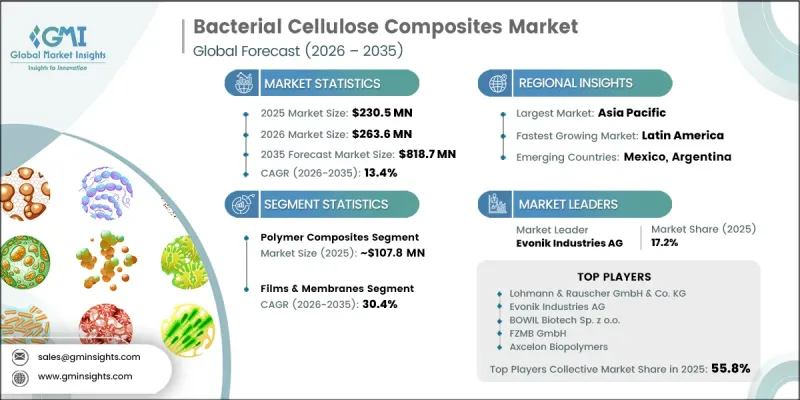
시장의 성장은 지속가능성에 대한 요구가 가속화되고, 석유화학 소재에 대한 규제가 강화되며, 북미, 유럽, 아시아태평양을 포함한 주요 산업 지역 전반에서 순환 경제 도입을 위한 체계적인 노력이 확대됨에 따라 견인되고 있습니다. 박테리아 셀룰로오스 복합재는 생분해성 및 재생 가능 원료의 함유율을 중시하는 진화하는 조달 기준에 부합하는 차세대 바이오 소재로서 주목을 받고 있습니다. 이러한 채택은 기존 플라스틱을 대체하는 것이 전략적 우선 과제로 대두되고 있는 포장, 퍼스널케어, 섬유 산업의 각 분야에서 확대되고 있습니다. 또한, 이러한 소재는 높은 인장 강도, 뛰어난 보습성, 생체 적합성, 나노 구조의 섬유 구조와 같은 고도의 기능성을 갖추고 있어 고성능 용도에 적합합니다. 센서, 플렉서블 디스플레이, 전도성 인터페이스 등 전자 분야에서의 유연하고 지속 가능한 소재 시스템으로의 전환은 유연성, 열 안정성, 구조적 균일성을 모두 갖춘 소재에 대한 수요로 인해 그 수요가 더욱 증가하고 있습니다. EU의 ‘포장 및 포장 폐기물 지침’과 같은 규제 체계와 보다 광범위한 지속가능성 노력은 바이오 대체 소재로의 전환을 의무화하는 움직임을 뒷받침하고 있으며, 전 세계적인 시장 침투를 가속화하고 있습니다.
| 시장 범위 | |
|---|---|
| 개시연도 | 2025년 |
| 예측 기간 | 2026-2035년 |
| 개시 연도 시장 규모 | 2억 3,050만 달러 |
| 예측액 | 8억 1,870만 달러 |
| CAGR | 13.4% |
폴리머 복합재 부문은 2025년에 1억 780만 달러에 달하며, 46.8%의 시장 점유율을 차지했습니다. 이러한 우위는 박테리아 셀룰로오스와 널리 사용되는 고분자의 결합을 용이하게 하는 검증된 통합 기술에 기반을 두고 있으며, 이를 통해 확장 가능한 생산과 광범위한 상업적 도입이 가능해집니다. 폴리머 기반 박테리아 셀룰로오스 시스템은 구조적 유연성과 차단 성능이 요구되는 용도, 특히 첨단 생의학 및 포장 솔루션 분야에서 점점 더 널리 활용되고 있습니다.
필름 및 막 부문은 2025년에 30.4%의 점유율을 차지하며 주요 형태로 부상했습니다. 이 부문의 성장은 의료용, 플렉서블 전자기기, 여과 시스템, 포장용 배리어 등 다양한 최종 이용 산업에 걸쳐 적용될 수 있는 적응성 덕분에 주도되고 있습니다. 이러한 기능적 범용성과 높은 재료 효율 덕분에, 세계 주요 지역에서 이미 상업적 활용이 확대되고 있습니다.
북미의 박테리아 셀룰로오스 복합재 시장은 의료, 포장, 전자 분야에서 수요 증가에 힘입어 2025년에는 27.5%의 시장 점유율을 차지했습니다. 이 지역에서는 바이오 복합재료의 기술 개발과 산업적 차원에서의 도입이라는 두 가지 측면에서 지속적인 진전이 이루어지고 있습니다. 미국은 강력한 혁신 생태계를 바탕으로 지역 내 소비를 주도하고 있는 반면, 캐나다는 환경적으로 지속 가능한 소재 솔루션에 중점을 두고 있습니다. 친환경 소재에 대한 규제 측면의 지원 확대와 의료 분야에서의 활용 범위 확대가 해당 지역 전체의 꾸준한 시장 성장을 지속적으로 뒷받침하고 있습니다.
자주 묻는 질문
목차
제1장 조사 방법과 범위
제2장 주요 요약
제3장 업계 인사이트
제4장 경쟁 구도
제5장 시장 추산 및 예측 : 복합 유형별, 2022년-2035년
제6장 시장 추산 및 예측 : 폼별, 2022년-2035년
제7장 시장 추산 및 예측 : 최종 사용 산업별, 2022년-2035년
제8장 시장 추산 및 예측 : 지역별, 2022년-2035년
제9장 기업 개요
LSH 26.07.13The Global Bacterial Cellulose Composites Market was valued at USD 230.5 million in 2025 and is estimated to grow at a CAGR of 13.4% to reach USD 818.7 million by 2035.
Market growth is driven by accelerating sustainability mandates, rising regulatory restrictions on petrochemical-based materials, and increasing organizational commitments to circular economy adoption across major industrial regions, including North America, Europe, and Asia Pacific. Bacterial cellulose composites are gaining traction as next-generation bio-based materials that align with evolving procurement standards emphasizing biodegradability and renewable content. Their adoption is expanding across the packaging, personal care, and textile industries, where the substitution of conventional plastics is becoming a strategic priority. In addition, these materials offer advanced functional properties such as high tensile strength, superior moisture retention, biocompatibility, and nanostructured fiber architecture, making them suitable for high-performance applications. The shift toward flexible and sustainable material systems in electronics, including sensors, flexible displays, and conductive interfaces, is further strengthening demand due to the need for materials that combine flexibility, thermal stability, and structural uniformity. Regulatory frameworks such as the EU's Packaging and Packaging Waste Directive and broader sustainability initiatives are reinforcing mandatory transitions toward bio-based alternatives, accelerating market penetration globally.
| Market Scope | |
|---|---|
| Start Year | 2025 |
| Forecast Year | 2026-2035 |
| Start Value | $230.5 Million |
| Forecast Value | $818.7 Million |
| CAGR | 13.4% |
The polymer composites segment reached USD 107.8 million, capturing a 46.8% share in 2025. Its dominance is supported by established integration technologies that facilitate the combination of bacterial cellulose with widely used polymers, enabling scalable production and broad commercial adoption. Polymer-based bacterial cellulose systems are increasingly utilized in applications requiring structural flexibility and barrier performance, particularly in advanced biomedical and packaging solutions.
The films and membranes segment accounted for 30.4% share in 2025, emerging as the leading form factor. This segment's growth is driven by its adaptability across multiple end-use industries, including medical applications, flexible electronics, filtration systems, and packaging barriers. Commercial deployment is already expanding across major global regions due to its functional versatility and material efficiency.
North America Bacterial Cellulose Composites Market held 27.5% share in 2025, supported by increasing demand across healthcare, packaging, and electronics sectors. The region continues to advance in both technological development and industrial-scale adoption of bio-based composites. The United States leads regional consumption due to strong innovation ecosystems, while Canada emphasizes environmentally sustainable material solutions. Growing regulatory support for eco-friendly materials and expansion in healthcare applications continue to reinforce steady market growth across the region.
Key companies operating in the Bacterial Cellulose Composites Market include Evonik Industries AG, Polybion S.A. de C.V., Hyundai Bioland Co., Ltd., Axcelon Biopolymers, BOWIL Biotech Sp. z o.o., FZMB GmbH, Hainan Guangyu Bio-technology, Lohmann & Rauscher GmbH & Co. KG, Malai Biomaterials Design, and Modern Synthesis Ltd. Companies operating in the Bacterial Cellulose Composites Market are focusing on material innovation, strategic collaborations, and scaling production capabilities to strengthen their competitive position. A key strategy involves advancing R&D in biofabrication processes to enhance material performance, durability, and cost efficiency. Firms are increasingly forming partnerships with biotechnology research institutes and end-use manufacturers to accelerate commercialization and application diversification. Expanding pilot-scale and industrial production facilities is another critical focus to support rising demand across packaging, healthcare, and electronics sectors.
Table of Contents
Chapter 1 Methodology & Scope
- 1.1 Research approach
- 1.2 Quality Commitments
- 1.2.1 GMI AI policy & data integrity commitment
- 1.2.1.1 Source consistency protocol
- 1.2.1 GMI AI policy & data integrity commitment
- 1.3 Research Trail & Confidence Scoring
- 1.3.1 Research Trail Components
- 1.3.2 Scoring Components
- 1.4 Data Collection
- 1.4.1 Partial list of primary sources
- 1.5 Data mining sources
- 1.5.1 Paid sources
- 1.5.1.1 Sources, by region
- 1.5.1 Paid sources
- 1.6 Base estimates and calculations
- 1.6.1 Base year calculation for any one approach
- 1.7 Forecast model
- 1.7.1 Quantified market impact analysis
- 1.7.1.1 Mathematical impact of growth parameters on forecast
- 1.7.1 Quantified market impact analysis
- 1.8 Research transparency addendum
- 1.8.1 Source attribution framework
- 1.8.2 Quality assurance metrics
- 1.8.3 Our commitment to trust
Chapter 2 Executive Summary
- 2.1 Industry 360° synopsis
- 2.2 Key market trends
- 2.2.1 Regional
- 2.2.2 Composite type
- 2.2.3 Form
- 2.2.4 End-user industry
Chapter 3 Industry Insights
- 3.1 Industry ecosystem analysis
- 3.1.1 Supplier landscape
- 3.1.2 Profit margin
- 3.1.3 Value addition at each stage
- 3.1.4 Factor affecting the value chain
- 3.1.5 Disruptions
- 3.2 Industry impact forces
- 3.2.1 Growth drivers
- 3.2.2 Industry pitfalls and challenges
- 3.2.3 Market opportunities
- 3.3 Growth potential analysis
- 3.4 Regulatory landscape
- 3.4.1 North America
- 3.4.2 Europe
- 3.4.3 Asia Pacific
- 3.4.4 Latin America
- 3.4.5 Middle East & Africa
- 3.5 Porter's analysis
- 3.6 PESTEL analysis
- 3.7 Price trends
- 3.7.1 By region
- 3.7.2 By composite type
- 3.8 Future market trends
- 3.9 Technology and innovation landscape
- 3.9.1 Current technological trends
- 3.9.2 Emerging technologies
- 3.10 Patent Landscape
- 3.11 Trade statistics (HS code)
- 3.11.1 Major importing countries
- 3.11.2 Major exporting countries
- 3.12 Sustainability and environmental aspects
- 3.12.1 Sustainable practices
- 3.12.2 Waste reduction strategies
- 3.12.3 Energy efficiency in production
- 3.12.4 Eco-friendly initiatives
- 3.13 Carbon footprint consideration
Chapter 4 Competitive Landscape, 2025
- 4.1 Introduction
- 4.2 Company market share analysis
- 4.2.1 By region
- 4.2.1.1 North America
- 4.2.1.2 Europe
- 4.2.1.3 Asia Pacific
- 4.2.1.4 LATAM
- 4.2.1.5 MEA
- 4.2.1 By region
- 4.3 Competitive analysis of major market players
- 4.4 Competitive positioning matrix
- 4.5 Key developments
- 4.5.1 Mergers & acquisitions
- 4.5.2 Partnerships & collaborations
- 4.5.3 New Product Launches
- 4.5.4 Expansion Plans
Chapter 5 Market Estimates and Forecast, By Composite Type, 2022-2035 (USD Million) (Kilo Tons)
- 5.1 Key trends
- 5.2 Polymer composites
- 5.3 Inorganic material composites
- 5.4 Carbon material composites
- 5.5 Hybrid composites
Chapter 6 Market Estimates and Forecast, By Form, 2022-2035 (USD Million) (Kilo Tons)
- 6.1 Key trends
- 6.2 Films & membranes
- 6.3 Hydrogels & wet forms
- 6.4 Dried sheets & papers
- 6.5 Powders & particles
- 6.6 Others
Chapter 7 Market Estimates and Forecast, By End Use Industry, 2022-2035 (USD Million) (Kilo Tons)
- 7.1 Key trends
- 7.2 Healthcare & pharmaceutical
- 7.3 Electronics & semiconductor
- 7.3.1 Flexible electronics & displays
- 7.3.2 Energy storage
- 7.3.3 Sensors & biosensors
- 7.4 Food & beverage
- 7.5 Automotive & aerospace
- 7.6 Consumer goods & personal care
- 7.7 Others
Chapter 8 Market Estimates and Forecast, By Region, 2022-2035 (USD Billion) (Kilo Tons)
- 8.1 Key trends
- 8.2 North America
- 8.2.1 U.S.
- 8.2.2 Canada
- 8.3 Europe
- 8.3.1 Germany
- 8.3.2 UK
- 8.3.3 France
- 8.3.4 Spain
- 8.3.5 Italy
- 8.3.6 Rest of Europe
- 8.4 Asia Pacific
- 8.4.1 China
- 8.4.2 India
- 8.4.3 Japan
- 8.4.4 Australia
- 8.4.5 South Korea
- 8.4.6 Rest of Asia Pacific
- 8.5 Latin America
- 8.5.1 Brazil
- 8.5.2 Mexico
- 8.5.3 Argentina
- 8.5.4 Rest of Latin America
- 8.6 Middle East and Africa
- 8.6.1 Saudi Arabia
- 8.6.2 South Africa
- 8.6.3 UAE
- 8.6.4 Rest of Middle East and Africa
Chapter 9 Company Profiles
- 9.1 Axcelon Biopolymers
- 9.2 BOWIL Biotech Sp. z o.o.
- 9.3 Evonik Industries AG
- 9.4 FZMB GmbH
- 9.5 Hainan Guangyu Bio-technology
- 9.6 Hyundai Bioland Co., Ltd.
- 9.7 Lohmann & Rauscher GmbH & Co. KG
- 9.8 Malai Biomaterials Design
- 9.9 Modern Synthesis Ltd.
- 9.10 Polybion S.A. de C.V.


