

|
시장보고서
상품코드
2083139
하이니켈 NMC 양극재 시장 기회, 성장 촉진요인, 업계 동향 분석 및 예측(2026-2035년)High-Nickel NMC (811, 9.5.5) Cathode Market Opportunity, Growth Drivers, Industry Trend Analysis, and Forecast 2026 - 2035 |
||||||

세계의 고니켈 NMC(811, 9.5.5) 정극 시장은 2025년에 32억 달러 규모로 평가되었고, CAGR 19.8%로 성장하여 2035년까지 199억 달러에 달할 것으로 추정되고 있습니다.
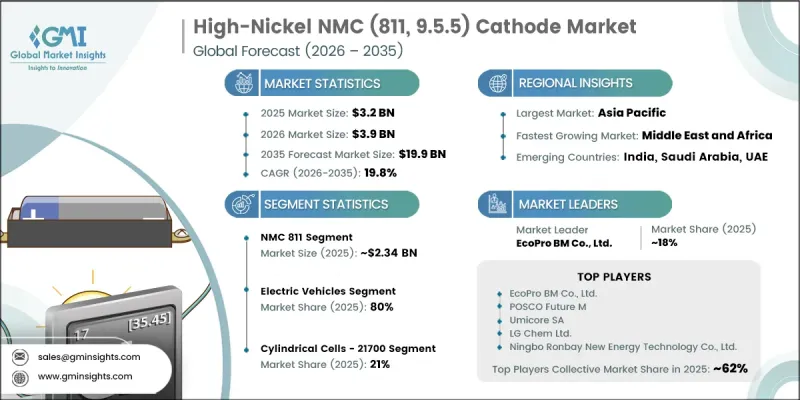
고니켈 NMC(811, 9.5.5) 양극 시장의 성장은 전 세계 전기차 보급의 지속, 코발트 의존도 저감에 초점을 맞춘 배터리 재료 전략의 진화, 그리고 주요 배터리 생산 지역의 양극 활물질 생산 능력에 대한 대규모 투자에 힘입어 견인되고 있습니다. 현지화된 배터리 공급망과 국내 생산 이니셔티브에 대한 규제 측면의 지원 덕분에, 지역별 양극 제조 생태계의 개발이 가속화되고 있습니다. 동시에, 고니켈 양극재는 더 높은 에너지 밀도를 실현할 수 있다는 점에서 점점 더 많은 지지를 얻고 있으며, 첨단 배터리 분야에서 매력적인 선택지로 떠오르고 있습니다. 견조한 성장 전망이 있는 반면, 업계는 여전히 원자재 가격 변동과 관련된 과제에 직면해 있으며, 이는 생산의 수익성 및 장기적인 투자 계획에 영향을 미칠 가능성이 있습니다. 또한, 고니켈 양극재의 기술적 특성상 안전하고 신뢰성 높은 성능을 확보하기 위해서는 고도의 배터리 관리 및 열 제어 솔루션이 필요합니다. 또한, 배터리 조달, 공급망 규정 준수 및 국내 제조 요건을 규정하는 규제 체계 역시 전 세계 배터리 산업 전반의 경쟁 동향과 조달 결정을 형성하는 데 있어 점점 더 중요한 역할을 하고 있습니다.
| 시장 범위 | |
|---|---|
| 개시 연도 | 2025년 |
| 예측 기간 | 2026-2035년 |
| 개시 금액 | 32억 달러 |
| 예측 금액 | 199억 달러 |
| CAGR | 19.8% |
NMC 811 부문은 73%의 시장 점유율을 차지했으며, 2025년에는 23억 4,000만 달러의 매출을 올렸습니다. 이러한 확고한 시장 지위는 기존 배터리 제조 플랫폼에서의 광범위한 채택과, 에너지 밀도와 상업적 확장성 사이에서 적절한 균형을 제공할 수 있는 능력에 의해 뒷받침되고 있습니다. 재료 공학의 지속적인 발전으로 인해 구조적 안정성, 열 성능 및 작동 신뢰성이 더욱 향상되어, 까다로운 요구 사항이 있는 배터리 분야에서 더 폭넓게 채택되고 있습니다.
에너지 저장 시스템 부문은 3%의 점유율을 차지하고 있으며, 2035년까지 연평균 성장률(CAGR) 19.8%로 성장할 것으로 전망됩니다. 첨단 에너지 저장 인프라의 도입 확대는 특히 제한된 공간 내에서 에너지 밀도를 극대화하는 것이 여전히 중요한 과제로 남아 있는 설치 현장에서 고니켈 양극 기술에 새로운 기회를 창출하고 있습니다.
북미의 고니켈 NMC(811, 9.5.5) 양극 시장은 2025년에 11%의 점유율을 차지했으며, 2035년까지 연평균 성장률(CAGR) 17.2%로 성장할 것으로 전망됩니다. 이 지역은 제조 지원 정책, 공급망 현지화를 위한 노력, 그리고 국내 배터리 생산 능력을 강화하기 위해 마련된 조달 요건의 혜택을 받고 있습니다. 이러한 추세는 양극 활물질 제조에 대한 투자를 가속화하여, 해당 지역이 기존에 수입에 의존하던 시장에서 보다 자립적이고 세계적으로 경쟁력 있는 배터리 재료 생태계로 전환하는 데 기여하고 있습니다.
자주 묻는 질문
목차
제1장 조사 방법과 범위
제2장 주요 요약
제3장 업계 인사이트
제4장 경쟁 구도
제5장 시장 추산 및 예측 : NMC 등급별, 2022년-2035년
제6장 시장 추산 및 예측 : 용도별, 2022년-2035년
제7장 시장 추산 및 예측 : 배터리 셀 형식별, 2022년-2035년
제8장 시장 추산 및 예측 : 지역별, 2022년-2035년
제9장 기업 개요
LSH 26.07.14The Global High-Nickel NMC (811, 9.5.5) Cathode Market was valued at USD 3.2 billion in 2025 and is estimated to grow at a CAGR of 19.8% to reach USD 19.9 billion by 2035.
Growth in the High-Nickel NMC (811, 9.5.5) Cathode Market is driven by continued global electric vehicle adoption, evolving battery material strategies focused on reducing cobalt dependency, and significant investments in cathode active material manufacturing capacity across major battery-producing regions. Regulatory support for localized battery supply chains and domestic production initiatives is accelerating the development of regional cathode manufacturing ecosystems. At the same time, high-nickel cathode chemistries are increasingly favored for their ability to deliver higher energy density, making them attractive for advanced battery applications. Despite strong growth prospects, the industry continues to face challenges related to raw material price fluctuations, which can affect production economics and long-term investment planning. In addition, the technical characteristics of high-nickel cathode materials require advanced battery management and thermal control solutions to ensure safe and reliable performance. Regulatory frameworks governing battery sourcing, supply chain compliance, and domestic manufacturing requirements are also playing an increasingly important role in shaping competitive dynamics and procurement decisions across the global battery industry.
| Market Scope | |
|---|---|
| Start Year | 2025 |
| Forecast Year | 2026-2035 |
| Start Value | $3.2 Billion |
| Forecast Value | $19.9 Billion |
| CAGR | 19.8% |
The NMC 811 segment accounted for 73% share, generating USD 2.34 billion in 2025. Its strong market position is supported by widespread adoption across established battery manufacturing platforms and its ability to provide a favorable balance between energy density and commercial scalability. Continuous advancements in material engineering are further enhancing structural stability, thermal performance, and operational reliability, supporting broader adoption across demanding battery applications.
The energy storage systems segment held 3% share and is projected to grow at a CAGR of 19.8% through 2035. Increasing deployment of advanced energy storage infrastructure is creating opportunities for high-nickel cathode technologies, particularly in installations where maximizing energy density within limited space remains a critical consideration.
North America High-Nickel NMC (811, 9.5.5) Cathode Market held 11% share in 2025 and is expected to grow at a CAGR of 17.2% through 2035. The region is benefiting from supportive manufacturing incentives, supply chain localization initiatives, and sourcing requirements designed to strengthen domestic battery production capabilities. These developments are accelerating investment in cathode active material manufacturing and contributing to the region's transition from a historically import-dependent market toward a more self-sustaining and globally competitive battery materials ecosystem.
Key companies operating in the Global High-Nickel NMC (811, 9.5.5) Cathode Market include POSCO Future M, EcoPro BM Co., Ltd., LG Chem Ltd., Umicore SA, Ningbo Ronbay New Energy Technology Co., Ltd., Sumitomo Metal Mining Co., Ltd., Beijing Easpring Material Technology Co., Ltd., Huayou Cobalt Co., Ltd., Hunan Shanshan Advanced Materials Co., Ltd., and BASF SE. Companies operating in the High-Nickel NMC (811, 9.5.5) Cathode Market are focusing on capacity expansion, technology innovation, and supply chain integration to strengthen their market position and enhance long-term competitiveness. Significant investments are being directed toward advanced cathode material research aimed at improving energy density, safety characteristics, cycle life, and manufacturing efficiency. Many industry participants are expanding production facilities and establishing regional manufacturing hubs to align with evolving localization requirements and growing battery demand. Strategic partnerships with battery manufacturers, automotive companies, and raw material suppliers are helping secure long-term supply agreements and improve market access. Companies are also emphasizing sustainable sourcing practices, process optimization, and vertical integration to reduce supply chain risks and improve cost control.
Table of Contents
Chapter 1 Methodology & Scope
- 1.1 Market scope and definition
- 1.2 Research design
- 1.2.1 Research approach
- 1.2.2 Data collection methods
- 1.3 Data mining sources
- 1.3.1 Global
- 1.3.2 Regional/Country
- 1.4 Base estimates and calculations
- 1.4.1 Base year calculation
- 1.4.2 Key trends for market estimation
- 1.5 Primary research and validation
- 1.5.1 Primary sources
- 1.6 Forecast model
- 1.7 Research assumptions and limitations
Chapter 2 Executive Summary
- 2.1 Industry 360° synopsis
- 2.2 Key market trends
- 2.2.1 NMC grade
- 2.2.2 Application
- 2.2.3 Battery cell format
- 2.2.4 Regional
- 2.3 TAM Analysis, 2026-2035
- 2.4 CXO perspectives: Strategic imperatives
Chapter 3 Industry Insights
- 3.1 Industry ecosystem analysis
- 3.1.1 Supplier landscape
- 3.1.2 Profit margin
- 3.1.3 Value addition at each stage
- 3.1.4 Factor affecting the value chain
- 3.1.5 Disruptions
- 3.2 Industry impact forces
- 3.2.1 Growth drivers
- 3.2.2 Industry pitfalls and challenges
- 3.2.3 Market opportunities
- 3.3 Growth potential analysis
- 3.4 Regulatory landscape
- 3.4.1 North America
- 3.4.2 Europe
- 3.4.3 Asia Pacific
- 3.4.4 Latin America
- 3.4.5 Middle East & Africa
- 3.5 Porter's analysis
- 3.6 PESTEL analysis
- 3.7 Price trends
- 3.7.1 By region
- 3.7.2 By NMC grade
- 3.8 Future market trends
- 3.9 Technology and Innovation landscape
- 3.9.1 Current technological trends
- 3.9.2 Emerging technologies
- 3.10 Patent Landscape
- 3.11 Trade statistics (HS code)
- 3.11.1 Major importing countries
- 3.11.2 Major exporting countries
- 3.12 Sustainability and environmental aspects
- 3.12.1 Sustainable practices
- 3.12.2 Waste reduction strategies
- 3.12.3 Energy efficiency in production
- 3.12.4 Eco-friendly initiatives
- 3.13 Carbon footprint consideration
Chapter 4 Competitive Landscape, 2025
- 4.1 Introduction
- 4.2 Company market share analysis
- 4.2.1 By region
- 4.2.1.1 North America
- 4.2.1.2 Europe
- 4.2.1.3 Asia Pacific
- 4.2.1.4 LATAM
- 4.2.1.5 MEA
- 4.2.1 By region
- 4.3 Competitive analysis of major market players
- 4.4 Competitive positioning matrix
- 4.5 Key developments
- 4.5.1 Mergers & acquisitions
- 4.5.2 Partnerships & collaborations
- 4.5.3 New Product Launches
- 4.5.4 Expansion Plans
Chapter 5 Market Estimates and Forecast, By NMC Grade, 2022-2035 (USD Billion) (Tons)
- 5.1 Key trends
- 5.2 NMC 811
- 5.2.1 Polycrystalline NMC 811
- 5.2.2 Single - crystal NMC 811
- 5.2.3 Doped NMC 811 (Al, Zr, W, Ti)
- 5.3 NMC 9.5.5/ NMC 955
- 5.3.1 Standard polycrystalline NMC 9.5.5
- 5.3.2 Surface-coated & CG-stabilized NMC 9.5.5
- 5.4 Other high-nickel variants
- 5.4.1 NMC 712 transitional
- 5.4.2 Ultra - high Ni
Chapter 6 Market Estimates and Forecast, By Application, 2022-2035 (USD Billion) (Tons)
- 6.1 Key trends
- 6.2 Electric vehicles
- 6.2.1 BEV
- 6.2.2 PHEV
- 6.2.3 HEV
- 6.2.4 Commercial EV
- 6.3 Energy storage systems
- 6.3.1 Utility & grids
- 6.3.2 C&I
- 6.3.3 Residential
- 6.4 Consumer electronics
- 6.4.1 Smartphones & tablets
- 6.4.2 Laptops & notebooks
- 6.4.3 Wearables & hearables
- 6.5 Other applications
- 6.5.1 E-bikes & E-scooters
- 6.5.2 Power tools
- 6.5.3 Medical devices
- 6.5.4 Aerospace & defense
Chapter 7 Market Estimates and Forecast, By Battery Cell Format, 2022-2035 (USD Billion) (Tons)
- 7.1 Key trends
- 7.2 Cylindrical cells
- 7.2.1 187650
- 7.2.2 21700
- 7.2.3 4680
- 7.3 Prismatic cells
- 7.3.1 Aluminum-case
- 7.3.2 Steel-case
- 7.4 Pouch cells
- 7.4.1 Standard laminate
- 7.4.2 Bipolar/stack architecture
Chapter 8 Market Estimates and Forecast, By Region, 2022-2035 (USD Billion) (Tons)
- 8.1 Key trends
- 8.2 North America
- 8.2.1 U.S.
- 8.2.2 Canada
- 8.3 Europe
- 8.3.1 Germany
- 8.3.2 UK
- 8.3.3 France
- 8.3.4 Spain
- 8.3.5 Italy
- 8.3.6 Rest of Europe
- 8.4 Asia Pacific
- 8.4.1 China
- 8.4.2 India
- 8.4.3 Japan
- 8.4.4 Australia
- 8.4.5 South Korea
- 8.4.6 Rest of Asia Pacific
- 8.5 Latin America
- 8.5.1 Brazil
- 8.5.2 Mexico
- 8.5.3 Argentina
- 8.5.4 Rest of Latin America
- 8.6 Middle East and Africa
- 8.6.1 Saudi Arabia
- 8.6.2 South Africa
- 8.6.3 UAE
- 8.6.4 Rest of Middle East and Africa
Chapter 9 Company Profiles
- 9.1 EcoPro BM Co., Ltd.
- 9.2 POSCO Future M
- 9.3 Umicore SA
- 9.4 LG Chem Ltd.
- 9.5 Ningbo Ronbay New Energy Technology Co., Ltd.
- 9.6 Sumitomo Metal Mining Co., Ltd.
- 9.7 Beijing Easpring Material Technology Co., Ltd.
- 9.8 Hunan Shanshan Advanced Materials Co., Ltd.
- 9.9 Huayou Cobalt Co., Ltd.
- 9.10 BASF SE


