

|
시장보고서
상품코드
2083251
큐브위성 시장 기회, 성장 촉진요인, 업계 동향 분석 및 예측(2026-2035년)CubeSat Market Opportunity, Growth Drivers, Industry Trend Analysis, and Forecast 2026 - 2035 |
||||||

세계의 큐브위성 시장은 2025년에 5억 1,260만 달러로 평가되었고, CAGR 14.4%로 성장하여 2035년까지 20억 달러에 달할 것으로 추정되고 있습니다.
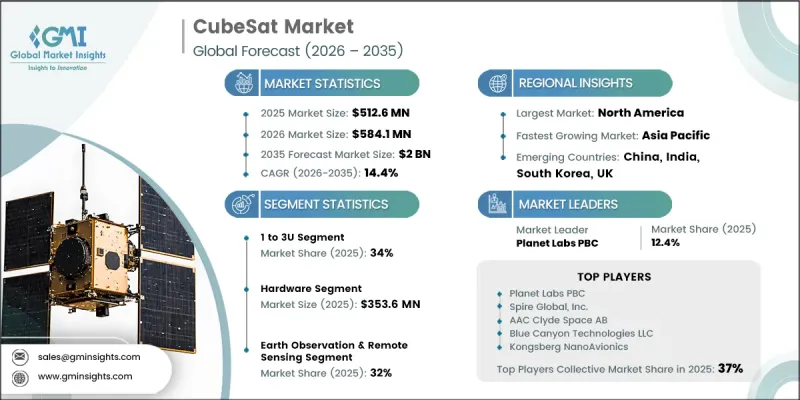
큐브위성 시장은 정부의 우주 프로그램과 국방 현대화 노력에 힘입어 소형 위성 임무가 확대되고, 우주 기반 서비스에 대한 상업적 관심이 높아지는 가운데, 강력한 성장세를 보이고 있습니다. 지구관측, 원격 감지, 실시간 지리 공간 정보에 대한 수요가 증가함에 따라 여러 최종 용도 분야에서 이러한 기술의 도입이 가속화되고 있습니다. 통신, 항법, 국가 안보 용도로 사용되는 위성 군집의 확대 역시 시장의 성장세를 더욱 가속화하고 있습니다. 소형 위성 기술의 지속적인 발전으로 성능이 향상되는 한편, 개발 비용과 발사 비용도 절감되고 있습니다. 또한, 저궤도 아키텍처의 활용이 확대됨에 따라, 보다 효율적인 데이터 전송과 전 세계적으로 더 광범위한 커버리지가 가능해졌습니다. 민간 우주 기업과 연구 기관 시장 진입이 늘어나면서 시장의 다양화에도 기여하고 있습니다. 비용 효율이 높은 위성 통신 시스템과 IoT(사물 인터넷) 연결의 중요성이 커지고 있는 점도 상업적 기회를 더욱 확대시키고 있습니다. 이러한 요인들이 복합적으로 작용하여, 급속한 혁신, 용도의 확대, 그리고 과학, 국방, 상업 임무에 걸친 전 세계적 확산을 특징으로 하는 매우 역동적인 큐브위성 생태계가 형성되고 있습니다.
| 시장 범위 | |
|---|---|
| 개시 연도 | 2025년 |
| 예측 기간 | 2026-2035년 |
| 개시 금액 | 5억 1,260만 달러 |
| 예측 금액 | 20억 달러 |
| CAGR | 14.4% |
2025년에는 1U-3U 큐브위성 부문이 시장 점유율의 34%를 차지했습니다. 이러한 압도적인 시장 점유율은 기술 실증 임무, 교육용 우주 프로그램, 지구관측 프로젝트 및 통신 기반 용도 분야에서 널리 활용되고 있기 때문입니다. 컴팩트한 설계, 표준화된 배포 호환성, 그리고 비교적 낮은 제조 요건 덕분에 이러한 구성은 대학, 정부 기관 및 민간 개발자에게 매우 적합합니다. 공동 발사 기회 증가와 소형 페이로드 시스템의 지속적인 개선이 과학, 상업, 국방 분야 임무에 대한 수요를 더욱 부추기고 있습니다.
하드웨어 분야 시장 규모는 2025년에 3억 5,360만 달러에 달했습니다. 이러한 성장은 지구관측, 통신 서비스, 우주 탐사, 국방 용도로 활용되는 큐브위성 군집의 확대에 힘입어 이루어지고 있습니다. 이 부문에는 구조 시스템, 탑재체, 추진 장치, 전원 시스템, 통신 모듈, 탑재형 컴퓨팅 시스템 등의 주요 구성 요소가 포함됩니다. 우주 프로그램에 대한 정부 투자 증가, 위성 발사 활동의 활성화, 그리고 위성 소형화 기술의 지속적인 발전이 수요를 뒷받침하고 있습니다. 저궤도 위성 네트워크의 확대는 하드웨어 부문의 수익 창출을 더욱 촉진하고 있습니다.
2025년, 북미의 큐브위성 시장은 41%의 점유율을 차지했습니다. 이 지역이 주도적인 위치를 차지하고 있는 배경에는 우주 프로그램에 대한 막대한 투자, 성숙한 위성 제조 생태계, 그리고 국방, 통신, 지구관측 용도의 큐브위성 군집 구축 확대가 있습니다. 주요 우주 기관 및 방위 기관이 주도하는 활동의 확대는 해당 지역 시장 성장을 더욱 촉진하고, 소형 위성 기술 분야의 지속적인 혁신을 뒷받침하고 있습니다.
자주 묻는 질문
목차
제1장 조사 방법과 범위
제2장 주요 요약
제3장 업계 인사이트
제4장 경쟁 구도
제5장 시장 추산 및 예측 : 사이즈별, 2022년-2035년
제6장 시장 추산 및 예측 : 컴포넌트별, 2022년-2035년
제7장 시장 추산 및 예측 : 용도별, 2022년-2035년
제8장 시장 추산 및 예측 : 최종사용자별, 2022년-2035년
제9장 시장 추산 및 예측 : 지역별, 2022년-2035년
제10장 기업 개요
LSH 26.07.14The Global CubeSat Market was valued at USD 512.6 million in 2025 and is estimated to grow at a CAGR of 14.4% to reach USD 2 billion by 2035.
The CubeSat market is experiencing strong expansion driven by the rising deployment of small satellite missions supported by government space programs, defense modernization initiatives, and increasing commercial interest in space-based services. Growing demand for Earth observation, remote sensing, and real-time geospatial intelligence is accelerating adoption across multiple end-use sectors. The expansion of satellite constellations for communication, navigation, and national security applications is further strengthening market momentum. Continuous advancements in miniaturized satellite technologies are improving performance capabilities while reducing development and launch costs. In addition, the growing utilization of low Earth orbit architectures is enabling more efficient data transmission and broader global coverage. Increasing participation from private space companies and research institutions is also contributing to market diversification. The rising importance of cost-efficient satellite communication systems and Internet of Things connectivity is further expanding commercial opportunities. Collectively, these factors are shaping a highly dynamic CubeSat ecosystem characterized by rapid innovation, expanding applications, and increasing global deployment across scientific, defense, and commercial missions.
| Market Scope | |
|---|---|
| Start Year | 2025 |
| Forecast Year | 2026-2035 |
| Start Value | $512.6 Million |
| Forecast Value | $2 Billion |
| CAGR | 14.4% |
The 1U to 3U CubeSat segment accounted for 34% share in 2025. This dominance is attributed to its widespread use across technology demonstration missions, educational space programs, Earth observation projects, and communication-based applications. The compact design, standardized deployment compatibility, and relatively lower manufacturing requirements make these configurations highly suitable for universities, government agencies, and commercial developers. Increasing availability of rideshare launch opportunities and continuous improvements in miniaturized payload systems are further supporting demand across scientific, commercial, and defense-oriented missions.
The hardware segment reached USD 353.6 million in 2025. This growth is driven by the expanding deployment of CubeSat constellations used for Earth observation, communication services, space research, and defense applications. The segment includes key components such as structural systems, payloads, propulsion units, power systems, communication modules, and onboard computing systems. Rising government investments in space programs, increasing satellite launch activities, and ongoing advancements in satellite miniaturization technologies are strengthening demand. The growing deployment of low Earth orbit satellite networks is further enhancing revenue generation within the hardware segment.
North America CubeSat Market accounted for 41% share in 2025. The region's leadership is supported by substantial investments in space programs, a mature satellite manufacturing ecosystem, and increasing deployment of CubeSat constellations for defense, communication, and Earth observation applications. Expanding initiatives led by major space agencies and defense organizations are further strengthening regional market growth and supporting continuous innovation in small satellite technologies.
Major companies operating in the Global CubeSat Market include Planet Labs PBC, Spire Global, Inc., Lockheed Martin Corporation, AAC Clyde Space AB, Blue Canyon Technologies LLC, EnduroSat AD, GomSpace A/S, ISISPACE (Innovative Solutions In Space), Kongsberg NanoAvionics, Open Cosmos Ltd., Orbital Astronautics Ltd. (OrbAstro), Pumpkin Space Systems, SFL Missions Inc., Surrey Satellite Technology Ltd. (SSTL), and Terran Orbital / Tyvak. Companies operating in the CubeSat market are strengthening their competitive position through continuous investment in miniaturized satellite technologies, advanced payload development, and scalable constellation architectures. Market participants are focusing on improving system reliability, reducing production costs, and enhancing mission flexibility to support diverse applications across defense, commercial, and scientific sectors. Strategic partnerships with government agencies, space research organizations, and private aerospace firms are enabling faster deployment and broader mission integration. Companies are also expanding manufacturing capabilities to support large-scale constellation deployment while improving launch efficiency through rideshare collaborations.
Table of Contents
Chapter 1 Methodology and Scope
- 1.1 Market scope and definition
- 1.2 Research design
- 1.2.1 Research approach
- 1.2.2 Data collection methods
- 1.3 Data mining sources
- 1.3.1 Global
- 1.3.2 Regional/Country
- 1.4 Base estimates and calculations
- 1.4.1 Base year calculation
- 1.4.2 Key trends for market estimation
- 1.5 Primary research and validation
- 1.5.1 Primary sources
- 1.6 Forecast model
- 1.7 Research assumptions and limitations
Chapter 2 Executive Summary
- 2.1 Industry 360° synopsis, 2022 - 2035
- 2.2 Key market trends
- 2.2.1 Size trends
- 2.2.2 Component trends
- 2.2.3 Application trends
- 2.2.4 End-user trends
- 2.2.5 Regional trends
- 2.3 TAM Analysis, 2026-2035
- 2.4 CXO perspectives: Strategic imperatives
Chapter 3 Industry Insights
- 3.1 Industry ecosystem analysis
- 3.1.1 Supplier Landscape
- 3.1.2 Profit Margin
- 3.1.3 Cost structure
- 3.1.4 Value addition at each stage
- 3.1.5 Factor affecting the value chain
- 3.1.6 Disruptions
- 3.2 Industry impact forces
- 3.2.1 Growth drivers
- 3.2.1.1 Increasing government investments in small satellite programs
- 3.2.1.2 Growing demand for Earth observation and remote sensing applications
- 3.2.1.3 Expansion of defense and national security satellite constellations
- 3.2.1.4 Advancements in miniaturized satellite technologies
- 3.2.1.5 Rising adoption of satellite communication and IoT connectivity solutions
- 3.2.2 Industry pitfalls and challenges
- 3.2.2.1 Limited payload capacity and power constraints
- 3.2.2.2 Space debris and orbital congestion risks
- 3.2.3 Market opportunities
- 3.2.3.1 Expansion of satellite-based IoT and connectivity services
- 3.2.3.2 Increasing adoption in Earth observation and climate monitoring missions
- 3.2.1 Growth drivers
- 3.3 Growth potential analysis
- 3.4 Regulatory landscape
- 3.4.1 North America
- 3.4.2 Europe
- 3.4.3 Asia Pacific
- 3.4.4 Latin America
- 3.4.5 Middle East & Africa
- 3.5 Porter’s analysis
- 3.6 PESTEL analysis
- 3.7 Technology and Innovation landscape
- 3.7.1 Current technological trends
- 3.7.2 Emerging technologies
- 3.8 Price trends
- 3.8.1 By region
- 3.8.2 By product
- 3.9 Pricing Strategies
- 3.10 Emerging Business Models
- 3.11 Compliance Requirements
- 3.12 Patent and IP analysis
Chapter 4 Competitive Landscape, 2025
- 4.1 Introduction
- 4.2 Company market share analysis
- 4.2.1 By region
- 4.2.1.1 North America
- 4.2.1.2 Europe
- 4.2.1.3 Asia Pacific
- 4.2.1.4 Latin America
- 4.2.1.5 Middle East & Africa
- 4.2.2 Market concentration analysis
- 4.2.1 By region
- 4.3 Competitive benchmarking of key players
- 4.3.1 Financial performance comparison
- 4.3.1.1 Revenue
- 4.3.1.2 Profit margin
- 4.3.1.3 R&D
- 4.3.2 Product portfolio comparison
- 4.3.2.1 Product range breadth
- 4.3.2.2 Technology
- 4.3.2.3 Innovation
- 4.3.3 Geographic presence comparison
- 4.3.3.1 Global footprint analysis
- 4.3.3.2 Service network coverage
- 4.3.3.3 Market penetration by region
- 4.3.4 Competitive positioning matrix
- 4.3.4.1 Leaders
- 4.3.4.2 Challengers
- 4.3.4.3 Followers
- 4.3.4.4 Niche players
- 4.3.5 Strategic outlook matrix
- 4.3.1 Financial performance comparison
- 4.4 Key developments
- 4.4.1 Mergers and acquisitions
- 4.4.2 Partnerships and collaborations
- 4.4.3 Technological advancements
- 4.4.4 Expansion and investment strategies
- 4.4.5 Digital transformation initiatives
- 4.5 Emerging/ startup competitors landscape
Chapter 5 Market Estimates and Forecast, By Size, 2022 - 2035 (USD Million)
- 5.1 Key trends
- 5.2 0.25U to 1U
- 5.3 1 to 3U
- 5.4 3U to 6U
- 5.5 6U to 12U
- 5.6 12U and Above
Chapter 6 Market Estimates and Forecast, By Component, 2022 - 2035 (USD Million)
- 6.1 Key trends
- 6.2 Hardware
- 6.2.1 Payloads
- 6.2.2 Structure
- 6.2.3 Electrical power systems (eps)
- 6.2.4 Attitude determination & control systems (adcs)
- 6.2.5 Propulsion systems
- 6.2.6 Communication systems
- 6.2.7 Others
- 6.3 Software
- 6.3.1 Flight software
- 6.3.2 Ground control software
- 6.3.3 Data processing & ai/ml solutions
- 6.4 Services
- 6.4.1 Integration & testing
- 6.4.2 Launch services
- 6.4.3 Mission operations & ground support
Chapter 7 Market Estimates and Forecast, By Application, 2022 - 2035 (USD Million)
- 7.1 Key trends
- 7.2 Earth observation & remote sensing
- 7.3 Communication & connectivity
- 7.4 Scientific research & space exploration
- 7.5 Technology demonstration
- 7.6 Defense & surveillance
- 7.7 Meteorology & weather monitoring
- 7.8 Iot connectivity & navigation
- 7.9 Others
Chapter 8 Market Estimates and Forecast, By End-user, 2022 - 2035 (USD Million)
- 8.1 Key trends
- 8.2 Government & civil space agencies
- 8.3 Military & defense organizations
- 8.4 Commercial enterprises
- 8.5 Academic & research institutions
- 8.6 Non-profit organizations
Chapter 9 Market Estimates and Forecast, By Region, 2022 - 2035 (USD Million)
- 9.1 Key trends
- 9.2 North America
- 9.2.1 U.S.
- 9.2.2 Canada
- 9.3 Europe
- 9.3.1 Germany
- 9.3.2 UK
- 9.3.3 France
- 9.3.4 Spain
- 9.3.5 Italy
- 9.4 Asia Pacific
- 9.4.1 China
- 9.4.2 India
- 9.4.3 Japan
- 9.4.4 Australia
- 9.4.5 South Korea
- 9.5 Latin America
- 9.5.1 Brazil
- 9.5.2 Mexico
- 9.5.3 Argentina
- 9.6 Middle East and Africa
- 9.6.1 South Africa
- 9.6.2 Saudi Arabia
- 9.6.3 UAE
Chapter 10 Company Profiles
- 10.1 Global Key Players
- 10.1.1 Planet Labs PBC
- 10.1.2 Spire Global, Inc.
- 10.1.3 GomSpace A/S
- 10.1.4 AAC Clyde Space AB
- 10.1.5 Blue Canyon Technologies LLC (Raytheon Technologies)
- 10.2 Regional key players
- 10.2.1 North America
- 10.2.1.1 Lockheed Martin Corporation
- 10.2.1.2 Terran Orbital / Tyvak
- 10.2.2 Asia Pacific
- 10.2.2.1 ISISPACE -Innovative Solutions In Space
- 10.2.3 Europe
- 10.2.3.1 Kongsberg NanoAvionics
- 10.2.3.2 Surrey Satellite Technology Ltd.
- 10.2.3.3 SFL Missions Inc.
- 10.2.1 North America
- 10.3 Niche Players/Disruptors
- 10.3.1 EnduroSat AD (Bulgaria)
- 10.3.2 Open Cosmos Ltd.
- 10.3.3 Pumpkin Space Systems
- 10.3.4 Orbital Astronautics Ltd.


