|
시장보고서
상품코드
2083258
고부가가치 어종용 아쿠아포닉스 및 순환식 양식 시스템(RAS) 시장 기회, 성장 촉진요인, 업계 동향 분석 및 예측(2026-2035년)Aquaponics and RAS for High-Value Fish Market Opportunity, Growth Drivers, Industry Trend Analysis, and Forecast 2026 - 2035 |
||||||

고부가가치 어종용 아쿠아포닉스 및 순환식 양식 시스템(RAS) 세계 시장은 2025년에 23억 달러로 평가되었고, CAGR 12.5%로 성장하여 2035년까지 73억 달러에 달할 것으로 추정되고 있습니다.
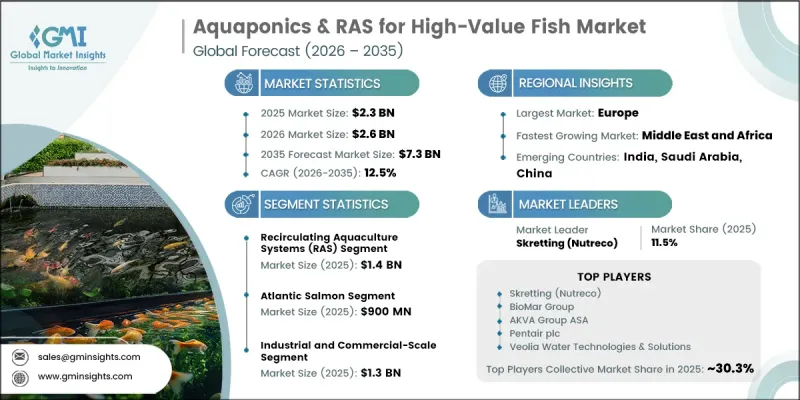
고부가가치 어종용 아쿠아포닉스 및 순환식 양식 시스템(RAS) 시장은 전 세계 수산업계에서 생물안전성 강화, 제품 추적성 확보, 연중 양식이 가능한 제어된 환경 하에서의 생산 방식이 점점 더 널리 채택됨에 따라 확대되고 있습니다. 고급 수산물에 대한 소비자 수요가 증가하고, 항생제를 사용하지 않은 단백질 공급원에 대한 선호도가 높아지며, 투명한 식품 생산에 대한 기대가 커짐에 따라 첨단 양식 기술에 대한 투자가 확대되고 있습니다. 이러한 시스템을 통해 생산자는 계절적·지리적 제약과 관계없이 일관된 품질과 생산 효율을 유지하면서 고부가가치 어종을 양식할 수 있게 됩니다. 또한, 수요가 기존 생산 방식의 생산 능력을 계속해서 상회하고 있어 양식 수산물로의 전환이 진행되고 있는 점도 이 시장의 성장에 기여하고 있습니다. 고급 어종의 소비 증가와 지속 가능하며 확장성이 있는 양식 솔루션에 대한 수요 증가가 전 세계 상업 양식 사업에 유리한 성장 기회를 창출하고 있습니다. 육상 양식에 대한 투자가 지속적으로 증가함에 따라, 고부가가치 어종을 대상으로 하는 아쿠아포닉스 및 순환식 양식 시스템(RAS) 시장은 예측 기간 동안 지속적인 성장이 예상됩니다.
| 시장 범위 | |
|---|---|
| 개시 연도 | 2025년 |
| 예측 기간 | 2026-2035년 |
| 개시 금액 | 23억 달러 |
| 예측 금액 | 73억 달러 |
| CAGR | 12.5% |
순환식 양식 시스템(RAS) 부문은 64%의 시장 점유율을 차지했으며, 2025년에는 14억 달러의 매출을 올렸습니다. 이 부문은 집약적이고 생물안전성이 뛰어난 양식을 가능하게 할 뿐만 아니라, 안정적인 운영 실적을 바탕으로 고급 어종의 상업적 규모의 생산을 실현할 수 있기 때문에 여전히 주요 생산 시스템으로서의 위상을 유지하고 있습니다. 이러한 확고한 시장 지위는 수질을 적절히 관리하고, 생산 효율을 높이며, 환경에 미치는 영향을 줄일 수 있을 뿐만 아니라, 고부가가치 수산물에 대한 전 세계적인 수요 증가에 부응할 수 있는 대규모 양식 사업을 뒷받침하고 있다는 점에 기인합니다.
연간 100 MT를 초과하는 산업·상업 규모의 사업 부문은 58%의 점유율을 차지했으며, 2025년에는 13억 달러 규모 시장을 형성했습니다. 이 부문이 시장을 독점하고 있는 이유는 대규모 생산 시설에서는 인프라 투자를 더 많은 생산량에 분산함으로써 운영 효율성이 향상되기 때문입니다. 생산 능력 확대에 따라 첨단 여과 시스템, 수처리 기술, 열 관리 장비 및 통합 모니터링 플랫폼의 비용 대비 효과는 점점 더 높아지고 있습니다. 업계 가동 데이터에 따르면, 연간 1,000MT 이상을 생산하는 시설은 연간 200 MT를 생산하는 동급 시설에 비해 1kg당 생산 비용을 약 30-40% 낮출 수 있으며, 이것이 대규모 사업에 대한 지속적인 투자를 뒷받침하고 있습니다.
북미의 고부가가치 어류를 대상으로 한 아쿠아포닉스 및 순환식 양식 시스템(RAS) 시장은 26.1%의 점유율을 차지하며, 2025년에는 6억 달러 규모 시장을 형성했습니다. 시장의 성장은 지역산 고급 수산물에 대한 활발한 수요, 산업 규모의 육상 양식 시설에 대한 투자 확대, 그리고 선진적인 어류 생산 기술을 지속적으로 장려하는 규제 환경에 힘입어 이루어지고 있습니다. 지속 가능한 수산물 생산에 대한 관심이 높아지고, 공급망의 회복탄력성에 대한 중요성이 부각됨에 따라, 세계 시장에서 북미의 입지는 계속해서 공고해지고 있습니다.
자주 묻는 질문
목차
제1장 조사 방법과 범위
제2장 주요 요약
제3장 업계 인사이트
제4장 경쟁 구도
제5장 시장 추산 및 예측 : 시스템 유형별, 2022년-2035년
제6장 시장 추산 및 예측 : 어 유형별, 2022년-2035년
제7장 시장 추산 및 예측 : 생산 단계별, 2022년-2035년
제8장 시장 추산 및 예측 : 시스템 규모별, 2022년-2035년
제9장 시장 추산 및 예측 : 지역별, 2022년-2035년
제10장 기업 개요
LSH 26.07.14The Global Aquaponics and Recirculating Aquaculture Systems (RAS) For High-Value Fish Market was valued at USD 2.3 billion in 2025 and is estimated to grow at a CAGR of 12.5% to reach USD 7.3 billion by 2035.
The aquaponics and recirculating aquaculture systems (RAS) for high-value fish market is expanding as the global seafood industry increasingly adopts controlled-environment production methods that offer enhanced biosecurity, product traceability, and year-round cultivation. Growing consumer demand for premium seafood, rising preference for antibiotic-free protein sources, and increasing expectations for transparent food production are encouraging greater investment in advanced aquaculture technologies. These systems enable producers to cultivate high-value fish species regardless of seasonal limitations or geographic constraints while maintaining consistent quality and production efficiency. The market is also benefiting from the ongoing transition toward farmed seafood as demand continues to outpace the capacity of conventional production methods. Increasing consumption of premium fish varieties and the need for sustainable, scalable aquaculture solutions are creating favorable growth opportunities across commercial operations worldwide. As investments in land-based fish production continue to rise, the aquaponics and recirculating aquaculture systems (RAS) for high-value fish market is expected to experience sustained expansion throughout the forecast period.
| Market Scope | |
|---|---|
| Start Year | 2025 |
| Forecast Year | 2026-2035 |
| Start Value | $2.3 Billion |
| Forecast Value | $7.3 Billion |
| CAGR | 12.5% |
The recirculating aquaculture systems (RAS) segment accounted for 64% share, generating USD 1.4 billion in 2025. This segment remains the leading production system because it supports intensive, biosecure cultivation while enabling commercial-scale production of premium fish species with consistent operational performance. Its strong market position is driven by the ability to maintain controlled water quality, improve production efficiency, reduce environmental impact, and support large-scale fish farming operations capable of meeting increasing global demand for high-value seafood.
The industrial and commercial-scale operations exceeding 100 MT per year segment represented 58% share, generating USD 1.3 billion in 2025. This segment dominates the market because large-scale production facilities benefit from improved operational economics by spreading infrastructure investments across greater production volumes. Advanced filtration systems, water treatment technologies, thermal management equipment, and integrated monitoring platforms become increasingly cost-efficient as production capacity expands. Industry operating data indicates that facilities producing more than 1,000 MT per year can achieve production costs approximately 30-40% lower on a per-kilogram basis than comparable facilities operating at 200 MT per year, supporting continued investment in large-scale operations.
North America Aquaponics and Recirculating Aquaculture Systems (RAS) For High-Value Fish Market accounted for 26.1% share, generating USD 600 million in 2025. Market growth is supported by strong demand for locally produced premium seafood, increasing investment in industrial-scale land-based aquaculture facilities, and a regulatory environment that continues to encourage advanced fish production technologies. Rising interest in sustainable seafood production and greater emphasis on supply chain resilience continue to strengthen North America's position within the global market.
Major companies operating in the global aquaponics and recirculating aquaculture systems (RAS) for high-value fish market include Nordic Aquafarms, Cermaq Group AS, AquaMaof Technologies Ltd., Aller Aqua Group, Atlantic Sapphire AS, Billund Aquaculture Service A/S, Kingfish Zeeland B.V., Mowi ASA, Salmon Evolution ASA, Cargill Aqua Nutrition (EWOS), and Grieg Seafood ASA. Companies operating in the aquaponics and recirculating aquaculture systems (RAS) for high-value fish market are strengthening their competitive position by investing in advanced water treatment technologies, automated monitoring systems, and energy-efficient production facilities that improve operational performance and fish health. Many organizations are expanding commercial-scale production capacity while adopting digital management platforms to optimize water quality, feeding efficiency, and overall productivity. Strategic investments in research and development are supporting innovations in sustainable aquaculture, biosecurity, and resource optimization. Companies are also forming partnerships across the aquaculture value chain to strengthen distribution, improve production capabilities, and expand market access.
Table of Contents
Chapter 1 Methodology & Scope
- 1.1 Market scope and definition
- 1.2 Research design
- 1.2.1 Research approach
- 1.2.2 Data collection methods
- 1.3 Data mining sources
- 1.3.1 Global
- 1.3.2 Regional/Country
- 1.4 Base estimates and calculations
- 1.4.1 Base year calculation
- 1.4.2 Key trends for market estimation
- 1.5 Primary research and validation
- 1.5.1 Primary sources
- 1.6 Forecast model
- 1.7 Research assumptions and limitations
Chapter 2 Executive Summary
- 2.1 Industry 360° synopsis
- 2.2 Key market trends
- 2.2.1 System type
- 2.2.2 Fish species
- 2.2.3 Production Stage
- 2.2.4 System scale
- 2.2.5 Regional
- 2.3 TAM Analysis, 2026-2035
- 2.4 CXO perspectives: Strategic imperatives
Chapter 3 Industry Insights
- 3.1 Industry ecosystem analysis
- 3.1.1 Supplier landscape
- 3.1.2 Profit margin
- 3.1.3 Value addition at each stage
- 3.1.4 Factor affecting the value chain
- 3.1.5 Disruptions
- 3.2 Industry impact forces
- 3.2.1 Growth drivers
- 3.2.2 Industry pitfalls and challenges
- 3.2.3 Market opportunities
- 3.3 Growth potential analysis
- 3.4 Regulatory landscape
- 3.4.1 North America
- 3.4.2 Europe
- 3.4.3 Asia Pacific
- 3.4.4 Latin America
- 3.4.5 Middle East & Africa
- 3.5 Porter's analysis
- 3.6 PESTEL analysis
- 3.7 Price trends
- 3.7.1 By region
- 3.7.2 By seed type
- 3.8 Future market trends
- 3.9 Technology and Innovation landscape
- 3.9.1 Current technological trends
- 3.9.2 Emerging technologies
- 3.10 Patent Landscape
- 3.11 Trade statistics (HS code)
- 3.11.1 Major importing countries
- 3.11.2 Major exporting countries
- 3.12 Sustainability and environmental aspects
- 3.12.1 Sustainable practices
- 3.12.2 Waste reduction strategies
- 3.12.3 Energy efficiency in production
- 3.12.4 Eco-friendly initiatives
- 3.13 Carbon footprint consideration
Chapter 4 Competitive Landscape, 2025
- 4.1 Introduction
- 4.2 Company market share analysis
- 4.2.1 By region
- 4.2.1.1 North America
- 4.2.1.2 Europe
- 4.2.1.3 Asia Pacific
- 4.2.1.4 LATAM
- 4.2.1.5 MEA
- 4.2.1 By region
- 4.3 Competitive analysis of major market players
- 4.4 Competitive positioning matrix
- 4.5 Key developments
- 4.5.1 Mergers & acquisitions
- 4.5.2 Partnerships & collaborations
- 4.5.3 New Product Launches
- 4.5.4 Expansion Plans
Chapter 5 Market Estimates and Forecast, By System Type, 2022-2035 (USD Billion)
- 5.1 Key trends
- 5.2 Recirculating aquaculture systems (RAS)
- 5.2.1 Freshwater RAS
- 5.2.2 Saltwater/marine RAS
- 5.2.3 Brackish water RAS
- 5.3 Aquaponic systems
- 5.3.1 Coupled aquaponic systems
- 5.3.2 Decoupled aquaponic systems
- 5.3.3 Parallel unit process aquaponics
- 5.4 Hybrid RAS-BFT systems
- 5.5 Photovoltaic-integrated RAS (PV-RAS)
- 5.6 Others/emerging system types
Chapter 6 Market Estimates and Forecast, By Fish Species, 2022-2035 (USD Million)
- 6.1 Key trends
- 6.2 Atlantic salmon
- 6.2.1 Post-smolt production (RAS pre-sea transfer)
- 6.2.2 Full cycle land-based grow-out
- 6.3 Rainbow trout
- 6.3.1 Marine high-value species
- 6.3.2 European sea bass
- 6.3.3 Turbot
- 6.3.4 Yellowtail kingfish
- 6.3.5 Eel (Anguilla spp.)
- 6.4 Sturgeon & caviar
- 6.4.1 Beluga/Huso sturgeon
- 6.4.2 Siberian/Baerii sturgeon
- 6.4.3 Other sturgeon species
- 6.5 Others (Pike-perch, Arctic char, etc.)
Chapter 7 Market Estimates and Forecast, By Production Stage, 2022-2035 (USD Million)
- 7.1 Key trends
- 7.2 Commercial grow-out
- 7.2.1 Full cycle land-based grow-out
- 7.2.2 Hybrid land-sea production
- 7.3 Fingerling & juvenile grow-out (nursery)
- 7.3.1 Freshwater nursery systems
- 7.3.2 Saltwater/pre-smolt nursery systems
- 7.4 Hatchery & broodstock management
- 7.4.1 Egg incubation & early larval rearing
- 7.4.2 Broodstock conditioning & spawning
- 7.5 Research & development facilities
Chapter 8 Market Estimates and Forecast, By System Scale, 2022-2035 (USD Million)
- 8.1 Key trends
- 8.2 Industrial/commercial scale (>100 MT/yr)
- 8.2.1 Large industrial RAS (>1,000 MT/yr)
- 8.2.2 Mid-industrial RAS (100-1,000 MT/yr)
- 8.3 Mid-scale operations (10-100 MT/yr)
- 8.3.1 Urban & peri-urban micro-farms
- 8.4 Small-scale & specialty (<10 MT/yr)
- 8.4.1 Hotel, restaurant & institutional systems
- 8.4.2 Community food security systems
Chapter 9 Market Estimates and Forecast, By Region, 2022-2035 (USD Million)
- 9.1 Key trends
- 9.2 North America
- 9.2.1 U.S.
- 9.2.2 Canada
- 9.3 Europe
- 9.3.1 Germany
- 9.3.2 UK
- 9.3.3 France
- 9.3.4 Spain
- 9.3.5 Italy
- 9.3.6 Rest of Europe
- 9.4 Asia Pacific
- 9.4.1 China
- 9.4.2 India
- 9.4.3 Japan
- 9.4.4 Australia
- 9.4.5 South Korea
- 9.4.6 Rest of Asia Pacific
- 9.5 Latin America
- 9.5.1 Brazil
- 9.5.2 Mexico
- 9.5.3 Argentina
- 9.5.4 Rest of Latin America
- 9.6 Middle East and Africa
- 9.6.1 Saudi Arabia
- 9.6.2 South Africa
- 9.6.3 UAE
- 9.6.4 Rest of Middle East and Africa
Chapter 10 Company Profiles
- 10.1 Bayer Crop Science AG
- 10.2 Corteva Agriscience
- 10.3 Syngenta Group
- 10.4 BASF SE
- 10.5 Limagrain
- 10.6 KWS SAAT SE & Co. KGaA
- 10.7 Yuan Longping High-Tech Agriculture Co. Ltd
- 10.8 DLF Seeds A/S
- 10.9 Rijk Zwaan
- 10.10 Sakata Seed Corporation
- 10.11 AgReliant Genetics LLC
- 10.12 Advanta Seeds
- 10.13 East-West Seed
- 10.14 Bejo Zaden B.V.
- 10.15 Enza Zaden