|
시장보고서
상품코드
2083274
어린이용 안전 헬멧 시장 기회, 성장 촉진요인, 업계 동향 분석 및 예측(2026-2035년)Child Safety Helmet Market Opportunity, Growth Drivers, Industry Trend Analysis, and Forecast 2026 - 2035 |
||||||

세계의 어린이용 안전 헬멧 시장은 2025년에 7억 달러 규모에 달하고, CAGR 5.8%로 성장하여 2035년까지 12억 2,000만 달러에 달할 것으로 추정됩니다.
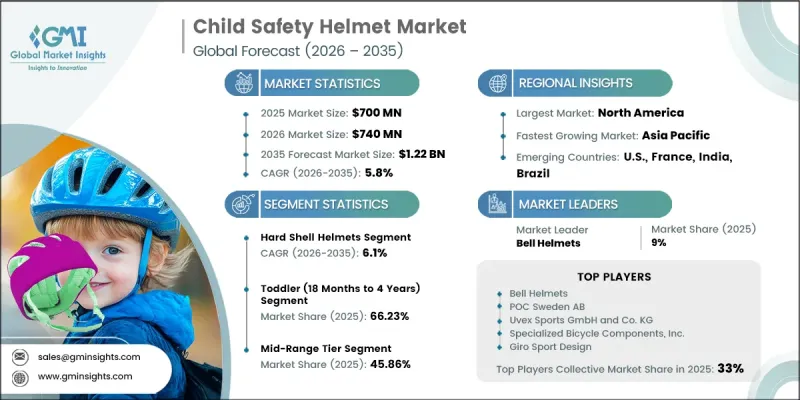
학부모들이 야외 활동이나 여가 활동 중 이동 시 발생하는 부상을 예방하는 데 더욱 중점을 두게 됨에 따라, 어린이용 안전 헬멧의 수요는 꾸준히 증가하고 있습니다. 영유아 및 저연령 아동들의 자전거 타기나 기타 바퀴를 이용한 활동에 대한 참여가 증가함에 따라, 어린 연령대의 사용자를 위해 특별히 설계된 머리 보호구에 대한 지속적인 수요가 발생하고 있습니다. 시장의 성장은 점점 더 엄격해지는 제품 안전 규제와 어린이 부상 예방에 대한 인식 제고로 인해 더욱 가속화되고 있습니다. 헬멧의 설계 및 인증에 관한 규제 요건으로 인해 업계 전반에 걸쳐 더 높은 성능이 요구되고 있으며, 보호 성능과 내구성이 향상된 인증 제품의 채택이 촉진되고 있습니다. 이러한 기준은 소비자의 신뢰를 높이는 동시에, 엄격한 규정 준수 요건을 충족할 수 있는 유서 깊은 제조업체들에게 유리한 환경을 조성하고 있습니다. 또한, 어린이 안전 향상을 목표로 한 정부의 지속적인 노력과 사고 예방을 위한 일반 시민 대상의 계몽 활동 강화가 맞물리면서, 헬멧 보급률이 빠르게 증가하고 있습니다. 또한, 아이가 성장하여 기존 제품이 맞지 않게 되거나, 보호자가 더 높은 수준의 안전 기능을 요구하게 됨에 따라, 안정적인 교체 수요도 업계에 호재가 되고 있습니다. 두부 외상 위험에 대한 인식이 전 세계적으로 지속적으로 높아지는 가운데, 어린이용 안전 헬멧 시장은 높은 안전 의식을 바탕으로 한 구매 행태와 진화하는 규제 체계에 힘입어 장기적으로 안정적인 성장을 유지할 것으로 예상됩니다.
| 시장 범위 | |
|---|---|
| 시작 연도 | 2025년 |
| 예측 기간 | 2026-2035년 |
| 개시 금액 | 7억 달러 |
| 예측 금액 | 12억 2,000만 달러 |
| CAGR | 5.8% |
하드쉘 헬멧 시장은 2035년까지 연평균 성장률(CAGR) 6.1%로 성장할 것으로 전망됩니다. 이 부문의 견실한 성장은 충격 보호 성능과 장기적인 신뢰성을 높여주는 내구성이 뛰어난 헬멧 구조가 널리 선호되고 있기 때문입니다. 하드쉘 모델은 일반적으로 견고한 외장 소재와 에너지 흡수성이 뛰어난 내장 소재를 조합하여, 제조사는 엄격한 성능 기준을 항상 충족시키면서 뛰어난 안전 성능을 실현하고 있습니다. 고품질 보호 장비에 대한 소비자들의 선호도가 높아지면서, 이 부문의 수요를 지속적으로 견인하고 있습니다.
2025년 기준으로, 유아용 부문은 66.23%의 시장 점유율을 차지했습니다. 이러한 주도적인 위상은 여가 활동이나 일상적인 야외 활동에서 어린 아이들을 보호하는 데 대한 보호자들의 관심이 높아지고 있음을 반영하고 있습니다. 유아기 활동에 따른 안전에 대한 우려는 인증된 보호용 헬멧의 구매를 지속적으로 촉진하고 있으며, 이 연령대의 장기적인 시장 수요를 뒷받침하고 있습니다.
북미 어린이용 안전 헬멧 시장은 2025년에 88.43%의 점유율을 차지하며 2억 2,160만 달러의 시장 규모를 기록했습니다. 이 지역의 시장 안정성은 확립된 안전 기준 체계, 소비자들의 폭넓은 인식, 그리고 가정 내 보호 장비의 보편화에 의해 뒷받침되고 있습니다. 지속적인 규제 감독과 아동 안전에 대한 노력 덕분에, 예측 기간 동안 교체 수요와 신제품에 대한 수요가 계속해서 뒷받침되고 있습니다.
자주 묻는 질문
목차
제1장 조사 방법
제2장 주요 요약
제3장 업계 인사이트
제4장 경쟁 구도
제5장 시장 추정 및 예측 : 유형별, 2022-2035년
제6장 시장 추정 및 예측 : 소재별, 2022-2035년
제7장 시장 추정 및 예측 : 연령층별, 2022-2035년
제8장 시장 추정 및 예측 : 가격대별, 2022-2035년
제9장 시장 추정 및 예측 : 유통 채널별, 2022-2035년
제10장 시장 추정 및 예측 : 지역별, 2022-2035년
제11장 기업 개요
KSM 26.07.16The Global Child Safety Helmet Market was valued at USD 700 million in 2025 and is estimated to grow at a CAGR of 5.8% to reach USD 1.22 billion by 2035.
Demand for child safety helmets continues to grow steadily as parents place greater emphasis on injury prevention during outdoor activities and recreational mobility. Rising participation in cycling and other wheeled activities among infants, toddlers, and young children is creating sustained demand for protective headgear designed specifically for early-age users. Market growth is further supported by increasingly stringent product safety regulations and broader awareness of pediatric injury prevention. Regulatory requirements governing helmet design and certification have established higher performance expectations across the industry, encouraging the adoption of certified products that provide enhanced protection and durability. These standards have strengthened consumer confidence while creating favorable conditions for established manufacturers capable of meeting rigorous compliance requirements. Additionally, ongoing government initiatives aimed at improving child safety, combined with greater public education regarding accident prevention, are accelerating helmet adoption rates. The industry also benefits from consistent replacement demand as children outgrow existing products and parents seek upgraded safety features. As awareness of head injury risks continues to rise globally, the child safety helmet market is expected to maintain stable long-term growth supported by safety-conscious purchasing behavior and evolving regulatory frameworks.
| Market Scope | |
|---|---|
| Start Year | 2025 |
| Forecast Year | 2026-2035 |
| Start Value | $700 Million |
| Forecast Value | $1.22 Billion |
| CAGR | 5.8% |
The hard shell helmets segment is anticipated to grow a CAGR of 6.1% through 2035. The segment's strong performance is driven by the widespread preference for durable helmet constructions that provide enhanced impact protection and long-term reliability. Hard shell models typically combine robust outer materials with energy-absorbing inner liners, enabling manufacturers to consistently meet stringent performance standards while delivering superior safety characteristics. Growing consumer preference for premium protective equipment continues to support demand for this category.
The toddler segment held a 66.23% share in 2025. Its leading position reflects heightened parental focus on protecting young children during recreational activities and everyday outdoor mobility. Safety concerns associated with early childhood activities continue to encourage the purchase of certified protective headgear, supporting long-term market demand within this demographic.
North America Child Safety Helmet Market held an 88.43% share, generating USD 221.6 million in 2025. Market stability across the region is supported by a well-established safety compliance framework, widespread consumer awareness, and strong adoption of protective equipment among families. Ongoing regulatory oversight and child safety initiatives continue to reinforce replacement purchases and new product demand throughout the forecast period.
Key companies operating in the global child safety helmet market include Bell Helmets, LIVALL Tech S.L., Strategic Sports Limited, Giro Sport Design, Scott Sports SA, August Bremicker Sohne KG, Trek Bicycle Corporation, Specialized Bicycle Components, Inc., Uvex Sports GmbH & Co. KG, Sports Group Denmark A/S, Nutcase Helmets, Louis Garneau Sports Inc., KASK S.p.A., POC Sweden AB, Aurora Sports Limited, Limar Srl, Kali Protectives, Lazer Sport NV, MET Helmets, C-Preme Limited LLC, and OGK Kabuto Co., Ltd. Companies operating in the child safety helmet market are implementing a range of strategic initiatives to strengthen their market position and expand their customer base. Product innovation remains a key focus area, with manufacturers introducing lightweight designs, enhanced impact protection technologies, adjustable fitting systems, and improved ventilation features to meet evolving consumer expectations. Many companies are investing in research and development to improve comfort, safety performance, and aesthetic appeal while ensuring compliance with increasingly stringent safety regulations. Strategic partnerships with retailers, sporting goods distributors, and e-commerce platforms are helping brands expand market reach and improve product accessibility.
Table of Contents
Chapter 1 Research Methodology
- 1.1 Research approach
- 1.2 Quality Commitments
- 1.2.1 GMI AI policy & data integrity commitment
- 1.2.1.1 Source consistency protocol
- 1.2.1 GMI AI policy & data integrity commitment
- 1.3 Research Trail & Confidence Scoring
- 1.3.1 Research Trail Components
- 1.3.2 Scoring Components
- 1.4 Data Collection
- 1.4.1 Partial list of primary sources
- 1.5 Data mining sources
- 1.5.1 Paid sources
- 1.5.1.1 Sources, by region
- 1.5.1 Paid sources
- 1.6 Base estimates and calculations
- 1.6.1 Base year calculation for any one approach
- 1.7 Forecast model
- 1.7.1 Quantified market impact analysis
- 1.7.1.1 Mathematical impact of growth parameters on forecast
- 1.7.1 Quantified market impact analysis
- 1.8 Research transparency addendum
- 1.8.1 Source attribution framework
- 1.8.2 Quality assurance metrics
- 1.8.3 Our commitment to trust
Chapter 2 Executive Summary
- 2.1 Industry 360° synopsis, 2022 - 2035
- 2.2 Key market trends
- 2.2.1 Regional
- 2.2.2 Type
- 2.2.3 Age Group
- 2.2.4 Material
- 2.2.5 Closure Type
- 2.2.6 Price range
- 2.2.7 Distribution Channel
Chapter 3 Industry Insights
- 3.1 Industry ecosystem analysis
- 3.1.1 Factor affecting the value chain
- 3.1.2 Profit margin analysis
- 3.1.3 Disruptions
- 3.1.4 Future outlook
- 3.1.5 Manufacturers
- 3.1.6 Distributors
- 3.2 Supplier landscape
- 3.3 Key news & initiatives
- 3.4 Technology & Innovation Landscape
- 3.5 Regulatory landscape
- 3.6 Impact on forces
- 3.6.1 Growth drivers
- 3.6.2 Industry pitfalls & challenges
- 3.6.3 Opportunities
- 3.7 Porter's analysis
- 3.8 PESTEL analysis
- 3.9 Pricing analysis (driven by primary research)
- 3.9.1 Historical Price Trend Analysis, 2019-2024 (Driven by Primary Research)
- 3.9.2 Pricing Strategy by Player Type (Driven by Primary Research)
- 3.10 Trade data analysis (driven by paid database)
- 3.10.1 Import/Export Volume & Value Trends (Driven by Primary Research)
- 3.10.2 Key Trade Corridors & Tariff Impact (Driven by Primary Research)
- 3.11 Impact of AI & Generative AI on the Market
- 3.11.1 AI-Driven Disruption of Existing Business Models
- 3.11.2 GenAI Use Cases & Adoption Roadmap by Segment
- 3.11.3 Risks, Limitations & Regulatory Considerations
- 3.12 Distribution Infrastructure & Channel Penetration Landscape (Driven by Primary Research)
- 3.12.1 Channel Coverage by Region & Format (Modern vs. Traditional Trade) (Driven by Primary Research)
- 3.12.2 Last-Mile Infrastructure Gaps & Emerging Channel Shifts (Driven by Primary Research)
Chapter 4 Competitive Landscape, 2025
- 4.1 Introduction
- 4.2 Company market share analysis
- 4.3 Competitive positioning matrix
- 4.4 Strategic outlook matrix
- 4.5 Competitive analysis of major market players
- 4.6 Key developments
- 4.6.1 Mergers & acquisitions
- 4.6.2 Partnerships & collaborations
- 4.6.3 New product launches
- 4.6.4 Expansion plans
Chapter 5 Market Estimates and Forecast, By type, 2022 - 2035 (USD Million, Thousand Units)
- 5.1 Key trends
- 5.2 Hard shell
- 5.3 Soft shell
Chapter 6 Market Estimates and Forecast, By Material, 2022 - 2035 (USD Million, Thousand Units)
- 6.1 Key trends
- 6.2 Acrylonitrile Butadiene Styrene (ABS)
- 6.3 Expanded Polystyrene (EPS)
- 6.4 Leather
- 6.5 Plastic
- 6.6 Polycarbonate (PC)
- 6.7 Polyvinyl Chloride (PVC)
Chapter 7 Market Estimates and Forecast, By Age Group, 2022 - 2035 (USD Million, Thousand Units)
- 7.1 Key trends
- 7.2 Newborn (0-6 months)
- 7.3 Infant (6-18 months)
- 7.4 Toddler (18 months-4 yrs)
Chapter 8 Market Estimates and Forecast, By Price range, 2022 - 2035 (USD Million, Thousand Units)
- 8.1 Key trends
- 8.2 Economy (Low) <$30
- 8.3 Mid-Range - $30-$70
- 8.4 Premium (High) >$70
Chapter 9 Market Estimates and Forecast, By Distribution Channel, 2022 - 2035 (USD Million, Thousand Units)
- 9.1 Key trends
- 9.2 Online
- 9.3 Offline
Chapter 10 Market Estimates & Forecast, By Region, 2022 - 2035, (USD Million, Thousand Units)
- 10.1 Key trends
- 10.2 North America
- 10.2.1 U.S.
- 10.2.2 Canada
- 10.3 Europe
- 10.3.1 Germany
- 10.3.2 U.K.
- 10.3.3 France
- 10.3.4 Italy
- 10.3.5 Spain
- 10.4 Asia Pacific
- 10.4.1 China
- 10.4.2 India
- 10.4.3 Japan
- 10.4.4 South Korea
- 10.4.5 Australia
- 10.5 Latin America
- 10.5.1 Brazil
- 10.5.2 Mexico
- 10.5.3 Argentina
- 10.6 MEA
- 10.6.1 UAE
- 10.6.2 Saudi Arabia
- 10.6.3 South Africa
Chapter 11 Company Profiles
- 11.1 Global players
- 11.1.1 Bell Helmets
- 11.1.2 Giro Sport Design
- 11.1.3 August Bremicker Sohne KG
- 11.1.4 POC Sweden AB
- 11.1.5 Uvex Sports GmbH & Co. KG
- 11.1.6 Specialized Bicycle Components, Inc.
- 11.1.7 Trek Bicycle Corporation
- 11.2 Regional players
- 11.2.1 MET Helmets
- 11.2.2 KASK S.p.A.
- 11.2.3 Lazer Sport NV
- 11.2.4 Scott Sports SA
- 11.2.5 OGK Kabuto Co., Ltd.
- 11.2.6 Louis Garneau Sports Inc.
- 11.2.7 Strategic Sports Limited
- 11.3 Emerging players
- 11.3.1 Sports Group Denmark A/S
- 11.3.2 LIVALL Tech S.L.
- 11.3.3 Nutcase Helmets
- 11.3.4 C-Preme Limited LLC
- 11.3.5 Kali Protectives
- 11.3.6 Aurora Sports Limited
- 11.3.7 Limar Srl