|
시장보고서
상품코드
2083302
반려동물 단일클론항체 시장 비즈니스 기회, 성장요인, 업계 동향 분석 및 예측(2026-2035년)Pet Monoclonal Antibodies Market Opportunity, Growth Drivers, Industry Trend Analysis, and Forecast 2026 - 2035 |
||||||

세계의 반려동물 단일클론항체 시장은 2025년에 13억 달러로 평가되었고, CAGR 13.8%로 성장하여 2035년까지 46억 달러에 달할 것으로 추정되고 있습니다.
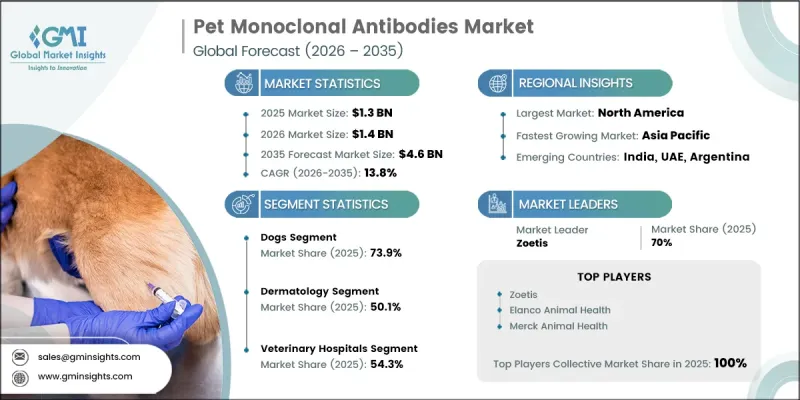
반려동물 단일클론항체 시장의 성장은 기존의 항염증 치료 및 통증 관리 치료에서 만성적인 동물 건강 상태에 대한 표적형 단일클론 항체 치료로의 전환에 의해 주도되고 있습니다. 피부 질환 및 근골격계 질환을 포함한 반려동물의 만성 질환 유병률 증가는 생물학적 제제를 이용한 치료에 대한 안정적이고 지속적인 수요 기반을 조성하고 있습니다. 이러한 질환들은 일반적으로 단기적인 치료가 아닌 지속적인 질환 관리가 필요하기 때문에 처방량의 지속적인 증가를 뒷받침하고 있습니다. 승인된 생물학적 제제의 상용화가 시장 확대를 더욱 촉진하고 있는 한편, 진행 중인 임상 개발 프로그램을 통해 종양학 및 감염증 분야에서의 잠재적 치료 용도가 확대되고 있습니다. 반려동물 사육 마릿수 증가, 반려인들의 고품질 수의의료 서비스에 대한 지출 의향 고조, 전문적인 수의의료 서비스에 대한 접근성 개선 또한 시장 성장을 뒷받침하고 있습니다. 또한, 수의학 인프라 확충과 첨단 진단·치료 프로토콜의 도입 확대 역시 단일클론 항체 요법의 보급 촉진에 기여하고 있습니다. 전반적으로, 이 시장은 반려동물의 임상적 결과와 삶의 질을 향상시키는 고정밀도이며 장기적인 생물학적 치료 솔루션으로의 수의학 분야의 구조적 변화를 반영하고 있습니다.
| 시장 범위 | |
|---|---|
| 개시 연도 | 2025년 |
| 예측 기간 | 2026-2035년 |
| 개시 연도 시장 규모 | 13억 달러 |
| 예측액 | 46억 달러 |
| CAGR | 13.8% |
2025년에는 반려견용 부문이 시장 점유율의 73.9%를 차지했습니다. 이러한 압도적인 시장 점유율은 개의 만성 질환, 특히 피부 질환 및 통증 관련 질환에 대한 단일클론 항체 요법의 임상 현장 도입이 현저히 증가했기 때문입니다. 개는 생물학적 수의학 분야에서 가장 확립된 환자군으로, 임상 현장에서의 광범위한 사용과 장기적인 질환 관리에 있어 뛰어난 치료 성과에 힘입고 있습니다. 이 부문은 첨단 치료 옵션에 대한 반려동물 주인들의 인식이 높아지고, 질병의 조기 발견과 개입을 가능하게 하는 수의학적 진단 기술이 발전함에 따라 계속해서 혜택을 보고 있습니다.
동물병원 부문은 2025년에 54.3%의 점유율을 차지했습니다. 이러한 우위는 단일클론 항체 요법의 전문적인 투여가 필요하다는 점에 기인하며, 일반적으로 훈련을 받은 수의학 전문의가 임상 현장에서 투여합니다. 동물병원은 생물학적 제제의 보관, 관리된 취급 및 환자 모니터링에 필요한 인프라를 갖추고 있어, 주요 유통 및 투여 경로로 자리 잡고 있습니다. 동물 의료시설에서 첨단 치료 프로토콜의 도입이 진행되고 있는 데다, 반려동물의 만성 질환에 대한 전문 의료 서비스 이용이 확대되면서 이 부문의 견조한 수요가 지속적으로 뒷받침되고 있습니다.
2025년, 북미의 반려동물 단일클론항체 시장은 42.8%의 점유율을 차지했습니다. 이 지역이 주도적인 위치를 차지하고 있는 배경에는 선진적인 동물 보건 시스템, 반려동물 돌봄에 대한 높은 지출, 그리고 생물학적 제제 요법의 조기 도입이 있습니다. 수의학용 단일클론 항체에 대한 강력한 규제적 지원 덕분에, 해당 지역 전체에서 신속한 상용화와 임상 현장에서의 광범위한 활용이 가능해졌습니다. 확립된 수의학 네트워크의 존재와 첨단 치료 옵션에 대한 반려동물 주인들의 인식 제고가 해당 지역 시장에서의 우위를 더욱 공고히 하고 있습니다.
자주 묻는 질문
목차
제1장 조사 방법과 범위
제2장 주요 요약
제3장 업계 인사이트
제4장 경쟁 구도
제5장 시장 추산 및 예측 : 동물별, 2022년-2035년
제6장 시장 추산 및 예측 : 용도별, 2022년-2035년
제7장 시장 추산 및 예측 : 최종 용도별, 2022년-2035년
제8장 시장 추산 및 예측 : 지역별, 2022년-2035년
제9장 기업 개요
LSH 26.07.14The Global Pet Monoclonal Antibodies Market was valued at USD 1.3 billion in 2025 and is estimated to grow at a CAGR of 13.8% to reach USD 4.6 billion by 2035.
Growth in the pet monoclonal antibodies market is driven by the transition from conventional anti-inflammatory and pain management treatments toward targeted monoclonal antibody-based therapies for chronic animal health conditions. Rising prevalence of long-term disorders in companion animals, including dermatological and musculoskeletal diseases, is creating a stable and recurring demand base for biologic treatments. These conditions typically require continuous disease management rather than short-term intervention, supporting sustained prescription volumes. The commercialization of approved biologic therapies has further strengthened market expansion, while ongoing clinical development programs are broadening potential therapeutic applications in oncology and infectious disease areas. Increasing pet ownership, higher willingness among pet owners to spend on advanced veterinary care, and improved access to specialized veterinary services are also reinforcing market growth. Additionally, expanding veterinary healthcare infrastructure and rising adoption of advanced diagnostic and treatment protocols are contributing to stronger uptake of monoclonal antibody therapies. Overall, the market reflects a structural transformation in veterinary care toward high-precision, long-duration biologic treatment solutions that improve clinical outcomes and quality of life for companion animals.
| Market Scope | |
|---|---|
| Start Year | 2025 |
| Forecast Year | 2026-2035 |
| Start Value | $1.3 Billion |
| Forecast Value | $4.6 Billion |
| CAGR | 13.8% |
The dogs segment accounted for 73.9% share in 2025. This dominance is attributed to the strong clinical adoption of monoclonal antibody therapies for canine chronic conditions, particularly dermatological and pain-related disorders. Dogs represent the most established patient base for biologic veterinary treatments, supported by widespread clinical usage and strong treatment outcomes in long-term disease management. The segment continues to benefit from increasing awareness among pet owners regarding advanced therapeutic options and improved veterinary diagnostics that enable early disease detection and intervention.
The veterinary hospitals segment held a 54.3% share in 2025. This dominance is driven by the requirement for professional administration of monoclonal antibody therapies, which are typically delivered through clinical settings by trained veterinary specialists. Veterinary hospitals are equipped with the necessary infrastructure for biologic storage, controlled handling, and patient monitoring, making them the primary distribution and administration channel. The increasing integration of advanced treatment protocols within veterinary healthcare facilities continues to support strong demand in this segment, alongside rising adoption of specialty care services for chronic pet conditions.
North America Pet Monoclonal Antibodies Market held a 42.8% share in 2025. The region's leadership is supported by advanced veterinary healthcare systems, high expenditure on companion animal care, and early adoption of biologic therapies. Strong regulatory support for veterinary monoclonal antibody approvals has enabled faster commercialization and widespread clinical use across the region. The presence of well-established veterinary networks and growing awareness among pet owners regarding advanced treatment options further strengthens regional market dominance.
Major companies operating in the Global Pet Monoclonal Antibodies Market include Zoetis Inc., Elanco Animal Health, Merck & Co., Inc. (Merck Animal Health), Dechra Pharmaceuticals PLC, Vetigenics Inc., Akston Biosciences Corporation, MabGenesis LLC, and VETmAb Biosciences Ltd. Companies in the Pet Monoclonal Antibodies Market are focusing on expanding their biologic drug pipelines through intensive research and development aimed at addressing a wider range of chronic and complex animal diseases. Strategic collaborations with veterinary clinics, research institutions, and biotechnology firms are being leveraged to accelerate product development and clinical validation. Firms are investing in advanced antibody engineering platforms to improve treatment efficacy, safety, and species-specific targeting. Expansion of manufacturing capabilities and cold-chain distribution infrastructure is also being prioritized to support growing demand. In addition, companies are strengthening regulatory engagement strategies to streamline approval timelines across key global markets.
Table of Contents
Chapter 1 Methodology & Scope
- 1.1 Research approach
- 1.2 Quality commitments
- 1.2.1 GMI AI policy & data integrity commitment
- 1.2.1.1 Source consistency protocol
- 1.2.1 GMI AI policy & data integrity commitment
- 1.3 Research trail & confidence scoring
- 1.3.1 Research trail components
- 1.3.2 Scoring components
- 1.4 Data collection
- 1.4.1 Partial list of primary sources
- 1.5 Data mining sources
- 1.5.1 Paid sources
- 1.5.1.1 Sources, by region
- 1.5.1 Paid sources
- 1.6 Base estimates and calculations
- 1.6.1 Base year calculation for any one approach
- 1.7 Market estimates & forecasts parameters
- 1.8 Forecast model
- 1.8.1 Quantified market impact analysis
- 1.8.1.1 Mathematical impact of growth parameters on forecast
- 1.8.1 Quantified market impact analysis
- 1.9 Research transparency addendum
- 1.9.1 Source attribution framework
- 1.9.2 Quality assurance metrics
- 1.9.3 Our commitment to trust
Chapter 2 Executive Summary
- 2.1 Industry 3600 synopsis
- 2.1.1 Business trends
- 2.1.2 Animal trends
- 2.1.3 Application trends
- 2.1.4 End use trends
- 2.1.5 Regional trends
- 2.2 CXO perspectives: Strategic imperatives
Chapter 3 Industry Insights
- 3.1 Industry ecosystem analysis
- 3.2 Industry impact forces
- 3.2.1 Growth drivers
- 3.2.1.1 Rising prevalence of chronic disease in pets
- 3.2.1.2 Growing advancement in targeted therapies
- 3.2.1.3 Increasing R&D investment and activities
- 3.2.1.4 Growing pet ownership and spending
- 3.2.2 Industry pitfalls and challenges
- 3.2.2.1 Adverse effects of the treatment
- 3.2.2.2 Regulatory challenges
- 3.2.3 Market opportunities
- 3.2.3.1 Expansion into novel therapeutic indications
- 3.2.3.2 Development of novel administration routes
- 3.2.3.3 Shift in companion animal pharma economics
- 3.2.1 Growth drivers
- 3.3 Growth potential analysis
- 3.4 Technology and innovation landscape
- 3.4.1 Current technological trends
- 3.4.2 Emerging technologies
- 3.5 Pricing trend analysis (Driven by primary research)
- 3.5.1 Pricing analysis, by product
- 3.5.2 Historic pricing analysis
- 3.6 Regulatory landscape (Driven by primary research)
- 3.6.1 North America
- 3.6.2 Europe
- 3.6.3 Asia Pacific
- 3.6.4 Latin America
- 3.6.5 MEA
- 3.7 Porter's analysis
- 3.8 PESTEL analysis
- 3.9 Pipeline analysis (Driven by primary research)
- 3.10 Future market trends
- 3.11 Impact of AI and Generative AI on the market (Driven by primary research)
- 3.12 Investment & funding analysis (Driven by primary research)
- 3.13 Pet statistics, by country (Driven by primary research)
- 3.14 Safety and tolerability considerations
Chapter 4 Competitive Landscape, 2025
- 4.1 Introduction
- 4.2 Company market share analysis (Driven by primary research)
- 4.3 Company matrix analysis
- 4.4 Competitive analysis of major market players
- 4.5 Competitive positioning matrix
- 4.6 Key developments
- 4.6.1 Merger and acquisition
- 4.6.2 Partnership and collaboration
- 4.6.3 New product launches
- 4.6.4 Expansion plans
Chapter 5 Market Estimates and Forecast, By Animal, 2022 - 2035 ($ Mn)
- 5.1 Key trends
- 5.2 Dogs
- 5.3 Cats
Chapter 6 Market Estimates and Forecast, By Application, 2022 - 2035 ($ Mn)
- 6.1 Key trends
- 6.2 Dermatology
- 6.3 Osteoarthritis
- 6.4 Cancer
- 6.5 Infectious diseases
Chapter 7 Market Estimates and Forecast, By End Use, 2022 - 2035 ($ Mn)
- 7.1 Key trends
- 7.2 Veterinary hospitals
- 7.3 Veterinary clinics
- 7.4 Academics and research institutes
Chapter 8 Market Estimates and Forecast, By Region, 2022 - 2035 ($ Mn)
- 8.1 Key trends
- 8.2 North America
- 8.2.1 U.S.
- 8.2.2 Canada
- 8.3 Europe
- 8.3.1 Germany
- 8.3.2 France
- 8.3.3 UK
- 8.3.4 Spain
- 8.3.5 Italy
- 8.3.6 Netherlands
- 8.4 Asia Pacific
- 8.4.1 China
- 8.4.2 Japan
- 8.4.3 India
- 8.4.4 Australia
- 8.4.5 South Korea
- 8.5 Latin America
- 8.5.1 Brazil
- 8.5.2 Mexico
- 8.5.3 Argentina
- 8.6 Middle East & Africa
- 8.6.1 Saudi Arabia
- 8.6.2 South Africa
- 8.6.3 UAE
Chapter 9 Company Profiles
- 9.1 Commercialized players
- 9.1.1 Zoetis Inc.
- 9.1.2 Merck Animal Health
- 9.1.3 Elanco Animal Health
- 9.2 Emerging/pipeline players
- 9.2.1 Vetigenics
- 9.2.2 Akston Biosciences
- 9.2.3 MabGenesis
- 9.2.4 Dechra Pharmaceuticals
- 9.2.5 VETmAb Biosciences