
|
시장보고서
상품코드
2083305
스낵 포장기 시장 비즈니스 기회, 성장요인, 업계 동향 분석 및 예측(2026-2035년)Snack Packaging Machine Market Opportunity, Growth Drivers, Industry Trend Analysis, and Forecast 2026 - 2035 |
||||||

세계의 스낵 포장기 시장은 2025년에 48억 달러로 평가되었고, CAGR 5%로 성장하여 2035년까지 78억 달러에 달할 것으로 추정되고 있습니다.
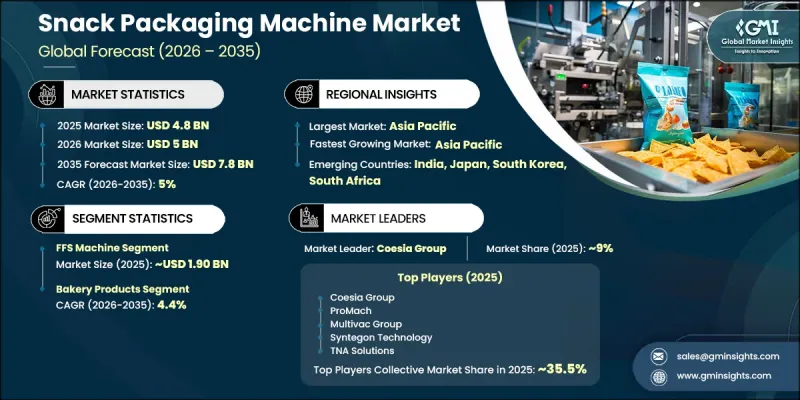
스낵 포장기 시장은 전 세계 스낵 소비 증가에 힘입어 꾸준히 성장하고 있습니다. 특히 신흥 경제국에서는 도시형 라이프스타일과 식습관의 변화가 포장된 스낵 제품 수요를 가속화하고 있습니다. 동시에, 선진 지역 전반에 걸쳐 포장 인프라의 노후화가 진행되고 있으며, 특히 북미와 유럽에서는 대규모 설비 교체 주기가 가속화되고 있습니다. 각 제조업체들은 생산 효율을 높이기 위해 여러 형식을 지원하며 디지털 기능과 AI 기능을 통합한 첨단 패키징 시스템을 점점 더 많이 도입하고 있습니다. 지속 가능한 포장재에 초점을 맞춘 규제 동향도 투자 결정에 영향을 미치고 있으며, 재활용 가능, 퇴비화 가능 및 바이오 필름에 대응하는 기계의 도입이 촉진되고 있습니다. 이러한 변화로 인해, 특히 확대 생산자 책임(EPR) 제도가 더욱 엄격해진 지역에서는 일반적인 갱신 주기를 초과하는 추가 설비 투자가 발생하고 있습니다. 완전 자동화된 생산 라인으로의 전환은 설비 투자 동향, 장비 조달 전략, 그리고 제품 개발 파이프라인의 모든 측면에서 이제 분명해졌습니다.
| 시장 범위 | |
|---|---|
| 개시 연도 | 2025년 |
| 예측 기간 | 2026-2035년 |
| 초기 시장 규모 | 48억 달러 |
| 예측액 | 78억 달러 |
| CAGR | 5% |
FFS(form-fill-seal) 기계 부문은 2025년에 19억 달러 규모를 기록했으며, 연포장 요건에 대한 높은 적합성과 진화하는 지속가능성 기준에 대한 적응성 덕분에 2035년까지 연평균 성장률(CAGR) 5.4%로 성장할 것으로 전망됩니다. 최신 FFS 시스템은 재활용 및 퇴비화가 가능한 필름을 포함한 다양한 포장재에 대응하면서도, 고속かつ효율적인 생산 성능을 유지할 수 있도록 설계되는 경향이 강해지고 있습니다. 이러한 범용성과 높은 비용 효율성 덕분에, 스낵 과자 제조 업계 전반에서 계속해서 선호되는 솔루션으로 자리 잡고 있습니다.
베이커리 제품 부문은 2025년에 28.1%의 시장 점유율을 차지했으며, 2035년까지 연평균 성장률(CAGR) 4.4%로 성장할 것으로 전망됩니다. 베이커리 제품을 기반으로 한 스낵 포장 분야에서는 개별 포장 및 대량 포장 용도로 설계된 플로우 래핑 및 자동 밀봉 시스템에 대한 의존도가 여전히 높은 상황이 지속되고 있습니다. 이 부문의 투자 동향은 경질 포장재에서 유연한 대체 포장재로 전환이 진행되고 있는 데 영향을 받고 있으며, 이는 생산 라인 전체의 설비 교체를 촉진하고 있습니다. 또한, 재활용이 가능하고 종이와 함께 사용할 수 있는 포장재에 대한 수요가 증가함에 따라, 특히 지속가능성을 중시하는 포장 규제에 주력하고 있는 지역에서 기계의 사양이 결정되고 있습니다.
2025년, 북미 간식 포장 기계 시장은 12억 6,000만 달러 규모를 기록하며 시장 점유율의 26.4%를 차지했습니다. 해당 지역 시장 성장은 주로 식품 가공 업계 전반에 걸친 대규모 설비 교체 주기에 힘입어 이루어지고 있습니다. 기존 포장 인프라의 상당 부분이 수명을 다해가고 있어, 각 제조업체들은 최신식이며 디지털로 연결되고 다양한 형식을 지원하는 포장 시스템에 대한 투자를 추진하고 있습니다. 이러한 변화로 인해 업무 효율이 향상되는 동시에, 새로 도입된 설비 전체의 가치도 높아지면서, 해당 지역에서 첨단 포장 기계에 대한 안정적인 수요가 더욱 강화되고 있습니다.
자주 묻는 질문
목차
제1장 조사 방법과 범위
제2장 주요 요약
제3장 업계 인사이트
제4장 경쟁 구도
제5장 시장 추산 및 예측 : 기계 유형별, 2022년-2035년
제6장 시장 추산 및 예측 : 포장 유형별, 2022년-2035년
제7장 시장 추산 및 예측 : 조작별, 2022년-2035년
제8장 시장 추산 및 예측 : 포장재료별, 2022년-2035년
제9장 시장 추산 및 예측 : 용도별, 2022년-2035년
제10장 시장 추산 및 예측 : 지역별, 2022년-2035년
제11장 기업 개요
LSH 26.07.14The Global Snack Packaging Machine Market was valued at USD 4.8 billion in 2025 and is estimated to grow at a CAGR of 5% to reach USD 7.8 billion by 2035.
The snack packaging machine market is expanding steadily due to rising global snack consumption, particularly in emerging economies where urban lifestyles and changing dietary habits are accelerating demand for packaged snack products. At the same time, aging packaging infrastructure across developed regions is driving significant equipment replacement cycles, especially in North America and Europe. Manufacturers are increasingly adopting advanced packaging systems capable of handling multiple formats and integrating digital and AI-enabled functionalities to improve production efficiency. Regulatory developments focused on sustainable packaging materials are also influencing investment decisions, encouraging the adoption of machinery compatible with recyclable, compostable, and biobased films. These changes are resulting in additional capital expenditure beyond routine replacement cycles, particularly in regions where extended producer responsibility frameworks are becoming more stringent. The shift toward fully automated production lines is now evident across capital investment trends, equipment procurement strategies, and product development pipelines.
| Market Scope | |
|---|---|
| Start Year | 2025 |
| Forecast Year | 2026-2035 |
| Start Value | $4.8 Billion |
| Forecast Value | $7.8 Billion |
| CAGR | 5% |
The form-fill-seal (FFS) machine segment accounted for USD 1.90 billion in 2025 and is projected to grow at a CAGR of 5.4% through 2035, owing to its strong alignment with flexible packaging requirements and its adaptability to evolving sustainability standards. Modern FFS systems are increasingly designed to operate with a wide range of packaging materials, including recyclable and compostable films, while maintaining high-speed and efficient production performance. Their versatility and cost efficiency continue to make them a preferred solution across snack manufacturing operations.
The bakery products segment held 28.1% share in 2025 and is expected to grow at a CAGR of 4.4% during 2035. Bakery-based snack packaging continues to rely heavily on flow wrapping and automated sealing systems designed for individual and bulk packaging applications. Investment trends in this segment are being influenced by the ongoing transition from rigid packaging formats to flexible alternatives, which is driving equipment upgrades across production lines. In addition, increasing demand for recyclable and paper-compatible packaging materials is shaping machinery specifications, particularly in regions focused on sustainability-driven packaging compliance.
North America Snack Packaging Machine Market accounted for USD 1.26 billion, representing 26.4% share in 2025. Market growth in the region is primarily driven by large-scale equipment replacement cycles across the food processing industry. A significant portion of existing packaging infrastructure is reaching end-of-life, prompting manufacturers to invest in modern, digitally connected, and multi-format packaging systems. This shift is improving operational efficiency while also increasing overall equipment value across new installations, reinforcing steady demand for advanced snack packaging machinery in the region.
Major companies operating in the global snack packaging machine market include Syntegon Technology, Coesia Group, ProMach, Multivac Group, TNA Solutions, Ishida Co. Ltd., GEA Group, IMA Group, BW Packaging, Heat and Control, Rovema, PFM, ULMA, Fuji Machinery, Theegarten, SN Maschinenbau, Nichrome, Soontrue, Atlas, and Fuji. Companies operating in the snack packaging machine market are strengthening their market position by investing in advanced automation technologies, AI-enabled systems, and digitally integrated packaging solutions that improve operational efficiency and production flexibility. Many manufacturers are expanding research and development activities to design equipment compatible with sustainable packaging materials such as recyclable and compostable films. Strategic partnerships with snack producers are helping companies align machinery development with evolving packaging requirements and regulatory standards. Businesses are also focusing on modular machine architectures, predictive maintenance capabilities, and smart monitoring systems to enhance equipment performance and reduce downtime.
Table of Contents
Chapter 1 Methodology & Scope
- 1.1 Market scope and definition
- 1.2 Research design
- 1.2.1 Research approach
- 1.2.2 Data collection methods
- 1.3 Data mining sources
- 1.3.1 Global
- 1.3.2 Regional/Country
- 1.4 Base estimates and calculations
- 1.4.1 Base year calculation
- 1.4.2 Key trends for market estimation
- 1.5 Primary research and validation
- 1.5.1 Primary sources
- 1.6 Forecast model
- 1.7 Research assumptions and limitations
Chapter 2 Executive Summary
- 2.1 Industry 360° synopsis
- 2.2 Key market trends
- 2.2.1 Region
- 2.2.2 Machine Type
- 2.2.3 Packaging Type
- 2.2.4 Operation
- 2.2.5 Packaging Material
- 2.2.6 Application
Chapter 3 Industry Insights
- 3.1 Industry ecosystem analysis
- 3.1.1 Supplier landscape
- 3.1.2 Profit margin
- 3.1.3 Value addition at each stage
- 3.1.4 Factor affecting the value chain
- 3.2 Industry impact forces
- 3.2.1 Growth drivers
- 3.2.1.1 Rising Global Snack Consumption & SKU Proliferation Driving High-Speed Flexible Line Investment
- 3.2.1.2 Growing Demand for Automation to Address Labor Shortages & Throughput Pressure
- 3.2.1.3 Expansion of Private-Label Snack Brands Increasing Co-Packer Machine Procurement
- 3.2.1.4 E-Commerce & DTC Channel Growth Requiring Smaller-Batch & Variable-Format Machines
- 3.2.2 Industry pitfalls & challenges
- 3.2.2.1 High Capital Expenditure & Long Payback Periods Limiting SME Adoption
- 3.2.2.2 Technical Complexity & Integration Challenges in Retrofitting Legacy Production Lines
- 3.2.3 Opportunities
- 3.2.3.1 Bio-Based & Compostable Film-Compatible Machine Development
- 3.2.3.2 Industry 4.0 & Smart Factory Integration - Connected Packaging Line Opportunity
- 3.2.3.3 Emerging Market Snack Industry Expansion Driving First-Time Machine Purchases
- 3.2.3.4 Modular & Reconfigurable Machine Design for Rapid SKU Changeover
- 3.2.1 Growth drivers
- 3.3 Growth potential analysis
- 3.4 Supply Chain Analysis
- 3.4.1 Key Raw Materials - Stainless Steel, Servo Components, Semiconductor Chips
- 3.4.2 Component Sourcing Concentration & Single-Source Risks
- 3.4.3 Supply Chain Disruptions & Lead Time Volatility
- 3.4.4 Near-Shoring & Regional Supply Chain Restructuring
- 3.5 Future market trends
- 3.6 Technology and innovation landscape
- 3.6.1 Current technological trends
- 3.6.2 Emerging technologies
- 3.7 Regulatory landscape
- 3.7.1 Food Safety & Packaging Machinery Standards (FDA, EU Machinery Directive)
- 3.7.2 Sustainable Packaging Mandates & Extended Producer Responsibility (EPR)
- 3.7.3 Energy Efficiency Regulations for Industrial Machinery
- 3.7.4 Regional Regulatory Fragmentation & Cross-Border Compliance
- 3.8 Trade data analysis (HS Code - 8422)
- 3.8.1 Import/Export Volume & Value Trends by Machine Type (Driven by Primary Research)
- 3.8.2 Key Trade Corridors & Tariff Impact (Driven by Primary Research)
- 3.9 Impact of AI & generative AI on the market
- 3.9.1 AI-Driven Disruption - Predictive Maintenance & Remote Diagnostics
- 3.9.2 GenAI Use Cases & Adoption Roadmap - Line Simulation, Operator Training, Quality Vision Systems
- 3.9.3 Risks, Limitations & Regulatory Considerations
- 3.10 Pricing Analysis
- 3.10.1 Historical Price Trend Analysis (2019-2024) (Driven by Primary Research)
- 3.10.2 Pricing Strategy by Player Type (Premium / Value / Cost-plus) (Driven by Primary Research)
- 3.10.3 Price Benchmarking by Machine Type - FFS vs. Flow Wrappers vs. Vacuum (Driven by Primary Research)
- 3.11 Porter’s analysis
- 3.12 PESTEL analysis
Chapter 4 Competitive Landscape, 2025
- 4.1 Introduction
- 4.2 Company market share analysis
- 4.3 Company matrix analysis
- 4.4 Competitive analysis of major market players
- 4.5 Competitive positioning matrix
- 4.6 Key developments
- 4.6.1 Mergers & acquisitions
- 4.6.2 Partnerships & collaborations
- 4.6.3 New product launches
- 4.6.4 Expansion plans
Chapter 5 Market Estimates & Forecast, By Machine Type, 2022 - 2035, (USD Billion) (Million Units)
- 5.1 Key Trends
- 5.2 Form-Fill-Seal (FFS) Machines
- 5.2.1 Vertical Form-Fill-Seal (VFFS) Machines
- 5.2.1.1 Pillow Bag/Standard VFFS
- 5.2.1.2 Gusseted Pouch VFFS
- 5.2.1.3 Multi-Lane VFFS
- 5.2.2 Horizontal Form-Fill-Seal (HFFS) Machines
- 5.2.3 Stick Pack & Sachet FFS Machines
- 5.2.1 Vertical Form-Fill-Seal (VFFS) Machines
- 5.3 Flow Wrapping Machines
- 5.3.1 Standard Horizontal Flow Wrappers
- 5.3.2 High-Speed Multi-Pitch Flow Wrappers
- 5.4 Vacuum Packaging Machines
- 5.4.1 Tray Sealer / Vacuum Thermoforming Machines
- 5.4.2 Chamber Vacuum Machines
- 5.5 Cartoning Machines
- 5.5.1 Horizontal Cartoners
- 5.5.2 Vertical Cartoners
- 5.6 Others
- 5.6.1 Bagging Machines
- 5.6.2 Multihead Weighers
- 5.6.3 Checkweighers
Chapter 6 Market Estimates & Forecast, By Packaging Type, 2022 - 2035, (USD Billion) (Million Units)
- 6.1 Key Trends
- 6.2 Flexible Packaging
- 6.2.1 Pillow Bags & Pouches
- 6.2.2 Stand-Up Pouches (SUP) & Doy-Packs
- 6.2.3 Stick Packs & Sachets
- 6.2.4 Flow-Wrapped Packs
- 6.2.5 Multi-Pack & Club-Pack Formats
- 6.3 Rigid Packaging
- 6.3.1 Paperboard Cartons & Boxes
- 6.3.2 Tins & Composite Cans
- 6.3.3 Thermoformed Trays & Clamshells
Chapter 7 Market Estimates & Forecast, By Operation, 2022 - 2035, (USD Billion) (Million Units)
- 7.1 Key Trends
- 7.2 Automatic
- 7.2.1 Fully Automatic Integrated Lines
- 7.2.2 Robotic End-of-Line Automated Systems
- 7.3 Semi-Automatic
- 7.3.1 Operator-Assisted Semi-Automatic Machines
- 7.3.2 Semi-Automatic Tabletop Machines for SMEs
Chapter 8 Market Estimates & Forecast, By Packaging Material, 2022 - 2035, (USD Billion) (Million Units)
- 8.1 Key Trends
- 8.2 Plastic Films
- 8.2.1 BOPP (Biaxially Oriented Polypropylene)
- 8.2.2 PET & Metalized PET Films
- 8.2.3 PE (Polyethylene) Films
- 8.3 Paper & Paperboard
- 8.3.1 Kraft Paper Laminates
- 8.3.2 Coated Paperboard
- 8.4 Metal & Foil Laminates
- 8.4.1 Aluminum Foil Laminates
- 8.4.2 Composite / Foil-Film Laminates
- 8.5 Others
- 8.5.1 Bio-Based & Compostable Films (PLA, PHA)
- 8.5.2 Multi-Layer High-Barrier Laminates
Chapter 9 Market Estimates & Forecast, By Application, 2022 - 2035, (USD Billion) (Million Units)
- 9.1 Key Trends
- 9.2 Bakery Products
- 9.2.1 Cookies & Biscuits
- 9.2.2 Crackers & Croutons
- 9.2.3 Wafers & Bars
- 9.3 Confectionery
- 9.3.1 Chocolate & Chocolate-Coated Snacks
- 9.3.2 Candy & Gummies
- 9.3.3 Toffees & Hard Candy
- 9.4 Savory Snacks
- 9.4.1 Potato Chips & Crisps
- 9.4.2 Extruded Snacks (Corn Puffs, Rings)
- 9.4.3 Popcorn
- 9.4.4 Tortilla Chips & Pretzels
- 9.5 Nuts & Dried Fruits
- 9.5.1 Almonds, Cashews & Mixed Nuts
- 9.5.2 Dried Fruits & Raisins
- 9.6 Meat Snacks
- 9.6.1 Jerky & Dried Meat Strips
- 9.6.2 Meat Sticks & Sausage Snacks
- 9.7 Others
- 9.7.1 Protein Snacks & Energy Bars
- 9.7.2 Seaweed & Vegetable-Based Snacks
Chapter 10 Market Estimates & Forecast, By Region, 2022 - 2035, (USD Billion) (Million Units)
- 10.1 Key Trends
- 10.2 North America
- 10.2.1 U.S.
- 10.2.2 Canada
- 10.3 Europe
- 10.3.1 Germany
- 10.3.2 France
- 10.3.3 UK
- 10.3.4 Italy
- 10.3.5 Spain
- 10.4 Asia Pacific
- 10.4.1 China
- 10.4.2 Japan
- 10.4.3 India
- 10.4.4 Australia
- 10.4.5 South Korea
- 10.5 Latin America
- 10.5.1 Brazil
- 10.5.2 Mexico
- 10.5.3 Argentina
- 10.6 MEA
- 10.6.1 Saudi Arabia
- 10.6.2 UAE
- 10.6.3 South Africa
Chapter 11 Company Profiles
- 11.1 Coesia Group
- 11.2 ProMach
- 11.3 Multivac Group
- 11.4 Syntegon Technology
- 11.5 TNA Solutions
- 11.6 Ishida Co. Ltd.
- 11.7 GEA Group (Food segment)
- 11.8 IMA Group (Food division)
- 11.9 BW Packaging
- 11.10 Heat and Control
- 11.11 Rovema
- 11.12 PFM
- 11.13 ULMA
- 11.14 Theegarten
- 11.15 SN Maschinenbau
- 11.16 Nichrome
- 11.17 Soontrue
- 11.18 Atlas
- 11.19 Fuji Machinery