|
시장보고서
상품코드
2083369
와전류 검사 시장 기회, 성장요인, 업계 동향 분석 및 예측(2026-2035년)Eddy Current Testing Market Opportunity, Growth Drivers, Industry Trend Analysis, and Forecast 2026 - 2035 |
||||||

세계의 와전류 검사 시장은 2025년에 9억 7,010만 달러 규모로 평가되었고, 2035년까지 연평균 복합 성장률(CAGR)5.8%로 성장하여 17억 달러에 이를 것으로 예측됩니다.
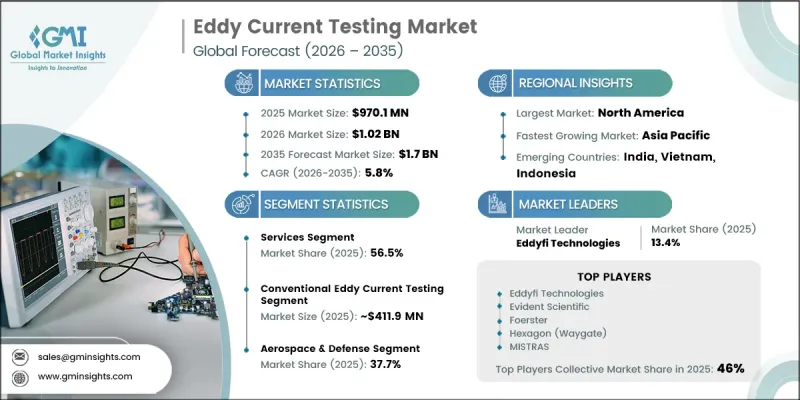
각 업계가 자산의 신뢰성과 운영 안전성을 높이기 위해 첨단 비파괴 평가 기술에 점점 더 중점을 두면서, 와전류 검사 시장은 꾸준히 확대되고 있습니다. 확립된 API 표준을 준수하는 위험 기반 검사 프레임워크의 활용 확대는 체계적인 검사 프로그램을 강화하고, 장기 서비스 계약을 뒷받침하고 있습니다. 이러한 변화로 인해 검사 사업자들은 단기적인 프로젝트 기반 계약이 아닌, 보다 예측 가능하고 지속적인 수익 모델로 전환할 수 있게 되었습니다. 자동화된 전자기 검사 시스템의 도입 확대는 제조 환경에서 고속かつ고정밀 결함 검출을 가능하게 함으로써, 산업 분야의 품질 보증 프로세스를 한층 더 혁신하고 있습니다. 이러한 시스템은 부품 품질의 일관성을 확보하고 중요한 용도에서의 고장 위험을 줄이기 위해 생산 라인에 널리 통합되어 있습니다. 또한, 로봇 기술을 활용한 검사 기술을 도입함으로써, 특히 대량 생산 환경에서 검사의 효율과 검사 범위가 향상되고 있습니다. 동시에, 첨단 소재 제조 기술의 확산에 따라 미세 수준의 결함을 식별할 수 있는 보다 정교한 시험 솔루션에 대한 수요가 증가하고 있습니다. 센서 설계, 데이터 분석, 자동화 분야의 지속적인 기술 발전으로 인해 산업용 검사 생태계 전반에서 와전류 검사의 역할이 더욱 강화되고 있습니다.
| 시장 범위 | |
|---|---|
| 개시 연도 | 2025년 |
| 예측 기간 | 2026-2035년 |
| 개시 연도 시장 규모 | 9억 7,010만 달러 |
| 예측액 | 17억 달러 |
| CAGR | 5.8% |
2025년, 와전류 검사 서비스 부문은 시장 점유율의 56%를 차지했습니다. 이러한 선도적인 지위는 주요 산업 전반에 걸친 현장 검사 활동, 유지보수 검증, 검사 계획, 그리고 훈련을 받은 기술 인력의 배치에 대한 강력한 수요에 힘입고 있습니다. 해당 부문은 항공우주, 에너지, 석유 및 가스, 발전, 원자력 사업 등의 분야에서 도입이 확대되면서 그 혜택을 누리고 있습니다. 장기 서비스 계약과 체계적인 자산 건전성 프로그램 역시 서비스 제공업체가 안정적이고 지속적인 수익을 창출하는 데 기여하고 있습니다.
2025년, 와전류 어레이 부문 시장 점유율은 25.7%를 차지했습니다. 이 부문은 기존의 싱글 코일 방식에 비해 더 광범위한 검사 범위, 빠른 스캔 성능, 그리고 향상된 영상 성능을 제공할 수 있어 주목을 받고 있습니다. 상세한 표면 매핑이나 신속한 평가가 요구되는 용도에서는 이 방식이 점점 더 선호되고 있습니다. 한편, 기존의 와전류 검사는 여전히 집중적인 정밀도가 필수적인, 특정 대상에 초점을 맞춘 결함 감지나 관형 구조물 검사 용도에서 계속해서 널리 활용되고 있습니다.
2025년, 북미의 와전류 검사 시장은 37.1%의 점유율을 차지했습니다. 이는 항공우주 분야의 정비, 노후화된 산업 인프라, 그리고 대규모 원자력 발전 사업에서의 견조한 수요에 힘입은 결과입니다. 해당 지역에서는 확립된 규제 환경으로 인해 항공, 에너지, 파이프라인 각 부문에서 일관된 검사 요건이 계속해서 요구되고 있습니다. 주요 규제 당국의 감독은 정기적인 검사 및 규정 준수에 기반한 유지보수 활동의 필요성을 더욱 강조함으로써, 시장의 지속적인 수요를 뒷받침하고 있습니다.
자주 묻는 질문
목차
제1장 조사 방법
제2장 주요 요약
제3장 업계 인사이트
제4장 경쟁 구도
제5장 시장 추산 및 예측 : 제공별, 2022년-2035년
제6장 시장 추산 및 예측 : 방법별, 2022년-2035년
제7장 시장 추산 및 예측 : 최종 용도별, 2022년-2035년
제8장 시장 추산 및 예측 : 지역별, 2022년-2035년
제9장 기업 개요
LSH 26.07.14The Global Eddy Current Testing Market was valued at USD 970.1 million in 2025 and is estimated to grow at a CAGR of 5.8% to reach USD 1.7 billion by 2035.
The eddy current testing market is expanding steadily as industries place greater emphasis on advanced non-destructive evaluation techniques to improve asset reliability and operational safety. The growing use of risk-based inspection frameworks aligned with established API standards is strengthening structured inspection programs and supporting long-term service contracts. This shift is enabling inspection providers to move toward more predictable, recurring revenue models rather than short-term project-based engagements. Increasing deployment of automated electromagnetic inspection systems is further transforming industrial quality assurance processes by enabling high-speed, high-precision defect detection in manufacturing environments. These systems are being widely integrated into production lines to ensure consistent component integrity and reduce failure risks in critical applications. The adoption of robotics-enabled inspection technologies is also enhancing inspection efficiency and coverage, particularly in high-volume manufacturing environments. At the same time, the expansion of advanced material production methods is driving the need for more sophisticated testing solutions capable of identifying micro-level defects. Continuous technological advancements in sensor design, data analytics, and automation are further strengthening the role of eddy current testing across industrial inspection ecosystems.
| Market Scope | |
|---|---|
| Start Year | 2025 |
| Forecast Year | 2026-2035 |
| Start Value | $970.1 Million |
| Forecast Value | $1.7 Billion |
| CAGR | 5.8% |
The eddy current testing services segment accounted for 56% share in 2025. This leadership is driven by strong demand for field inspection activities, maintenance verification, inspection planning, and deployment of trained technical personnel across critical industries. The segment benefits from rising adoption in sectors such as aerospace, energy, oil and gas, power generation, and nuclear operations. Long-term service agreements and structured asset integrity programs are also contributing to stable and recurring revenue generation for service providers.
The eddy current array segment represented 25.7% share in 2025. This segment is gaining traction due to its ability to provide broader inspection coverage, faster scanning capabilities, and enhanced imaging performance compared to conventional single-coil methods. It is increasingly preferred in applications requiring detailed surface mapping and rapid evaluation, while traditional eddy current testing continues to be widely used in targeted defect detection and tubular inspection applications where focused precision remains essential.
North America Eddy Current Testing Market accounted for 37.1% share in 2025, supported by strong demand across aerospace maintenance, aging industrial infrastructure, and extensive nuclear energy operations. The region's well-established regulatory environment continues to drive consistent inspection requirements across aviation, energy, and pipeline sectors. Regulatory oversight from key governing bodies further reinforces the need for routine inspection and compliance-driven maintenance practices, supporting sustained market demand.
Major companies operating in the global eddy current testing market include MISTRAS Group, Eddyfi Technologies, Evident Scientific, Waygate Technologies (Hexagon), FOERSTER Group, Magnetic Analysis Corporation, and UniWest. Companies operating in the eddy current testing market are strengthening their competitive position through continuous innovation in inspection technologies, automation integration, and advanced data interpretation systems. Market participants are increasingly focusing on enhancing detection accuracy, inspection speed, and system portability to meet evolving industrial requirements. Strategic collaborations with aerospace, energy, and manufacturing companies are enabling wider deployment of advanced inspection solutions. Firms are also investing in robotics-enabled and automated testing platforms to improve operational efficiency and reduce manual intervention. Expansion of service-based offerings, including long-term inspection contracts and predictive maintenance solutions, is further supporting recurring revenue growth.
Table of Contents
Chapter 1 Methodology
- 1.1 Research approach
- 1.2 Quality Commitments
- 1.2.1 GMI AI policy & data integrity commitment
- 1.3 Research Trail & Confidence Scoring
- 1.3.1 Research Trail Components
- 1.3.2 Scoring Components
- 1.4 Data Collection
- 1.5 Data mining sources
- 1.5.1 Paid sources
- 1.6 Base estimates and calculations
- 1.6.1 Base year calculation
- 1.7 Forecast model
- 1.7.1 Quantified market impact analysis
- 1.8 Research transparency addendum
- 1.8.1 Source attribution framework
- 1.8.2 Quality assurance metrics
- 1.8.3 Our commitment to trust
Chapter 2 Executive Summary
- 2.1 Industry 360° synopsis
- 2.2 Key market trends
- 2.2.1 Regional
- 2.2.2 Offering
- 2.2.3 Technique
- 2.2.4 End Use
- 2.3 TAM analysis, 2026-2035
- 2.4 CXO perspectives: Strategic imperatives
Chapter 3 Industry Insights
- 3.1 Industry ecosystem analysis
- 3.1.1 Supplier landscape
- 3.1.2 Profit margin
- 3.1.3 Cost structure
- 3.1.4 Value addition at each stage
- 3.1.5 Factor affecting the value chain
- 3.1.6 Disruptions
- 3.2 Industry impact forces
- 3.2.1 Growth drivers
- 3.2.1.1 Aging Industrial Infrastructure Driving Demand for Continuous Asset Integrity Management
- 3.2.1.2 Stringent Regulatory Mandates for NDT in Aerospace, Nuclear & Oil & Gas Industries
- 3.2.1.3 Rising Adoption of Automated & Robotic ECT in High-Volume Manufacturing
- 3.2.1.4 Expansion of Renewable Energy Infrastructure Creating New ECT Applications
- 3.2.2 Industry pitfalls and challenges
- 3.2.2.1 High Capital Investment for Automated ECT Systems Limiting SME Adoption
- 3.2.2.2 Critical Shortage of Certified Level II/III NDT Technicians Globally
- 3.2.3 Market opportunities
- 3.2.3.1 Integration of AI/ML in ECT Signal Analysis
- 3.2.3.2 Emerging ECT Applications in EV Battery Module Inspection & Semiconductor Wafer Testing
- 3.2.3.3 Growth of Inspection-as-a-Service (IaaS) & Subscription-Based ECT Service Models
- 3.2.1 Growth drivers
- 3.3 Technology and innovation landscape
- 3.3.1 Current technological trends
- 3.3.1.1 Conventional Eddy Current Testing (ECT)
- 3.3.1.2 Array Eddy Current Testing (ECA)
- 3.3.2 Emerging technologies
- 3.3.2.1 AI-Assisted Eddy Current Signal Analysis
- 3.3.2.2 Digital Twin Integration for NDT Inspection
- 3.3.1 Current technological trends
- 3.4 Growth potential analysis
- 3.5 Pricing Analysis (Driven by Primary Research)
- 3.5.1 Historical Price Trend Analysis
- 3.5.2 Pricing Strategy by Player Type (Premium / Value / Cost-plus)
- 3.6 Regulatory landscape
- 3.6.1 North America
- 3.6.1.1 ASTM E309
- 3.6.1.2 ASTM E2261
- 3.6.2 Europe
- 3.6.2.1 EN ISO 15549
- 3.6.2.2 EN ISO 15548
- 3.6.2.3 EN ISO 9712
- 3.6.3 Asia Pacific
- 3.6.3.1 JIS Z 2314
- 3.6.3.2 GB/T 5126
- 3.6.4 LATAM
- 3.6.4.1 ABNT NBR NM ISO 15549
- 3.6.4.2 IRAM-ISO 17643
- 3.6.5 MEA
- 3.6.5.1 SANS 15549
- 3.6.5.2 Saudi Standards, Metrology and Quality Organization (SASO)
- 3.6.1 North America
- 3.7 Porter's analysis
- 3.8 PESTEL analysis
- 3.9 Cost breakdown analysis
- 3.10 Patent analysis (Driven by Primary Research)
- 3.11 Sustainability and environmental aspects
- 3.11.1 Sustainable Practices
- 3.11.2 Waste Reduction Strategies
- 3.11.3 Energy Efficiency in Production
- 3.11.4 Eco-friendly Initiatives
- 3.11.5 Carbon Footprint Considerations
- 3.12 Impact of AI & generative AI on the market
- 3.12.1 AI-driven disruption of existing business models
- 3.12.2 GenAI use cases & adoption roadmap by segment
- 3.12.3 Risks, limitations & regulatory considerations
- 3.13 Software-Defined Inspection Systems
- 3.14 Forecast assumptions & scenario analysis (Driven by Primary Research)
- 3.14.1 Base Case - Key Macro & Industry Variables Driving CAGR
- 3.14.2 Optimistic Scenarios- Favorable macro and industry tailwinds
- 3.14.3 Pessimistic Scenario - Macroeconomic slowdown or industry headwinds
Chapter 4 Competitive Landscape, 2025
- 4.1 Introduction
- 4.2 Company market share analysis
- 4.2.1 North America
- 4.2.2 Europe
- 4.2.3 Asia Pacific
- 4.2.4 LATAM
- 4.2.5 MEA
- 4.3 Competitive analysis of major market players
- 4.4 Competitive positioning matrix
- 4.5 Key developments
- 4.5.1 Mergers & acquisitions
- 4.5.2 Partnerships & collaborations
- 4.5.3 New product launches
- 4.5.4 Expansion plans and funding
- 4.6 Company tier benchmarking
- 4.6.1 Tier classification criteria & qualifying thresholds
- 4.6.2 Tier positioning matrix by revenue, geography & innovation
Chapter 5 Market Estimates and Forecast, By Offering, 2022 - 2035 ($ Mn)
- 5.1 Key trends
- 5.2 Equipment
- 5.2.1 ECT Instruments & Systems
- 5.2.1.1 Portable / Handheld ECT Instruments
- 5.2.1.2 Benchtop / Desktop ECT Instruments
- 5.2.1.3 Automated / Inline ECT Systems
- 5.2.1.4 Others
- 5.2.2 ECT Probes, Sensors & Accessories
- 5.2.2.1 Bobbin Probes
- 5.2.2.2 Surface / Pencil Probes
- 5.2.2.3 Others
- 5.2.1 ECT Instruments & Systems
- 5.3 Software
- 5.4 Services
- 5.4.1 Inspection Services
- 5.4.2 Calibration & Maintenance Services
- 5.4.2.1 Instrument Calibration Services
- 5.4.2.2 Probe & System Maintenance Services
- 5.4.3 Training & Certification Services
- 5.4.4 Equipment Rental Services
- 5.4.5 Others
Chapter 6 Market Estimates and Forecast, By Technique, 2022 - 2035 ($ Mn)
- 6.1 Key trends
- 6.2 Conventional Eddy Current Testing (CECT)
- 6.3 Eddy Current Array (ECA)
- 6.4 Pulsed Eddy Current Testing (PECT)
- 6.5 Remote Field Testing (RFT)
- 6.6 Near-Field Testing (NFT)
Chapter 7 Market Estimates and Forecast, By End Use, 2022 - 2035 ($ Mn)
- 7.1 Key trends
- 7.2 Aerospace & Defense
- 7.3 Oil & Gas
- 7.4 Power Generation
- 7.5 Automotive
- 7.6 Manufacturing & Industrial
- 7.7 Infrastructure & Construction
- 7.8 Others
Chapter 8 Market Estimates & Forecast, By Region, 2022 - 2035 ($Mn)
- 8.1 Key trends
- 8.2 North America
- 8.2.1 US
- 8.2.2 Canada
- 8.3 Europe
- 8.3.1 Germany
- 8.3.2 UK
- 8.3.3 France
- 8.3.4 Italy
- 8.3.5 Spain
- 8.3.6 Netherlands
- 8.3.7 Sweden
- 8.3.8 Norway
- 8.4 Asia Pacific
- 8.4.1 China
- 8.4.2 India
- 8.4.3 Japan
- 8.4.4 Australia
- 8.4.5 South Korea
- 8.4.6 Singapore
- 8.4.7 Malaysia
- 8.5 Latin America
- 8.5.1 Brazil
- 8.5.2 Mexico
- 8.5.3 Argentina
- 8.5.4 Chile
- 8.6 MEA
- 8.6.1 South Africa
- 8.6.2 Saudi Arabia
- 8.6.3 UAE
Chapter 9 Company Profiles
- 9.1 Global players
- 9.1.1 Olympus
- 9.1.2 Hexagon
- 9.1.3 Eddyfi Technologies (ESAB)
- 9.1.4 Evident
- 9.1.5 Foerster
- 9.1.6 ibg NDT System
- 9.1.7 MISTRAS
- 9.1.8 Magnetic Analysis Corporation (MAC)
- 9.1.9 Rohmann
- 9.2 Regional players
- 9.2.1 ETher NDE
- 9.2.2 UniWest
- 9.2.3 OKOndt
- 9.2.4 Criterion NDT
- 9.2.5 Centurion NDT
- 9.2.6 Ashtead Technology
- 9.2.7 Nanjing BKN Automation System
- 9.3 Emerging players
- 9.3.1 JENTEK Sensors
- 9.3.2 SURAGUS
- 9.3.3 HUATEC
- 9.3.4 ACTUNI