
|
시장보고서
상품코드
2083370
공랭식 열교환기 시장 비즈니스 기회, 성장요인, 업계 동향 분석 및 예측(2026-2035년)Air Cooled Heat Exchanger Market Opportunity, Growth Drivers, Industry Trend Analysis, and Forecast 2026 - 2035 |
||||||

세계의 공랭식 열교환기 시장은 2025년에 46억 달러 규모로 평가되었고, CAGR 8.4%로 성장하여 2035년까지 102억 달러에 달할 것으로 추정되고 있습니다.
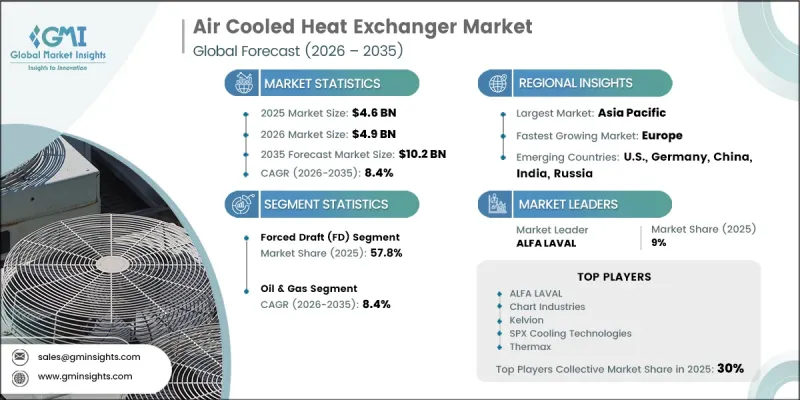
시장 확대는 공업용수 소비에 관한 환경 규제 강화, 신흥 산업국에서의 설비 투자 증가, 그리고 LNG, 석유화학, 발전 프로젝트 분야의 지속적인 인프라 개발이 복합적으로 작용하여 이루어지고 있습니다. 정유, 화학, 에너지 인프라 분야의 대규모 설비 투자는 특히 신규 공장 건설이나 생산 능력 확대 프로젝트에서 공랭식 열교환기에 대한 안정적인 수요를 지속적으로 창출하고 있습니다. 특히 아시아태평양과 중동의 제조 거점에 대한 외국인 직접 투자 증가 역시 산업 시설 설계 단계에서 공랭식 시스템의 도입을 가속화하고 있습니다. 또한, 주요 경제권의 규제 체계는 물을 대량으로 소비하는 냉각 기술을 억제하고, 공랭식 대체 기술로의 구조적인 전환을 촉진하고 있습니다. EU 산업 배출 지침 개정안(지침 EU 2024/1785)을 포함한 개정된 산업 배출 기준은 에너지 및 물 사용량에 대한 더 엄격한 제한을 통해 준수 요건을 강화하고, 대상 시설에 환경 경영 시스템 도입을 의무화함으로써 산업 부문 전반에 걸쳐 그 도입이 더욱 촉진되고 있습니다.
| 시장 범위 | |
|---|---|
| 개시 연도 | 2025년 |
| 예측 기간 | 2026-2035년 |
| 초기 시장 규모 | 46억 달러 |
| 예측액 | 102억 달러 |
| CAGR | 8.4% |
강제 환기 부문은 57.8%의 점유율을 차지하고 있으며, 2035년까지 연평균 성장률(CAGR) 7.8%를 나타낼 것으로 예측됩니다. 이 구성에서는 열교환기 묶음의 흡기 측에 팬 시스템이 설치되어, 핀이 달린 튜브에 공기를 불어넣음으로써 열전달 효율을 높입니다. 이 설계는 흡기 온도를 낮게 유지할 수 있고, 안정적인 열 성능을 확보할 수 있으며, 공정을 중단하지 않고도 유지보수 작업을 간소화할 수 있다는 점에서 널리 채택되고 있습니다. 이러한 운영상의 장점 덕분에 강제 통풍 시스템은 정유시설의 냉각 작업, 압축기 스테이션의 냉각 시스템, 그리고 산업용 윤활유의 온도 조절 용도에서 선호되는 선택지가 되고 있습니다.
석유 및 가스 분야는 2025년에 16.2%의 점유율을 차지했으며, 2035년까지 연평균 성장률(CAGR) 8.4%로 성장할 것으로 전망됩니다. 공랭식 열교환기는 가스 압축 냉각 시스템, 원유 처리, 윤활유 냉각 용도 및 업스트림·중류·하류 각 공정에서 공정 가스의 온도 제어에 널리 사용되고 있습니다. API 661 규격 준수는 여전히 기본적인 조달 요건이며, 공급업체 선정에 영향을 미치고 업계 전반에 걸쳐 가격 규율을 유지하고 있습니다. 여러 지역에서 LNG 인프라 개발에 대한 지속적인 투자가 대규모 장비 조달을 뒷받침하고 있으며, 프로젝트의 각 단계에서 일반적으로 여러 대의 설비 설치가 요구되고 있습니다.
북미의 공랭식 열교환기 시장은 2025년에 18.3%의 점유율을 차지했으며, 2035년까지 연평균 성장률(CAGR) 8.1%로 성장할 것으로 전망됩니다. 미국은 해안 지역의 활발한 LNG 수출 터미널 개발, 정유시설의 현대화 및 확장 프로젝트, 그리고 대용량 방열 시스템이 필요한 데이터 인프라 및 콜드체인 물류 시설에서 수요 증가에 힘입어 이 지역의 주요 수요 거점으로 자리매김하고 있습니다. 천연가스 처리 및 LNG 수출 인프라에 대한 지속적인 투자를 통해 여러 설비에 걸친 안정적인 조달 수요가 지속적으로 창출되고 있으며, 이는 해당 지역 시장 성장이 프로젝트 기반이라는 특성을 더욱 공고히 하고 있습니다.
자주 묻는 질문
목차
제1장 조사 방법과 범위
제2장 주요 요약
제3장 업계 인사이트
제4장 경쟁 구도
제5장 시장 규모와 예측 : 유형별, 2022년-2035년
제6장 시장 규모와 예측 : 용도별, 2022년-2035년
제7장 시장 규모와 예측 : 지역별, 2022년-2035년
제8장 기업 개요
LSH 26.07.14The Global Air Cooled Heat Exchanger Market was valued at USD 4.6 billion in 2025 and is estimated to grow at a CAGR of 8.4% to reach USD 10.2 billion by 2035.
Market expansion is shaped by a combination of tightening environmental regulations on industrial water consumption, increasing capital investment in emerging industrial economies, and ongoing infrastructure development across LNG, petrochemical, and power generation projects. Large-scale capital deployment in refining, chemicals, and energy infrastructure continues to generate consistent demand for air cooled heat exchangers, particularly in new plant construction and capacity expansion projects. Rising foreign direct investment into manufacturing hubs, especially in Asia Pacific and the Middle East, is also accelerating the installation of air-cooled systems at the design stage of industrial facilities. In addition, regulatory frameworks in major economies are discouraging water-intensive cooling technologies and encouraging a structural transition toward air-cooled alternatives. Updated industrial emissions standards, including the EU Industrial Emissions Directive revision (Directive EU 2024/1785), are reinforcing compliance requirements through stricter limits on energy and water usage and mandating environmental management systems for covered installations, further strengthening adoption across industrial sectors.
| Market Scope | |
|---|---|
| Start Year | 2025 |
| Forecast Year | 2026-2035 |
| Start Value | $4.6 Billion |
| Forecast Value | $10.2 Billion |
| CAGR | 8.4% |
The forced draft segment held a 57.8% share and is expected to grow at a CAGR of 7.8% through 2035. In this configuration, fan systems are installed at the air inlet side of the heat exchanger bundle, pushing air across finned tubes to enhance heat transfer efficiency. This design is widely adopted due to its ability to maintain lower inlet air temperatures, ensure consistent thermal performance, and simplify maintenance procedures without requiring process shutdowns. These operational advantages make forced draft systems a preferred choice in refinery cooling operations, compressor station cooling systems, and industrial lubricant temperature regulation applications.
The oil and gas segment accounted for 16.2% share in 2025 and is projected to grow at a CAGR of 8.4% through 2035. Air cooled heat exchangers are widely used in gas compression cooling systems, crude oil processing, lube oil cooling applications, and process gas temperature control across upstream, midstream, and downstream operations. Compliance with API 661 standards remains a fundamental procurement requirement, shaping supplier selection and maintaining pricing discipline across the industry. Ongoing investment in LNG infrastructure development across multiple regions continues to support large-scale equipment procurement, with multi-unit installations commonly required across different project phases.
North America Air Cooled Heat Exchanger Market held 18.3% share in 2025 and is projected to grow at a CAGR of 8.1% through 2035. The United States represents the primary regional demand hub, driven by active LNG export terminal development along coastal regions, refinery modernization and expansion projects, and rising demand from data infrastructure and cold-chain logistics facilities requiring high-capacity heat rejection systems. Sustained investment in natural gas processing and LNG export infrastructure continues to generate consistent multi-unit procurement demand, reinforcing the project-based nature of market growth in the region.
Major companies operating in the global air cooled heat exchanger market include Kelvion, ALFA LAVAL, Chart Industries, Baker Hughes, Kawasaki Heavy Industries, SPX Cooling Technologies, Thermax, and Evapco Dry Cooling. Companies operating in the air cooled heat exchanger market are focusing on technological advancement, product customization, and capacity expansion to strengthen their market position. Manufacturers are investing in energy-efficient designs, improved heat transfer technologies, and corrosion-resistant materials to enhance system performance and durability. Strategic collaborations with engineering procurement and construction firms are helping suppliers secure large-scale project contracts. Expansion of manufacturing facilities in high-growth regions is improving supply chain efficiency and reducing delivery timelines. Companies are also strengthening aftermarket services, including maintenance, retrofitting, and performance optimization solutions, to enhance customer retention.
Table of Contents
Chapter 1 Methodology & Scope
- 1.1 Research design
- 1.2 Quality commitment
- 1.2.1 GMI AI policy & data integrity commitment
- 1.2.1.1 Source consistency protocol
- 1.2.1 GMI AI policy & data integrity commitment
- 1.3 Research trail & confidence scoring
- 1.3.1 Research trail components
- 1.3.2 Scoring components
- 1.4 Data collection
- 1.4.1 Partial list of primary sources
- 1.5 Data mining sources
- 1.5.1 Paid sources
- 1.5.1.1 Sources, by region
- 1.5.1 Paid sources
- 1.6 Base estimates and calculations
- 1.6.1 Base year calculation for any one approach
- 1.7 Market estimates & forecasts parameters
- 1.8 Forecast model
- 1.8.1 Quantified market impact analysis
- 1.8.1.1 Mathematical impact of growth parameters on forecast
- 1.8.1 Quantified market impact analysis
- 1.9 Research transparency addendum
- 1.9.1 Source attribution framework
- 1.9.2 Quality assurance metrics
- 1.9.3 Our commitment to trust
- 1.10 Market definitions
Chapter 2 Executive Summary
- 2.1 Industry synopsis, 2022 - 2035
- 2.1.1 Business trends
- 2.1.2 Type trends
- 2.1.3 Application trends
- 2.1.4 Regional trends
Chapter 3 Industry Insights
- 3.1 Industry ecosystem analysis
- 3.1.1 Component availability & sourcing analysis
- 3.1.2 Key factors affecting the value chain
- 3.1.3 Disruptions
- 3.2 Industry impact forces
- 3.2.1 Growth drivers
- 3.2.2 Industry pitfalls & challenges
- 3.3 Growth potential analysis
- 3.4 Regulatory landscape
- 3.5 Porter's analysis
- 3.5.1 Bargaining power of suppliers
- 3.5.2 Bargaining power of buyers
- 3.5.3 Threat of new entrants
- 3.5.4 Threat of substitutes
- 3.6 PESTEL analysis
- 3.6.1 Political factors
- 3.6.2 Economic factors
- 3.6.3 Social factors
- 3.6.4 Technological factors
- 3.6.5 Legal factors
- 3.6.6 Environmental factors
- 3.7 Cost structure analysis of air cooled heat exchanger (Driven by Primary Research)
- 3.8 Emerging opportunities & trends
- 3.8.1 Digital transformation with IoT technologies
- 3.8.2 Emerging market penetration
- 3.9 Investment analysis & future outlook
- 3.10 Impact of AI & Generative AI on the market (Driven by Primary Research)
- 3.10.1 AI-Driven production optimization (Driven by Primary Research)
- 3.10.2 Predictive maintenance & fault detection (Driven by Primary Research)
Chapter 4 Competitive Landscape, 2026
- 4.1 Introduction
- 4.2 Company market share analysis, by region, 2025
- 4.2.1 North America
- 4.2.2 Europe
- 4.2.3 Asia Pacific
- 4.2.4 Middle East & Africa
- 4.2.5 Latin America
- 4.3 Competitive analysis of major market players
- 4.4 Competitive positioning matrix
- 4.5 Key developments
- 4.5.1 Mergers & acquisitions
- 4.5.2 Partnerships & collaborations
- 4.5.3 New product launches
- 4.5.4 Expansion plans and funding
- 4.6 Company tier benchmarking
- 4.6.1 Tier classification criteria & qualifying thresholds
- 4.6.2 Tier positioning matrix by revenue, geography & innovation
Chapter 5 Market Size and Forecast, By Type, 2022 - 2035 (USD Million)
- 5.1 Key trends
- 5.2 Forced draft
- 5.3 Induced draft
- 5.4 Natural draft
Chapter 6 Market Size and Forecast, By Application, 2022 - 2035 (USD Million)
- 6.1 Key trends
- 6.2 Oil & gas
- 6.3 Chemical
- 6.4 Power generation & metallurgy
- 6.5 Marine
- 6.6 Mechanical industry
- 6.7 Central heating & refrigeration
- 6.8 Food processing
- 6.9 Others
Chapter 7 Market Size and Forecast, By Region, 2022 - 2035 (USD Million)
- 7.1 Key trends
- 7.2 North America
- 7.2.1 U.S.
- 7.2.2 Canada
- 7.2.3 Mexico
- 7.3 Europe
- 7.3.1 Germany
- 7.3.2 UK
- 7.3.3 France
- 7.3.4 Russia
- 7.3.5 Italy
- 7.3.6 Spain
- 7.3.7 Poland
- 7.3.8 Turkey
- 7.4 Asia Pacific
- 7.4.1 China
- 7.4.2 Japan
- 7.4.3 South Korea
- 7.4.4 India
- 7.4.5 Indonesia
- 7.4.6 Malaysia
- 7.4.7 Thailand
- 7.4.8 Vietnam
- 7.4.9 Philippines
- 7.4.10 Australia
- 7.5 Middle East & Africa
- 7.5.1 Saudi Arabia
- 7.5.2 UAE
- 7.5.3 Egypt
- 7.5.4 South Africa
- 7.6 Latin America
- 7.6.1 Brazil
- 7.6.2 Argentina
Chapter 8 Company Profiles
- 8.1 ALFA LAVAL
- 8.2 Altex Industries
- 8.3 AXH air-coolers
- 8.4 Baker Hughes
- 8.5 Bronswerk
- 8.6 Boldrocchi
- 8.7 Chart Industries
- 8.8 Dry Coolers
- 8.9 EMMEGI Heat Exchangers
- 8.10 Evapco Dry Cooling
- 8.11 Exchanger Industries
- 8.12 Fbm Hudson Italiana
- 8.13 Graham Hart (Process Technology)
- 8.14 Kawasaki Heavy Industries
- 8.15 Kelvion
- 8.16 Marmon Industrial Water
- 8.17 Positron Engineering
- 8.18 SPG Dry Cooling
- 8.19 Spiro-Gills Thermal Products
- 8.20 SPX Cooling Tech
- 8.21 Thermax
- 8.22 Thermofin