
|
시장보고서
상품코드
2083372
락킹 플라이어 시장 기회, 성장요인, 업계 동향 분석 및 예측(2026-2035년)Locking Pliers Market Opportunity, Growth Drivers, Industry Trend Analysis, and Forecast 2026 - 2035 |
||||||

세계의 락킹 플라이어 시장은 2025년에 15억 9,000만 달러 규모로 평가되었고, 2035년까지 연평균 복합 성장률(CAGR) 4.3%로 성장하여 24억 달러에 달할 것으로 추정되고 있습니다.
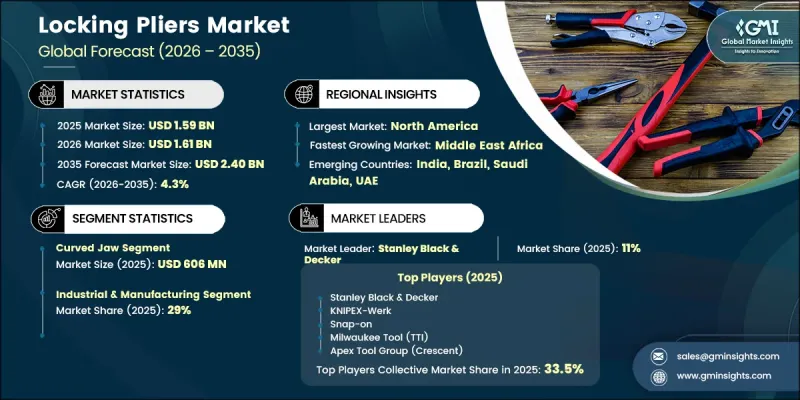
이 시장은 수요 구조가 매우 다양하다는 강점을 가지고 있으며, 개별 최종 사용자 부문이 총 매출의 28% 이상을 차지하는 경우는 없으며, 또한 단일 지역이 전 세계 매출의 4% 미만을 차지하는 지역도 없습니다. 이러한 균형 잡힌 시장 구조는 특정 산업이나 지역 경제의 변동에 대한 저항력을 제공하며, 경제 전망이 불투명한 시기에도 안정적인 성장을 유지하는 데 기여하고 있습니다. 수요는 제품의 합리적인 가격, 다용도성, 그리고 업무용 및 가정용 환경에서 폭넓게 활용될 수 있다는 점에 힘입어 계속해서 유지되고 있습니다. 또한, 공구의 마모, 파손, 분실 및 지속적인 제품 업그레이드로 인한 정기적인 교체 수요가 안정적인 구매 활동에 기여하고 있습니다. 여전히 업무용 사용자가 주요 수익원으로 자리 잡고 있으며, 산업 및 제조 업무, 건설 활동, 자동차 용도가 합쳐서 시장 총수익의 약 74%를 차지하고 있습니다. 그 결과, 시장 동향은 소비자의 재량 지출 동향이라기보다는 산업 생산 수준이나 건설 활동과 밀접한 관련이 있습니다. 특수 공구에 대한 수요 증가, 온라인 판매 채널의 확대, 그리고 프리미엄 제품에 첨단 소재가 점점 더 많이 사용되고 있는 추세는 추가적인 성장 기회를 창출할 것으로 예상되며, 이러한 요인들이 복합적으로 작용하여 산업 및 건설 수요에 따른 기초적인 성장률을 상회하는 연평균 성장률(CAGR) 4.2%라는 시장 전망을 뒷받침할 것으로 보입니다.
| 시장 범위 | |
|---|---|
| 개시 연도 | 2025년 |
| 예측 기간 | 2026-2035년 |
| 개시 연도 시장 규모 | 15억 9,000만 달러 |
| 예측액 | 24억 달러 |
| CAGR | 4.3% |
2025년에는 곡선형 조(curved jaw) 부문이 시장 점유율의 38%를 차지하며 6억 600만 달러에 달했으며, 2035년까지 연평균 성장률(CAGR) 3.9%로 성장할 것으로 전망됩니다. 이 부문은 다양한 형상과 크기의 공작물을 처리할 수 있다는 점에서 선도적인 위치를 유지하고 있습니다. 다용도로 활용 가능한 조 구성 덕분에 사용자는 여러 가지 집게 작업을 효율적으로 수행할 수 있으며, 다양한 유지보수, 수리 및 제조 분야에서 선호되는 선택지가 되고 있습니다. 이러한 적응성과 실용적인 기능성 덕분에, 전문적인 최종 용도 분야 전반에 걸쳐 계속해서 견조한 수요를 뒷받침하고 있습니다.
산업 및 제조 부문은 2025년에 29%의 점유율을 차지하며 4억 6,000만 달러에 달했습니다. 이 부문 수요는 지속적인 업무 사용에 따른 대량 구매 수요와 정기적인 교체 주기에 의해 주도되고 있습니다. 이 카테고리의 구매자들은 제품의 내구성, 고정 정밀도, 소재의 품질, 그리고 장기적인 성능의 신뢰성을 특히 중요하게 여깁니다. 전 세계적으로 산업 생산 활동이 지속적으로 확대되는 가운데, 고성능 록 플라이어에 대한 수요는 예측 기간 동안 견조한 추세를 보일 것으로 예측됩니다.
북미의 락킹 플라이어 시장은 2025년에 5억 5,800만 달러 규모에 달했으며, 시장 점유율의 35%를 차지했습니다. 전문직, 산업용 유지보수 활동, 건설 작업에서 비롯된 견조한 수요가 해당 지역 전체 시장 성장을 지속적으로 뒷받침하고 있습니다. 또한, 무역 정책의 변천과 조달 동향의 변화가 전문 유통 채널 및 소매 유통 채널에서 사업을 전개하는 유서 깊은 브랜드들에게 유리한 환경을 조성하여, 해당 지역 시장에서의 리더십을 더욱 공고히 하고 있습니다.
목차
제1장 조사 방법과 범위
제2장 주요 요약
제3장 업계 인사이트
제4장 경쟁 구도
제5장 시장 추산 및 예측 : 제품 유형별, 2022년-2035년
제6장 시장 추산 및 예측 : 소재별, 2022년-2035년
제7장 시장 추산 및 예측 : 가격별, 2022년-2035년
제8장 시장 추산 및 예측 : 최종사용자별, 2022년-2035년
제9장 시장 추산 및 예측 : 유통 채널별, 2022년-2035년
제10장 시장 추산 및 예측 : 지역별, 2022년-2035년
제11장 기업 개요
LSHThe Global Locking Pliers Market was valued at USD 1.59 billion in 2025 and is estimated to grow at a CAGR of 4.3% to reach USD 2.40 billion by 2035.
The market benefits from a highly diversified demand structure, with no individual end-user category accounting for more than 28% of overall revenue and no single geographic region contributing less than 4% of global sales. This balanced market composition provides resilience against fluctuations in specific industries or regional economies, helping maintain stable growth during periods of economic uncertainty. Demand continues to be supported by the product's affordability, versatility, and broad range of applications across professional and consumer environments. In addition, recurring replacement requirements caused by tool wear, damage, loss, and ongoing product upgrades contribute to consistent purchasing activity. Professional users remain the primary revenue contributors, with industrial and manufacturing operations, construction activities, and automotive applications collectively generating approximately 74% of total market revenue. As a result, market performance is closely tied to industrial production levels and construction activity rather than discretionary consumer spending trends. The emergence of specialized tooling requirements, expanding online sales channels, and the increasing use of advanced materials in premium product offerings are expected to create additional growth opportunities, collectively supporting the market's projected CAGR of 4.2% beyond the baseline growth generated by industrial and construction demand.
| Market Scope | |
|---|---|
| Start Year | 2025 |
| Forecast Year | 2026-2035 |
| Start Value | $1.59 Billion |
| Forecast Value | $2.40 Billion |
| CAGR | 4.3% |
The curved jaw segment accounted for 38% share in 2025, representing USD 606 million, and is forecast to grow at a CAGR of 3.9% through 2035. This segment maintains its leading position due to its ability to accommodate a broad range of workpiece shapes and sizes. The versatile jaw configuration enables users to perform multiple gripping tasks efficiently, making it the preferred option across various maintenance, repair, and fabrication applications. Its adaptability and practical functionality continue to support strong demand across professional end-use sectors.
The industrial and manufacturing segment accounted for 29% share, equivalent to USD 460 million in 2025. Demand within this segment is driven by large-volume purchasing requirements and recurring replacement cycles associated with continuous operational use. Buyers in this category place significant emphasis on product durability, gripping precision, material quality, and long-term performance reliability. As industrial production activities continue to expand globally, demand for high-performance locking pliers is expected to remain steady throughout the forecast period.
North America Locking Pliers Market generated USD 558 million in 2025, accounting for 35% share. Strong demand from professional trades, industrial maintenance activities, and construction operations continues to support market growth across the region. In addition, evolving trade policies and changing sourcing dynamics have contributed to a favorable environment for established brands operating within professional and retail distribution channels, further reinforcing the region's market leadership.
Key companies operating in the global locking pliers market include Stanley Black & Decker (IRWIN Vise-Grip), Snap-on, Apex Tool Group (Crescent), KNIPEX-Werk, Klein Tools, GEDORE Group, Milwaukee Tool (TTI), Channellock, Beta Utensili, SATA Tools, Grip-on Tools, Strong Hand Tools, WORKPRO, Deli Group, Ningbo Great Wall, and other prominent manufacturers serving global markets. Companies competing in the locking pliers market are implementing a range of strategic initiatives to strengthen their market position and expand customer reach. Product innovation remains a key priority, with manufacturers focusing on advanced materials, ergonomic handle designs, improved jaw mechanisms, and enhanced durability to differentiate their offerings. Many companies are also expanding their premium product portfolios to capture higher-margin opportunities among professional users. Investments in e-commerce platforms and digital marketing initiatives are helping brands improve visibility and reach a broader customer base. Strategic partnerships, acquisitions, and distribution network expansion continue to support geographic growth and market penetration.
Table of Contents
Chapter 1 Methodology & Scope
- 1.1 Research approach
- 1.2 Quality Commitments
- 1.2.1 GMI AI policy & data integrity commitment
- 1.2.1.1 Source consistency protocol
- 1.2.1 GMI AI policy & data integrity commitment
- 1.3 Research Trail & Confidence Scoring
- 1.3.1 Research Trail Components
- 1.3.2 Scoring Components
- 1.4 Data Collection
- 1.4.1 Partial list of primary sources
- 1.5 Data mining sources
- 1.5.1 Paid sources
- 1.5.1.1 Sources, by region
- 1.5.1 Paid sources
- 1.6 Base estimates and calculations
- 1.6.1 Base year calculation for any one approach
- 1.7 Forecast model
- 1.7.1 Quantified market impact analysis
- 1.7.1.1 Mathematical impact of growth parameters on forecast
- 1.7.1 Quantified market impact analysis
- 1.8 Research transparency addendum
- 1.8.1 Source attribution framework
- 1.8.2 Quality assurance metrics
- 1.8.2.1 Our commitment to trust
Chapter 2 Executive Summary
- 2.1 Industry 360° synopsis, 2022 - 2035
- 2.2 Key market trends
- 2.2.1 Region
- 2.2.2 Product Type
- 2.2.3 Material
- 2.2.4 Price Range
- 2.2.5 End-user
- 2.2.6 Distribution channel
Chapter 3 Industry Insights
- 3.1 Industry ecosystem analysis
- 3.2 Supply chain analysis
- 3.2.1 Raw Material Sourcing & Supplier Concentration
- 3.2.2 Manufacturing Footprint - Global vs. Regional Production
- 3.2.3 Supply Chain Disruption Risk Assessment
- 3.2.4 Nearshoring & Reshoring Trends in Tool Manufacturing
- 3.3 Industry impact forces
- 3.3.1 Market drivers
- 3.3.1.1 Growing Automotive Production, EV Assembly & MRO Activities Driving Demand for Precision Locking Pliers
- 3.3.1.2 Expanding Construction & Infrastructure Projects Globally Fueling Demand for Heavy-Duty Hand Tools
- 3.3.1.3 Rising DIY Culture & Home Improvement Spending Broadening Consumer Base
- 3.3.1.4 Industrial Manufacturing Growth in Asia Pacific Increasing Professional Tool Demand
- 3.3.2 Market restraints
- 3.3.2.1 Competition from Power Tools & Pneumatic Gripping Devices Limiting Incremental Demand
- 3.3.2.2 Proliferation of Low-Cost Counterfeit & Sub-Quality Products Eroding Brand Margins
- 3.3.3 Market opportunities
- 3.3.3.1 EV Manufacturing Boom Creating Specialized Demand for Needle Nose & Precision Locking Pliers
- 3.3.3.2 Ergonomic & Quick-Release Innovation Opening Premium Price-Tier Expansion
- 3.3.3.3 Growth of E-commerce & MRO Digital Procurement Channels Expanding Market Reach
- 3.3.1 Market drivers
- 3.4 Growth potential analysis
- 3.5 Technology & innovation landscape
- 3.5.1 Advances in Jaw Geometry & Locking Mechanism Design
- 3.5.2 Ergonomic Handle & Grip Technology Innovations
- 3.5.3 Coating & Surface Treatment Innovations (Corrosion Resistance)
- 3.5.4 Smart Tool Integration (Torque Sensing, Connected Tooling)
- 3.6 Regulatory framework
- 3.6.1 International Safety Standards (ANSI/ASME, DIN, ISO)
- 3.6.2 Environmental Regulations on Steel Manufacturing & Tool Coatings
- 3.6.3 Trade Policy & Tariff Landscape (US Section 301, EU Import Duties)
- 3.7 Major market trends and disruptions
- 3.8 Future market trends
- 3.9 Pricing analysis (driven by primary research)
- 3.9.1 Historical Price Trend Analysis (Driven by Primary Research)
- 3.9.2 Pricing Strategy by Player Type (Premium / Value / Cost-plus) (Driven by Primary Research)
- 3.10 Trade data analysis (driven by primary research)
- 3.10.1 Import/Export Volume & Value Trends by HS Code (Driven by Primary Research)
- 3.10.2 Key Trade Corridors & Tariff Impact (Driven by Primary Research)
- 3.11 Impact of AI & generative AI on the market
- 3.11.1 AI-Driven Disruption of Existing Business Models (MRO Procurement, Inventory Optimization)
- 3.11.2 GenAI Use Cases & Adoption Roadmap by Segment (Smart Tool Design, Predictive Maintenance)
- 3.11.3 Risks, Limitations & Regulatory Considerations
- 3.12 Investment & funding analysis
- 3.12.1 M&A Activity in Hand Tools Industry
- 3.12.2 Private Equity & Venture Investment in Tool Innovation
- 3.12.3 Manufacturing Capacity Investments by Key Players
- 3.13 Porter's analysis
- 3.14 PESTEL analysis
Chapter 4 Competitive Landscape, 2025
- 4.1 Introduction
- 4.2 Company market share analysis
- 4.2.1 By Region
- 4.2.1.1 North America
- 4.2.1.2 Europe
- 4.2.1.3 Asia Pacific
- 4.2.1.4 Latin America
- 4.2.1.5 Middle East and Africa
- 4.2.1 By Region
- 4.3 Company matrix analysis
- 4.4 Competitive analysis of major market players
- 4.5 Competitive positioning matrix
- 4.6 Key developments
- 4.6.1 Mergers & acquisitions
- 4.6.2 Partnerships & collaborations
- 4.6.3 New product launches
- 4.6.4 Expansion plans
Chapter 5 Market Estimates and Forecast, By Product Type, 2022 - 2035 (USD Billion) (Thousand Units)
- 5.1 Key trends
- 5.2 Curved Jaw Locking Pliers
- 5.3 Straight Jaw Locking Pliers
- 5.4 Needle Nose Locking Pliers
- 5.5 C-Clamp Locking Pliers
- 5.6 Others (Sheet Metal, Wire/Cable, Pipe, Specialty Rotating Jaw)
Chapter 6 Market Estimates and Forecast, By Material, 2022 - 2035 (USD Billion) (Thousand Units)
- 6.1 Key trends
- 6.2 Carbon Steel
- 6.3 Stainless Steel
- 6.4 Forged Steel
- 6.5 Alloy Steel
Chapter 7 Market Estimates and Forecast, By Price Range, 2022 - 2035 (USD Billion) (Thousand Units)
- 7.1 Key trends
- 7.2 Low
- 7.3 Medium
- 7.4 High
Chapter 8 Market Estimates and Forecast, By End User, 2022 - 2035 (USD Billion) (Thousand Units)
- 8.1 Key trends
- 8.2 Automotive
- 8.2.1 OEM Assembly
- 8.2.2 Aftermarket & MRO
- 8.3 Industrial & Manufacturing
- 8.3.1 Metal Fabrication & Welding
- 8.3.2 Heavy Industry
- 8.3.3 Electronics Manufacturing
- 8.4 Construction
- 8.4.1 Commercial Construction
- 8.4.2 Industrial Construction
- 8.4.3 Residential Construction
- 8.5 Home Improvement & DIY
- 8.6 Electrical
- 8.6.1 Electricians & HVAC Technicians
- 8.6.2 Telecommunications & Data Infrastructure
- 8.7 Others
Chapter 9 Market Estimates and Forecast, By Distribution Channel, 2022 - 2035 (USD Billion) (Thousand Units)
- 9.1 Key trends
- 9.2 Direct Sales (Manufacturer-to-OEM/Institutional B2B)
- 9.3 Indirect Sales
- 9.3.1 Specialty Tool Retailers
- 9.3.2 Hardware Stores & Home Centers
- 9.3.3 E-commerce Platforms
- 9.3.4 MRO Distributors
Chapter 10 Market Estimates & Forecast, By Region, 2022 - 2035, (USD Billion) (Thousand Units)
- 10.1 Key trends
- 10.2 North America
- 10.2.1 U.S.
- 10.2.2 Canada
- 10.3 Europe
- 10.3.1 Germany
- 10.3.2 U.K.
- 10.3.3 France
- 10.3.4 Italy
- 10.3.5 Spain
- 10.4 Asia Pacific
- 10.4.1 China
- 10.4.2 India
- 10.4.3 Japan
- 10.4.4 South Korea
- 10.4.5 Australia
- 10.5 Latin America
- 10.5.1 Brazil
- 10.5.2 Mexico
- 10.5.3 Argentina
- 10.6 MEA
- 10.6.1 UAE
- 10.6.2 Saudi Arabia
- 10.6.3 South Africa
Chapter 11 Company Profiles
- 11.1 Stanley Black & Decker (IRWIN Vise-Grip)
- 11.2 KNIPEX-Werk
- 11.3 Snap-on
- 11.4 Milwaukee Tool (TTI)
- 11.5 Apex Tool Group (Crescent)
- 11.6 Klein Tools
- 11.7 Channellock
- 11.8 GEDORE Group
- 11.9 Beta Utensili
- 11.10 SATA Tools
- 11.11 Toptul Taiwan
- 11.12 King Tony Technology
- 11.13 Grip-on Tools
- 11.14 Ningbo Great Wall
- 11.15 Irimo (SNA Europe)
- 11.16 Draper Tools
- 11.17 Wurth (ZEBRA brand)
- 11.18 Deli Group
- 11.19 Sonic Equipment
- 11.20 WORKPRO
- 11.21 Strong Hand Tools
- 11.22 C.K. Tools